
The Era of At-Home Brain Implants Has Arrived for ALS Patients
A landmark study and a wave of new clinical trials demonstrate that brain-computer interfaces have successfully transitioned from laboratory experiments to reliable, everyday tools for patients with severe paralysis.
By Factlen Editorial Team

- Clinical Researchers
- Prioritize peer-reviewed safety, decoding accuracy, and the long-term viability of brain implants in real-world settings.
- Commercial Neurotech Developers
- Focus on rapid technological iteration, scaling production, and maximizing the bandwidth of human-computer interaction.
- Patient Advocacy & Care
- Emphasize the immediate impact on quality of life, focusing on restoring independence, dignity, and communication for those locked in by disease.
- Industry Analysts
- Evaluate the transition of brain-computer interfaces from experimental laboratory science to viable, scalable medical devices.
What's not represented
- · Health Insurance Providers
- · Bioethics Committees
- · Caregivers of ALS Patients
Why this matters
For decades, brain-computer interfaces were tethered to research labs, requiring teams of scientists to operate. The successful transition to independent, at-home use means millions of people locked in by neurodegenerative diseases or spinal cord injuries are on the verge of regaining their digital voices and autonomy.
Key points
- A landmark Nature Medicine study details an ALS patient successfully using a BCI at home for nearly two years without researcher support.
- The patient achieved 97.5% word accuracy using a 125,000-word vocabulary.
- Commercial developers like Neuralink and Synchron are rapidly expanding trials and integrating implants with consumer technology.
- Current BCI users are reaching typing speeds of 40 words per minute, with trials aiming for 140 words per minute.
- The shift from laboratory experiments to independent at-home use marks a critical threshold in neurotechnology.
The cruelest aspect of amyotrophic lateral sclerosis (ALS) is the intact mind trapped inside a failing body. As motor neurons degenerate, patients gradually lose the ability to walk, use their hands, and eventually speak, leaving them functionally locked in while remaining fully cognitively aware.
For decades, the promise of a technological rescue—a brain-computer interface (BCI) that could translate thoughts into digital actions—remained tethered to the laboratory. Patients could perform miraculous feats of digital communication, but only while surrounded by a team of researchers calibrating complex machinery and managing wired connections.
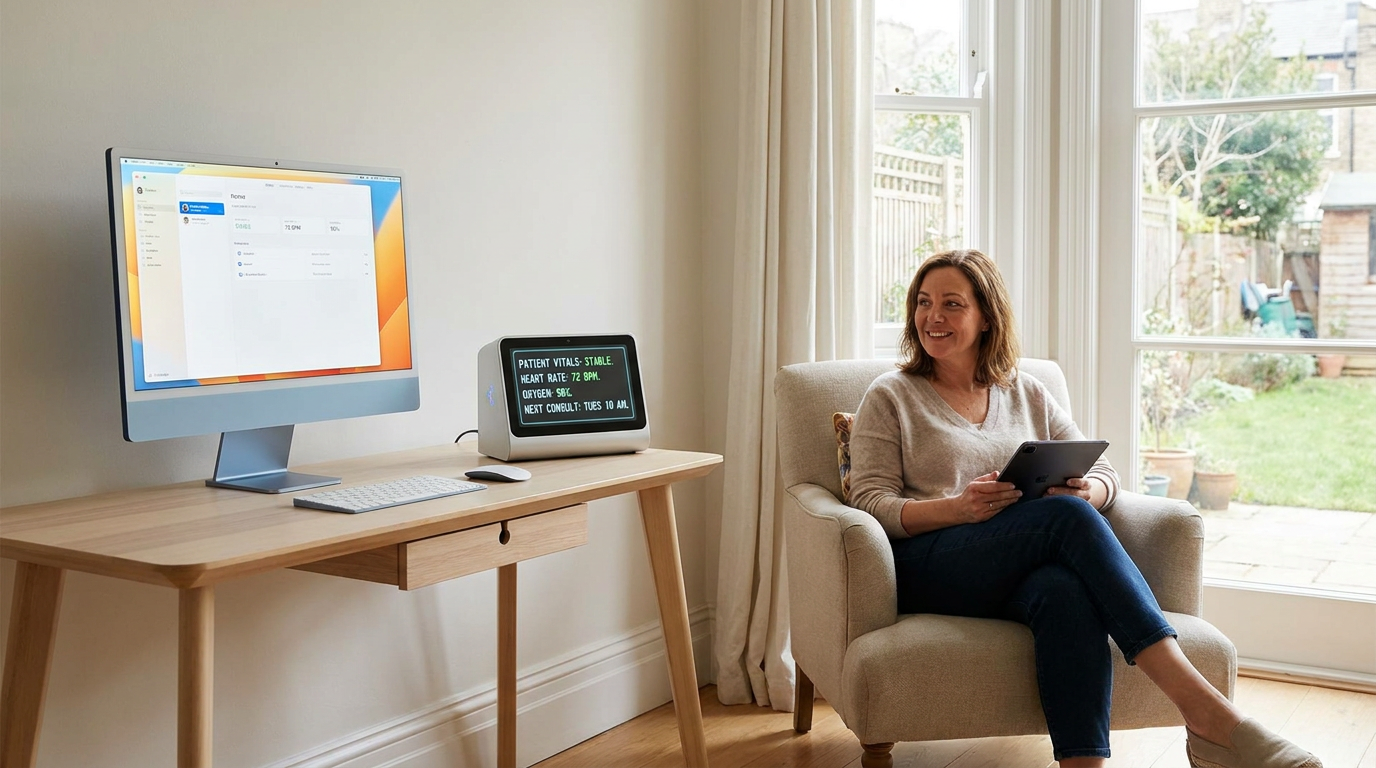
That era of tethered experimentation has officially ended. In a landmark shift for neuroprosthetics, the summer of 2026 has brought a cascade of breakthroughs demonstrating that BCIs have successfully transitioned into reliable, everyday tools that patients can use independently in their own living rooms.
The definitive proof arrived in mid-June, when a consortium of researchers from UC Davis Health, Brown University, and Mass General Brigham published a watershed study in Nature Medicine. The paper detailed the experience of Casey Harrell, an ALS patient who has used an implanted BCI at home for nearly two years.[1][2]

The results shattered previous benchmarks for real-world BCI application. Operating the system without any on-site researcher support, Harrell achieved a staggering 97.5 percent word accuracy. The system's predictive language model is equipped with a 125,000-word vocabulary, allowing for nuanced, unrestricted expression rather than selecting from a small menu of pre-programmed phrases.[1][2]
Over the course of the study, Harrell logged more than 3,800 hours of independent use. He utilized the neuroprosthesis on 364 out of 397 days, seamlessly integrating the technology into his daily routine to communicate with family, browse the internet, and interact with the digital world.[1]
The underlying mechanism relies on microelectrode sensors surgically placed in the brain's motor cortex. When a patient intuitively attempts to speak or move their fingers, the electrodes capture the corresponding electrical activity. Advanced decoding algorithms then translate those neural spikes into text or cursor movements on a screen.[6]
"For years, BCIs have been proof-of-concept devices that lived in highly controlled research labs," noted Dr. David Brandman, a UC Davis neurosurgeon and co-senior author of the study. The ability to deploy this technology in a patient's home, unassisted, marks the crossing of a critical threshold toward clinical usefulness.[2]

This academic milestone is unfolding alongside a fiercely competitive commercial race to scale neurotechnology. Companies backed by billions in venture capital are rapidly iterating on implant designs, surgical techniques, and software integrations to bring BCIs to a broader patient population.
This academic milestone is unfolding alongside a fiercely competitive commercial race to scale neurotechnology.
Neuralink, the high-profile neurotech firm founded by Elon Musk, has aggressively expanded its clinical footprint in 2026. The company recently announced that 21 "Neuralnauts" are now enrolled in its global trials, utilizing its Telepathy implant to control computers and smartphones with unprecedented speed.[3]
While able-bodied individuals typically use a computer mouse at a rate of 8 to 10 bits per second, Neuralink reports that several of its trial participants have already exceeded that bandwidth. By mapping imagined finger movements to a digital keyboard, users have reached typing speeds of 40 words per minute.[3]
The company is now pushing toward even more ambitious targets with its newly launched VOICE trial. By reading signals directly from the brain regions involved in speech production, Neuralink aims to restore real-time, conversational speech at speeds of up to 140 words per minute for patients with ALS and brainstem strokes.[3]

Meanwhile, rival firm Synchron is pioneering a different, less invasive approach. Rather than requiring open brain surgery to place electrodes directly into the cortical tissue, Synchron's Stentrode device is delivered through the body's natural network of veins, entering via the jugular and resting near the motor cortex.[4]
Synchron recently demonstrated the versatility of its platform by successfully integrating its BCI with the Apple Vision Pro. A 64-year-old ALS patient named Mark became the first person to control the advanced augmented reality headset entirely through thought, using the interface to play games, watch television, and send text messages.[4]
The geographic scope of BCI development is also expanding. In June 2026, regulatory authorities in the Netherlands approved a clinical trial for Ability Neurotech, a Swiss company developing a fully implantable, wireless BCI. Like the American trials, the Dutch study is explicitly designed to test the system's viability for long-term, independent communication in everyday home environments.[5]

For the patients participating in these trials, the metrics of success are measured not in bits per second, but in reclaimed autonomy. The ability to send a private text message, turn on a light, or speak to a spouse without a caregiver acting as an intermediary represents a profound restoration of dignity.
The psychological impact of this technology cannot be overstated. Patients who were previously isolated by their physical limitations report a renewed sense of purpose. Some have used their implants to return to academic studies, create digital art, or simply rejoin the dynamic flow of a crowded room.
As the industry looks toward the end of the decade, the focus is shifting from proof-of-concept to industrial scale. Leading firms are developing automated surgical robots and high-volume manufacturing processes, aiming to transform bespoke neurosurgery into a standardized medical procedure.[3][7]
Significant hurdles remain, including ensuring the decade-long durability of the implants, navigating complex regulatory pathways, and eventually driving down costs so the technology can be covered by standard health insurance.
Yet, the consensus among neuroscientists, engineers, and patient advocates is clear: the fundamental science risk has been retired. The era of the at-home brain-computer interface has arrived, promising to unlock the minds of millions who have been silenced by disease.[7]
How we got here
2020
Synchron implants the first Stentrode endovascular BCI in a human patient.
January 2024
Neuralink implants its first human patient with the Telepathy device.
August 2024
Synchron successfully integrates its BCI with the Apple Vision Pro for an ALS patient.
June 2026
Nature Medicine publishes a landmark study detailing a patient's successful, independent use of a BCI at home for nearly two years.
June 2026
The Netherlands approves Ability Neurotech's fully implantable wireless BCI for at-home clinical trials.
Viewpoints in depth
Clinical Researchers
Academic scientists emphasize the rigorous validation of safety and long-term viability.
For clinical researchers, the true test of a neuroprosthesis is not a flashy demonstration in a controlled lab, but its quiet reliability in a patient's living room. The UC Davis and BrainGate milestones are celebrated because they prove that the decoding algorithms and hardware can remain stable over thousands of hours of unsupervised use. The focus remains on peer-reviewed validation, minimizing surgical risks, and ensuring the predictive language models accurately reflect the patient's intended speech without hallucinating words.
Commercial Neurotech Developers
Private companies are racing to scale production and maximize the bandwidth of the human-computer connection.
Firms like Neuralink and Synchron view the current state of BCI technology as the equivalent of the early dial-up internet—functional, but far too slow. Their primary objective is to increase the 'bitrate' of communication, pushing typing speeds from 40 words per minute to conversational speeds of 140 words per minute. To achieve this, they are heavily investing in automated surgical robots, high-density electrode arrays, and seamless integration with consumer electronics like smartphones and augmented reality headsets.
Patient Advocacy & Care
Advocates focus on the profound psychological and practical benefits of restoring a patient's digital voice.
From the perspective of patients and their families, the technical specifications of the implants are secondary to the restoration of dignity. ALS strips away autonomy, forcing patients to rely on caregivers for every interaction. The ability to independently send a text message, browse the internet, or speak to a loved one through a digital avatar fundamentally alters the psychological trajectory of the disease. Advocates are now pushing for these devices to become widely accessible and eventually covered by health insurance.
What we don't know
- It remains unclear how long the implanted microelectrodes will remain functional before degrading or being encapsulated by scar tissue.
- The final cost of the devices and the surgical procedures—and whether health insurance will cover them—has not yet been established.
- The timeline for when these devices will move from clinical trials to general FDA approval for the broader public is still uncertain.
Key terms
- Brain-Computer Interface (BCI)
- A system that decodes electrical signals from the brain and translates them into commands for external devices.
- Amyotrophic Lateral Sclerosis (ALS)
- A progressive neurodegenerative disease that destroys motor neurons, eventually leading to paralysis and loss of speech.
- Motor Cortex
- The region of the cerebral cortex involved in the planning, control, and execution of voluntary movements.
- Endovascular Implant
- A medical device inserted into the body via the blood vessels, avoiding the need for open surgery.
- Neuroprosthesis
- A device that connects to the nervous system to replace or improve the function of an impaired sensory or motor system.
Frequently asked
Does the patient need open brain surgery to get a BCI?
It depends on the device. Systems like Neuralink and BrainGate require surgical implantation into the brain tissue, while Synchron's Stentrode is delivered through the jugular vein without open brain surgery.
Can the user operate the device without a scientist present?
Yes. Recent breakthroughs published in 2026 have finally allowed patients to use these systems independently at home, without researchers needing to calibrate the equipment daily.
How fast can someone type using a brain implant?
Current clinical trial participants are achieving speeds between 40 and 56 words per minute, with next-generation trials aiming for conversational speeds of 140 words per minute.
Is this technology available to the general public?
Not yet. These devices are currently in highly regulated clinical trials for patients with severe paralysis, though companies are preparing for high-volume production in the coming years.
Sources
Source coverage
7 outlets
4 viewpoints surfaced







[1]Nature MedicineClinical Researchers
At-home brain implant gives man with motor neuron disease his daily life back
Read on Nature Medicine →[2]UC Davis HealthClinical Researchers
Brain-computer interface enables independent, accurate communication for man living with ALS
Read on UC Davis Health →[3]NeuralinkCommercial Neurotech Developers
Breaking the Speed Barrier for BCI
Read on Neuralink →[4]Inc.Commercial Neurotech Developers
Neuralink Rival Synchron Announces Breakthrough With Vision Pro
Read on Inc. →[5]ALS News TodayPatient Advocacy & Care
Netherlands approves trial of brain implant for ALS communication
Read on ALS News Today →[6]Mass General BrighamClinical Researchers
Implantable device research from the BrainGate clinical trial enables communication
Read on Mass General Brigham →[7]Factlen Editorial TeamIndustry Analysts
Synthesis by Factlen editorial team
Read on Factlen Editorial Team →

More in science
See all 5 stories →Exoplanet Weather
JWST Maps Dawn and Dusk on Ultra-Hot Exoplanet WASP-121 b
0 sources

Coral Resilience
Scientists Map 166,000 Square Kilometers of Coral Reefs Capable of Surviving Climate Change
0 sources

Brain-Computer Interfaces
At-Home Brain Implant Restores Independent Communication for Paralyzed ALS Patient
0 sources
Every angle. Every day.
Get science stories with full source coverage and perspective breakdowns delivered to your inbox.