
Scientists Map 166,000 Square Kilometers of Coral Reefs Capable of Surviving Climate Change
A massive new mapping project has identified climate-resilient coral reefs across 71 countries, tripling previous estimates and offering a blueprint for targeted ocean conservation.
By Factlen Editorial Team
- Marine Conservationists
- Advocate for using the data to execute targeted, triage-style protection of resilient reefs.
- Climate Scientists
- Warn that resilient reefs are a temporary buffer and decarbonization remains essential.
- Coastal Policymakers
- Focus on the economic and structural benefits of protecting these reefs for national resilience.
What's not represented
- · Local fishing communities whose livelihoods might be impacted by the sudden expansion of Marine Protected Areas.
- · Commercial shipping and tourism industries that operate in the newly identified resilient reef zones.
Why this matters
Coral reefs support a quarter of all marine life and the livelihoods of half a billion people. Identifying exactly which reefs can survive warming oceans gives governments a precise map of where to invest limited conservation funds to prevent ecological collapse.
Key points
- Scientists have identified 166,000 square kilometers of climate-resilient coral reefs globally.
- This figure triples previous estimates and challenges the narrative of inevitable reef extinction.
- Resilient reefs survive by avoiding heat, genetically resisting it, or recovering rapidly.
- 60 percent of these climate refugia are located in just five countries, including Australia and Indonesia.
- Only 28 percent of the identified resilient reefs are currently in protected marine areas.
- The data provides a blueprint for governments to target conservation funds effectively.
For years, the narrative surrounding the world's coral reefs has been one of inevitable, irreversible decline. Driven by marine heatwaves and ocean acidification, mass bleaching events have become almost annual occurrences, leading the Intergovernmental Panel on Climate Change (IPCC) to warn that up to 90 percent of reefs could perish at 1.5 degrees Celsius of warming. However, a sweeping new global analysis is challenging that fatalistic outlook, revealing that nature has built-in lifeboats.[5]
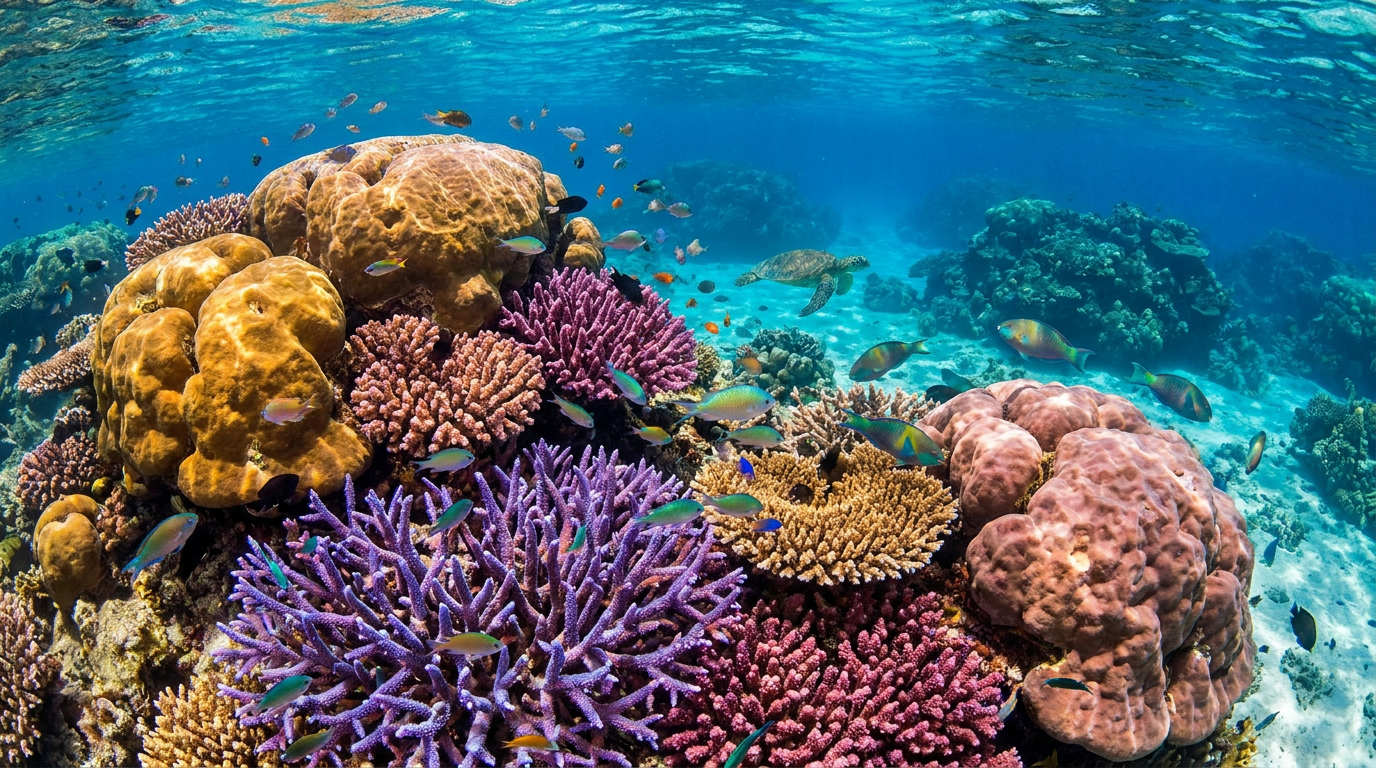
Presented on Tuesday at the Our Ocean Conference in Mombasa, Kenya, the landmark study identifies approximately 166,000 square kilometers (64,000 square miles) of coral reefs that possess the capacity to withstand or recover from the effects of global warming. This figure triples previous estimates of climate-resilient coral, offering a rare and vital note of hope for one of the planet's most threatened ecosystems.[2][3][4]
The research, spearheaded by the Wildlife Conservation Society (WCS) and Australia's Macquarie University, utilized machine learning to process more than 45,000 field observations collected between 1960 and 2025. By combining decades of coral surveys with high-resolution climate and oceanographic data, the team generated a map of global reef resilience that is 10,000 times more detailed than any previous version.[3][4][7]
“Coral reefs are often framed as ecosystems beyond saving, but this research shows that there is a global set of reefs that have the potential to survive and recover,” said Dr. Emily Darling, director of coral conservation at the WCS and co-author of the assessment. “We know where the hope is and what we need now is political will.”[2][3][6]

The study categorizes the survival mechanisms of these resilient reefs into three distinct biological and environmental pathways: avoidance, resistance, and rapid recovery. Understanding these mechanisms is crucial for conservationists attempting to triage which ecosystems can be saved and how they might be used to restore others.[1][6][7]
The first mechanism, avoidance, relies entirely on geography and oceanography. Some reefs are situated in rare oceanic "cool spots" where natural phenomena shield them from the worst of the heat. For example, deep-water upwellings off the coast of Mozambique continuously cycle cold water to the surface, preventing the localized ocean temperatures from reaching the bleaching threshold even during global marine heatwaves.[1][6]
The second mechanism is genetic resistance. In areas where cooler currents are absent—such as the shallow, sun-baked coastal waters of Kenya—corals are essentially living in a "bathtub" where hot water stagnates. Yet, researchers found that certain stony coral colonies in these environments have genetically adapted to endure extreme thermal stress without expelling the symbiotic algae that keep them alive.[1][6]
In areas where cooler currents are absent—such as the shallow, sun-baked coastal waters of Kenya—corals are essentially living in a "bathtub" where hot water stagnates.
The third mechanism involves ecosystems that still suffer damage during heatwaves but exhibit an extraordinary capacity for rapid recovery. These reefs bounce back from bleaching events significantly faster than average, maintaining their structural integrity and continuing to support diverse marine life while neighboring reefs crumble.[1][3]

Geographically, these climate refugia are not distributed evenly across the globe. The mapping project located resilient reefs across 71 countries and 100 territories, but found that roughly 60 percent of them are concentrated in the coastal waters of just five nations: Australia, the Bahamas, Cuba, Indonesia, and the Philippines.[2][3][4]
This concentration presents both a vulnerability and an immense strategic opportunity. Lead author Kyle J. A. Zawada of Macquarie University noted that these resilient pockets could act as "living seed banks." If protected, the heat-tolerant larvae from these reefs could eventually be carried by ocean currents to repopulate wider, degraded ecosystems across the Pacific and Caribbean.[4][5][7]
However, the evidence pack presented in Mombasa also highlights a glaring conservation gap. Of the 166,000 square kilometers of resilient reefs identified by the model, only 28 percent currently fall within formally protected and conserved areas. This leaves more than 119,000 square kilometers of vital, heat-tolerant coral exposed to localized human threats like bottom-trawling, dynamite fishing, and agricultural pollution.[2][4]

This data arrives at a critical moment for international environmental policy. Under the United Nations' "30 by 30" framework, countries are currently drafting action plans to bring 30 percent of their land and marine environments under formal protection by the end of the decade. The WCS mapping tool provides governments with a precise, evidence-based blueprint for where limited conservation funds should be deployed to maximize long-term ecological returns.[2][4]
“In certain cases, where reefs are below certain benchmarks for ecosystem function, it may be a case of triage,” explained Stacy Jupiter, executive director of the WCS's Global Marine Program. By focusing resources on the reefs proven to withstand climate pressure, policymakers can ensure that conservation budgets are not wasted on ecosystems that are mathematically guaranteed to collapse under future warming scenarios.[2][5]
To translate this data into policy, the researchers launched a civil society campaign dubbed "Our Reefs, Our Future" alongside the study. The initiative calls on governments and private investors to prioritize the immediate protection of these specific reef networks from local threats, thereby giving them the breathing room they need to survive the overarching threat of global warming.[4][7]

Despite the optimistic findings, the researchers maintain transparent uncertainty regarding the limits of coral endurance. The machine-learning models are trained on historical observation patterns from the past six decades. The authors explicitly warn that their projections "may underestimate novel future states" if ocean temperatures spike in entirely unprecedented ways, such as during a severe, prolonged super El Niño event.[3][7]
Furthermore, the identification of climate refugia does not negate the urgent need for decarbonization. While these 166,000 square kilometers of reef buy the oceans critical time, scientists stress that reducing global carbon emissions remains the only permanent solution. Without halting the underlying warming trend, even the most resilient "super reefs" will eventually reach their biological breaking point.[5]
Ultimately, the WCS and Macquarie University study shifts the global conservation paradigm from mourning an inevitable loss to executing a targeted rescue mission. By proving that substantial portions of the ocean's architecture can survive the coming decades, the research provides the exact coordinates for where humanity must draw its line in the sand.[2][4]
How we got here
2018
An initial '50 Reefs' assessment identifies a small network of coral ecosystems with the potential to survive climate change.
2023–2024
Record-breaking marine heatwaves trigger severe global coral bleaching, heightening fears of imminent ecosystem collapse.
June 16, 2026
WCS and Macquarie University present a new machine-learning model identifying 166,000 sq km of resilient reefs, tripling previous estimates.
2030
The deadline for the UN's '30 by 30' initiative, which aims to bring 30 percent of the world's marine environments under formal protection.
Viewpoints in depth
Marine Conservationists
Focus on using the new data to execute targeted, triage-style conservation.
For organizations like the Wildlife Conservation Society, this data represents a fundamental shift in strategy. Rather than spreading limited funding thinly across all threatened marine environments, conservationists argue for a triage approach: aggressively protecting the 166,000 square kilometers of proven resilient reefs from local threats like overfishing and pollution. By securing these 'seed banks,' they believe the ocean will retain the biological capital necessary to eventually repopulate areas that have already collapsed.
Climate Scientists
Emphasize that resilient reefs are a temporary buffer, not a cure for emissions.
While welcoming the discovery of climate refugia, climate scientists and IPCC contributors caution against using this resilience as an excuse to delay decarbonization. They point out that genetic adaptation and cooler currents have limits; if global temperatures exceed the 2-degree Celsius threshold, even these 'super reefs' will face unprecedented thermal stress. From this perspective, the newly mapped reefs buy humanity critical time, but reducing greenhouse gas emissions remains the only permanent mechanism to save marine ecosystems.
Coastal Policymakers
View the findings as an economic and structural blueprint for national planning.
For governments in the five nations hosting 60 percent of these resilient reefs—such as the Bahamas and the Philippines—the study provides an actionable blueprint for the UN's '30 by 30' initiative. Policymakers view these reefs not just as ecological wonders, but as critical infrastructure that provides billions of dollars in coastal storm protection and tourism revenue. The data allows them to justify the economic trade-offs of expanding Marine Protected Areas (MPAs) by proving that the protected zones will actually survive the coming decades.
What we don't know
- Whether these resilient corals can survive entirely novel climate states, such as a prolonged super El Niño that exceeds historical temperature maximums.
- How effectively the larvae from these 'seed bank' reefs can travel and successfully repopulate distant, degraded reef systems under future ocean current conditions.
Key terms
- Climate Refugia
- Specific geographic areas that remain relatively buffered from contemporary climate change, allowing ecosystems to survive.
- Coral Bleaching
- A stress response where corals expel the symbiotic algae living in their tissues, causing them to turn white and become highly vulnerable to starvation and disease.
- Upwelling
- An oceanographic process where deep, cold, and nutrient-rich water rises to the surface, often cooling localized reef environments.
- 30 by 30
- A global conservation target aiming to protect 30 percent of the Earth's land and ocean by the year 2030.
Frequently asked
How do these coral reefs survive the warming oceans?
They survive through three main mechanisms: natural cooling from deep-water upwellings, genetic adaptations that allow them to resist heat stress, or an extraordinary ability to recover rapidly after a bleaching event.
Where are these resilient reefs located?
While spread across 71 countries, roughly 60 percent of these resilient reefs are concentrated in the waters of Australia, the Bahamas, Cuba, Indonesia, and the Philippines.
Are these surviving reefs currently protected?
Most are not. The study found that only 28 percent of the identified climate-resilient reefs currently fall within formally protected marine areas.
Does this mean climate change is no longer a threat to corals?
No. Scientists stress that these resilient reefs buy humanity time, but if global carbon emissions are not reduced, even these 'super reefs' will eventually succumb to extreme temperatures.
Sources
Source coverage
7 outlets
3 viewpoints surfaced







[1]The New York TimesCoastal Policymakers
New Coral Study Identifies Areas Where Reefs Are Hanging On
Read on The New York Times →[2]The IndependentClimate Scientists
Scientists just identified 166,000 sq km of coral reef capable of surviving climate change
Read on The Independent →[3]The Straits TimesCoastal Policymakers
Scientists found some coral reefs can survive climate change
Read on The Straits Times →[4]Oceanographic MagazineMarine Conservationists
Reef relief: Scientists map 165,000km² of climate resilient coral
Read on Oceanographic Magazine →[5]Bangkok PostClimate Scientists
Study sparks hope for 'climate-resistant' coral reefs
Read on Bangkok Post →[6]CBC News
Ghostly but not yet gone, reefs are in trouble
Read on CBC News →[7]Wildlife Conservation SocietyMarine Conservationists
Machine-learning and prioritization models reveal climate refugia for coral reefs into 2050
Read on Wildlife Conservation Society →


Every angle. Every day.
Get science stories with full source coverage and perspective breakdowns delivered to your inbox.