
The Science of the Maillard Reaction: How Heat and Chemistry Transform Food
Understanding the chemical reaction between amino acids and sugars is the key to achieving restaurant-quality browning and flavor at home.
By Factlen Editorial Team
- Culinary Scientists
- Focus on precise temperature control, pH manipulation, and chemical optimization to engineer flavor.
- Traditional Chefs
- Rely on sensory cues, experience, and traditional techniques rather than strict chemical formulas.
- Food Safety Researchers
- Monitor the high-heat byproducts of browning, advocating for moderation to avoid harmful compounds.
What's not represented
- · Industrial food manufacturers scaling the reaction
- · Vegetarian chefs adapting browning techniques for plant proteins
Why this matters
Mastering the Maillard reaction elevates everyday home cooking from bland to exceptional. By understanding the science of heat and moisture, you can consistently achieve the deep, savory flavors usually reserved for professional kitchens.
Key points
- The Maillard reaction is a chemical cascade between amino acids and sugars that creates hundreds of new flavor compounds.
- The reaction requires high heat, typically proceeding rapidly only between 140°C and 165°C (280°F to 330°F).
- Surface moisture prevents browning because water caps the temperature at its boiling point of 100°C (212°F) until it fully evaporates.
- Caramelization is a separate chemical process that involves only the breakdown of sugars, without the presence of proteins.
- Pushing the temperature beyond 180°C (355°F) leads to pyrolysis, or burning, which destroys flavor and creates bitter, potentially harmful compounds.
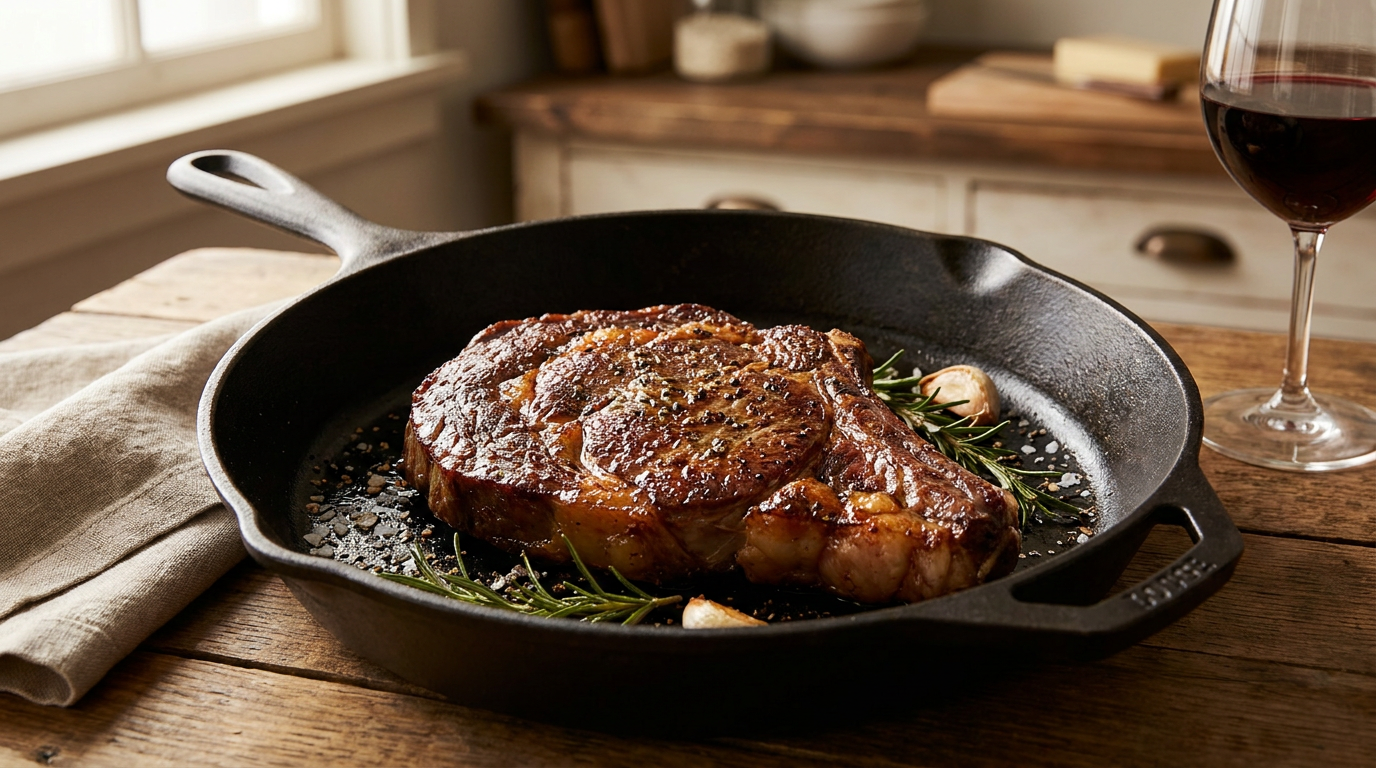
You know the exact moment a meal transforms from raw ingredients into something extraordinary. It is the sharp sizzle when a steak hits a hot cast-iron skillet, the intoxicating aroma of bread baking in the oven, or the deep, savory scent of onions softening and catching color in a pan. This sensory explosion is not merely the result of food getting hot. It is the signature of one of the most complex and beautiful chemical cascades in the natural world, a process that fundamentally alters the molecular structure of what we eat. For generations, cooks relied on intuition and sensory cues to achieve this transformation, passing down techniques without necessarily understanding the underlying mechanics. Today, culinary science allows us to look under the hood of this phenomenon, revealing that the secret to restaurant-quality flavor lies in mastering a specific set of chemical rules.[6]
The phenomenon responsible for this culinary magic is known as the Maillard reaction. Often dubbed the "flavor reaction" by food scientists, it is a form of non-enzymatic browning that occurs when proteins and sugars are subjected to high heat. Unlike simple melting or boiling, the Maillard reaction is a generative process. It takes the basic building blocks of food and recombines them into hundreds of entirely new, highly complex flavor and aroma compounds. This reaction is the definitive answer to the question of why cooked food tastes so profoundly different, and generally much better, than its raw counterparts. Whether you are searing a scallop, roasting a chicken, or simply popping a slice of bread into the toaster, you are initiating this exact chemical sequence.[1][2]
Despite its universal application in kitchens around the world, the reaction was not discovered by a chef. It is named after Louis-Camille Maillard, a French chemist and physician who first described the process in 1912. Maillard was not studying culinary arts; his research was focused on understanding biological protein synthesis and how amino acids behave within living organisms. During his experiments, he observed that when amino acids and reducing sugars were heated together, they behaved in unexpected ways, eventually turning brown and emitting rich aromas. While his discovery was initially viewed through a purely biological and medical lens, it eventually became the foundational pillar of modern food science, explaining the invisible architecture of flavor that cooks had been building for millennia.[1][2][3]
At its core, the Maillard reaction requires three essential components to ignite: amino acids (the fundamental building blocks of proteins), reducing sugars (such as glucose or fructose), and a significant application of heat. Both the proteins and the sugars must be present simultaneously for the cascade to begin. When these elements meet under the right thermal conditions, the reactive carbonyl group of the sugar interacts with the nucleophilic amino group of the amino acid. This initial collision forms an unstable intermediate structure, setting the stage for a massive multiplication of molecular diversity. Because different foods contain vastly different profiles of amino acids and sugars, the resulting chemical offspring are entirely unique to the ingredient being cooked.[1][3][5]

Once that initial interaction occurs, the molecules rearrange themselves into what chemists call an Amadori or Heyns compound. This compound is highly unstable and almost immediately begins to break down, branching off into a dizzying array of secondary reactions. These secondary reactions produce volatile aromatic compounds—such as pyrazines, furans, and thiophenes—which float into the air and register in our olfactory receptors as the smell of roasting, toasting, and searing. A single piece of searing meat can generate hundreds of distinct flavor compounds in a matter of seconds. These compounds then interact with one another, breaking down further to create tertiary flavors, building a deep, layered complexity that cannot be replicated by any single spice or seasoning.[2][5]
While the volatile compounds handle the aroma and flavor, another branch of the Maillard cascade is responsible for the visual transformation. In the final stages of the reaction, the molecules polymerize, linking together to form large, complex structures known as melanoidins. Melanoidins are the pigments that give browned food its distinctive, appetizing golden-to-dark-brown coloration. They are the reason a perfectly baked brioche boasts a shiny mahogany crust and why a roasted coffee bean turns from pale green to deep, oily black. Beyond just aesthetics, melanoidins also contribute to the texture of the food, helping to form the satisfying, crispy exterior that contrasts so beautifully with a tender interior.[3][5]
The most critical variable in controlling the Maillard reaction is temperature. The chemical cascade does not happen efficiently at room temperature, nor does it thrive in gentle warmth. The reaction typically proceeds rapidly only when the surface temperature of the food reaches a specific sweet spot: between 140°C and 165°C (280°F to 330°F). Below this threshold, the reaction is sluggish, requiring days or even months to produce noticeable browning—a timeline entirely impractical for cooking. Hitting this precise thermal window is why recipes constantly advise preheating pans, using high-heat cooking oils, and ensuring ovens are fully up to temperature before baking. The goal is to flash the exterior of the food into the Maillard zone as quickly as possible.[1][3]

The most critical variable in controlling the Maillard reaction is temperature.
This temperature requirement introduces the greatest enemy of the Maillard reaction: moisture. Water is a thermal regulator, and under normal atmospheric pressure, it cannot be heated beyond its boiling point of 100°C (212°F). When food is wet, the heat energy from the pan or oven is entirely consumed by the process of converting that liquid water into steam. As long as water is actively evaporating from the surface of the food, the temperature of that surface is physically capped at 100°C—falling a full 40 degrees Celsius short of the minimum temperature required to trigger rapid Maillard browning. This immutable law of physics is the reason why boiling, steaming, or poaching will never produce a browned crust.[4][6]
Understanding the moisture barrier completely changes how one approaches preparation in the kitchen. It explains the absolute necessity of patting proteins dry with a paper towel before they hit a hot skillet. If a steak goes into a pan covered in surface moisture, the pan's heat must first boil off that water. By the time the moisture is gone and the surface temperature can finally climb into the 140°C Maillard zone, the interior of the steak has likely overcooked. By starting with a bone-dry surface, the heat immediately goes toward initiating the chemical browning cascade, allowing the cook to develop a thick, flavorful crust while keeping the center perfectly rare or medium-rare.[4][6]
The physics of moisture also explains the cardinal sin of pan-frying: overcrowding. When too many ingredients are crammed into a skillet, two detrimental things happen simultaneously. First, the massive influx of cold food rapidly drops the temperature of the pan's surface. Second, as the food begins to release its internal water, the tightly packed pan traps the escaping steam. Without enough exposed surface area for the water to quickly evaporate and clear out, the ingredients end up stewing in their own juices. The temperature remains locked at 100°C, the Maillard reaction stalls, and the result is pale, gray, and rubbery food rather than a deeply seared masterpiece.[6]

A common point of confusion in culinary circles is the conflation of the Maillard reaction with caramelization. While both processes require high heat and result in browning, they are fundamentally different chemical events. Caramelization is the pyrolysis of sugar—it involves only carbohydrates breaking down under heat, with no proteins involved. When you melt pure sugar in a pan to make caramel sauce, you are caramelizing. But when you roast vegetables, bake bread, or sear meat, you are triggering the Maillard reaction, because those foods contain both the necessary sugars and the essential amino acids. The two reactions can happen simultaneously—such as when roasting sweet carrots—but the Maillard reaction generally begins at a lower temperature and produces a vastly more complex, savory flavor profile.[2][3]
While meat is the most famous beneficiary of the Maillard reaction, the process is ubiquitous across the entire culinary spectrum. It is the reason why a pale, doughy lump of flour and water emerges from the oven as a crusty, aromatic loaf of bread. It is the science behind the golden, crispy exterior of a perfect french fry. The global coffee and chocolate industries rely entirely on the Maillard reaction during the roasting phase to transform bitter, grassy raw beans into complex, deeply flavored commodities. Even the toasted exterior of a marshmallow roasted over a campfire owes its sticky, caramelized-yet-savory crust to the interaction of its sugars with trace amounts of gelatin proteins.[1][3]
For advanced cooks, understanding the chemistry opens the door to manipulating the reaction. One of the most effective hacks involves altering the pH of the food. The Maillard reaction accelerates significantly in an alkaline environment, as the amino groups become deprotonated and more reactive. This is why traditional pretzel makers dip their dough in a lye solution before baking, resulting in a dark, glossy, deeply flavored crust that cannot be achieved with heat alone. Home cooks can harness this same principle by adding a tiny pinch of baking soda to onions they wish to brown quickly, or to marinades for meats, dramatically speeding up the browning process and intensifying the savory notes.[1][4]

Modernist cuisine has also found ways to cheat the moisture barrier using technology. While it is generally impossible to achieve Maillard browning in a wet environment, a pressure cooker changes the rules of physics. By sealing the environment and increasing the atmospheric pressure, a pressure cooker raises the boiling point of water well beyond 100°C. This allows the liquid inside to reach temperatures high enough to trigger the Maillard reaction without boiling away. Chefs use this technique to create deeply browned, intensely flavored stocks and soups—like a rich French onion soup—in a fraction of the time it would take to slowly caramelize the ingredients in an open pan.[4]
However, the pursuit of the perfect crust requires careful moderation, as pushing the temperature too high leads to diminishing returns and potential health risks. Once the surface temperature exceeds 180°C (355°F), the Maillard reaction gives way to pyrolysis—the chemical term for burning. Pyrolysis destroys the delicate flavor compounds, replacing them with harsh, acrid, and bitter notes. Furthermore, high-temperature cooking, particularly of carbohydrate-rich foods, can lead to the formation of acrylamide, a compound that health researchers classify as a probable carcinogen. Mastering the Maillard reaction is therefore an act of thermal balancing: applying enough heat to unlock the flavor cascade, but pulling back before the chemistry tips into destruction.[1][4][5]
Ultimately, the Maillard reaction is the great equalizer in the kitchen. It does not require expensive equipment or rare ingredients; it only demands an understanding of heat, moisture, and patience. By viewing cooking through the lens of chemistry, home cooks can stop guessing and start engineering flavor. Whether it is taking the time to thoroughly dry a piece of fish, giving mushrooms enough space in the pan to breathe, or utilizing a pressure cooker to build a complex broth, leveraging the science of browning is the single most effective way to elevate everyday meals into extraordinary culinary experiences.[6]
How we got here
1912
French chemist Louis-Camille Maillard first describes the reaction while studying biological protein synthesis.
1953
Chemist John E. Hodge publishes the definitive paper mapping the complex chemical pathways of the Maillard reaction, establishing its culinary importance.
Early 2000s
The Modernist Cuisine movement popularizes the deliberate manipulation of the Maillard reaction using pH adjustments and pressure cookers.
Present Day
Understanding the Maillard reaction is considered a fundamental pillar of culinary education and home cooking science.
Viewpoints in depth
Culinary Scientists
Focus on precise temperature control, pH manipulation, and chemical optimization to engineer flavor.
For food scientists and modernist chefs, the Maillard reaction is a formula to be optimized. They advocate for using tools like infrared thermometers to guarantee pan temperatures hit the 140°C threshold, and they frequently employ chemical interventions—such as adding baking soda to increase alkalinity—to accelerate browning. This camp views traditional cooking intuition as unreliable, preferring to use pressure cookers to force Maillard reactions in wet environments or precise dehydration techniques to eliminate the moisture barrier entirely before searing.
Traditional Chefs
Rely on sensory cues, experience, and traditional techniques rather than strict chemical formulas.
Traditional culinary professionals acknowledge the science but argue that cooking remains an art guided by the senses. Rather than measuring exact temperatures, they rely on the sound of the sizzle, the smell of the volatile compounds releasing, and the visual cue of the crust forming. This perspective emphasizes that while knowing the chemistry is helpful, the dynamic environment of a hot kitchen requires a cook to adapt to the ingredient in front of them—adjusting heat on the fly to prevent pyrolysis while ensuring an even, golden-brown finish.
Food Safety Researchers
Monitor the high-heat byproducts of browning, advocating for moderation to avoid harmful compounds.
While celebrating the flavor benefits, health researchers focus on the chemical risks associated with pushing the Maillard reaction too far. They point out that temperatures exceeding 120°C, particularly in carbohydrate-rich foods like potatoes and bread, trigger the formation of acrylamide—a probable human carcinogen. This camp advocates for 'golden, not brown' cooking standards, encouraging lower-temperature baking and boiling where possible, and strictly warning against the consumption of heavily charred or pyrolyzed foods where the reaction has tipped into burning.
What we don't know
- The exact chemical structure of every single melanoidin polymer formed during the reaction remains unmapped due to their immense complexity.
- The long-term health impacts of consuming high volumes of advanced glycation end-products (AGEs) generated by the reaction are still being studied.
- Food scientists are still working to perfectly replicate the exact Maillard flavor profiles of meat in plant-based alternatives without relying on artificial additives.
Key terms
- Maillard reaction
- A chemical reaction between amino acids and reducing sugars under high heat that produces browned colors and complex savory flavors.
- Amino acids
- Organic compounds that serve as the fundamental building blocks of proteins, essential for triggering the Maillard reaction.
- Reducing sugars
- Simple carbohydrates, such as glucose and fructose, that act as the reactive partner to amino acids during browning.
- Melanoidins
- Large, complex polymer molecules formed at the end of the Maillard cascade that give cooked food its distinctive brown pigment.
- Pyrolysis
- The chemical breakdown of organic materials at extremely high temperatures (above 180°C), commonly known as burning, which produces bitter flavors.
- Caramelization
- The non-enzymatic browning process that occurs when pure sugars are subjected to heat, distinct from the protein-dependent Maillard reaction.
Frequently asked
Is the Maillard reaction the same as caramelization?
No. Caramelization involves only sugars breaking down under heat. The Maillard reaction requires both sugars and amino acids (proteins) to interact, creating a much more complex, savory flavor profile.
Why do recipes always say to pat meat dry before searing?
Surface moisture acts as a thermal barrier. Because water boils at 100°C (212°F), the surface of the meat cannot reach the 140°C needed for the Maillard reaction until all the water has evaporated. Patting it dry jumpstarts the browning process.
Can the Maillard reaction happen in liquids like soups?
Under normal conditions, no, because liquids cannot exceed 100°C. However, using a pressure cooker raises the boiling point of water, allowing the reaction to occur in wet environments, which is how chefs create deeply flavored stocks quickly.
Does the Maillard reaction only happen with meat?
Not at all. It is responsible for the brown crust on baked bread, the golden color of french fries, the dark color of roasted coffee beans, and the savory notes in toasted marshmallows.
Sources
Source coverage
6 outlets
3 viewpoints surfaced






[1]WikipediaCulinary Scientists
Maillard reaction
Read on Wikipedia →[2]HowStuffWorksCulinary Scientists
The Maillard Reaction and the Science of Browning Foods
Read on HowStuffWorks →[3]MasterClassTraditional Chefs
Maillard Reaction Explained: What Is the Maillard Reaction?
Read on MasterClass →[4]Modernist CuisineCulinary Scientists
Using the Maillard Reaction in Cooking
Read on Modernist Cuisine →[5]PMC / National Institutes of HealthFood Safety Researchers
Maillard Reaction: Mechanism, Influencing Parameters, Advantages, Disadvantages, and Food Industrial Applications
Read on PMC / National Institutes of Health →[6]Factlen Editorial TeamTraditional Chefs
Synthesis by Factlen editorial team
Read on Factlen Editorial Team →
Every angle. Every day.
Get food drink stories with full source coverage and perspective breakdowns delivered to your inbox.