
At-Home Brain Implant Restores Independent Communication for Paralyzed ALS Patient
A 47-year-old man with severe paralysis has successfully used a brain-computer interface at home for nearly two years without daily researcher supervision. The system translates his neural signals into text with 99% accuracy, marking a major milestone in assistive neurotechnology.
By Factlen Editorial Team
- Neuroengineering Researchers
- Focus on the technical milestones of autonomous calibration and high-speed decoding.
- Patient Advocates & Clinicians
- Emphasize the restoration of agency, quality of life, and practical independence for patients.
- Technology Observers
- Contextualize the UC Davis trial within the broader commercial race to commercialize brain-computer interfaces.
What's not represented
- · Health Insurance Providers
- · Medical Ethicists
Why this matters
This breakthrough proves that brain-computer interfaces can function reliably outside the laboratory, offering a realistic path to restore independent communication and digital access for millions of people paralyzed by neurological diseases.
Key points
- A 47-year-old man with ALS successfully used a brain-computer interface (BCI) at home for nearly two years.
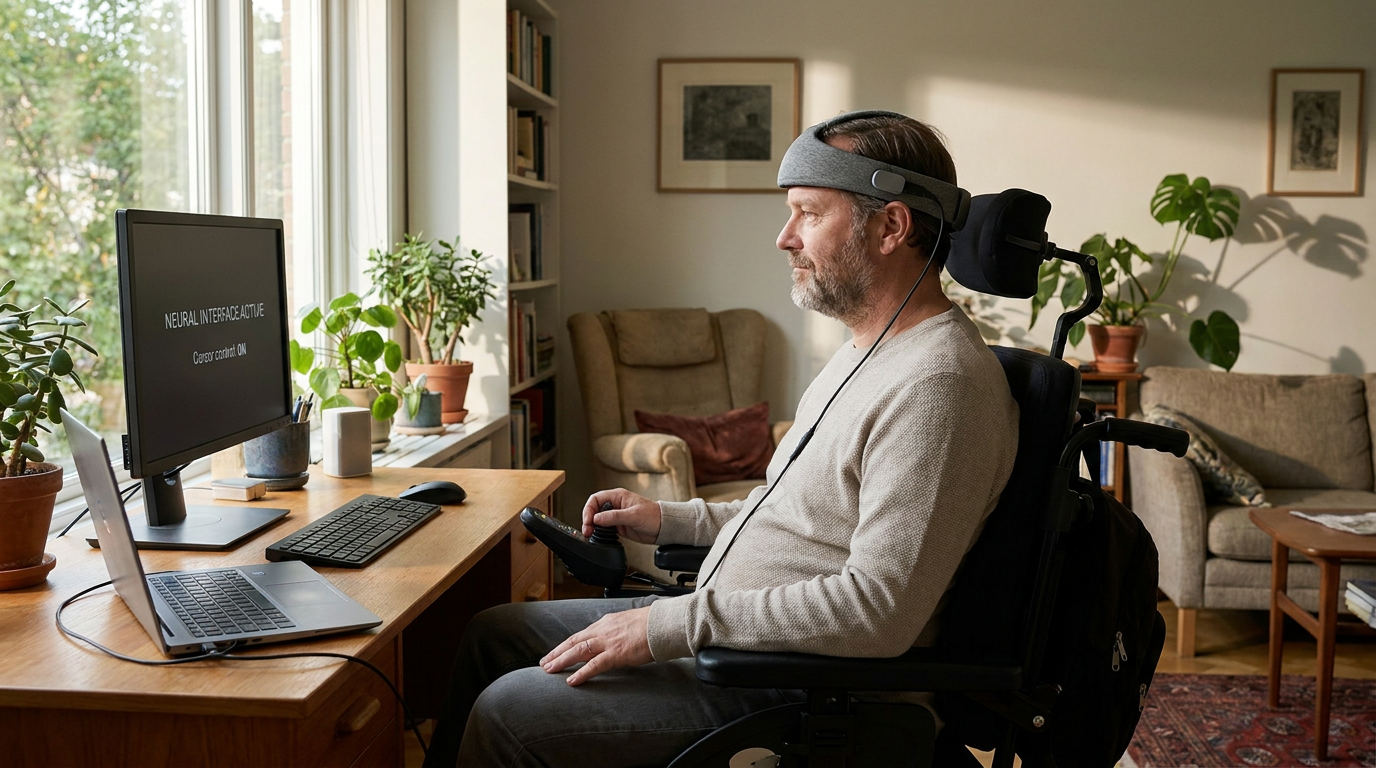
- The system translates neural signals from the motor cortex into text and computer cursor movements.
- The decoding algorithm achieved 99% accuracy on a 125,000-word vocabulary, allowing communication at 56 words per minute.
- Unlike previous lab-bound systems, the software automatically recalibrates itself, eliminating the need for daily expert supervision.
- The patient used the device independently for more than 3,800 hours, generating over two million words.
For decades, brain-computer interfaces (BCIs) have been confined to highly controlled laboratory environments. Patients with severe paralysis could translate their thoughts into text, but only while tethered to complex machinery and surrounded by a team of neuroscientists constantly recalibrating the software.[1][4]
That paradigm has fundamentally shifted. According to a landmark study published in Nature Medicine, a 47-year-old man with amyotrophic lateral sclerosis (ALS) has successfully used an intracortical BCI to communicate and operate a computer independently from his home for nearly two years.[1][7]
The patient, Casey Harrell, was diagnosed with ALS, a progressive neurological disease that gradually strips away voluntary muscle control, leading to severe weakness known as tetraparesis and a total loss of speech.[6]
Facing the prospect of being entirely locked inside his own body, Harrell enrolled in a clinical trial led by researchers at UC Davis, Brown University, and Mass General Brigham. In July 2023, surgeons implanted four microelectrode arrays directly into his brain.[4][6]
The mechanism relies on capturing high-resolution neural activity at the source. The arrays, containing a total of 256 electrodes, were placed in the left precentral gyrus—the specific region of the motor cortex responsible for coordinating speech and hand movements.[4][7]
Rather than attempting to read Harrell's abstract thoughts, the system is designed to intercept the motor commands his brain sends to his vocal cords and limbs. When Harrell attempts to speak, the electrodes detect the specific neural firing patterns associated with forming those physical sounds.[6][7]

Advanced decoding algorithms then translate these neural signals into text on a screen. Simultaneously, a movement BCI translates Harrell's imagined hand movements—such as the thought of squeezing his hand—into directional cursor control and digital mouse clicks.[4][6]
The clinical evidence from Harrell's trial is unprecedented in its duration and volume. Over the first 22.6 months following the implantation, Harrell used the device for more than 3,800 hours in his own home.[2][6]
The clinical evidence from Harrell's trial is unprecedented in its duration and volume.
During that period, he generated over 183,000 sentences and approximately two million words, communicating with his family, browsing the internet, and continuing his work. Researchers have dubbed him the first true power user of a speech BCI.[2][5]
The system's accuracy represents a major leap forward for assistive neurotechnology. In controlled testing utilizing a massive 125,000-word vocabulary, the decoding algorithm achieved over 99 percent word accuracy.[4]
Harrell was able to generate text at an average speed of 56 words per minute. In real-world, daily use, he rated 92 percent of the sentences he produced as either entirely accurate or mostly correct.[4][6]

The most critical breakthrough, however, is the system's autonomy. Historically, neural signals shift slightly from day to day, requiring technicians to manually adjust the decoding software before each session to maintain accuracy.[6]
The research team overcame this barrier by engineering the software to automatically recalibrate and update itself in the background. This self-correcting algorithm eliminated the need for daily expert supervision.[6][7]
The hardware was also adapted for practical home use. While researchers initially had to visit Harrell's home to physically connect him to the system, the setup was eventually simplified so that his caregiver could easily plug him in each morning.[2]

For years, BCIs have been proof-of-concept devices that lived in highly controlled research labs, noted David Brandman, a UC Davis neurosurgeon and co-senior author of the study. This work shows that we may have crossed a threshold.[4][6]
Despite the profound success of this single-patient trial, significant uncertainties remain before the technology can be widely deployed. The procedure requires invasive brain surgery, carrying inherent risks of infection or tissue damage.[7]
Furthermore, the long-term durability of the microelectrode arrays is not fully understood. While Harrell's implant has remained stable for nearly two years, the brain's immune response can sometimes cause scar tissue to build up around electrodes over a decade, potentially degrading the signal quality.[1][7]
Scalability and cost also present formidable hurdles. The bespoke nature of the surgery, the specialized hardware, and the advanced computing power required currently make the system prohibitively expensive for the general public.[2][5]
Nevertheless, the demonstration that a fully paralyzed individual can regain independent, high-bandwidth communication in a real-world setting marks a watershed moment. As Harrell noted, the technology has allowed him to defy the diminished expectations typically associated with an ALS diagnosis, giving him his daily life back.[1][2]
How we got here
July 2023
Surgeons implant four microelectrode arrays into Casey Harrell's brain as part of a clinical trial.
Late 2023
Researchers automate the system's calibration, allowing Harrell's caregiver to connect the device without expert supervision.
June 2026
Nature Medicine publishes the study detailing Harrell's 3,800 hours of independent, at-home use over nearly two years.
Viewpoints in depth
Neuroengineering Researchers
Focus on the technical milestones of autonomous calibration and high-speed decoding.
For the engineers and neuroscientists developing these systems, the primary victory is the algorithmic stability. The fact that the software can automatically adjust to daily shifts in neural firing patterns without a technician present solves one of the field's most stubborn bottlenecks. They view this single-patient study as the definitive proof-of-concept that high-bandwidth intracortical arrays can function reliably outside the laboratory for years at a time.
Patient Advocates & Clinicians
Emphasize the restoration of agency, quality of life, and practical independence for patients.
Clinicians and ALS advocates evaluate the breakthrough through the lens of patient autonomy. The ability to generate 56 words per minute and control a cursor independently means patients can maintain employment, manage their own digital lives, and communicate intimately with family members. For this camp, the transition from a supervised lab experiment to a caregiver-managed home device is the true revolution, fundamentally altering the trajectory of locked-in syndromes.
Technology Observers
Contextualize the UC Davis trial within the broader commercial race to commercialize brain-computer interfaces.
Industry analysts view this academic milestone alongside commercial efforts by companies like Neuralink and Synchron. While commercial ventures often dominate headlines, observers note that this publicly funded, peer-reviewed trial has quietly demonstrated some of the most robust, long-term, high-accuracy data to date. They caution, however, that moving from a bespoke academic prototype to an affordable, mass-manufactured medical device will require billions in investment and navigating complex regulatory pathways.
What we don't know
- How long the microelectrode arrays will maintain their signal quality before the brain's natural immune response potentially degrades their performance.
- Whether the 99% accuracy rate achieved in this single-patient trial will hold true across a larger, more diverse population of patients with different neurological profiles.
- How quickly the bespoke hardware and surgical procedures can be scaled and made affordable for the broader public.
Key terms
- Brain-Computer Interface (BCI)
- A system that records electrical activity directly from the brain and translates it into digital commands to control external devices.
- Amyotrophic Lateral Sclerosis (ALS)
- A progressive neurological disease that destroys motor neurons, leading to the gradual loss of voluntary muscle control.
- Intracortical Microelectrode Array
- A small sensor implanted directly into the brain tissue to record the high-resolution firing patterns of individual neurons.
- Motor Cortex
- The region of the brain responsible for planning, controlling, and executing voluntary physical movements.
- Tetraparesis
- Muscle weakness affecting all four limbs, often resulting from severe neurological conditions.
Frequently asked
What disease does the patient have?
The patient, Casey Harrell, has amyotrophic lateral sclerosis (ALS), a progressive neurological disease that causes severe paralysis and loss of speech.
How does the brain implant work?
Microelectrode arrays implanted in the brain's motor cortex intercept the neural signals intended for speech and hand movement. Algorithms then translate these signals into text and computer cursor movements.
Did researchers have to be present for the device to work?
No. Unlike previous systems, the software was designed to automatically recalibrate itself, allowing the patient to use the device independently at home with only basic setup help from a caregiver.
Is this technology available to the public?
Not yet. The system is currently part of an ongoing clinical trial. Widespread availability will require further testing, regulatory approval, and solutions to reduce the high costs of the bespoke hardware and surgery.
Sources
Source coverage
7 outlets
3 viewpoints surfaced





[1]NaturePatient Advocates & Clinicians
At-home brain implant gives man with motor neuron disease his daily life back
Read on Nature →[2]MIT Technology ReviewTechnology Observers
This man with ALS is 'the first power user' of a brain implant that lets him speak
Read on MIT Technology Review →[3]The Washington PostPatient Advocates & Clinicians
Two years, 2 million words: How a brain implant transformed an ALS patient's life
Read on The Washington Post →[4]UC Davis HealthNeuroengineering Researchers
Study shows BCI system allows man to 'speak' accurately and operate digital platforms, unassisted, for prolonged period
Read on UC Davis Health →[5]Medical XpressTechnology Observers
Brain-computer interface enables independent, accurate communication for man living with ALS
Read on Medical Xpress →[6]PsyPostTechnology Observers
Unprecedented brain implant allows paralyzed man to completely control his computer and “speak” independently
Read on PsyPost →Long-term independent use of an intracortical brain–computer interface for speech and cursor control
Read on Nature Medicine →

Every angle. Every day.
Get science stories with full source coverage and perspective breakdowns delivered to your inbox.