
WNBA and Players Union Agree to Landmark Collective Bargaining Agreement, Unlocking Revenue Sharing
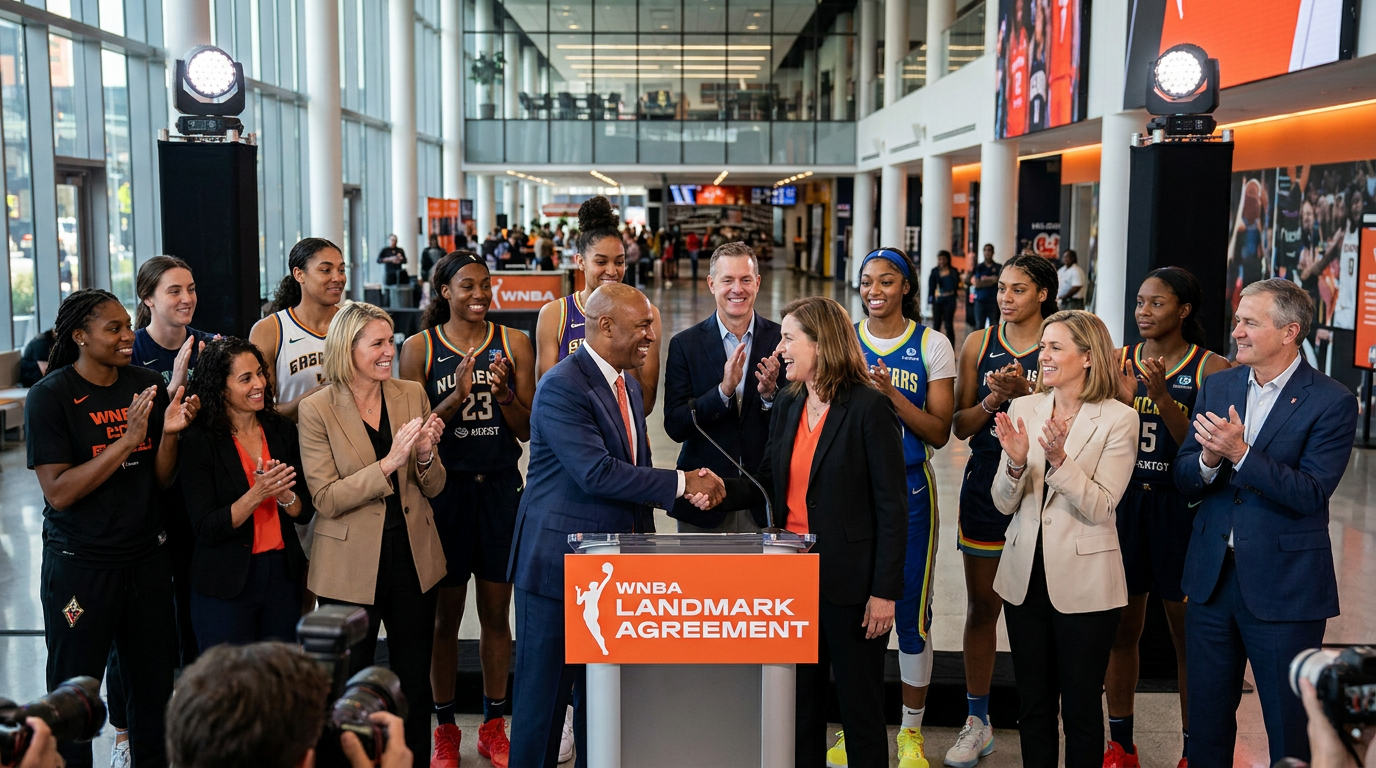
The WNBA and its players' association have finalized a transformative new collective bargaining agreement that introduces direct revenue sharing, significantly boosts base salaries, and establishes comprehensive family planning benefits.
By Factlen Editorial Team
- Players & Union Advocates
- Focuses on securing equitable compensation, health protections, and a fair share of the revenue generated by the athletes' labor.
- League Management & Owners
- Views the agreement as a strategic, long-term investment to ensure labor peace and maximize the value of upcoming media rights deals.
- Sports Business Analysts
- Analyzes the mechanics of the revenue sharing model and its precedent-setting impact on the broader landscape of women's sports.
What's not represented
- · International league executives facing a potential talent drain
- · Lower-tier players navigating the new roster limits
Why this matters
This agreement fundamentally changes the financial trajectory of professional women's basketball, ensuring players share directly in the league's recent explosive growth while setting a new global standard for maternity and family benefits in professional sports.
Key points
- The WNBA and WNBPA have ratified a new collective bargaining agreement running through 2032.
- The deal introduces a true 50-50 revenue sharing model, abandoning previous hard-to-reach thresholds.
- Veteran minimum salaries will increase to $250,000, reducing reliance on overseas offseason leagues.
- The agreement guarantees fully paid maternity leave and mandatory charter flights for all games.
- Labor peace positions the league strongly for its upcoming, highly anticipated media rights negotiations.
Following months of intense but collaborative negotiations, the WNBA and the Women's National Basketball Players Association (WNBPA) announced the ratification of a landmark collective bargaining agreement on Tuesday. The new deal, which runs through the 2032 season, fundamentally restructures the financial relationship between the league and its athletes. By replacing the previous, highly conditional revenue-sharing metrics with a direct 50-50 split of incremental broadcast and commercial revenue, the agreement ensures that the players who drove the league's recent explosion in popularity will directly benefit from its financial windfall.[1][6]
The core breakthrough of the 2026 CBA is the dismantling of the old revenue-sharing threshold. Under the 2020 agreement, players were only entitled to a 50-50 split if the league achieved aggressive, cumulative revenue growth targets—a mechanism that proved nearly impossible to trigger despite record-breaking viewership. The new framework institutes a true 50-50 split on all league revenues exceeding a newly established, much lower baseline. Sports economists note this shift transforms WNBA players from traditional salaried employees into genuine financial stakeholders in the league's ongoing expansion.[2][7]
This financial restructuring arrives on the heels of an unprecedented three-year growth period for the WNBA. Driven by a generational influx of talent, expanded national broadcast windows, and a surge in live attendance, the league has seen its valuation multiply. Gate receipts have broken records across all markets, and merchandise sales have consistently outpaced supply. The new CBA acknowledges this reality, effectively closing the chapter on the league's "survival" era and officially ushering in an era of sustainable, highly profitable growth.[1][4]

Beyond revenue sharing, the agreement introduces dramatic increases to the salary cap and individual player compensation. The minimum base salary for veterans will jump to $250,000 annually, while the supermax salary cap for franchise players will exceed $500,000 for the first time in league history. These figures do not include the newly expanded league and team marketing agreements, which can add hundreds of thousands of dollars to a player's annual take-home pay. This structural boost is designed to make the WNBA a lucrative, year-round primary employer for its athletes.[3][7]
The substantial increase in domestic earning potential directly addresses one of the most persistent challenges in women's basketball: the reliance on overseas leagues. For decades, top WNBA talent spent their offseasons playing in Europe or Asia to supplement their incomes, leading to physical burnout and scheduling conflicts. While the new CBA softens the controversial "prioritization rules" that previously penalized players for arriving late from overseas commitments, the financial incentives to remain in the United States year-round are now robust enough that the union expects a sharp decline in offseason international play.[2][8]

Perhaps the most universally praised aspect of the new agreement is its comprehensive overhaul of family planning and maternity benefits. The 2026 CBA guarantees fully paid maternity leave, significantly increased childcare stipends, and mandatory two-bedroom accommodations for players traveling with children. Furthermore, the league has committed to providing dedicated, on-site childcare facilities at all WNBA arenas during games and practices. Player advocates have hailed these provisions as a new gold standard for women's professional sports globally.[3][5][8]
Perhaps the most universally praised aspect of the new agreement is its comprehensive overhaul of family planning and maternity benefits.
WNBPA leadership emphasized that the negotiations were driven by a desire to secure the future for the next generation of athletes. Union representatives noted that while veteran players fought for these benefits, the true beneficiaries will be the rookies entering the league over the next decade. By establishing a baseline of financial security and family support, the union believes the WNBA will attract and retain elite athletic talent that might otherwise have pursued different professional paths.[6][8]
The agreement also permanently resolves the long-standing issue of travel accommodations. After piecemeal rollouts of charter flights during the 2024 and 2025 seasons, the new CBA codifies full, league-funded charter flights for all regular-season and playoff games. This eliminates the physical toll and security concerns associated with commercial air travel, a grievance that had been a focal point of player advocacy for over a decade. The permanent charter mandate is viewed as a critical investment in player health and safety.[1][5]

Looking toward the future, the CBA paves the way for the league's planned expansion to 16 teams by 2028. The financial models built into the agreement account for the influx of expansion fees and the broader national footprint the new franchises will provide. Ownership groups have expressed confidence that the labor peace secured by this long-term deal will make the remaining expansion bids highly competitive, further driving up the valuation of WNBA franchises.[4][7]
The timing of the agreement is strategically aligned with the WNBA's upcoming media rights negotiations. With labor peace guaranteed through the next decade and a product that is drawing record television ratings, the league enters broadcast negotiations with unprecedented leverage. Industry analysts project that the next media rights package will feature a massive multiplier over the previous deal, providing the necessary capital to fund the CBA's ambitious salary and benefit increases.[2][7]
League management and team owners have publicly framed the new CBA not as a series of concessions, but as a necessary and enthusiastic investment in the product. The WNBA Commissioner noted that the league's athletes are its greatest asset, and providing them with world-class compensation and working conditions is essential to maintaining the WNBA's status as the premier women's basketball league in the world. This collaborative tone marks a significant departure from the more adversarial labor disputes seen in other professional sports.[6]

The ripple effects of this landmark agreement are expected to be felt far beyond basketball. Sports business experts suggest that the WNBA's new CBA will serve as a powerful benchmark for other women's leagues, including the National Women's Soccer League (NWSL) and the Professional Women's Hockey League (PWHL). By proving that aggressive revenue sharing and comprehensive family benefits are economically viable, the WNBA has provided a blueprint for the broader professionalization and equitable compensation of female athletes worldwide.[4][7]
Implementation of the new CBA will begin immediately, with the revised salary cap and minimum salary structures taking effect for the upcoming 2026-2027 free agency period. Teams are already adjusting their front-office strategies to navigate the new financial landscape, preparing for what is expected to be the most active and lucrative player movement period in the history of women's basketball. For the players, the focus now returns to the court, secure in the knowledge that their off-court value has finally been fully recognized.[2][8]
How we got here
2020
The previous WNBA Collective Bargaining Agreement is signed, introducing the first iteration of maternity benefits and higher caps.
2024
A generational rookie class drives unprecedented viewership, exposing the financial limitations of the 2020 CBA.
Nov 2024
The WNBPA officially opts out of the 2020 CBA, triggering a negotiation window for a new economic model.
June 2026
The WNBA and WNBPA announce the ratification of a landmark new agreement featuring direct revenue sharing.
Viewpoints in depth
Players & Union Advocates
Viewing the agreement as a long-overdue correction that properly values the athletes' labor.
For player advocates, this CBA is the culmination of years of organizing against a system they felt artificially suppressed their earning potential. By securing a true 50-50 revenue split, the union ensured that the athletes who physically generate the league's product will capture the upside of its current cultural boom. Furthermore, the codification of family planning benefits and charter flights represents a victory for player health and safety, treating the athletes as premium professionals rather than gig workers forced to supplement their income overseas.
League Management & Owners
Framing the deal as a strategic investment that stabilizes the league for massive upcoming media deals.
Ownership groups and league executives approach the new CBA from a perspective of sustainable, long-term growth. While the upfront costs of higher salaries and charter flights are significant, management views labor peace as the ultimate asset. By locking in a deal through 2032, the WNBA can approach broadcast networks and corporate sponsors with absolute certainty about the league's future. Owners believe the increased investment in player compensation will ultimately pay for itself by driving up franchise valuations and securing a massive multiplier in the next media rights package.
Sports Business Analysts
Analyzing the structural shift from a 'survival' economic model to a 'growth' economic model.
Industry analysts note that this CBA marks the WNBA's graduation into the upper echelon of North American sports business. The previous agreements were structured around risk mitigation—protecting owners from losses during leaner years. The 2026 agreement is structured around wealth generation. Analysts point out that by aligning the players' financial incentives directly with league revenue, the WNBA has created a powerful, unified front to market the sport globally, setting a new operational template for emerging women's leagues worldwide.
What we don't know
- The exact dollar value of the WNBA's upcoming national media rights package, which will fund the new salary caps.
- How European and Asian basketball leagues will adjust their compensation models to compete with the new WNBA salaries.
- Which specific cities will be awarded the final expansion franchises targeted for the 2028 season.
Key terms
- Revenue Sharing
- A financial model where the league's income from television deals, sponsorships, and merchandise is split evenly between the team owners and the players.
- Prioritization Rule
- A league policy that requires players to return from overseas commitments in time for WNBA training camps, previously a major point of contention due to low domestic salaries.
- Supermax Salary
- The absolute maximum amount a franchise can pay a single designated star player under the league's salary cap rules.
- Collective Bargaining Agreement (CBA)
- The foundational legal contract between a sports league and its players' union that dictates salaries, benefits, travel rules, and working conditions.
Frequently asked
When do the new WNBA salaries take effect?
The new salary structures, including the $250,000 veteran minimum, will be implemented immediately for the upcoming 2026-2027 free agency period.
Will WNBA players still play overseas?
While players are not banned from playing internationally, the significant increase in domestic salaries and marketing opportunities is expected to drastically reduce the number of players who spend their offseasons in overseas leagues.
How does the new revenue sharing work?
The new CBA eliminates complex cumulative targets, instead offering players a direct 50-50 split of all league broadcast and commercial revenues that exceed a newly established, lower baseline.
Are charter flights fully guaranteed now?
Yes. The new agreement codifies that the league will fund full charter flights for all regular-season and playoff games, permanently ending commercial travel for the teams.
Sources
Source coverage
8 outlets
3 viewpoints surfaced








[1]ESPNSports Business Analysts
WNBA, WNBPA reach historic CBA agreement with revenue sharing
Read on ESPN →[2]The AthleticPlayers & Union Advocates
Inside the WNBA's groundbreaking new collective bargaining agreement
Read on The Athletic →[3]Associated PressPlayers & Union Advocates
WNBA players secure major salary bumps, family benefits in new deal
Read on Associated Press →[4]Yahoo SportsSports Business Analysts
How the new WNBA CBA changes the landscape of women's sports
Read on Yahoo Sports →[5]CBS SportsSports Business Analysts
WNBA CBA details: Revenue sharing, chartered flights, and what's next
Read on CBS Sports →[6]WNBA OfficialLeague Management & Owners
WNBA and WNBPA Announce New Collective Bargaining Agreement
Read on WNBA Official →[7]Sports Business JournalLeague Management & Owners
The financial mechanics of the WNBA's new revenue sharing model
Read on Sports Business Journal →[8]The Next HoopsPlayers & Union Advocates
Players react to landmark CBA: 'A new era for the W'
Read on The Next Hoops →

More in sports
See all 9 stories →Injury
Super Rugby Pacific Semi-Finals: Massive Boosts as Barrett, McKenzie, and Newell Return from Injury
0 sources

Women's Soccer
US Women's Soccer Reaches Historic Heights in 2026 as NWSL and USL Super League Shatter Records
0 sources

Standings
Global Club Rugby Reaches Its Climax: URC, Premiership, and Super Rugby Finals Set
0 sources

Injury
Grass-Court Injury Report: Triumphant Returns and Major Absences Reshape the Road to Wimbledon
0 sources

Every angle. Every day.
Get sports stories with full source coverage and perspective breakdowns delivered to your inbox.