
2026 Rivian R2 vs. Tesla Model Y: The Midsize EV SUV Showdown
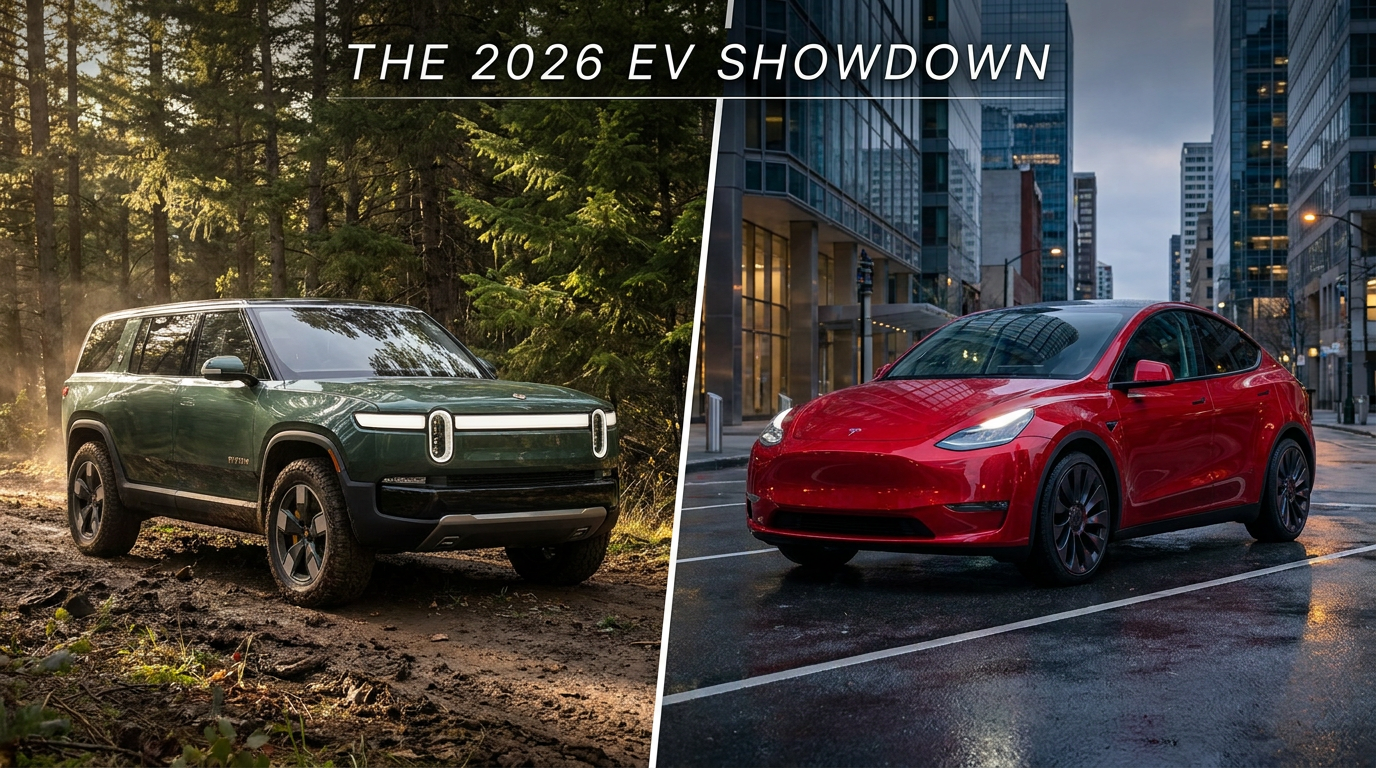
The refreshed 2026 Tesla Model Y and the all-new Rivian R2 offer buyers a stark choice between aerodynamic street performance and rugged, boxy utility.
By Factlen Editorial Team
- Outdoor Adventurers
- Prioritizes rugged capability, ground clearance, and maximum cargo volume for gear.
- Efficiency Maximizers
- Focuses on aerodynamic range, fast charging speeds, and on-road driving dynamics.
- Value & Availability Shoppers
- Emphasizes immediate availability and the lowest possible entry price into the midsize EV segment.
What's not represented
- · Traditional Dealership Advocates
- · Large Family Buyers
Why this matters
For buyers entering the electric vehicle market in 2026, the midsize SUV segment is the most practical and hotly contested space. Choosing between the Model Y and the R2 dictates not just your monthly payment, but whether your vehicle is optimized for highway road trips or off-grid weekend adventures.
Key points
- The 2026 Rivian R2 and Tesla Model Y Juniper represent two distinct philosophies: rugged outdoor utility versus aerodynamic street performance.
- Tesla holds a significant advantage in entry-level pricing, with the Model Y starting at $41,630 compared to the R2's $57,990 launch price.
- The Rivian R2 offers superior cargo flexibility, boasting 90.1 cubic feet of space and fold-flat seating in both rows.
- The Model Y delivers slightly faster charging and a longer maximum range of 357 miles on its Premium Rear-Wheel Drive trim.
- Both vehicles feature native NACS ports, granting them equal, adapter-free access to the Tesla Supercharger network.
The 2026 electric vehicle market has matured past the early-adopter phase, and the midsize SUV segment has emerged as the ultimate battleground for mainstream buyers. For years, the Tesla Model Y has dominated this space, serving as the default choice for millions. But the landscape is shifting. The arrival of the Rivian R2 introduces a formidable challenger that fundamentally rethinks what a midsize electric SUV should be.[2]
This side-by-side comparison pits the newly refreshed 2026 Tesla Model Y—benefiting from its comprehensive "Juniper" update—against the highly anticipated 2026 Rivian R2. While they occupy roughly the same footprint and overlap in price at the top of their respective ranges, they are built around entirely different priorities. One is meticulously tuned for aerodynamic efficiency and on-road refinement, while the other is engineered for maximum versatility and outdoor capability.[2][5]
On price and availability, the Tesla Model Y holds a commanding advantage for buyers shopping today. The entry-level rear-wheel-drive Model Y starts at a highly accessible $41,630. In contrast, Rivian is employing a top-down launch strategy. The only R2 available in spring 2026 is the fully loaded Performance Launch Edition, priced at $57,990. Buyers waiting for Rivian's promised $45,000 base model will have to hold out until late 2027.[1][2][7]
However, when comparing top-tier trims, the price gap vanishes. The $57,990 Rivian R2 Performance lines up almost exactly with the Tesla Model Y Performance, which hovers around the $58,000 to $60,000 mark depending on options. At this level, the decision is no longer about budget, but rather about which vehicle's philosophy better aligns with the driver's lifestyle.[2]

The strongest argument for the Rivian R2 centers on its unmatched interior versatility and rugged utility. Rivian designed the R2 with a boxy, upright silhouette that prioritizes usable space over wind resistance. This approach yields a vehicle that feels significantly larger on the inside than its exterior dimensions suggest, catering directly to families and outdoor enthusiasts who need to haul substantial gear.[4][5]
The evidence for Rivian's utility advantage is found in the raw numbers. The R2 boasts a massive 90.1 cubic feet of total cargo space when the seats are folded, representing a 19 percent increase over the Model Y's 76 cubic feet. Furthermore, the R2 features fold-flat seating in both the second and first rows, transforming the cabin into a cavernous space capable of accommodating an air mattress or extra-long equipment like surfboards. Its front trunk, or frunk, also edges out the Tesla's, offering 5.2 cubic feet compared to 4.1.[3][4]
The primary trade-off against the Rivian R2 is its delayed rollout for budget-conscious buyers and a slightly slower fast-charging curve. While the R2 can charge from 10 to 80 percent in roughly 29 minutes, the Model Y completes the same task in 24 to 26 minutes. Additionally, the R2's boxier shape inherently creates more wind noise at highway speeds compared to the ultra-sleek Tesla.[2][7]
The primary trade-off against the Rivian R2 is its delayed rollout for budget-conscious buyers and a slightly slower fast-charging curve.
Conversely, the case for the Tesla Model Y is rooted in proven aerodynamic efficiency, immediate availability, and superior on-road driving dynamics. The recent Juniper refresh addressed many of the older Model Y's weaknesses, introducing better cabin insulation, upgraded interior materials, and a more compliant suspension system that irons out harsh bumps.[1][5]

The evidence for Tesla's dominance lies in its range and acceleration. The Premium Rear-Wheel Drive Model Y is the undisputed efficiency leader, delivering an impressive 357 miles of range on a single charge. When it comes to raw speed, the lighter Model Y Performance outpaces the R2, sprinting to 60 mph in a blistering 3.3 seconds, compared to the Rivian's 3.6 seconds. The Tesla handles with the precision of a sports sedan, offering a lower center of gravity and more direct steering.[1][2]
The case against the Model Y highlights its limitations when the pavement ends. Its sloping roofline cuts into rear headroom and creates an awkwardly shaped cargo area that struggles with bulky, square items. Furthermore, its street-oriented suspension and lower stance make it unsuitable for anything more challenging than a well-graded gravel driveway.[4][5]
Interestingly, the efficiency data presents a surprising twist at the top of the lineup. Despite its boxy shape and an extra 370 pounds of weight, the Rivian R2 Performance actually edges out the Model Y Performance in EPA testing, achieving 109 MPGe combined against the Tesla's 104 MPGe. This remarkable feat highlights the sophistication of Rivian's new powertrain engineering and its ability to extract maximum energy from the battery pack.[4]

Ground clearance and geometry dictate exactly where these two vehicles can travel. The Rivian R2 sits high with 9.6 inches of ground clearance, paired with a 25-degree approach angle and a 26-degree departure angle. This makes it genuinely trail-capable. The Model Y, with just 6.6 inches of clearance, is strictly an on-road machine, designed to hug the tarmac rather than clear trail obstacles.[1][4]
One historical advantage that no longer separates the two is charging infrastructure. Both the 2026 Model Y and the Rivian R2 are equipped with native North American Charging Standard (NACS) ports. This means Rivian drivers have seamless, adapter-free access to Tesla's expansive Supercharger network, effectively neutralizing what was once Tesla's most significant competitive moat.[2]
Ultimately, the Rivian R2 fits perfectly when a buyer prioritizes outdoor adventures, maximum cargo flexibility, and a commanding, truck-like ride height. It is the superior choice for drivers who frequently haul bulky gear, navigate rough terrain, or simply prefer the rugged aesthetic and thoughtful utility features that Rivian has baked into the cabin.[3][5]

The Tesla Model Y fits perfectly when a buyer wants maximum highway range, sports-car acceleration, and the lowest possible entry price today. It remains the sensible, highly refined choice for road-trippers, daily commuters, and driving enthusiasts who value a sleek, aerodynamic profile and a proven track record of software excellence.[1][2]
Neither vehicle fits well when a buyer requires genuine three-row seating for adults or heavy-duty towing capacity. While the Model Y offers an optional third row, it is strictly sized for small children, and both vehicles max out their towing capabilities well below the requirements for large boats or heavy travel trailers. For those needs, buyers must look to larger, more expensive segments.[1][6]
How we got here
March 2024
Rivian officially unveils the R2, promising a smaller, more affordable alternative to the R1S.
Late 2025
Tesla rolls out the highly anticipated "Juniper" refresh for the Model Y, updating its exterior and interior.
Spring 2026
The Rivian R2 Performance Launch Edition begins reaching its first customers.
Late 2027
Rivian plans to release the entry-level $45,000 Standard trim of the R2.
Viewpoints in depth
The Outdoor Adventurer's View
Prioritizes rugged capability, ground clearance, and maximum cargo volume for gear.
For this camp, the Rivian R2 is the clear winner. The 9.6 inches of ground clearance and dedicated off-road geometry mean the R2 can tackle trails that would leave the Model Y stranded. Furthermore, the ability to fold all seats completely flat to create 90.1 cubic feet of space transforms the vehicle into a mobile basecamp, perfectly aligning with the needs of campers, surfers, and outdoor enthusiasts.
The Efficiency Maximizer's View
Focuses on aerodynamic range, fast charging speeds, and on-road driving dynamics.
This perspective strongly favors the Tesla Model Y. By prioritizing a sleek, aerodynamic teardrop shape, the Model Y achieves up to 357 miles of range and benefits from a slightly faster charging curve. Enthusiasts in this camp also value the Model Y's lower center of gravity and sportier suspension, which deliver a more engaging and precise driving experience on paved roads.
The Value Shopper's View
Emphasizes immediate availability and the lowest possible entry price into the midsize EV segment.
Value-focused buyers are drawn to the Model Y's immediate availability and highly competitive $41,630 starting price. While Rivian promises a $45,000 base model, its delay until late 2027 makes it a non-factor for those shopping in 2026. For buyers who want a premium electric SUV today without crossing the $50,000 threshold, the entry-level Model Y remains the undisputed champion.
What we don't know
- Whether Rivian will be able to hit its late-2027 target for the $45,000 entry-level R2 Standard trim without delays.
- How the long-term reliability of Rivian's new midsize platform will compare to Tesla's highly mature Model Y architecture.
Key terms
- NACS
- North American Charging Standard, the plug design originally developed by Tesla and now adopted by Rivian and most other automakers.
- MPGe
- Miles Per Gallon Equivalent, a metric used by the EPA to compare the energy efficiency of electric vehicles to gas-powered cars.
- Frunk
- A front trunk, utilizing the space where a traditional gas engine would sit to provide extra cargo storage.
Frequently asked
When can I buy the $45,000 Rivian R2?
The entry-level $45,000 Rivian R2 is not expected to arrive until late 2027. The initial launch in spring 2026 is limited to the $57,990 Performance trim.
Does the Rivian R2 use Tesla Superchargers?
Yes, the Rivian R2 features a native NACS port, allowing it to use compatible Tesla Superchargers without an adapter.
Which SUV has more cargo space?
The Rivian R2 offers significantly more room, with 90.1 cubic feet of total storage compared to the Model Y's 76 cubic feet.
Is the new Tesla Model Y Juniper faster than the Rivian R2?
In a straight line, the Model Y Performance is slightly quicker, reaching 60 mph in 3.3 seconds compared to the R2 Performance's 3.6 seconds.
Sources
Source coverage
7 outlets
3 viewpoints surfaced







[1]Car and DriverEfficiency Maximizers
2026 Tesla Model Y Review, Pricing, and Specs
Read on Car and Driver →[2]Road EthosValue & Availability Shoppers
Tesla Model Y vs Rivian R2: An Honest Comparison For 2026 Buyers
Read on Road Ethos →[3]CarBuzzOutdoor Adventurers
Here's every way the new SUV is ready to beat the Model Y at its own game
Read on CarBuzz →[4]ElectrekOutdoor Adventurers
Rivian R2 vs Tesla Model Y spotted side-by-side: Detailed size comparison
Read on Electrek →[5]carwowValue & Availability Shoppers
Rivian R2 vs Tesla Model Y: which electric SUV is better?
Read on carwow →[6]TrueCarEfficiency Maximizers
2026 Rivian R2 Specs & Features
Read on TrueCar →[7]Motor1Value & Availability Shoppers
2026 Rivian R2: Everything We Know
Read on Motor1 →
Every angle. Every day.
Get automotive stories with full source coverage and perspective breakdowns delivered to your inbox.