
Solid-State Batteries Move From Lab to Production in 2026
After decades of research, solid-state batteries are finally entering pilot manufacturing, promising to double EV range, eliminate fire risks, and cut charging times to just 10 minutes.
By Factlen Editorial Team
- Industry Analysts & Observers
- Financial analysts and industry experts evaluating the manufacturing hurdles and realistic timelines for mass adoption.
- Battery Innovators
- Startups and pure-play battery tech companies focused on rapid commercialization and pushing the boundaries of energy density.
- Legacy Automakers
- Automotive giants taking a measured, vertically integrated approach to ensure safety and secure supply chains.
What's not represented
- · Raw material mining companies
- · Battery recycling facilities
Why this matters
Solid-state batteries solve the three biggest anxieties of electric vehicle ownership: range, charging speed, and safety. By fundamentally changing the chemistry of the battery, this technology paves the way for EVs that can travel over 600 miles on a single charge and refuel as quickly as a gas-powered car.
Key points
- Solid-state batteries replace flammable liquid electrolytes with solid materials, eliminating the risk of thermal runaway.
- The solid barrier allows for lithium-metal anodes, which can double energy density to 400-500 Wh/kg.
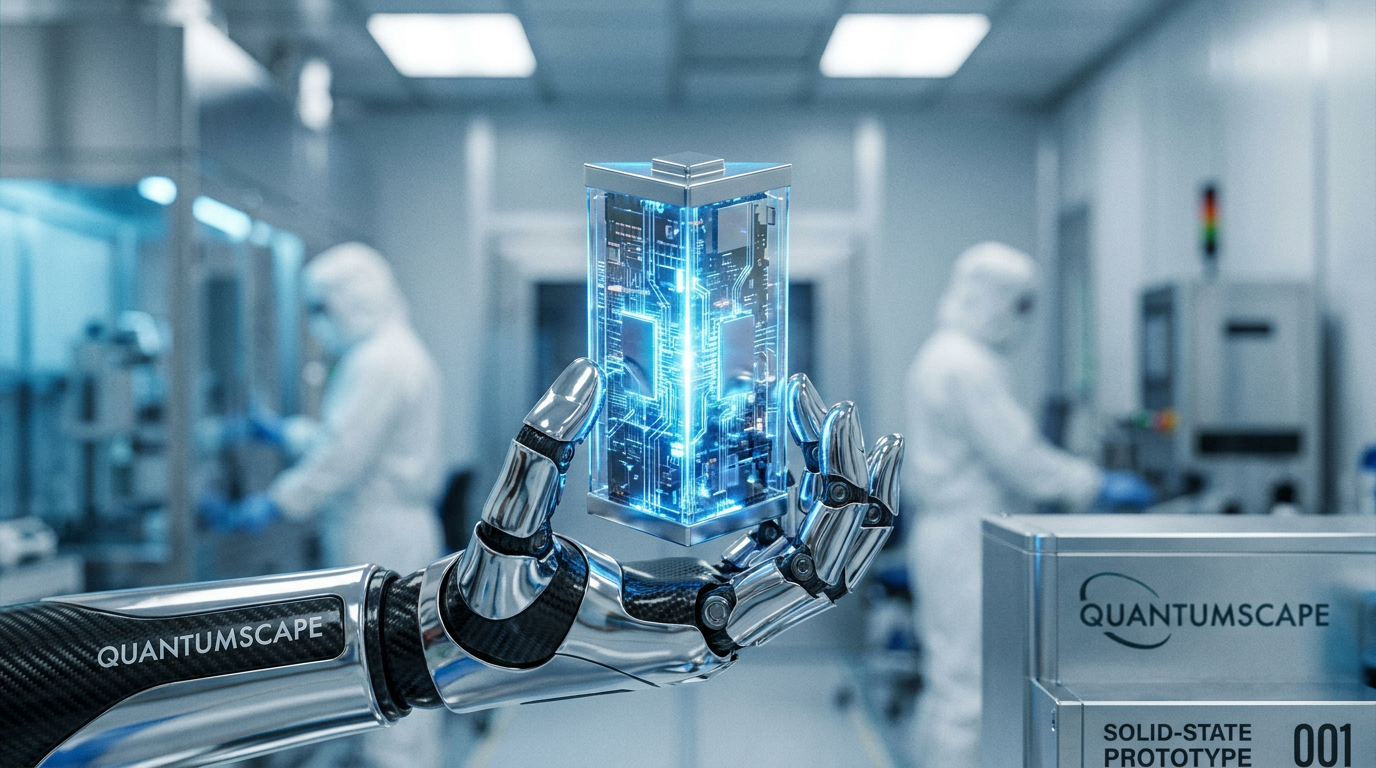
- Major players like QuantumScape and Toyota are launching pilot production lines in 2026 to solve manufacturing bottlenecks.
- Early commercial applications are targeting premium EVs, motorcycles, and aerospace drones, with mass-market adoption expected in the 2030s.
For the past decade, the electric vehicle revolution has been tethered to a single, inescapable chemical compromise: the liquid lithium-ion battery. While these power cells have successfully driven millions of EVs off assembly lines, they are fundamentally limited by their liquid electrolytes, which restrict charging speeds, cap energy density, and pose a persistent—albeit rare—fire risk.[1]
But in 2026, the automotive industry is crossing a historic threshold. Solid-state batteries (SSBs), long dismissed as a theoretical "holy grail" permanently trapped in laboratory testing, are finally entering pilot manufacturing. From Silicon Valley to Shenzhen and Tokyo, the race to commercialize the biggest leap in energy storage since the invention of lithium-ion is accelerating into reality.[1]
To understand why this shift is monumental, one must look at the mechanism inside the cell. Traditional batteries rely on a liquid organic solvent to transport lithium ions back and forth between the cathode and the anode. This liquid is volatile and flammable. If the battery is punctured, overcharged, or subjected to extreme heat, the liquid can ignite, triggering a dangerous chain reaction known as thermal runaway.[7]

Solid-state batteries eliminate this vulnerability by replacing the liquid solvent with a solid, non-flammable material—typically a ceramic, polymer, or sulfide-based glass. Because there is no liquid to boil or catch fire, the safety profile of the vehicle is transformed. Comparative testing shows that thermal events in solid-state systems do not even begin until temperatures reach roughly 247°C, compared to just 90°C for conventional lithium-ion cells.[7]
In April 2026, Greater Bay Technology (GBT), a battery manufacturer backed by China's GAC Group, demonstrated this resilience publicly. The company announced that its first "A-sample" all-solid-state battery cells had rolled off the production line and successfully passed rigorous needle penetration, extrusion, and thermal shock tests without a single fire or explosion.[2]
Beyond safety, the true prize of the solid electrolyte is its ability to unlock a new chemical architecture: the lithium-metal anode. In conventional batteries, the anode is made of graphite, which acts as a heavy, bulky sponge to absorb lithium ions. Engineers have long wanted to replace graphite with pure lithium metal to save weight and space, but doing so in a liquid battery causes microscopic, needle-like structures called dendrites to grow and short-circuit the cell.[7]
A rigid solid electrolyte acts as a physical barrier, suppressing dendrite growth and allowing the safe use of lithium metal. This single change effectively doubles the battery's energy density. While today's best commercial lithium-ion batteries max out around 250 to 300 watt-hours per kilogram (Wh/kg), the solid-state cells entering pilot production in 2026 are targeting 400 to 500 Wh/kg.[7]

A rigid solid electrolyte acts as a physical barrier, suppressing dendrite growth and allowing the safe use of lithium metal.
For the consumer, this density translates directly into freedom. A vehicle equipped with a solid-state pack could travel over 600 miles (1,000 kilometers) on a single charge without increasing the physical size or weight of the battery. Alternatively, automakers could build lighter, more efficient vehicles with smaller batteries that still deliver 300 miles of range.[1][3]
Charging speeds are also poised for a paradigm shift. Because solid electrolytes are highly efficient at ion transport and less prone to degradation under high voltage, they can absorb energy at staggering rates. Both QuantumScape, a leading U.S. battery developer, and Toyota have demonstrated solid-state prototypes capable of charging from 10% to 80% in roughly 10 minutes—bringing the EV charging experience remarkably close to the time it takes to fill a gas tank.[3][4]
If the science is so superior, the obvious question is why it has taken so long to reach the market. The answer lies in the brutal realities of manufacturing. Producing microscopically thin, defect-free solid separators at gigawatt-hour scale is notoriously difficult. Even a microscopic flaw in the ceramic or sulfide layer can ruin the cell.[5][8]
However, 2026 has brought concrete evidence that these manufacturing bottlenecks are being solved. In February, QuantumScape inaugurated its "Eagle Line" in San Jose, California. This highly automated pilot facility utilizes the company's proprietary "Cobra" process, which manufactures ceramic separators roughly 25 times faster than previous iterations, laying the blueprint for gigawatt-hour-scale replication with automotive partners like Volkswagen.[4][5][8]
Meanwhile, Toyota, which holds more solid-state battery patents than any other company, is advancing its own sulfide-based approach. The Japanese automaker has partnered with oil refiner Idemitsu Kosan to construct a large-scale pilot plant for solid electrolytes. Toyota is targeting 2027 to 2028 for the limited production of solid-state EVs, likely debuting the technology in premium Lexus models.[3]

Chinese automakers are moving even faster to claim the "first-to-market" mantle. Chery recently announced plans to deploy a 600 Wh/kg solid-state battery in its Exeed Liefeng model before the end of 2026. While some industry analysts caution that early Chinese iterations may be "semi-solid" hybrids rather than true all-solid-state cells, the aggressive timelines underscore the intense geopolitical race to control the next generation of mobility.[6]
The first commercial applications of true solid-state technology are actually arriving on two wheels. Donut Lab, an electric mobility startup, announced that its solid-state batteries are powering the 2026 model Verge Motorcycles, hitting the road in the first quarter of the year. High-performance motorcycles and aerospace drones—where weight savings are paramount and buyers are willing to pay a premium—are serving as the perfect beachhead markets.[6]

Despite the immense progress, significant uncertainties remain. Cost parity with liquid lithium-ion batteries is still years away. Early solid-state cells will be expensive to produce, restricting them to luxury vehicles, hypercars, and commercial aviation in the near term. Mass-market affordability is not expected until the early 2030s, as economies of scale gradually drive down the price of raw materials like lithium sulfide.[1][8]
Furthermore, while lab results boast impressive cycle life—with QuantumScape demonstrating 400 consecutive fast-charge cycles with minimal degradation—these cells must now prove their durability in the real world. They will need to withstand the relentless vibrations of potholed roads, the freezing temperatures of northern winters, and the scorching heat of desert summers over a 15-year vehicle lifespan.[4][7]
Nevertheless, the developments of 2026 mark a definitive turning point. The debate is no longer about whether solid-state batteries will work, but rather how quickly they can be manufactured at scale. As production lines spin up and the first commercial vehicles hit the pavement, the electric vehicle industry is finally moving past its liquid limitations and into a denser, safer, and faster-charging future.[1]
How we got here
2020
QuantumScape goes public, bringing widespread investor attention to solid-state tech.
Late 2025
Toyota and Idemitsu Kosan announce a partnership to mass-produce solid sulfide electrolytes.
Feb 2026
QuantumScape inaugurates the Eagle Line pilot facility in San Jose to scale ceramic separator production.
April 2026
Greater Bay Technology announces its first A-sample solid-state cells have rolled off the production line.
Viewpoints in depth
The Battery Innovators
Startups and pure-play battery tech companies argue that the fundamental science is solved, and the focus is now purely on manufacturing throughput.
Companies like QuantumScape and Greater Bay Technology view 2026 as the year solid-state technology crosses the chasm from theoretical physics to industrial reality. Having proven that solid electrolytes can safely enable lithium-metal anodes in the lab, these innovators are aggressively building automated pilot lines. They argue that proprietary manufacturing techniques—like QuantumScape's Cobra process—will rapidly drive down defect rates and allow them to license the technology to global automakers at gigawatt-hour scales.
The Legacy Automakers
Automotive giants emphasize a vertically integrated approach, prioritizing safety and gradual rollout in premium models.
For legacy manufacturers like Toyota and Volkswagen, solid-state batteries represent a massive supply chain pivot. Rather than rushing the technology into mass-market commuter cars, they are taking a measured approach. Toyota is partnering with chemical and oil refining giants to secure the raw materials needed for sulfide-based electrolytes. These automakers plan to introduce the technology first in high-margin luxury vehicles, ensuring that the batteries can withstand a 15-year lifespan before risking their broader brand reputation.
The Manufacturing Skeptics
Industry analysts warn that producing defect-free solid separators at scale remains a monumental and costly challenge.
While acknowledging the lab breakthroughs, manufacturing experts and financial analysts caution that building a few thousand cells on a pilot line is vastly different from producing millions of battery packs annually. They point out that solid-state cells require entirely new factory equipment and cleanroom environments, making them significantly more expensive than heavily optimized liquid lithium-ion batteries. Skeptics argue that until cost parity is achieved, solid-state will remain a niche technology for hypercars and aerospace, rather than a silver bullet for global EV adoption.
What we don't know
- Exactly when solid-state batteries will reach cost parity with traditional lithium-ion cells for mass-market vehicles.
- How well the solid electrolytes will resist degradation over a 15-year lifespan in extreme real-world weather conditions.
- Whether the supply chain for specialized materials, like lithium sulfide, can scale fast enough to meet global automaker demand.
Key terms
- Solid Electrolyte
- A solid material (ceramic, polymer, or sulfide) that conducts ions between the battery's anode and cathode, replacing liquid solvents.
- Lithium-Metal Anode
- An anode made of pure lithium metal, which stores significantly more energy than the graphite anodes used in conventional batteries.
- Energy Density
- The amount of energy a battery can store relative to its weight, typically measured in watt-hours per kilogram (Wh/kg).
- Thermal Runaway
- A dangerous chain reaction where a battery cell overheats and catches fire, a risk primarily associated with liquid electrolytes.
- Dendrites
- Microscopic, needle-like metallic structures that can grow inside a liquid battery during charging, potentially causing short circuits.
Frequently asked
What makes a solid-state battery different?
It replaces the liquid chemical solvent found in traditional batteries with a solid material, such as a ceramic or polymer, to conduct energy between the anode and cathode.
Will solid-state batteries catch fire?
They are vastly safer. Because they lack the flammable liquid solvents that cause thermal runaway in traditional EVs, they can withstand extreme heat and physical damage without igniting.
When can I buy a car with a solid-state battery?
Early premium models from automakers like Toyota and Chery are expected between 2026 and 2028, with mass-market adoption likely arriving in the early 2030s.
Why do they charge so much faster?
Solid electrolytes are highly efficient at ion transport and resist degradation under high voltage, allowing them to safely absorb a 10% to 80% charge in roughly 10 minutes.
Sources
Source coverage
8 outlets
3 viewpoints surfaced








[1]Factlen Editorial TeamIndustry Analysts & Observers
Synthesis by Factlen editorial team
Read on Factlen Editorial Team →[2]ElectrekBattery Innovators
China ramps up solid-state EV battery production
Read on Electrek →[3]CarscoopsLegacy Automakers
Toyota's 620-Mile Solid-State EV Plan Just Got A Major Boost From Big Oil
Read on Carscoops →[4]QuantumScapeBattery Innovators
QuantumScape Inaugurates Eagle Line for Solid-State Battery Pilot Production
Read on QuantumScape →[5]Battery-NewsIndustry Analysts & Observers
QuantumScape inaugurates Eagle Line pilot for solid-state battery production
Read on Battery-News →[6]ElectriveBattery Innovators
Chery plans to deploy solid-state battery in an EV this year
Read on Electrive →[7]To7MotorIndustry Analysts & Observers
Solid-State Batteries 2026: The Complete Guide to the EV Revolution
Read on To7Motor →[8]Zacks Investment ResearchIndustry Analysts & Observers
QuantumScape's Solid-State Battery Strategy: What Investors Show Know
Read on Zacks Investment Research →
Every angle. Every day.
Get automotive stories with full source coverage and perspective breakdowns delivered to your inbox.