
Brain Implant Allows Man With ALS to Communicate Independently at Home
A new brain-computer interface has enabled a man with severe paralysis to speak and operate a computer at home without the need for constant supervision by researchers.
By Factlen Editorial Team
- Neurotechnology Researchers
- Scientists emphasize the technical milestone of background auto-calibration.
- ALS Patients and Advocates
- Advocates focus on the restoration of dignity, autonomy, and human connection.
- Medical Regulators
- Regulators prioritize long-term safety, hardware durability, and infection risks.
What's not represented
- · Insurance Providers
- · Caregivers
Why this matters
This breakthrough transitions brain-computer interfaces from highly controlled laboratory experiments into practical, life-changing medical devices, offering a realistic path to restoring autonomy for millions of people with severe paralysis.
Key points
- A 47-year-old man with ALS successfully used a brain-computer interface to communicate independently at home for nearly two years.
- The system translates attempted speech into text at an average speed of 56 words per minute with 97.5% accuracy.
- Unlike previous devices, the new software recalibrates itself automatically, eliminating the need for daily expert supervision.
- The breakthrough marks a major step toward practical, consumer-ready assistive technology for severe paralysis.
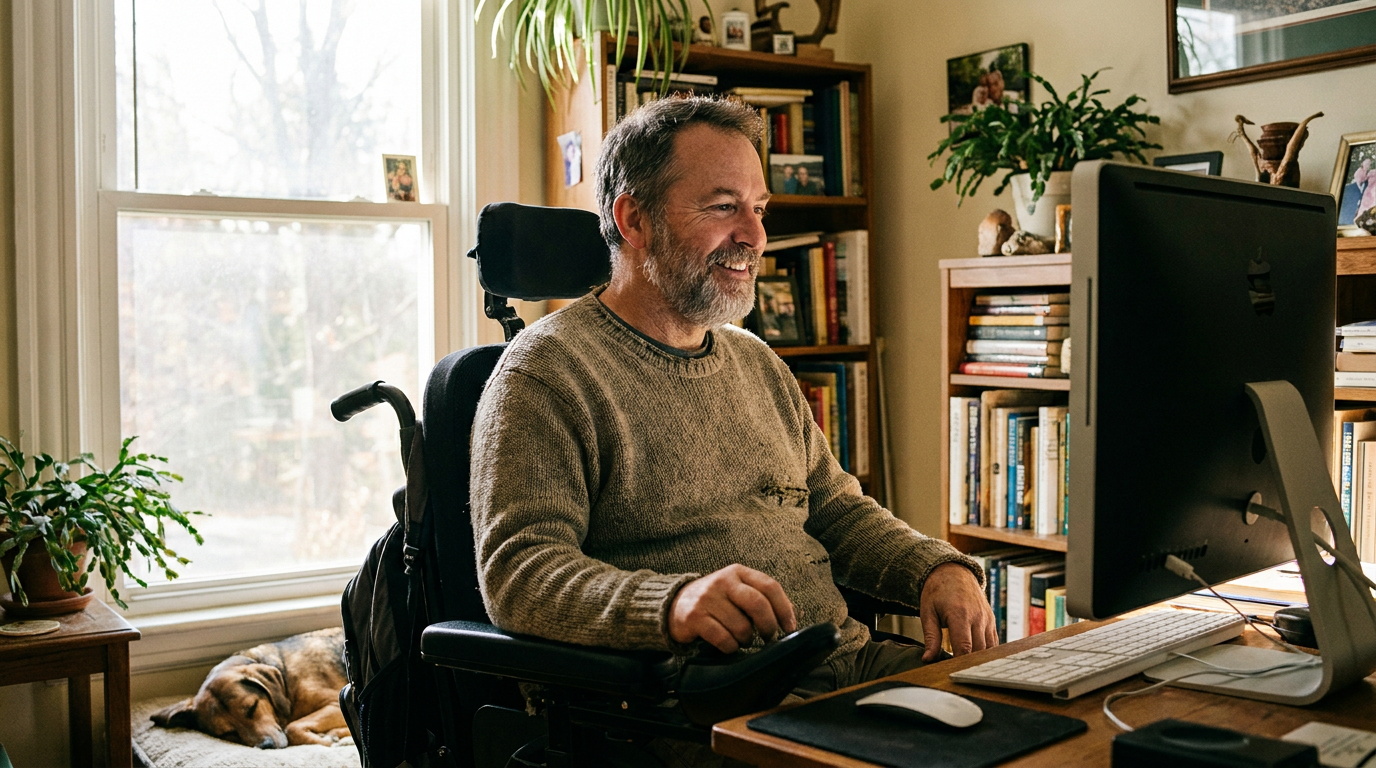
For nearly three years, Casey Harrell, a 47-year-old man living with amyotrophic lateral sclerosis (ALS), has been quietly making medical history from his home in Oakland, California. Diagnosed with the progressive neurodegenerative disease six years ago, Harrell lost the ability to speak and move as his motor neurons degraded. Today, he is communicating at an average speed of 56 words per minute, sending emails, and continuing his work in climate advocacy. This remarkable restoration of autonomy is the result of a next-generation brain-computer interface (BCI) that translates his neural activity directly into text on a screen.[1][2]
ALS is a devastating condition that progressively destroys the nerve cells responsible for controlling voluntary muscles. As the disease advances, patients often experience "locked-in syndrome," where their cognitive functions remain entirely intact, but they are trapped inside a body that can no longer move, speak, or even breathe independently. For decades, assistive technologies relied on residual movements—such as eye-tracking cameras or slight muscle twitches—to help patients spell out words painstakingly slowly.[3][5]
To bypass the failing muscles, scientists have spent years developing intracortical brain-computer interfaces. These systems record electrical activity directly from the brain and translate it into digital commands. However, until now, they suffered from a fatal flaw for real-world application: they were strictly proof-of-concept devices confined to highly controlled research laboratories.[2][3]
In previous trials, neural signals recorded from the brain tended to shift slightly from day to day due to microscopic movements of the electrodes or changes in the surrounding tissue. This required a team of specialized technicians to set up the equipment and manually recalibrate the decoding software before every single use. A patient could not simply wake up and decide to send a text message; they had to wait for the scientists to arrive.[3][6]

A collaborative team from UC Davis, Brown University, and the Mass General Brigham Neuroscience Institute has finally shattered this barrier. In a landmark study published in Nature Medicine, researchers detailed a modified BCI system designed specifically to overcome the need for constant expert supervision. By programming the software to automatically update and recalibrate itself in the background, they created a user-friendly process for independent home use.[1][2]
In 2023, neurosurgeons implanted the investigational device into Harrell's left precentral gyrus, the specific region of the brain responsible for coordinating speech. The hardware consists of four microelectrode arrays containing a total of 256 cortical electrodes. These microscopic sensors penetrate the outer layer of the brain to eavesdrop on the electrical chatter of individual neurons as Harrell attempts to silently mouth words.[2][7]
The true magic of the system lies in its software. As Harrell attempts to speak, the system continuously analyzes the neural signals and predicts the corresponding speech sounds, known as phonemes. Advanced machine learning algorithms then assemble these phonemes into full words and sentences on a screen. The system is equipped with a vast vocabulary of 125,000 words, allowing for nuanced and unrestricted expression.[3][6]
As Harrell attempts to speak, the system continuously analyzes the neural signals and predicts the corresponding speech sounds, known as phonemes.
The clinical evidence gathered over the past two years is unprecedented. Harrell used the BCI system in his home for more than 3,800 hours over 22.6 months, operating it independently on a near-daily basis. During that time, he communicated more than 183,000 sentences and close to 2 million words. The system maintained a staggering 97.5% accuracy rate, a massive leap from earlier iterations that struggled with high error rates outside the lab.[2][4]

Beyond the raw data, the technology has profoundly altered Harrell's quality of life. "It is very sweet to have the ability to look at my wife's eyes when she hears my voice and conjures up a sweet memory," Harrell shared, noting that the device also allows him to remind his young daughter of what he used to sound like. He frequently uses the system for up to 12 straight hours, engaging in dynamic conversations with friends and colleagues who previously struggled to understand him.[2][4]
The UC Davis breakthrough arrives during a period of intense acceleration for the neurotechnology sector. Earlier this year, Elon Musk's Neuralink successfully implanted its own brain chip in Noland Arbaugh, a patient with quadriplegia, allowing him to browse the internet and play video games using his thoughts. While Neuralink focuses on a wireless, robotically implanted consumer device, the UC Davis consortium has proven that high-resolution, speech-focused decoding can be sustained reliably over years.[8]
Regulatory bodies worldwide are beginning to recognize the viability of these systems. In the Netherlands, authorities recently approved a clinical trial for Ability Neurotech's experimental BCI, which aims to test a fully implantable, battery-free device for ALS patients. The industry is collectively moving away from proving that neural interfaces can work, toward proving they can scale as practical, everyday medical devices.[5]
Despite the triumph, significant clinical unknowns remain. The most pressing question in the BCI field is the long-term durability of the implanted electrodes. Over time, the brain's immune system naturally forms scar tissue around foreign objects, which can gradually degrade the quality of the recorded neural signals. While Harrell's device has functioned beautifully for nearly two years, researchers do not yet know if the signal will remain viable for a decade or more.[2][8]

Additionally, the current UC Davis system still requires a physical connection. While the software operates independently, the hardware involves a pedestal protruding from the skull, which must be connected to external computers to process the immense data load. The ultimate goal for the field is a fully internalized system that transmits data wirelessly to a smartphone or wearable processor, eliminating the infection risk associated with open skin ports.[5][8]
Researchers are already looking beyond text-on-a-screen. The next frontier is "brain-to-voice" technology, which aims to convert decoded neural activity directly into a synthesized, natural-sounding voice. By analyzing the neural signals associated with emotional inflection and tone, scientists hope to restore not just the words a patient wants to say, but the exact way they want to say them.[4]
For now, the successful deployment of an independent, at-home BCI represents a watershed moment in neurology. "For years, BCIs have been proof-of-concept devices," said Dr. David Brandman, the UC Davis neurosurgeon who co-led the study. "This work shows that we may have crossed a threshold, by empowering a person with paralysis to speak on his own terms." For patients facing the silence of locked-in syndrome, the technology offers a profound promise: the mind can still find a way out.[2][6]
How we got here
2020
Casey Harrell is diagnosed with amyotrophic lateral sclerosis (ALS), eventually losing the ability to speak and move.
2023
Neurosurgeons implant a 256-electrode brain-computer interface into Harrell's left precentral gyrus.
June 2026
The Netherlands approves a clinical trial for a separate, fully implantable BCI developed by Ability Neurotech.
June 15, 2026
Nature Medicine publishes the UC Davis study, detailing Harrell's unprecedented 3,800 hours of independent home use.
Viewpoints in depth
Neurotechnology Researchers
Scientists emphasize the technical milestone of background auto-calibration.
For researchers, the true breakthrough of the UC Davis study is not the decoding speed, but the software's ability to recalibrate itself. Historically, the microscopic shifting of electrodes meant that decoding algorithms had to be manually adjusted by experts every day. By automating this process, researchers have crossed the critical threshold from a supervised laboratory experiment to a viable, independent medical device.
ALS Patients and Advocates
Advocates focus on the restoration of dignity, autonomy, and human connection.
For the ALS community, the technology represents a lifeline out of locked-in syndrome. The ability to communicate independently means patients can continue working, make their own medical decisions, and maintain emotional connections with their families. Advocates stress that these devices shift the narrative of ALS from one of inevitable isolation to one where patients can remain active participants in their own lives.
Medical Regulators
Regulators prioritize long-term safety, hardware durability, and infection risks.
While celebrating the communication milestones, regulatory bodies and medical ethicists remain focused on the physical risks of the hardware. Current systems often require a physical pedestal protruding through the skin, carrying a persistent risk of infection. Regulators are pushing the industry toward fully implantable, wireless systems, while closely monitoring how long the electrodes can survive in the brain before scar tissue degrades the signal.
What we don't know
- It remains unclear how many years the microelectrode arrays can function before the brain's natural scar tissue degrades the neural signal.
- Researchers do not yet have a definitive timeline for when a fully wireless, implantable version of this specific speech-decoding system will be available.
Key terms
- Amyotrophic Lateral Sclerosis (ALS)
- A progressive neurodegenerative disease that destroys motor neurons, leading to severe muscle weakness and paralysis.
- Brain-Computer Interface (BCI)
- A system that records electrical activity from the brain and translates it into digital commands to control external devices.
- Precentral Gyrus
- A region on the surface of the brain's frontal lobe that is primarily responsible for executing voluntary motor movements, including speech.
- Phonemes
- The distinct units of sound in a specified language that distinguish one word from another.
Frequently asked
How fast can the patient communicate?
The patient communicates at an average speed of 56 words per minute, with a 97.5% accuracy rate.
Does the device require a scientist to operate?
No. Unlike previous models, this new system automatically recalibrates itself in the background, allowing the patient to use it independently at home.
Is the device completely wireless?
Not yet. The current UC Davis system still relies on a physical pedestal on the skull connected to external computers, though the industry is moving toward fully wireless implants.
Sources
Source coverage
8 outlets
3 viewpoints surfaced







[1]NatureNeurotechnology Researchers
At-home brain implant gives man with motor neuron disease his daily life back
Read on Nature →[2]UC Davis HealthNeurotechnology Researchers
Brain-computer interface enables independent, accurate communication for man living with ALS
Read on UC Davis Health →[3]PsyPost
Unprecedented brain implant allows paralyzed man to completely control his computer and 'speak' independently
Read on PsyPost →[4]Sri Lanka GuardianALS Patients and Advocates
Brain Implant Gives Man With ALS a New Voice as Scientists Push Boundaries of Communication
Read on Sri Lanka Guardian →[5]ALS News TodayALS Patients and Advocates
Netherlands approves trial of brain implant for ALS communication
Read on ALS News Today →[6]Medical XpressMedical Regulators
Brain-computer interface enables independent, accurate communication for man living with ALS
Read on Medical Xpress →[7]ScienmagNeurotechnology Researchers
Brain-Computer Interface Empowers ALS Patient with Independent and Precise Communication
Read on Scienmag →[8]Sawt Al-EmaratMedical Regulators
Elon Musk's chip for patients: How Neuralink will bring paralyzed patients into the age of mind control?
Read on Sawt Al-Emarat →

More in science
See all 5 stories →Coral Resilience
Scientists Map 166,000 Square Kilometers of Coral Reefs Capable of Surviving Climate Change
0 sources

Brain-Computer Interfaces
At-Home Brain Implant Restores Independent Communication for Paralyzed ALS Patient
0 sources
Arctic Ecosystem
Arctic Ocean Reaches Nutrient Tipping Point as Sea Ice Retreats
0 sources

Every angle. Every day.
Get science stories with full source coverage and perspective breakdowns delivered to your inbox.