
SpaceX Surges to $2.1 Trillion Valuation in Largest IPO in History
SpaceX shattered Wall Street records with a $75 billion public offering, propelling Elon Musk to trillionaire status and sparking a frenzy of retail and ETF trading.
By Factlen Editorial Team
- Bullish Institutional Investors
- View SpaceX as a generational monopoly combining space logistics and AI infrastructure, justifying its premium valuation.
- Retail and Momentum Traders
- Focus on the immediate price action and volatility, utilizing leveraged ETFs to amplify daily swings.
- Skeptical Valuation Analysts
- Focus on the company's massive cash burn and eye-watering revenue multiples, warning of significant downside risk.
What's not represented
- · Traditional aerospace and defense contractors facing new public-market comparisons.
- · Regulators monitoring the unprecedented concentration of wealth and infrastructure control.
Why this matters
The SpaceX IPO not only unlocks unprecedented liquidity for the commercial space sector but also sets a new benchmark for mega-cap tech valuations, paving the way for a wave of artificial intelligence companies to enter the public markets.
Key points
- SpaceX raised $75 billion in its IPO, nearly tripling the previous global record set by Saudi Aramco.
- The stock opened at $150 and closed at $160.95, giving the company a $2.1 trillion market capitalization.
- Elon Musk became the world's first trillionaire, with his net worth surging to an estimated $1.1 trillion.
- Retail investors received roughly 20% of the allocation, sparking massive demand for leveraged SpaceX ETFs.
- Despite $18.7 billion in 2025 revenue, the company posted an $8.7 billion net loss due to infrastructure investments.
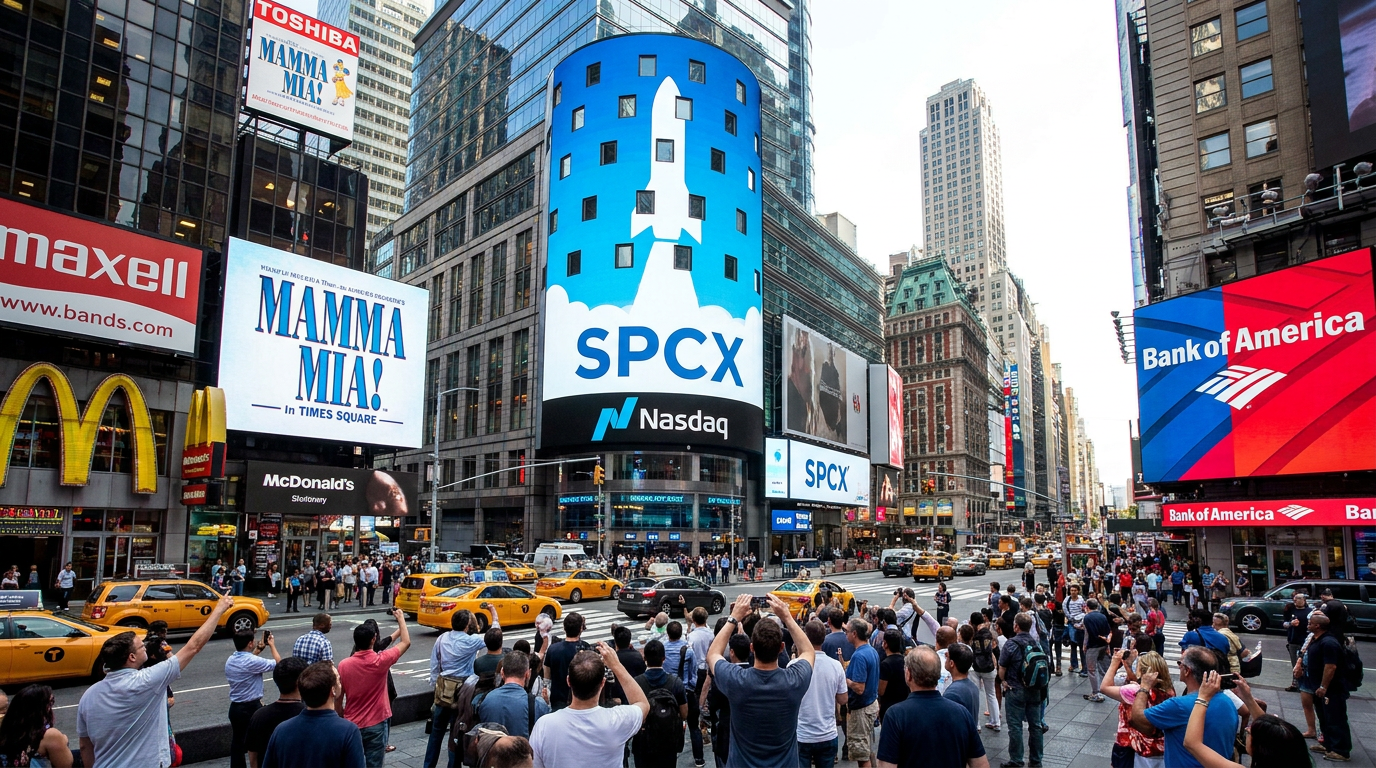
The long-awaited public debut of Space Exploration Technologies Corp. shattered Wall Street records on Friday, as SpaceX executed the largest initial public offering in history. Bypassing traditional IPO mechanics, the aerospace giant listed on the Nasdaq under the ticker SPCX, opening at $150 a share and surging to close at $160.95. The 19 percent first-day pop cemented a staggering $2.1 trillion market capitalization, instantly making SpaceX the sixth most valuable public company in the United States. The milestone marks a dramatic evolution for a company that began in an El Segundo warehouse with what its founder once estimated was less than a 10 percent chance of survival.[1]
The sheer scale of the capital raise redefines the modern equity market. SpaceX sought and secured $75 billion by selling 555.6 million shares, nearly tripling the previous global record set by Saudi Aramco’s $25.6 billion listing in 2019. Demand for the shares reached a fever pitch in the days leading up to the debut, with order books reportedly swelling to $250 billion—more than three times the available supply. Institutional giants like BlackRock placed multi-billion-dollar orders, competing fiercely for a piece of the highly restricted float.[1][7]
The historic listing also triggered an unprecedented wealth creation event. The surge in SpaceX’s valuation propelled CEO Elon Musk’s personal fortune to an estimated $1.1 trillion, making him the world’s first trillionaire. Musk, who retains massive voting control over the enterprise, now presides over a vertically integrated empire that spans orbital launch vehicles, global satellite broadband, and artificial intelligence infrastructure. The speed of this wealth accumulation is staggering, considering Musk's net worth hovered around $14 billion just a decade ago.[2]

Unlike standard mega-cap offerings that spend weeks narrowing an indicative price range through institutional bookbuilding, SpaceX handed the market a take-it-or-leave-it proposition. The company went straight to a fixed price of $135 per share. The unorthodox strategy reflected the immense leverage SpaceX held over its underwriters and prospective investors, knowing that demand would vastly outstrip the roughly 4 percent of the company’s equity being floated to the public.[7]
Retail investors, who have long clamored for a piece of Musk’s space venture, were granted an unusually large seat at the table. Approximately 20 percent of the IPO allocation was directed to individual buyers, brokerages, and private-bank clients. While this was slightly lower than the initially rumored 30 percent, it still represented one of the largest retail tranches in U.S. history. Hundreds of thousands of individual accounts received shares, though many large orders were scaled back to a maximum of 1,000 shares due to the overwhelming oversubscription.[6]
The retail appetite spilled immediately into the derivatives market, sparking what analysts dubbed the "Super Bowl of ETF advertising." Asset managers rushed to launch a wave of single-stock and space-themed exchange-traded funds to capture the momentum. On the first day of trading alone, leveraged bets on SpaceX generated more than $1 billion in trading volume, underscoring the intense speculative interest surrounding the stock and the broader commercial space sector.[3][5]
Issuers like Defiance, ProShares, and Leverage Shares flooded the market with tools offering amplified exposure. Funds like the Defiance Daily Target 2X Long SpaceX ETF and the Leverage Shares 2X Long SpaceX Daily ETF allow traders to double their daily return on the stock. The rapid rollout of these complex instruments means traders now have a full toolkit to express directional views on SpaceX without managing margin accounts or options chains, further fueling the stock's daily liquidity.[5]
Issuers like Defiance, ProShares, and Leverage Shares flooded the market with tools offering amplified exposure.
But the enthusiasm masks a complex financial reality detailed in the company’s S-1 registration statement. SpaceX is growing rapidly, generating $18.7 billion in full-year revenue for 2025—a 33 percent year-over-year increase. Its Starlink satellite internet division is the primary engine, accounting for $11.4 billion of that total as it serves over 10 million subscribers globally. However, the cost of building the future is exceptionally steep.[7]

Despite its top-line growth, SpaceX remains deeply unprofitable on a GAAP basis. The company posted an $8.7 billion net loss in 2025, followed by a $4.28 billion loss in the first quarter of 2026 alone. The massive cash burn is driven by heavy depreciation on the Starlink constellation, aggressive stock-based compensation, and billions in capital expenditures for AI infrastructure following the integration of Musk’s xAI startup into the broader corporate structure.[7][8]
For bullish institutional investors, the current losses are merely the cost of constructing an unassailable monopoly. Shaun Maguire, a partner at Sequoia Capital and an early SpaceX backer, called Musk "the most visionary entrepreneur of all time." Maguire argues that the market is still underestimating the convergence of space logistics and cloud computing, comparing the Starship rocket program to the invention of the railroad. He projects that SpaceX could generate hundreds of billions in revenue by 2030 and publicly vowed to hold his personal shares forever.[4]
Conversely, the $2.1 trillion valuation has drawn sharp skepticism from fundamental analysts. At its $135 IPO price, SpaceX traded at an eye-watering 94 times its 2025 sales—a multiple that leaves virtually no room for execution errors. Critics point to the inherent risks of spaceflight, regulatory hurdles, and the key-man risk associated with Musk’s divided attention across multiple ventures, warning that the valuation is dangerously disconnected from the company's near-term cash flows.[8]

This skepticism has birthed a counter-market of bearish instruments. Alongside the bullish leveraged funds, issuers launched inverse ETFs like the Leverage Shares 2X Short SpaceX Daily ETF and Defiance’s SPCQ, designed to deliver twice the inverse of the stock’s daily move. These funds cater to short-sellers betting that gravity will eventually pull the company’s valuation back in line with its current revenue profile, setting the stage for intense daily battles between bulls and bears.[5][8]
Beyond SpaceX itself, the blockbuster listing is expected to unfreeze the broader IPO market, which has been sluggish in recent years. Analysts predict the injection of liquidity and the validation of massive private-market valuations will pave the way for other highly anticipated tech debuts. Artificial intelligence giants Anthropic and OpenAI are reportedly preparing their own public offerings, potentially making 2026 a record year for equity issuance and reshaping the composition of major indices.[6]
As the dust settles on the largest equity debut in history, the true test for SpaceX begins. The company must now balance the relentless capital demands of its Starship and AI programs with the quarterly scrutiny of public markets. Whether it grows into its $2.1 trillion valuation or faces a harsh correction, SpaceX has undeniably altered the financial landscape, proving that Wall Street’s appetite for frontier technology remains as vast as the cosmos itself.[1][4][7]
How we got here
May 2026
SpaceX publicly files its S-1 registration statement, revealing its financials for the first time.
June 3, 2026
The company bypasses a traditional price range, setting a fixed IPO price of $135 per share.
June 11, 2026
Underwriters close the order books after receiving $250 billion in demand for the $75 billion offering.
June 12, 2026
SpaceX begins trading on the Nasdaq under the ticker SPCX, closing its first day up 19%.
Viewpoints in depth
Bullish Institutional Investors
View SpaceX as a generational monopoly combining space logistics and AI infrastructure.
For early backers and institutional bulls, SpaceX is not evaluated as a traditional aerospace manufacturer, but as the foundational infrastructure of the next century. Investors like Sequoia Capital argue that the Starship launch vehicle acts as a 'railroad to space,' dramatically lowering the cost of orbit and enabling entirely new industries, from orbital data centers to direct-to-cell satellite networks. In this view, the company's current unprofitability is a feature, not a bug, representing aggressive reinvestment to secure an unassailable monopoly before competitors can react.
Retail and Momentum Traders
Focus on the immediate price action and volatility, utilizing leveraged ETFs to amplify daily swings.
The retail trading community has approached the SpaceX listing as a generational momentum play. Rather than focusing on 2030 revenue projections, this camp is highly active in the derivatives and ETF markets, utilizing tools like 2X leveraged long and short funds to trade the stock's daily volatility. For these participants, the sheer scale of the IPO and the intense media coverage guarantee high trading volume and liquidity, making SPCX the ultimate vehicle for short-term, catalyst-driven trading strategies.
Skeptical Valuation Analysts
Focus on the company's massive cash burn and eye-watering revenue multiples, warning of significant downside risk.
Fundamental analysts and short-sellers look at SpaceX's $2.1 trillion valuation and see a dangerous disconnect from financial reality. They point out that trading at 94 times trailing sales leaves absolutely no margin for error. This camp emphasizes the company's $8.7 billion net loss in 2025 and warns that the capital-intensive nature of both spaceflight and artificial intelligence will require continuous cash burn. Furthermore, they highlight the 'key man risk' of relying on Elon Musk, arguing that any delays in the Starship program or regulatory setbacks could trigger a severe market correction.
What we don't know
- How quickly SpaceX can transition its massive capital expenditures into GAAP profitability.
- Whether the retail enthusiasm and leveraged ETF volume will lead to extreme volatility in the stock's first few months of trading.
- How the expiration of early-investor lockup periods later this year will impact the share price.
Key terms
- Initial Public Offering (IPO)
- The process by which a private company offers shares to the public in a new stock issuance.
- Market Capitalization
- The total dollar market value of a company's outstanding shares of stock, calculated by multiplying the stock price by total shares.
- Leveraged ETF
- An exchange-traded fund that uses financial derivatives and debt to amplify the daily returns of an underlying asset.
- Price-to-Sales Multiple
- A valuation metric that compares a company's stock price to its revenues, often used to evaluate unprofitable growth companies.
- Bookbuilding
- The process by which underwriters attempt to determine the price at which an IPO will be offered based on demand from institutional investors.
Frequently asked
What was the SpaceX IPO price?
SpaceX bypassed the traditional price range and set a fixed price of $135 per share before trading began.
How much of the company was sold to the public?
SpaceX sold 555.6 million shares to raise $75 billion, representing roughly 4% of the company's total equity.
Did retail investors get access to the IPO?
Yes, approximately 20% of the IPO allocation was directed to retail investors, though demand far exceeded supply, leading to scaled-back orders.
Is SpaceX currently profitable?
No. Despite generating $18.7 billion in revenue in 2025, the company posted an $8.7 billion net loss due to heavy investments in Starlink and AI infrastructure.
Sources
Source coverage
8 outlets
3 viewpoints surfaced








[1]ForbesBullish Institutional Investors
SpaceX Opens At $150—Surging 20% After Largest IPO Ever
Read on Forbes →[2]The Guardian
How much money did Elon Musk make in SpaceX's stock market debut?
Read on The Guardian →[3]BloombergRetail and Momentum Traders
A Billion Dollars of Leveraged SpaceX Bets Hit ETFs in One Day
Read on Bloomberg →[4]BenzingaBullish Institutional Investors
SpaceX Investor Shaun Maguire Calls Elon Musk 'The Most Visionary Entrepreneur Of All Time'
Read on Benzinga →[5]TradingViewRetail and Momentum Traders
SpaceX IPO Sparks More ETF Frenzy: BlackRock, ProShares Join The Rush
Read on TradingView →[6]Interactive InvestorRetail and Momentum Traders
SpaceX IPO: how records fell on market debut
Read on Interactive Investor →[7]BitMEX ResearchSkeptical Valuation Analysts
SpaceX IPO Guide: S-1 Breakdown, Valuation & Trading Strategy
Read on BitMEX Research →[8]BriefGlanceSkeptical Valuation Analysts
Betting Against Gravity: The Risky New ETF to Short SpaceX
Read on BriefGlance →
Every angle. Every day.
Get business stories with full source coverage and perspective breakdowns delivered to your inbox.