
The Rise of Small Language Models: How AI is Moving from the Cloud to Your Pocket
A new generation of compact, highly efficient 'Small Language Models' is allowing smartphones and laptops to run advanced AI locally, offering unprecedented privacy, offline access, and zero subscription fees.
By Factlen Editorial Team

- Privacy & Open-Source Advocates
- Champion local AI as the ultimate solution to data harvesting and corporate control.
- Mobile Hardware Ecosystem
- View SLMs as the catalyst for a new era of device upgrades and NPU integration.
- AI Researchers & Developers
- Focus on the technical breakthroughs of synthetic data and model distillation.
What's not represented
- · Environmental analysts tracking AI energy consumption
Why this matters
By processing data directly on your device rather than sending it to a corporate server, local AI guarantees absolute privacy for sensitive tasks like medical or financial queries, while eliminating the latency and subscription costs of cloud-based models.
Key points
- Small Language Models (SLMs) allow advanced AI to run directly on smartphones and laptops without an internet connection.
- By processing data locally, SLMs guarantee absolute privacy, ensuring sensitive information never reaches corporate servers.
- Breakthroughs in 'textbook quality' synthetic training data allow 3-billion parameter models to rival the performance of much larger systems.
- Specialized Neural Processing Units (NPUs) in modern devices handle the computational load without draining battery life.
- Local AI eliminates the need for costly monthly cloud subscriptions and API usage fees.
The era of artificial intelligence as a massive, cloud-bound monolith is quietly ending. For the past three years, the narrative surrounding generative AI has been dominated by colossal data centers, billions of dollars in compute costs, and models so large they require supercomputers just to answer a simple question.[1]
But a parallel revolution has been taking shape at the opposite end of the spectrum. In 2026, the most transformative AI trend isn't about building bigger brains in the cloud; it is about shrinking them down to fit comfortably in your pocket.[5]
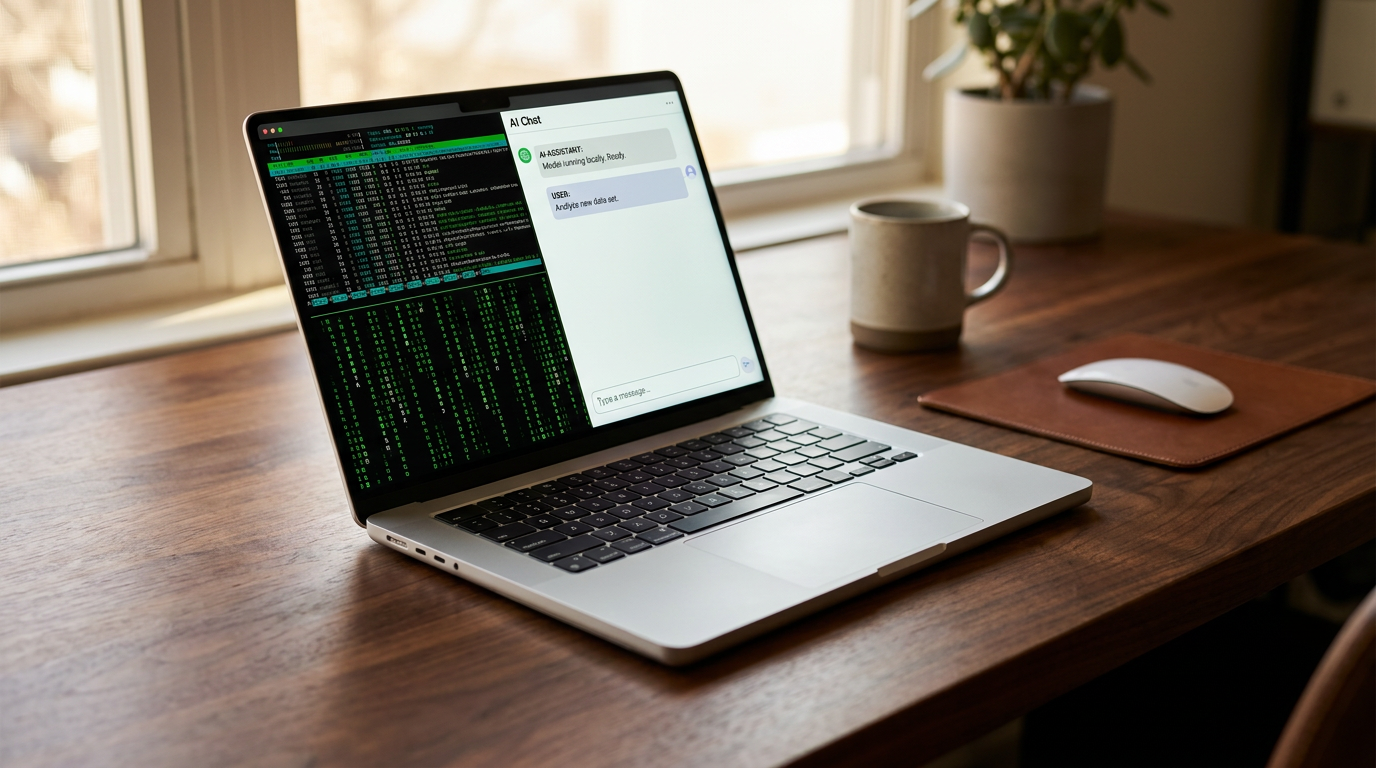
Enter the Small Language Model (SLM). These compact, highly efficient AI systems are designed to run entirely "on-device"—meaning they operate directly on the silicon of a smartphone, tablet, or laptop without ever needing to connect to the internet.[1][5]
To understand the scale of this shift, one must look at the math of AI parameters. Parameters are the internal neural connections a model uses to process information and generate text. Frontier cloud models operate with over a trillion parameters. In stark contrast, modern SLMs operate with roughly 1 to 8 billion parameters.[3][6]

Despite being a fraction of the size, these small models are punching far above their weight class. In benchmark testing, a 3.8-billion parameter model today can rival the reasoning and conversational performance of the massive cloud models that shocked the world just a few years ago.[4][7]
How did developers pack so much capability into such a small footprint? The secret lies in a fundamental shift from quantity to quality in training data. Instead of scraping the entire unfiltered internet, researchers began training SLMs on highly curated, "textbook quality" synthetic data.[2][3]
By feeding the AI clear, logical, and educational examples—much like teaching a child with a carefully curated curriculum rather than dropping them in a massive, unorganized library—the models learn reasoning and language structure far more efficiently.[3][9]
The second breakthrough enabling this localized AI boom is hardware. Modern smartphones and laptops are now equipped with Neural Processing Units (NPUs)—specialized silicon designed specifically to handle the mathematical heavy lifting of machine learning without draining the device's battery.[7]
Software optimization techniques like "quantization" further compress the AI. Quantization reduces the precision of the model's internal weights from 16-bit to 4-bit, effectively shrinking the file size so it can comfortably fit within a standard smartphone's RAM constraints.[7][8]

Software optimization techniques like "quantization" further compress the AI.
The implications of on-device AI are profound, starting with absolute data privacy. When a user asks a cloud-based AI to summarize a sensitive medical document, draft a confidential legal contract, or analyze personal finances, that data must be transmitted to a corporate server.[1][5]
With an SLM, the data never leaves the device. The processing happens locally, meaning there is zero risk of interception, data harvesting, or the information being used to train future models. For enterprise users and privacy-conscious consumers, this guarantee of data sovereignty is a game-changer.[2][5]
Then there is the advantage of latency and offline capability. Because the model lives on the device's hard drive, responses are instantaneous. There is no waiting for a server to reply, no network lag, and no loading spinners.[1][8]
This unlocks entirely new use cases. A traveler can use real-time, nuanced voice translation on an airplane without Wi-Fi. A field worker in a remote location can use an AI diagnostic tool without a cell signal. The AI becomes a permanent, reliable utility rather than a web service.[2][5]
The financial model of AI is also being upended. Cloud AI requires massive ongoing server costs, which companies pass on to consumers via $20 monthly subscriptions or API usage fees. Local AI, once downloaded, is entirely free to run. The only cost is the electricity used by the device.[5][8]

Major tech platforms have fully embraced this localized future. Apple Intelligence relies heavily on a 3-billion parameter on-device model to handle everyday tasks like notification summaries and text rewriting, only calling out to a secure cloud for highly complex requests.[6]
Similarly, Google has integrated its Gemini Nano model directly into the Android operating system via AI Core, allowing app developers to tap into local AI capabilities without needing to build their own models or pay for cloud APIs.[6]
Open-source models like Meta's Llama 3 8B and Microsoft's Phi-3 have democratized this technology even further. Independent developers can now download these models, fine-tune them for specific tasks, and deploy them in lightweight apps that run natively on consumer hardware.[2][4]
SLMs are not a complete replacement for massive cloud models. If a user needs to write complex software from scratch, analyze massive datasets, or engage in deep, multi-step logical reasoning, the trillion-parameter behemoths in the cloud remain unmatched.[1][8]

How we got here
March 2023
Meta releases the LLaMA model weights, sparking the open-source and local AI movement.
December 2023
Google announces Gemini Nano, bringing foundational on-device AI directly to the Android operating system.
April 2024
Microsoft unveils Phi-3 Mini, proving that a 3.8-billion parameter model trained on synthetic data can rival massive cloud models.
June 2024
Apple introduces Apple Intelligence, heavily utilizing a 3-billion parameter on-device model for core iOS features.
2025-2026
Local AI becomes mainstream, with millions of users running models completely offline via intuitive apps and built-in OS tools.
Viewpoints in depth
Privacy & Open-Source Advocates
Argue that local AI is the only ethical path forward for personal computing.
This camp emphasizes that keeping data on-device is the ultimate defense against corporate surveillance and data harvesting. They argue that as AI becomes deeply integrated into our personal lives—reading our emails, analyzing our health data, and managing our finances—sending that information to a centralized cloud is an unacceptable security risk. They champion open-weight models that anyone can audit, modify, and run for free, viewing SLMs as a democratizing force that breaks the monopoly of massive tech giants.
Mobile Hardware Ecosystem
View SLMs as the ultimate catalyst for a new 'supercycle' of device upgrades.
Chipmakers and smartphone manufacturers highlight the necessity of NPUs (Neural Processing Units) and increased RAM to run these models smoothly. For years, smartphone upgrades have felt incremental, but the hardware industry sees local AI as a compelling reason for consumers to buy new devices. They argue that hardware must evolve rapidly to support these powerful local models, pushing the boundaries of thermal management and battery efficiency to accommodate the new computational demands.
AI Researchers & Developers
Focus on the technical marvel of distillation and synthetic data while acknowledging limitations.
Researchers marvel at how techniques like model distillation and 'textbook' synthetic data have allowed 3-billion parameter models to achieve reasoning scores that previously required 100-billion parameters. However, they caution against viewing SLMs as a complete replacement for frontier models. They argue that while SLMs are incredibly efficient for routing, summarization, and basic generation, they are fundamentally limited by their size and will always serve as a complement—an edge-computing filter—to massive cloud models for complex reasoning tasks.
What we don't know
- How quickly the hardware requirements for local AI will render current-generation smartphones obsolete.
- Whether the performance gap between SLMs and massive cloud models will eventually close, or if they will permanently serve different tiers of tasks.
- How regulators will approach open-source SLMs that can be run locally without safety guardrails or content filters.
Key terms
- Small Language Model (SLM)
- A compact artificial intelligence model designed to run efficiently on personal devices like smartphones and laptops.
- Parameters
- The internal numerical weights and connections a neural network uses to process information and make predictions.
- Quantization
- A compression technique that reduces the precision of an AI model's weights, drastically shrinking its file size so it can fit in a device's memory.
- Neural Processing Unit (NPU)
- A specialized hardware chip designed specifically to accelerate machine learning tasks efficiently without draining battery life.
- Edge Computing
- The practice of processing data locally on the device where it is generated, rather than sending it to a centralized cloud server.
Frequently asked
Do I need an internet connection to use a Small Language Model?
No. Once the model is downloaded to your device, it runs entirely offline, making it perfect for travel, remote areas, or highly secure environments.
Will running an AI locally drain my smartphone's battery?
Modern devices use specialized Neural Processing Units (NPUs) designed to run these models efficiently, minimizing battery drain compared to using the main CPU.
Can a local AI write code or essays like ChatGPT?
Yes, but with limitations. While SLMs are excellent at drafting emails, summarizing text, and basic coding, they lack the deep reasoning capabilities of massive cloud models for highly complex tasks.
Is local AI really free to use?
Yes. Because the processing happens on your own hardware, there are no server costs, meaning no monthly subscriptions or API fees are required.
Sources
Source coverage
9 outlets
3 viewpoints surfaced









[1]CogitxPrivacy & Open-Source Advocates
Small Language Models (SLMs): The Efficient Future of AI
Read on Cogitx →[2]MediumAI Researchers & Developers
Small Language Models: The Master of Efficiency
Read on Medium →[3]Tom's GuideMobile Hardware Ecosystem
Microsoft has revealed its impressive new Phi-3 artificial intelligence model
Read on Tom's Guide →[4]DataCampAI Researchers & Developers
Phi-3 Model Variants and Architecture Explained
Read on DataCamp →[5]Local AI MasterPrivacy & Open-Source Advocates
What is Local AI: Private, Offline AI Models
Read on Local AI Master →[6]Hindustan TimesMobile Hardware Ecosystem
Apple Intelligence and Google Gemini Nano: The On-Device AI Race
Read on Hindustan Times →[7]Towards Data ScienceAI Researchers & Developers
Small Language Models: Using 3.8B Phi-3 and 8B Llama-3 Models on a PC
Read on Towards Data Science →[8]BentoMLPrivacy & Open-Source Advocates
Are Small Language Models Good Enough for Production?
Read on BentoML →[9]Factlen Editorial TeamAI Researchers & Developers
Synthesis by Factlen editorial team
Read on Factlen Editorial Team →

Every angle. Every day.
Get ai stories with full source coverage and perspective breakdowns delivered to your inbox.