
How Agrivoltaics is Solving the Conflict Between Solar Energy and Farming
By elevating solar panels above active farmland, agrivoltaic systems are creating microclimates that boost crop yields, save water, and increase renewable energy efficiency.
By Factlen Editorial Team
- Agricultural Advocates
- Prioritize crop yields, soil health, and keeping rural lands in the hands of farmers rather than energy developers.
- Renewable Energy Developers
- Focus on scaling clean energy rapidly and overcoming land-use conflicts to meet decarbonization goals.
- Climate & Ecological Scientists
- Emphasize the bi-directional benefits of water conservation and microclimate cooling.
What's not represented
- · Local zoning boards and rural municipalities tasked with regulating these new dual-use structures.
- · Consumers and food distributors who purchase the crops grown under these modified light conditions.
Why this matters
The transition to clean energy requires massive amounts of land, often putting solar developers in direct conflict with rural farming communities. Agrivoltaics proves that we do not have to choose between harvesting the sun and harvesting our food, offering a blueprint for sustainable land use that benefits both the grid and the global food supply.
Key points
- Agrivoltaics combines solar power generation and agriculture on the same land, solving the growing conflict over rural land use.
- The solar panels create a microclimate that protects crops from extreme heat and reduces irrigation needs by up to 50%.
- Plants release moisture that cools the overhead solar panels, increasing their electricity generation efficiency by up to 10%.
- Shade-tolerant crops like leafy greens and tomatoes thrive in these systems, while sun-hungry crops like corn may see reduced yields.
- Dual-use systems can boost overall land-use efficiency by 60% to 70% compared to separating farming and solar operations.
- High upfront construction costs and fragmented zoning regulations remain the primary hurdles to widespread global adoption.
The global push to achieve net-zero emissions by 2050 requires a staggering amount of land for renewable energy infrastructure. In the United States alone, the Department of Energy estimates that ground-based solar arrays could consume roughly 0.5% of the contiguous landmass by mid-century to meet clean energy targets. While this fraction sounds relatively small in percentage terms, it represents millions of acres of prime real estate. Finding the physical space to deploy these massive utility-scale solar farms has become one of the most significant bottlenecks in the transition away from fossil fuels, forcing energy developers to look toward expansive rural areas.[1]
This massive land requirement has sparked fierce zoning battles in rural communities across the globe. Farmers and local residents often resist large-scale solar developments, which traditionally involve stripping topsoil, laying down gravel, and fencing off acreage that once produced food. The transition to clean energy has frequently been framed as a zero-sum game: we can either harvest the sun for electricity to power our cities, or we can use the soil to feed a growing global population. This tension has led to moratoriums on solar development in several agricultural counties, threatening to slow the pace of decarbonization.[8]
But a rapidly scaling approach known as "agrivoltaics"—the simultaneous use of land for both solar photovoltaic power generation and agriculture—is turning this conflict into a profound symbiosis. By rethinking how solar arrays are physically built, engineers and agronomists are proving that food and energy production can share the exact same footprint, benefiting both systems in the process. Rather than displacing the agricultural heritage of rural communities, this dual-use model integrates clean energy directly into the farming ecosystem, creating a mutually beneficial relationship between the technology and the biology.[1][7]
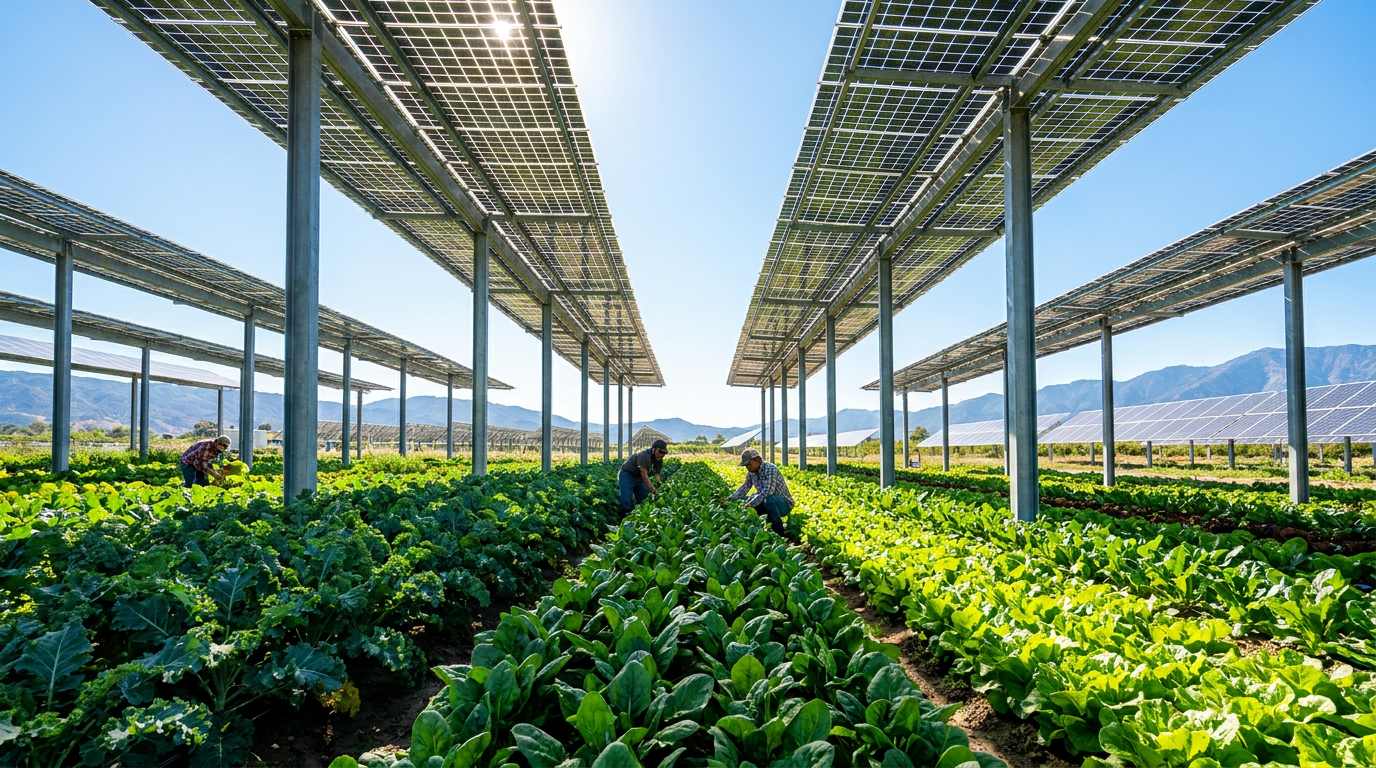
Instead of treating food and energy as competitors, agrivoltaic systems elevate solar panels several meters above the ground or space them widely apart in carefully calculated rows. This specialized architecture allows standard agricultural machinery, including tractors and combine harvesters, to navigate the fields safely, while crops grow in the dappled light beneath the arrays. The panels can even be mounted on dynamic tracking systems that tilt throughout the day, optimizing solar capture while ensuring the plants below receive the precise amount of sunlight required for their specific growth stage.[6]

The core mechanism driving the success of agrivoltaics is the creation of a highly efficient, regulated microclimate. By casting partial shade over the soil, the solar panels protect vulnerable crops from the brutal midday sun and shield them from extreme weather events. In an era of increasing climate volatility, this physical barrier defends delicate plants against damaging hail, torrential rainstorms that can wash away topsoil, and late-season frosts, effectively extending the viable growing season for many farmers.[3]
This shading dramatically reduces soil evaporation, a critical advantage as global temperatures rise and freshwater resources become increasingly scarce. In arid regions like the American Southwest and parts of the Mediterranean, researchers have documented water savings of 30% to 50% for crops grown under solar arrays compared to traditional open-field farming. The panels effectively trap moisture in the local environment, allowing farmers to maintain high crop yields while significantly reducing their reliance on heavily depleted groundwater aquifers and expensive irrigation systems.[2][3]
The benefits of this microclimate, however, are entirely bi-directional. While the steel and glass panels protect the biological plants below, the living plants actively cool the technological infrastructure above, solving one of the solar industry's most persistent and frustrating engineering challenges. This symbiotic relationship challenges the long-held assumption that solar panels are best suited for barren, lifeless deserts, proving instead that they actually operate most efficiently when paired with active, irrigated vegetation in traditional agricultural settings.[2][5]
Solar panels are notoriously sensitive to heat; as ambient temperatures soar during the peak of summer, their photovoltaic efficiency noticeably drops, right when grid demand for air conditioning is at its highest. But living plants continuously release moisture into the surrounding air through a natural biological process known as transpiration. As the plants breathe, they exhale water vapor, which rises and interacts with the heated surface of the solar modules mounted directly above them, fundamentally altering the thermal dynamics of the array.[5][7]

This invisible upward flow of water vapor acts as a natural, zero-carbon air-conditioning system for the solar array. Field experiments have shown that plant transpiration can lower the surface temperature of the overhead solar panels by as much as 18 degrees Fahrenheit. Because cooler panels are capable of converting a higher percentage of sunlight into usable electricity, this biological cooling effect can boost the overall electricity output of the array by up to 10%, generating significantly more revenue for the energy developer.[2][5]
This invisible upward flow of water vapor acts as a natural, zero-carbon air-conditioning system for the solar array.
To measure the overall efficiency of this dual-use system, agronomists rely on a metric called the Land Equivalent Ratio (LER). If a farm produces 100% of its normal crop yield, and a separate solar facility produces 100% of its normal energy, combining them into a single space might initially seem like a compromise that would diminish both outputs. Traditional logic suggests that sharing the sunlight would inevitably lead to a reduction in both the agricultural harvest and the electrical generation.[6]
Yet data from the Fraunhofer Institute for Solar Energy Systems and other leading research bodies reveals that agrivoltaic systems frequently achieve an LER of 1.6 or higher. This means a single hectare of dual-use land can produce 60% to 70% more total economic and energetic value than if the land were split strictly between separate, isolated farming and solar operations. It is a rare instance where the combined output of the system is substantially greater than the sum of its individual parts.[6]

Naturally, not every crop thrives in this modified environment. Sun-hungry staple crops like corn and certain varieties of wheat often see notable yield reductions when deprived of direct, full-day sunlight, making them less ideal candidates for dense agrivoltaic integration. Agronomists must carefully select the right plant varieties and calibrate the spacing of the solar panels to ensure that the specific light requirements of the crop are met, requiring a highly tailored approach for every individual farm.[4][7]
However, shade-tolerant and heat-sensitive crops—such as leafy greens, tomatoes, peppers, root vegetables, and berries—frequently exhibit increased yields and improved quality under the panels. The partial shade prevents heat stress, allowing these plants to continue photosynthesizing during the hottest parts of the afternoon when they would normally shut down to conserve water. In many cases, the produce grown under the arrays is physically larger and less prone to sun-scald than crops grown in adjacent open fields.[2][5]
Beyond traditional crop cultivation, the agrivoltaics framework is rapidly expanding to include solar grazing and ecological restoration. Sheep are increasingly deployed to manage the vegetation beneath the panels, replacing gas-powered mowers and providing a natural source of fertilizer while the animals enjoy the shade. Simultaneously, developers are planting pollinator-friendly wildflowers around the arrays to support local bee populations, which in turn enhances the yields of nearby farms and helps restore heavily degraded local ecosystems that have suffered from decades of intensive monoculture farming.[1][3]
For the agricultural sector, the financial implications of this dual-use model are profound. Farmers face increasing economic volatility from extreme weather events, prolonged droughts, and wildly fluctuating commodity prices, threatening the viability of multi-generational family farms. The profit margins in traditional agriculture are notoriously thin, leaving many rural landowners highly vulnerable to bankruptcy after a single bad harvest, a severe local drought, or an unexpected spike in the global cost of diesel fuel and chemical fertilizers.[7][8]
Leasing the vertical space above their fields for solar generation provides a stable, guaranteed, and diversified revenue stream that is entirely independent of the weather or the crop market. It allows rural families to keep their working lands operational and profitable, rather than selling them off to developers to be paved over for housing subdivisions or traditional industrial solar parks. This financial stability is crucial for preserving the cultural and economic fabric of rural farming communities, ensuring that the land remains productive for future generations.[1][8]

Despite the clear agronomic and energetic advantages, scaling agrivoltaics to a global standard presents distinct engineering, financial, and regulatory hurdles that the renewable energy industry is still working to overcome. Building a dual-use facility is inherently more complex than constructing a standard solar farm, requiring deep, ongoing collaboration between electrical engineers, agronomists, and the farmers who will ultimately work the land beneath the arrays. Every project must be custom-designed to accommodate the specific soil conditions, crop types, and machinery dimensions of the individual farm.[4]
Elevating massive solar arrays high enough to clear combine harvesters requires substantial steel infrastructure. These elevated structures act like massive sails, necessitating deep, expensive foundations to withstand heavy wind loading, which significantly increases the initial capital cost of construction compared to standard ground-mounted solar. While the long-term returns are higher due to the dual revenue streams, securing the upfront financing for these specialized, heavy-duty installations remains a significant barrier for many developers and independent farmers who lack access to large-scale institutional capital.[4][7]
Furthermore, the regulatory landscape remains highly fragmented. In Europe and the United States, only a handful of jurisdictions have established clear legal definitions for agrivoltaics, leading to bureaucratic confusion over whether dual-use lands still qualify for vital agricultural tax exemptions and farming subsidies. Without clear, standardized policies that protect the agricultural status of the land, many farmers are hesitant to adopt the technology, fearing that they will be penalized by local tax assessors for hosting commercial energy infrastructure.[4]

As policymakers work to standardize permitting and financial incentives, agrivoltaics stands out as a rare, elegant solution to the food-energy-water nexus. By mimicking the protective canopy of a natural forest, these systems prove that the urgent transition to clean energy does not have to come at the expense of the soil that feeds us. Instead of forcing rural communities to choose between harvesting the sun and harvesting their crops, agrivoltaics offers a blueprint for doing both, simultaneously and sustainably.[3][7]
How we got here
1981
The concept of combining solar energy and agriculture is first proposed by researchers at the Fraunhofer Institute in Germany.
2010s
Early pilot projects and performance studies begin demonstrating the viability of dual-use solar in France and Japan.
2021
The U.S. Department of Energy and USDA expand funding for agrivoltaics research to study crop yields and water savings.
2025-2026
Utility-scale agrivoltaic projects, generating hundreds of megawatts, begin coming online across Europe and the United States.
Viewpoints in depth
Agricultural Advocates
Prioritizing crop yields, soil health, and keeping rural lands in the hands of farmers.
For farming advocates, the primary concern is ensuring that agriculture remains the dominant use of the land. They argue that traditional solar farms have historically destroyed topsoil and displaced food production. Agrivoltaics is seen as a necessary compromise, but advocates stress that systems must be designed around the needs of the crops and the tractors, not just optimized for maximum energy output. They also push for policies ensuring that dual-use lands retain their agricultural tax status and subsidies.
Renewable Energy Developers
Focusing on scaling clean energy rapidly and overcoming land-use bottlenecks.
Energy developers view agrivoltaics as the key to unlocking vast tracts of land that would otherwise be blocked by local opposition. By partnering with farmers, they can bypass the fierce zoning battles that often stall utility-scale solar projects. However, developers point out that elevating panels and spacing them widely increases the structural costs and reduces the total megawatt density per acre. They advocate for streamlined permitting and financial incentives to offset these higher initial capital expenditures.
Climate & Ecological Scientists
Emphasizing the bi-directional benefits of water conservation and microclimate cooling.
Researchers and hydrologists focus on the profound ecological synergies of the system. They highlight the data showing that the microclimate created by the panels can reduce irrigation needs by up to 50%, a critical adaptation for drought-stricken regions. Furthermore, they emphasize the physics of transpiration cooling, noting that the plants actively improve the efficiency of the solar panels. For scientists, agrivoltaics is less about compromise and more about engineering a superior, resilient ecosystem.
What we don't know
- How the long-term presence of heavy steel infrastructure and altered rain patterns will affect deep soil health over multiple decades.
- Whether the high upfront capital costs of elevated solar arrays will become accessible to small, independent farmers without heavy government subsidies.
- How local zoning boards will ultimately standardize the classification of agrivoltaic land for tax and agricultural subsidy purposes.
Key terms
- Agrivoltaics
- The simultaneous use of land for both solar power generation and agricultural production.
- Transpiration
- The process by which moisture is carried through plants from roots to small pores on the underside of leaves, where it changes to vapor and is released to the atmosphere.
- Land Equivalent Ratio (LER)
- A metric used in agriculture to measure the relative land area required under sole cropping to produce the same yield as under a combined or intercropped system.
- Microclimate
- The local set of atmospheric conditions that differ from those in the surrounding areas, often created by shade or vegetation.
Frequently asked
Does growing crops under solar panels reduce the amount of electricity generated?
No, it often increases it. Plants release moisture that cools the solar panels, which can improve their photovoltaic efficiency by up to 10%.
Can you grow any type of crop under a solar array?
Not all crops thrive. Shade-tolerant plants like leafy greens, tomatoes, and root vegetables do very well, while sun-hungry crops like corn and wheat may see reduced yields.
How do tractors and farm machinery operate around the panels?
Agrivoltaic systems are specifically engineered with elevated mounts and wide row spacing to allow standard agricultural equipment to pass underneath and between the arrays safely.
Sources
Source coverage
8 outlets
3 viewpoints surfaced








[1]USDA Climate HubsAgricultural Advocates
Agrivoltaics: Coming Soon to a Farm Near You?
Read on USDA Climate Hubs →[2]Inside Climate NewsClimate & Ecological Scientists
In the Sweltering Southwest, Planting Solar Panels in Farmland Can Help Both Photovoltaics and Crops
Read on Inside Climate News →[3]Union of Concerned ScientistsClimate & Ecological Scientists
Agrivoltaics and Ecovoltaics: Middle-Ground Solutions for Multibenefit Land Repurposing
Read on Union of Concerned Scientists →[4]SolarplazaRenewable Energy Developers
3 hard truths about agrivoltaics in Europe
Read on Solarplaza →[5]National Renewable Energy LaboratoryClimate & Ecological Scientists
Benefits of Co-Locating Solar and Agriculture
Read on National Renewable Energy Laboratory →[6]Fraunhofer Institute for Solar Energy SystemsClimate & Ecological Scientists
Agrivoltaics: Opportunities for Agriculture and the Energy Transition
Read on Fraunhofer Institute for Solar Energy Systems →[7]Factlen Editorial TeamClimate & Ecological Scientists
Synthesis by Factlen editorial team
Read on Factlen Editorial Team →[8]Sol SystemsRenewable Energy Developers
Agrivoltaics in Action: How Sol Systems Is Rewriting the Future of Land, Energy, and Agriculture
Read on Sol Systems →
Every angle. Every day.
Get environment stories with full source coverage and perspective breakdowns delivered to your inbox.