
Media Literacy in 2026: How to Verify Digital Content and Spot AI Fakes
As synthetic media floods the internet, traditional media literacy is evolving. Here is how to identify AI-generated content, verify digital provenance, and navigate the new era of Content Credentials.
By Sergei Orlov

In short
- Automated AI detection tools are increasingly unreliable, making human observation and cryptographic provenance essential.
- Generative models still leave visual clues, such as hyper-smooth skin, asymmetrical eye reflections, and structural anomalies.
- The C2PA standard embeds tamper-evident Content Credentials into files to prove authenticity at the point of creation.
The digital reality of 2026 is fundamentally synthetic. With generative models continuously improving, synthetic content is projected to account for up to 90 percent of all online media. The line dividing digital reality from synthetic generation has completely dissolved, flooding social feeds with flawless portraits, hyper-realistic travel captures, and conceptual illustrations.
For everyday users, knowing how to verify digital content is no longer a niche technical hobby for graphic designers—it has transformed into a foundational media literacy requirement. Navigating this landscape requires a new set of skills, blending traditional critical thinking with an understanding of modern cryptographic verification.[1]
For years, the primary defense against digital deception was automated AI detection tools. Users would upload a suspicious image or text block to an algorithmic sniffer, hoping for a definitive verdict. However, these detection-only approaches are increasingly viewed by cybersecurity experts as a losing battle.
Algorithmic detectors routinely struggle with false positives, often flagging authentic photos that feature aggressive color grading, custom camera filters, or traditional compression artifacts. As generative models evolve and their outputs become indistinguishable from reality, relying solely on software to catch software is no longer a sustainable or sufficient strategy.[1]
Instead, human observation remains one of the most reliable lines of defense against synthetic media. While premium models constantly push updates to resolve architectural limitations, generative software still leaves behind micro-anomalies where the underlying rendering math breaks down. By understanding exactly where these systems struggle, users can spot synthetic creations instantly without running a digital script. Training your eyes to recognize structural physical consistency provides an immediate analytical edge when scrolling through unverified social media feeds or evaluating questionable news assets.[1]
The most common visual giveaway in 2026 is the 'airbrushed uncanny' finish. Authentic human skin features natural variations, including fine lines, asymmetry, visible pores, scars, and micro-hairs. Generated faces, particularly those from basic prompts or lower-tier models, often look completely smooth, resembling polished wax figurines or airbrushed video game characters. The highlights on cheeks and foreheads frequently look unnaturally metallic, bouncing light in ways that break real-world physics. Understanding how to navigate this over-processed look is a critical first step in visual verification.[1]
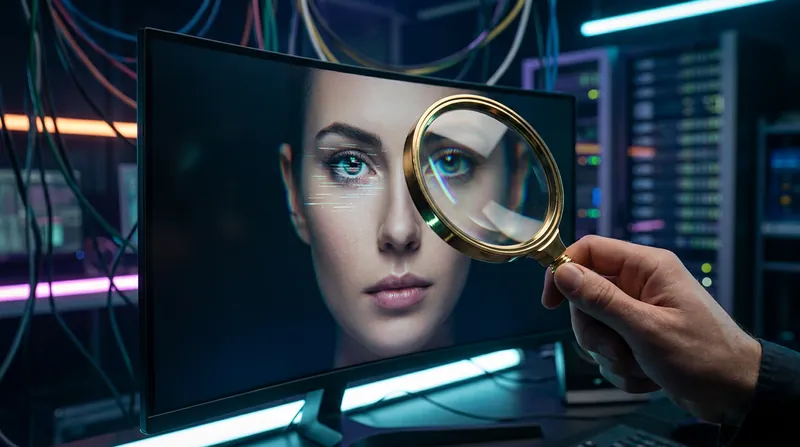
Eyes offer another critical clue, exposing the blind spots of data processing engines. Because generative systems often process each eye as an independent cluster of pixels rather than a unified physical object, they frequently produce asymmetrical iris corruptions. In a real photograph, a single environmental light source casts identical catchlights—tiny white reflections—across both eyes simultaneously. In synthetic images, these reflections are often mismatched, pointing in different directions, or entirely 'dead.' Zooming into the center of the pupils to check these catchlights is a highly effective manual verification technique.[1]
Structural anomalies also persist in complex textures and background elements. AI still struggles with overlapping objects, frequently resulting in extra fingers, limbs that blend awkwardly into shoulders, or complex patterns like lace dissolving into neighboring skin. Furthermore, text in the background of AI-generated images often appears as nonsensical symbols or misspelled words. The model attempts to replicate the visual shape of language without actually understanding its meaning, resulting in street signs, t-shirts, or background documents that look like alien script upon closer inspection.[1]
While visual inspection is crucial, the technology industry is fundamentally shifting its approach from detecting fakes after the fact to proving authenticity at the point of creation. This paradigm shift is driven by the Coalition for Content Provenance and Authenticity (C2PA), an open technical standard that embeds verifiable provenance metadata directly into digital files. Rather than trying to guess if an image is fake, C2PA allows creators to cryptographically prove that an image is real, establishing a tamper-evident chain of custody from the moment of capture.
Known to consumers as 'Content Credentials,' this system acts like a secure digital shipping label. It uses cryptographic hashing and digital certificates to record who created the content, when it was captured, what editing tools were used, and whether artificial intelligence was involved at any stage. Anyone with a compliant viewer can verify this manifest offline, without relying on a central database. If the file is maliciously altered, the cryptographic seal breaks, immediately alerting the viewer that the provenance data is no longer valid.
By 2026, hardware adoption of the C2PA standard has accelerated significantly. Consumer devices like the Google Pixel 10 now sign every photo by default using hardware-backed security chips, providing an accessible way for everyday users to capture cryptographically verified images. Professional camera manufacturers, including Leica and Sony, have also integrated C2PA support directly into their flagship models. This hardware-level integration ensures that the authenticity chain begins the exact millisecond light hits the camera sensor, making it exponentially harder for bad actors to spoof the origin of a photograph.
Regulatory momentum is accelerating this transition across the global internet. The European Union's AI Act, which takes full effect in August 2026, imposes strict transparency obligations, requiring all AI-generated content to carry machine-readable labels. Major AI generators, including OpenAI's DALL-E 3, Adobe Firefly, and Google Imagen, now automatically embed Content Credentials identifying their outputs as synthetic, directly satisfying these new legal requirements. This regulatory pressure is forcing social media platforms and content networks to standardize how they handle and display provenance data, moving the industry toward a more transparent ecosystem.
Despite its immense promise, C2PA is not a flawless shield against misinformation. The standard faces a persistent vulnerability known as a 'strip attack.' Because many social media platforms and non-compliant editing software still strip metadata during routine image compression, a file can easily lose its Content Credentials upon upload.
Crucially, the absence of a manifest does not prove an image is fake; it simply means the file lacks verifiable provenance. The vast majority of legitimate, older content on the internet does not carry these credentials, meaning users cannot rely on their absence as proof of deception.
There is also a significant public perception problem surrounding the rollout of these new tools. Early in 2026, industry analyses revealed that many users fundamentally misunderstood the Content Credentials icon, mistakenly assuming it marked an image as an 'AI fake' rather than certifying it as an authentic photograph. Without widespread public education campaigns, authenticity labels risk being misread by the general public, achieving the exact opposite of their intended outcome. The technology is only as effective as the user's ability to correctly interpret it.[4]
Because technological solutions remain imperfect and adoption is still ongoing, traditional media literacy skills are more vital than ever. Educators and fact-checkers emphasize the critical practice of 'lateral reading'—leaving the suspicious article or image to cross-check the claim across multiple reputable sources.
Rather than trusting a single viral post or an emotionally charged video, users are encouraged to open a new tab and search for corroborating evidence from established news organizations, academic institutions, or official government portals. This simple act of verifying information laterally breaks the echo chamber effect and grounds the user in verified reality.[2][3]
The classic 'CRAAP Test'—evaluating Currency, Relevancy, Authority, Accuracy, and Purpose—remains a cornerstone of digital literacy, perfectly adapted for the AI age. Users must question the source of the information, investigate the author's credentials, and consider whether the content is designed to inform or merely to provoke an angry or anxious reaction. Misinformation thrives on speed and emotion; taking a deliberate pause before sharing or reacting to a piece of content is often the most effective defense against digital manipulation.[2][3]
Ultimately, navigating the 2026 digital landscape requires a hybrid, multi-layered approach. By combining a skeptical human eye for rendering glitches with an understanding of cryptographic Content Credentials and rigorous lateral reading habits, users can confidently separate fact from fiction.
In an era where seeing is no longer believing, informed observation and critical thinking are the most powerful tools for digital self-defense, empowering individuals to consume media safely and responsibly. As synthetic media becomes ubiquitous, these skills ensure that technology serves as a tool for creativity rather than a vector for deception.[3][4]
Terms to know
- C2PA
- The Coalition for Content Provenance and Authenticity, an open technical standard that embeds verifiable metadata into digital files.
- Content Credentials
- The consumer-facing name for C2PA manifests, acting as a tamper-evident digital shipping label that records the origin and edit history of a media file.
- Lateral Reading
- The practice of verifying information by leaving the original source and cross-checking claims across multiple reputable websites.
- Strip Attack
- The intentional or accidental removal of cryptographic metadata from a file, often occurring when images are compressed during social media uploads.
- Catchlights
- The tiny white reflections of environmental light sources visible in a subject's eyes, which are often rendered asymmetrically by AI generators.
Questions readers ask
Does a missing Content Credential mean an image is fake?
No. The vast majority of legitimate, older content on the internet does not carry Content Credentials. A missing credential simply means the file lacks verifiable provenance data.
Can AI detectors reliably spot fake images?
Automated detectors are increasingly unreliable. They frequently flag authentic photos as fake (false positives) and struggle to keep pace with the rapid improvements in generative AI models.
What is lateral reading?
Lateral reading is a media literacy technique where you leave a suspicious article or post and open new tabs to cross-check the claim across multiple reputable sources.
Different angles
Media Literacy Educators
Emphasize critical thinking and human verification skills over purely technological solutions.
Educators argue that technology alone cannot solve the misinformation crisis, especially since metadata is frequently stripped during social media uploads. They advocate for teaching 'lateral reading' and the CRAAP test, noting that human judgment and critical thinking remain the ultimate filter when cryptographic provenance is unavailable or misunderstood.
Provenance Technologists
Advocate for cryptographic standards to prove authenticity at the source.
Technologists view post-creation AI detection as a losing battle against exponentially improving generative models. Instead, they advocate for a 'zero-trust' digital environment where authenticity must be cryptographically proven at the point of capture. By embedding tamper-evident Content Credentials into files via hardware, they aim to create a secure chain of custody that bad actors cannot easily spoof.
Digital Forensics Analysts
Focus on identifying structural anomalies and rendering glitches left behind by generative models.
Forensics experts maintain that despite rapid advancements, generative AI still operates on mathematical approximations that break down under close scrutiny. They focus on training users to spot micro-anomalies—such as asymmetrical catchlights, hyper-smooth skin textures, and contradictory shadows—arguing that the human eye's understanding of physical consistency is currently more reliable than automated algorithmic sniffers.
- Media Literacy Educators
- Emphasize critical thinking, lateral reading, and human verification skills over purely technological solutions.
- Provenance Technologists
- Advocate for cryptographic standards to prove authenticity at the source, arguing detection is a losing battle.
- Digital Forensics Analysts
- Focus on identifying structural anomalies and rendering glitches left behind by generative models.
Perspectives this story doesn't cover
- Social Media Platform Moderators
- Generative AI Model Developers
Sources
Source coverage
4 outlets
3 viewpoints surfaced



- [1]Global Tech TalesDigital Forensics Analysts
How to Tell if Image is AI: 9 Shocking Glitches
Read on Global Tech Tales → - [2]KQED TeachMedia Literacy Educators
Evaluating Online Sources: Checking Facts and Identifying Misinformation
Read on KQED Teach → - [3]ConnectSafelyMedia Literacy Educators
Quick Guide to Misinformation & Media Literacy
Read on ConnectSafely → - [4]Factlen Editorial TeamMedia Literacy Educators
Synthesis by Factlen editorial team
Read on Factlen Editorial Team →

More in Content Types
See all →Digital Literacy
How to Verify Information in the AI Era: A Plain-English Guide to Lateral Reading
5 sources

Digital Literacy
How to Spot AI-Generated Images in 2026: A Guide to Modern Fact-Checking
4 sources
Knowledge Management
How to Build an AI-Powered 'Second Brain' to Master Meta-Learning
2 sources

Developer Experience
Prescribing Linear Steps Without Decision Branches: Why the Diátaxis Framework Isolates Tutorials From How-To Guides
4 sources

Comments
Every angle. Every day.
Get Content Types stories with full source coverage and perspective breakdowns, free every day.