
How the 'Banana Flick' Rewrote the Rules of Modern Table Tennis
Once a niche trick shot, the heavily spun backhand receive known as the Chiquita has fundamentally transformed table tennis strategy, neutralizing the traditional service advantage and accelerating the pace of the modern game.
By Omar Haddad

For decades, the geometry of a table tennis match was governed by a strict, unspoken treaty: the server held the absolute advantage. Because a serve could be kept short—bouncing twice on the opponent's side of the table—the receiver was physically prevented from taking a full, aggressive swing. The table itself was in the way. The only reliable response was a passive "push," a gentle underspin shot designed merely to keep the ball in play and wait for a better opportunity.[1]
This dynamic made the sport heavily reliant on the third-ball attack. The server would execute a tricky short serve, wait for the inevitable passive push return, and then unleash a massive forehand loop to win the point. It was a chess match where white always had the first two moves, and defensive players were forced to survive a barrage of calculated aggression before they could even think about scoring.[2]
That paradigm began to fracture in the late 1990s thanks to a Czech player named Petr Korbel. Facing the relentless short serves of his opponents, Korbel experimented with a radical biomechanical solution. Instead of pushing the ball, he stepped deep into the table, dropped his racket tip straight down toward the floor, and violently snapped his wrist upward and over the ball.
The resulting shot was entirely alien to the sport. The extreme wrist action imparted heavy topspin and sidespin, causing the ball to arc sharply over the net and curve laterally through the air. Because the trajectory resembled the shape of a banana, the shot was affectionately dubbed the "Chiquita," or the banana flick. At the time, it was viewed as a brilliant but risky trick shot—a crowd-pleaser rather than a foundational tactic.
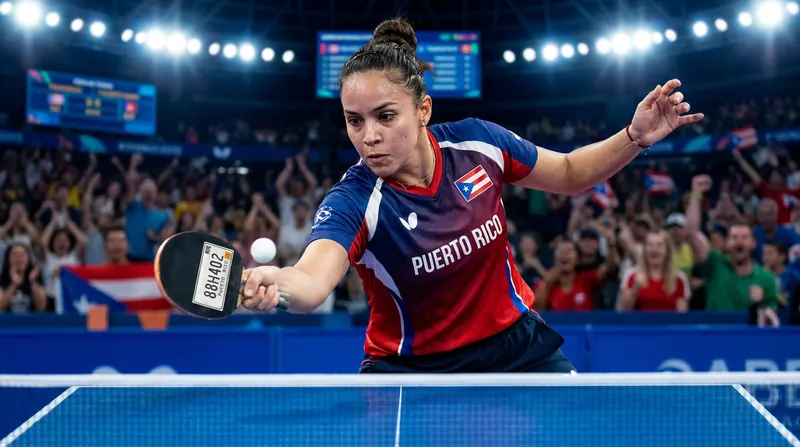
To understand why the Chiquita is so devastating, one must look at the physics of the stroke. The technique requires extreme forearm supination and wrist flexion. By contorting the arm, the player creates artificial space over the table, allowing for a miniature but explosive swing. The racket brushes the ball at high velocity, generating upwards of 3,000 revolutions per minute of spin.
This massive rotational energy engages the Magnus effect, a physical phenomenon where a spinning object creates a pressure differential in the air around it. The topspin forces the ball to dive sharply downward after crossing the net, allowing players to hit the ball with immense power while still guaranteeing it will land safely on the table. The sidespin adds a secondary layer of complexity, making the ball kick unpredictably off the opponent's racket.
Despite its potential, the Chiquita remained a secondary weapon until the emergence of Chinese superstar Zhang Jike in the early 2010s. Zhang did not just use the banana flick as a surprise tactic; he weaponized it as his primary method of receiving serves. He possessed the explosive core strength and wrist flexibility to execute the shot from almost anywhere on the table, completely neutralizing the traditional service advantage.[2]
Suddenly, serving short was no longer a safe haven. If a server placed the ball short, Zhang would step in and launch a Chiquita, instantly taking control of the rally. The server, expecting a passive push, was suddenly forced onto the defensive. The "third-ball attack" was effectively hijacked by the receiver, turning the foundational logic of table tennis upside down.[2][3]
This tactical earthquake forced a massive shift in footwork and table coverage. Historically, players stood slightly to their backhand side, looking to pivot and use their more powerful forehand to cover the majority of the table. But the Chiquita requires the backhand. To utilize it effectively, players began shifting their ready position toward the middle, prioritizing backhand dominance.[3]
The next generation of elite players, such as China's Fan Zhendong and Chinese Taipei's Lin Yun-ju, took this evolution to its logical extreme. They developed the ability to execute the banana flick not just from the backhand corner, but from the middle and even the deep forehand side of the table. Today, elite players cover up to 70% of the table with their backhand during the receive phase.[2]
This strategic revolution was inadvertently accelerated by a major equipment change in 2014. The International Table Tennis Federation (ITTF) mandated a switch from celluloid balls to plastic balls, and slightly increased the diameter to 40+ millimeters. The new plastic balls were slightly heavier and less porous, which fundamentally reduced the amount of spin that could be generated.[1]
While traditionalists lamented the loss of spin, the plastic ball was a massive boon for the Chiquita. With less spin on the incoming serve, receivers found it much easier to "read" the ball and grip it with their own rubber. The reduced incoming spin meant they could swing harder and impart their own topspin with less fear of the ball flying unpredictably off the racket.[1][3]
Simultaneously, rubber technology evolved to support this aggressive style. Manufacturers developed high-tension "tensor" rubbers, which feature a stretched topsheet and a porous, spring-like sponge. These rubbers provide a catapult effect, allowing players to generate massive speed and spin even with the highly abbreviated swing required when reaching over the table.[1]
The sport is now in a phase of counter-evolution. Because serving short is so frequently punished by the banana flick, servers are adapting. There is a resurgence of fast, deep serves designed to jam the receiver and prevent them from stepping in. Alternatively, servers are targeting the extreme wide forehand, forcing the receiver to stretch uncomfortably and making the backhand flick geometrically impossible.[3]
We are also seeing the rise of the "strawberry flick," a reverse-pendulum variation of the Chiquita that curves in the opposite direction, adding yet another layer of complexity to the short game. The arms race between server and receiver continues, driven by the relentless pursuit of microscopic biomechanical advantages.[3]
What began as a creative experiment by a single player has trickled down to every level of the sport. Today, junior players are taught the mechanics of the banana flick before they even master traditional defensive pushes. It stands as a testament to the beautiful, ever-evolving nature of sports—where a simple shift in wrist angle can rewrite the rulebook and propel a game into a faster, more thrilling future.[2][3]
Key points
- The Chiquita (banana flick) allows players to aggressively attack short serves over the table.
- The technique requires extreme wrist flexion to generate heavy topspin and sidespin.
- Zhang Jike popularized the shot as a primary receive in the 2010s, neutralizing the server's advantage.
- The shift forced players to adopt backhand-dominant table coverage rather than relying solely on forehands.
- The 2014 introduction of the 40+ plastic ball accelerated the adoption of the technique by reducing incoming spin.
How we got here
Late 1990s
Czech player Petr Korbel pioneers the backhand flick, earning it the 'Chiquita' nickname.
2011
Zhang Jike wins the World Championship, heavily utilizing the banana flick as his primary receive.
2014
The ITTF mandates the switch to the 40+ plastic ball, inadvertently making the flick easier to execute.
2020s
The technique achieves universal adoption, with players like Fan Zhendong covering the majority of the table with their backhand.
- Modern Professional Players
- View the technique as an absolute necessity for survival at the elite level, fundamentally shifting the game toward backhand dominance.
- Biomechanical Researchers
- Focus on the physical kinematics of the stroke, analyzing how extreme wrist flexion and modern rubber generate unprecedented rotational velocity.
- Traditionalist Coaches
- Acknowledge the stroke's effectiveness but mourn the decline of classic forehand footwork and the strategic chess match of traditional serving.
Perspectives this story doesn't cover
- Amateur players struggling to adapt to the high physical demands of the modern backhand technique
- Equipment manufacturers designing specific blade compositions to enhance the flick
Sources
Source coverage
3 outlets
3 viewpoints surfaced



- [1]International Table Tennis Federation (ITTF)Traditionalist Coaches
Evolution of Table Tennis Equipment and the 40+ Ball
Read on International Table Tennis Federation (ITTF) → - [2]Olympics.comModern Professional Players
The Backhand Revolution: How Zhang Jike and Fan Zhendong Changed Table Tennis
Read on Olympics.com → - [3]Factlen Editorial TeamModern Professional Players
Synthesis by Factlen editorial team
Read on Factlen Editorial Team →
More in Sports
See all →Standings
Kanak Jha Surges to World No. 24 in ITTF Rankings, Cementing Historic Comeback
7 sources
Standings
The Race for Men's Doubles No. 1: India's Manav Thakkar and Manush Shah Surge to Historic World No. 2
4 sources
Injury
Global Table Tennis Injury Report: Sathiyan Gnanasekaran Returns as Kristian Karlsson Battles Groin Setback
2 sources
Standings
The Race for Americas No. 1: Adriana Diaz and Bruna Takahashi Redefine the ITTF Women's Top 25
4 sources
Comments
Every angle. Every day.
Get Sports stories with full source coverage and perspective breakdowns, free every day.