
The Revival of 'Third Places': How Communities Are Designing the Antidote to Loneliness
As the loneliness epidemic deepens, urban planners and sociologists are championing the return of 'third places'—the cafes, parks, and libraries that serve as the social backbone of society.
By Factlen Editorial Team
- Mental Health & Sociology Experts
- Focusing on the psychological benefits of 'weak ties' and passive socialization.
- Urban Planners & Designers
- Advocating for physical infrastructure and zoning changes to foster community.
- Civic & Cultural Advocates
- Viewing third places as essential engines of democracy and social equality.
What's not represented
- · Commercial real estate developers
- · Remote workers
- · Digital community builders
Why this matters
With half of all adults experiencing measurable loneliness, understanding and rebuilding the physical spaces where we connect is critical for both personal mental health and the resilience of our neighborhoods.
Key points
- Third places are neutral, accessible environments outside of home and work where informal socializing occurs.
- Repeated, low-pressure interactions with familiar faces in these spaces help regulate the nervous system and reduce stress.
- Car-centric urban planning and strict zoning laws have contributed to the decline of walkable community hubs.
- Urban designers are now prioritizing mixed-use spaces and public seating to foster natural, unforced human connection.
The modern paradox of hyper-connection is that we have never been more digitally linked, yet a profound sense of isolation permeates modern life. In 2023, the U.S. Surgeon General declared a national epidemic of loneliness, noting that roughly one in two American adults report experiencing measurable social isolation. This isn't merely a fleeting emotional state; researchers and public health officials increasingly recognize loneliness as a systemic crisis with severe physical consequences. Studies have equated the health risks of prolonged social isolation to smoking 15 cigarettes a day. While the instinct is often to treat loneliness as a personal failure or a psychological hurdle to be overcome with therapy, urban planners and sociologists are pointing to a structural culprit: the quiet disappearance of the physical spaces where communities naturally gather.[4][5][6]
To understand what we have lost, we have to look at the geography of our daily lives. In 1989, American sociologist Ray Oldenburg coined a framework that divided human environments into three distinct realms. The "first place" is the home, the private sanctuary where we rest and live with family. The "second place" is the workplace or school, characterized by productivity, hierarchy, and structured expectations. But a healthy society, Oldenburg argued, relies on the existence of a robust "third place." These are the neutral, accessible environments where people gather simply for the joy of good company, free from the obligations of domestic life or the performance metrics of the office.[2][3][4]
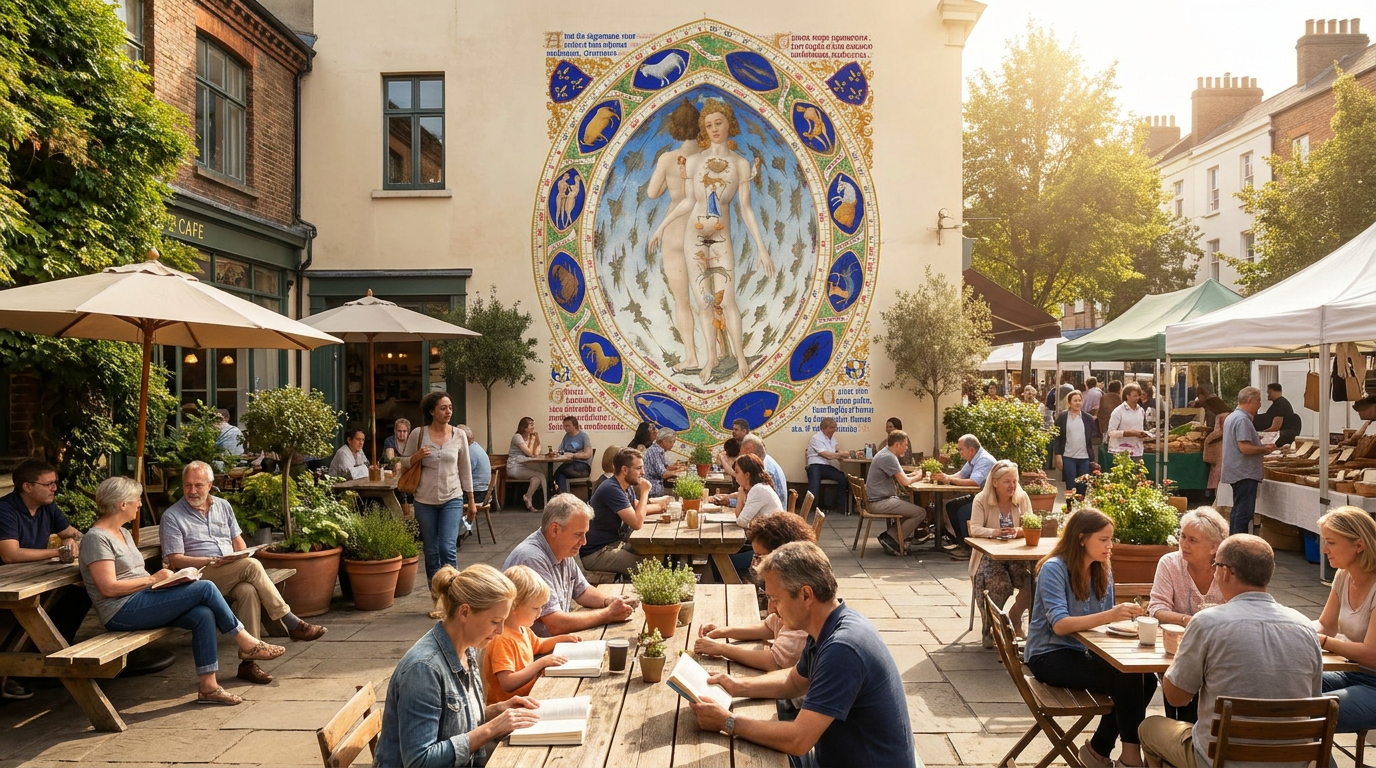
Historically, third places have been the living rooms of society. They took the form of English pubs, French cafés, American barbershops, public libraries, and neighborhood stoops. According to Oldenburg and his co-author Karen Christensen, true third places share several non-negotiable characteristics. They are neutral ground where anyone can enter without an invitation, and they act as a "leveler" where social status, job titles, and economic class are temporarily suspended. In these spaces, conversation is the primary activity, and a core group of "regulars" sets a welcoming tone that makes newcomers feel instantly at ease.[2][3][4]

The psychological benefits of these informal gathering spots are profound, operating largely through what sociologists call "weak ties." You do not need to be close friends with the barista, the person reading on the adjacent park bench, or the regular at the local diner for them to positively impact your mental health. Mental health clinicians note that repeated exposure to familiar faces in a low-pressure environment helps regulate the human nervous system. It provides a passive sense of belonging that requires no scheduling, no optimization, and no performative socializing. You are simply allowed to exist as a human among other humans.[5][6]
However, the infrastructure that supports these casual interactions has been steadily dismantled over the past few decades. Suburban sprawl, car-centric urban planning, and the rise of big-box retail have hollowed out the human-scale architecture of many neighborhoods. Zoning laws in many municipalities strictly separate residential areas from commercial ones, making it illegal to open a corner café or a neighborhood pub within walking distance of homes. Consequently, socializing has transformed from a natural byproduct of daily life into a scheduled task that requires a car, a calendar invite, and often, a significant expenditure of money.[1][5][8]
However, the infrastructure that supports these casual interactions has been steadily dismantled over the past few decades.
The commercialization of public life has further complicated the survival of genuine third places. While coffee shops have proliferated, many operate on a model of rapid turnover and digital isolation, where patrons stare at laptops through noise-canceling headphones rather than engaging in the banter Oldenburg envisioned. Furthermore, as gentrification drives up commercial rents, the mom-and-pop diners, local bookstores, and community centers that traditionally served as inclusive third places are frequently priced out of existence. When a neighborhood loses these accessible venues, it loses its social backbone, leaving residents with fewer places to connect outside of their immediate social circles.[2][7][8]
This architectural shift has driven a measurable decline in social interaction. Between 2014 and 2019, the amount of time Americans spent socializing with friends dropped by 37 percent, a trend that was violently accelerated by the COVID-19 pandemic. As physical spaces closed, people retreated into their first places and attempted to replace the third place with digital alternatives. Social media platforms, multiplayer video games, and online forums promised a virtual public square, and for some marginalized groups, they provided vital lifelines of connection.[3][4][8]

Yet, experts caution that the internet is a fundamentally flawed substitute for physical community. While digital platforms can facilitate shared interests, they lack the embodied presence required to fully alleviate loneliness. Sociologists point out that the internet allows us to curate our interactions and retreat into echo chambers, whereas a physical third place forces us to share space with people who are different from us. The casual friction of bumping into a neighbor, making eye contact, and sharing a spontaneous laugh cannot be replicated through a screen, and the absence of these micro-interactions leaves our nervous systems starved for genuine connection.[4][5]
Recognizing this crisis, a growing movement of urban designers, public health advocates, and civic leaders is actively working to revive the third place. The Brookings Institution highlights that stabilizing neighborhoods requires intentional investment in social infrastructure, urging cities to rethink zoning laws to allow for mixed-use development. By permitting small-scale commercial and community spaces to exist within residential neighborhoods, cities can create walkable environments where third places can naturally take root and thrive.[1][8]
Innovative urban design is also focusing on the concept of "proximity without pressure." Catherine Barratt, an expert in outdoor urban spaces, emphasizes that public infrastructure like parks, courtyards, and street furniture must be designed to allow people to sit near one another comfortably without feeling forced to interact. Well-designed public seating, clear sightlines, and accessible layouts invite people to linger, transforming a simple thoroughfare into an ecosystem of belonging. When public spaces are treated as vital infrastructure rather than aesthetic afterthoughts, they become the free, inclusive third places that communities desperately need.[6][8]

Libraries are emerging as the unsung heroes of the modern third-place revival. As one of the few remaining indoor spaces where people can exist without the expectation of spending money, libraries have evolved far beyond book repositories. They are hosting community classes, providing free Wi-Fi, and serving as safe havens for teenagers, remote workers, and retirees alike. In university settings, student centers and campus cafes are being intentionally designed to foster the chance encounters and habitual meetups that anchor young adults to their communities.[7][8]

Ultimately, the revival of the third place is not just an architectural challenge; it is a cultural shift toward valuing informal connection. It requires a collective recognition that efficiency and privacy, while valuable, cannot be the sole organizing principles of our cities and towns. By protecting existing community hubs, advocating for walkable neighborhoods, and simply choosing to put down our phones and become "regulars" in our own communities, we can rebuild the social fabric. The antidote to the loneliness epidemic isn't just trying harder to make friends—it is building the spaces where friendship is allowed to happen.[4][5][8]
How we got here
1989
Sociologist Ray Oldenburg publishes 'The Great Good Place', coining the term 'third place'.
Mid-20th Century
Suburban sprawl and car-centric zoning begin to physically separate commercial and residential spaces.
2020-2022
The COVID-19 pandemic forces the closure of physical gathering spaces, accelerating digital isolation.
2023
The U.S. Surgeon General issues an advisory declaring loneliness a public health epidemic.
2026
A growing movement of urban planners and civic leaders actively redesign neighborhoods to prioritize accessible community hubs.
Viewpoints in depth
Urban Planners & Designers
Advocating for physical infrastructure and zoning changes to foster community.
This camp argues that the loneliness epidemic is fundamentally a structural problem, not just a psychological one. They point to zoning laws that separate commercial and residential areas, car-centric infrastructure, and the privatization of public space as the primary drivers of isolation. Their proposed solutions involve mixed-use zoning, walkable neighborhoods, and the intentional design of public seating that allows for 'proximity without pressure.'
Mental Health & Sociology Experts
Focusing on the psychological benefits of 'weak ties' and passive socialization.
Sociologists and clinicians emphasize that human nervous systems require regular, low-stakes interaction to feel secure. They argue that 'weak ties'—the familiar faces we see at cafes or parks—provide a critical buffer against stress and depression. This perspective often highlights the limitations of digital connection, noting that while online communities offer shared interests, they lack the embodied presence necessary to fully alleviate the physical symptoms of loneliness.
Civic & Cultural Advocates
Viewing third places as essential engines of democracy and social equality.
For civic advocates, the decline of the third place is a threat to democratic society itself. They focus on the 'leveling' effect of these spaces, where people of different economic classes and backgrounds can interact as equals. This camp champions the preservation of free public spaces like libraries and parks, warning that the over-commercialization of socializing prices out marginalized groups and deepens societal polarization.
What we don't know
- How the widespread adoption of permanent remote work will permanently alter the geographic distribution of third places.
- Whether commercial spaces can remain inclusive third places amidst rising real estate costs and gentrification.
- The long-term effectiveness of digital and virtual reality communities in replicating the nervous-system benefits of physical presence.
Key terms
- Third Place
- A social environment separate from home and work where people gather informally to enjoy companionship.
- Weak Ties
- Casual acquaintances or familiar faces in a community who provide a sense of belonging without the demands of close friendship.
- Proximity without pressure
- An urban design concept where seating and spaces allow people to be near others comfortably without forced interaction.
- Social Infrastructure
- The physical places and organizations that shape the way people interact and build community.
Frequently asked
What is the difference between a third place and a public space?
A public space is simply a physical geography open to the public, like a sidewalk. A third place has a specific culture of regulars, warmth, and conversation that makes people feel they belong.
Do I have to be an extrovert to benefit from third places?
No. Sociologists note that simply being around familiar faces and experiencing 'proximity without pressure' helps regulate the nervous system, even if you don't actively converse.
Are online communities considered third places?
While online forums offer shared interests and connection, experts argue they lack the embodied physical presence required to fully alleviate the physiological symptoms of loneliness.
Sources
Source coverage
8 outlets
3 viewpoints surfaced








[1]Brookings InstitutionUrban Planners & Designers
Third places build communities
Read on Brookings Institution →[2]UNESCOCivic & Cultural Advocates
Third places, true citizen spaces
Read on UNESCO →[3]WikipediaMental Health & Sociology Experts
Third place
Read on Wikipedia →[4]Newport HealthcareMental Health & Sociology Experts
What Is a 'Third Place' for Social Connection?
Read on Newport Healthcare →[5]Light On AnxietyMental Health & Sociology Experts
Rebuilding third spaces starts small
Read on Light On Anxiety →[6]FurnitubesUrban Planners & Designers
Understanding third places: A conversation with Catherine Barratt
Read on Furnitubes →[7]Boston UniversityMental Health & Sociology Experts
Why Third Places Are Important
Read on Boston University →[8]Factlen Editorial TeamCivic & Cultural Advocates
Synthesis by Factlen editorial team
Read on Factlen Editorial Team →
Every angle. Every day.
Get lifestyle stories with full source coverage and perspective breakdowns delivered to your inbox.