
Why Millions Are Retreating to the 'Cozy Web' and Cultivating Digital Gardens
Exhausted by algorithmic feeds and the hostile 'Dark Forest' of public social media, a growing movement of users is reclaiming the internet through private group chats and interconnected, slow-paced personal websites.
By Factlen Editorial Team
- Digital Gardeners
- Advocates for personal knowledge management and slow, intentional internet use.
- Slow Web Advocates
- Technologists and philosophers pushing back against the speed and commodification of the modern web.
- Platform Skeptics
- Critics who believe the public internet has become a 'Dark Forest' dominated by bots and surveillance.
What's not represented
- · Social media platform executives
- · Advertisers reliant on algorithmic feeds
Why this matters
The era of the public social media square is fracturing. Understanding this shift reveals how the next generation of the internet is being built not by massive corporations, but by individuals choosing intentionality, privacy, and ownership over viral engagement.
Key points
- Users are abandoning public social media feeds for private, gatekept communities known as the 'Cozy Web.'
- The 'Dark Forest' theory suggests the open internet is now too hostile and bot-driven for authentic human connection.
- Digital gardens are replacing traditional chronological blogs with interconnected, continuously updated knowledge spaces.
- The broader 'Slow Web' movement advocates for technology that respects human pacing and data ownership.
- Tools featuring bi-directional linking, like Obsidian, are powering this new wave of personal digital curation.
For the better part of a decade, the public internet has felt increasingly hostile. Between algorithmic feeds optimized for outrage, the proliferation of generative AI spam, and the relentless creep of surveillance capitalism, the open web has transformed into what technologists now commonly refer to as a "Dark Forest." This shift has fundamentally altered how people behave online, driving a mass exodus away from the sprawling public squares of legacy social media.[3][8]
The Dark Forest theory of the internet, coined by Kickstarter co-founder Yancey Strickler and popularized by sci-fi author Liu Cixin's Fermi paradox metaphor, posits that the public web is full of predatory actors—trolls, bots, and attention-harvesting algorithms. To survive in such an environment, internet users learned to stay silent, masking their true selves or retreating entirely to avoid unwanted attention.[3]
But in 2026, a vibrant counter-culture has fully blossomed. Rather than simply logging off in defeat, millions of users are actively migrating to alternative digital spaces that prioritize intimacy, intentionality, and data ownership. This is not a rejection of the internet, but a rejection of its current commercialized architecture.[1][8]
The first stage of this retreat was the "Cozy Web." Coined by writer Venkatesh Rao, the Cozy Web refers to the private, gatekeeper-bounded spaces we have all retreated to over the last few years. It is the digital equivalent of a dimly lit coffee shop or a comfortable living room couch, shielded from the glare of the public street.[3][4]

This is the realm of Discord servers, private Slack channels, Telegram group chats, and invite-only forums. It is an informal, untracked, messily human space that bots and engagement algorithms have not yet infiltrated. In these environments, the architecture of the platform dictates a slower, more deliberate pace of interaction.[3][4]
In the Cozy Web, the pressure to perform for a massive, invisible audience evaporates. Users can share half-formed thoughts, niche memes, and genuine vulnerabilities because they know exactly who is in the room. The psychological safety provided by these gated communities has made them the primary social engine for a growing demographic of internet users.[3]
However, while the Cozy Web offers safety, it is inherently ephemeral. Group chats are rapid streams of consciousness that wash away yesterday's brilliant insights as soon as someone posts a new link. To solve this problem of digital amnesia, the internet's most forward-thinking users have revived and modernized an older concept: the Digital Garden.[8]
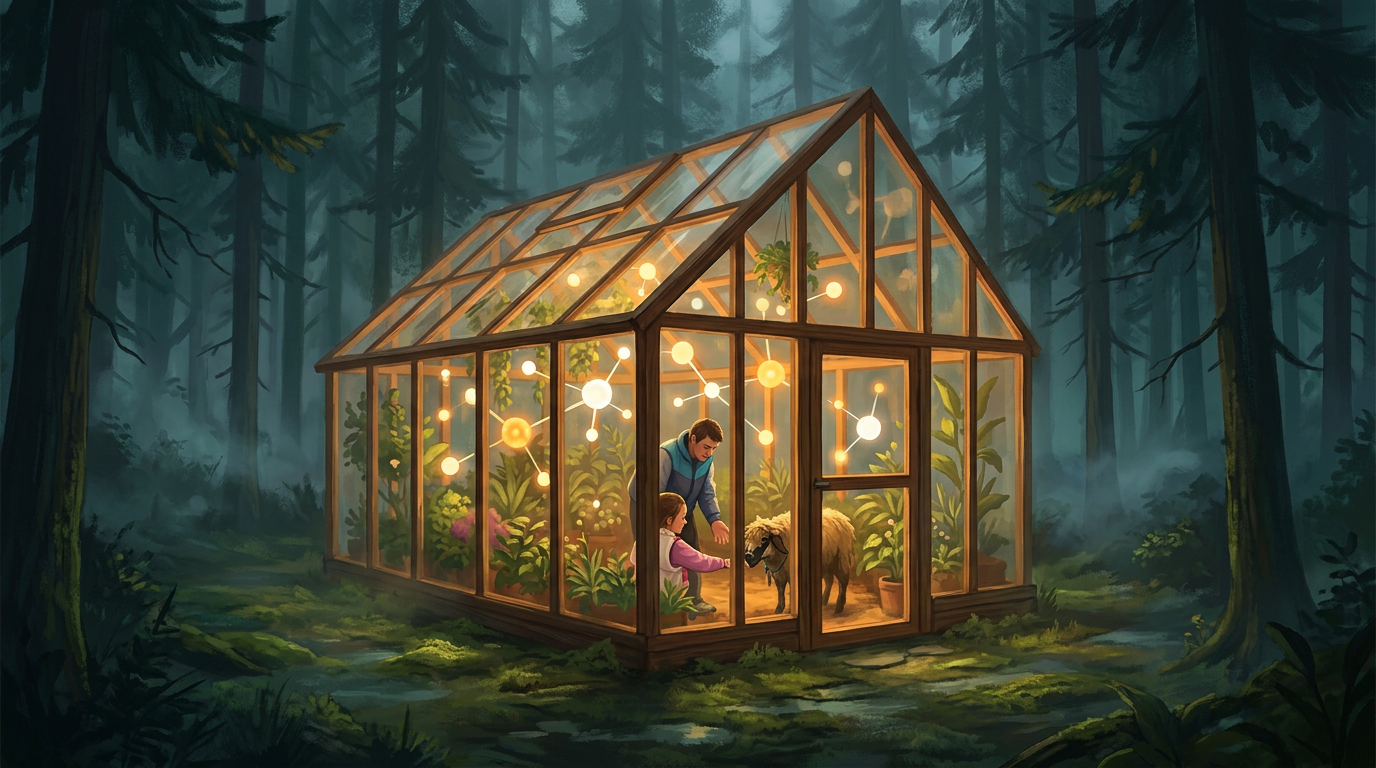
If the Cozy Web is where we hide, the Digital Garden is where we cultivate. A digital garden is a personal website, but it operates on completely different principles than a traditional blog or a social media feed. It is a space designed for the slow accumulation of knowledge rather than the rapid broadcasting of hot takes.[2][4]
If the Cozy Web is where we hide, the Digital Garden is where we cultivate.
Blogs are strictly chronological; they demand a constant stream of new, polished content, inevitably pushing older posts into obscurity at the bottom of a feed. Digital gardens, by contrast, are topological. They are non-linear, continuously evolving spaces where ideas can grow organically, unconstrained by the pressure of time or publication dates.[2]
Designer and anthropologist Maggie Appleton, a leading voice in this movement, visualizes the digital garden as a space that helps users move away from time-bound streams and into contextual knowledge spaces. It is a rejection of the idea that an online thought must be a finished product the moment it is published.[4]
In a digital garden, a user might publish a "seedling" note—a rough, unpolished thought about a book they are reading or a concept they are exploring. Over months, as they learn more, they return to that note, editing and expanding it until it eventually becomes an "evergreen" essay. The process is transparent, inviting readers to watch ideas mature.[4][7]

This practice of "learning in public" removes the friction of perfectionism. It allows individuals to build a personal wiki of interconnected thoughts, often using tools like Obsidian, Roam Research, or Notion. These tools feature bi-directional linking, automatically connecting related concepts and creating a visual, navigable graph of the user's own mind.[2][7]
The rise of digital gardening is the crown jewel of the broader "Slow Internet Movement." Much like the Slow Food movement pushed back against the industrialization of fast food, Slow Web advocates are pushing back against fast, disposable, algorithmically sorted content that prioritizes engagement over nourishment.[5][6]
The Slow Web Initiative, a think tank dedicated to this ethical renaissance, argues that technology should respect a user's inner pace. They advocate for an internet that acts as a silent observer and coach, rather than a frantic conductor demanding constant attention through notifications and infinite scrolls.[5]

This ethos is manifesting in surprising ways across broader internet culture. In 2026, "mega slow" content has ironically become a viral trend in its own right. Creators are deliberately embracing extreme slowness—posting long, unedited, unhurried videos or writing deep-dive essays that require deep, focused reading.[6][8]
Audiences, exhausted by the overstimulation of short-form video and rapid-fire discourse, are rewarding this unhurried authenticity. They crave clarity, craftsmanship, and calm, proving that there is a massive, underserved market for digital spaces that do not actively try to hijack the human nervous system.[6]
The underlying infrastructure of the web is also shifting to support this cultural change. We are seeing a massive resurgence of hand-coded HTML sites on platforms like Neocities, and even experimental art projects like solar-powered web servers that only operate during daylight hours, enforcing a natural, planetary rhythm on digital consumption.[8]
Ultimately, the shift toward the Cozy Web and Digital Gardens is about reclaiming agency. It is a joyful, constructive rejection of the idea that we must be passive consumers of corporate algorithms, and a return to the weird, wonderful, and deeply personal internet of the past—rebuilt for the future.[1][5]
How we got here
2015
Mike Caulfield introduces the concept of 'The Garden and the Stream,' contrasting algorithmic feeds with curated knowledge.
2019
Yancey Strickler publishes his essay on the 'Dark Forest' theory of the internet, and Venkatesh Rao coins the 'Cozy Web.'
2020
Designer Maggie Appleton popularizes the visual metaphors of digital gardens, sparking widespread interest in personal wikis.
2023
The Slow Web Initiative gains traction as users report record-high fatigue with algorithmic social media platforms.
2026
Digital gardens and 'mega slow' content become a dominant cultural trend, celebrated at major tech and arts festivals.
Viewpoints in depth
The Digital Gardeners
Advocates for personal knowledge management and slow, intentional internet use.
This camp views the internet not as a broadcast medium, but as a personal canvas. They argue that by moving away from algorithmic feeds and chronological blogs, users can reclaim their attention and build lasting, interconnected knowledge. For them, the friction of 'learning in public' and maintaining a personal site is a feature, not a bug, fostering genuine connection over viral metrics.
The Slow Web Movement
Technologists and philosophers pushing back against the speed and commodification of the modern web.
Drawing parallels to the Slow Food movement, this perspective argues that the current internet ecosystem is fundamentally unhealthy. They advocate for 'organic' technology that respects human pacing, limits notifications, and prioritizes user ownership of data. Their focus is on systemic ethical design rather than just individual habits, pushing for decentralized infrastructure and non-extractive business models.
Platform Skeptics
Critics who believe the public internet has become a 'Dark Forest' dominated by bots and surveillance.
This group emphasizes the hostile nature of the modern web, pointing to the rise of generative AI spam, aggressive advertising, and algorithmic radicalization. They argue that retreating to the 'Cozy Web' of private group chats and gated communities is a necessary survival tactic. In their view, the era of the open, public social square is effectively over, replaced by a need for digital self-defense.
What we don't know
- Whether digital gardens will remain a niche practice for technologists and writers, or achieve mainstream adoption.
- How legacy social media platforms will adapt their business models if the exodus to the Cozy Web continues to accelerate.
Key terms
- Digital Garden
- A personal, non-chronological website where ideas are cultivated, updated, and interconnected over time, rather than published once as a finished post.
- Cozy Web
- The private, invite-only layer of the internet, including group chats and Discord servers, where users retreat to escape the public gaze.
- Dark Forest Theory
- A metaphor suggesting the public internet is full of hostile actors (bots, algorithms, trolls), prompting real users to hide or remain silent for self-preservation.
- Bi-directional Linking
- A feature in note-taking software where linking from Note A to Note B automatically creates a return link from Note B to Note A, forming a web of knowledge.
- Slow Web Movement
- A cultural pushback against the speed and virality of modern social media, advocating for intentional, mindful, and user-controlled digital experiences.
Frequently asked
What is the difference between a blog and a digital garden?
A blog is chronological, pushing older posts down as new ones are published. A digital garden is topological and non-linear, allowing ideas to be updated, linked, and grown over time regardless of when they were first written.
What is the 'Dark Forest' theory of the internet?
It is the idea that the public internet has become hostile, filled with predatory algorithms, bots, and trolls. In response, real users stay silent or hide in private spaces to avoid unwanted attention.
How do people build digital gardens?
Many use personal knowledge management tools like Obsidian, Roam Research, or Notion, which allow for bi-directional linking between notes. Others hand-code personal websites or use specialized platforms like Are.na.
What is the Cozy Web?
Coined by Venkatesh Rao, the Cozy Web refers to the private, gatekeeper-bounded spaces of the internet, such as Discord servers, private Slack channels, and group chats, where people feel safe to be authentic.
Sources
Source coverage
8 outlets
3 viewpoints surfaced








[1]Sónar+DSlow Web Advocates
Digital Gardens and Dark Forests – alternative futures for the Internet
Read on Sónar+D →[2]The Online ClarionDigital Gardeners
Digital gardens: The internet's new personal renaissance
Read on The Online Clarion →[3]Early MagazinePlatform Skeptics
Burrowing into the Cozy Web
Read on Early Magazine →[4]Maggie AppletonDigital Gardeners
A Brief History & Ethos of the Digital Garden
Read on Maggie Appleton →[5]Slow Web InitiativeSlow Web Advocates
The Slow Web Manifesto
Read on Slow Web Initiative →[6]Big ThinkSlow Web Advocates
The Slow Internet movement and the joy of quiet
Read on Big Think →[7]NSS MagazineDigital Gardeners
Why we should all cultivate a digital garden
Read on NSS Magazine →[8]Factlen Editorial TeamPlatform Skeptics
Synthesis by Factlen editorial team
Read on Factlen Editorial Team →
Every angle. Every day.
Get culture stories with full source coverage and perspective breakdowns delivered to your inbox.