
How Forgotten Species and Precision Fermentation Are Saving the Future of Coffee
As climate change threatens traditional Arabica crops, the coffee industry is turning to resilient forgotten plant species and lab-grown beanless alternatives to secure the global supply.

For centuries, the global coffee industry has balanced on a precarious genetic tightrope. Nearly 99% of the world’s consumption relies on just two species: the smooth, highly prized Coffea arabica and the harsher, caffeine-heavy Coffea canephora, commonly known as Robusta. But this duopoly is buckling under the weight of a rapidly warming planet.
Arabica is notoriously fragile, requiring cool, high-altitude climates and predictable rainfall to thrive. As global temperatures creep upward and weather patterns become increasingly erratic, the narrow bands of land suitable for cultivating these traditional beans are shrinking rapidly, pushing farmers to higher elevations and threatening the delicate ecosystems of tropical mountainsides.[1][2]
The stakes for the morning ritual are existential. Agronomists project that by 2050, climate change could render half of the world’s current coffee-growing land entirely unsuitable for cultivation. The economic tremors are already visible: in 2024, severe droughts in Brazil—which produces over a third of the global supply—slashed yields by 12%, driving Arabica prices to multi-decade highs. With global demand continuing to climb toward 168 million bags annually, the industry is racing to find solutions before the supply chain fractures completely, leaving both consumers and producers stranded.[4][5]
In response to this looming agricultural crisis, scientists, farmers, and food-tech innovators are pursuing two radically different rescue missions. The first approach looks backward, scouring the botanical archives to revive forgotten, climate-resilient coffee species that were sidelined during Arabica’s rise to global dominance. The second approach looks forward, leveraging the cutting-edge tools of synthetic biology and precision fermentation to decouple the beverage from the coffee plant entirely. Together, these dual strategies represent a comprehensive effort to future-proof one of the world's most traded commodities.[1][5]
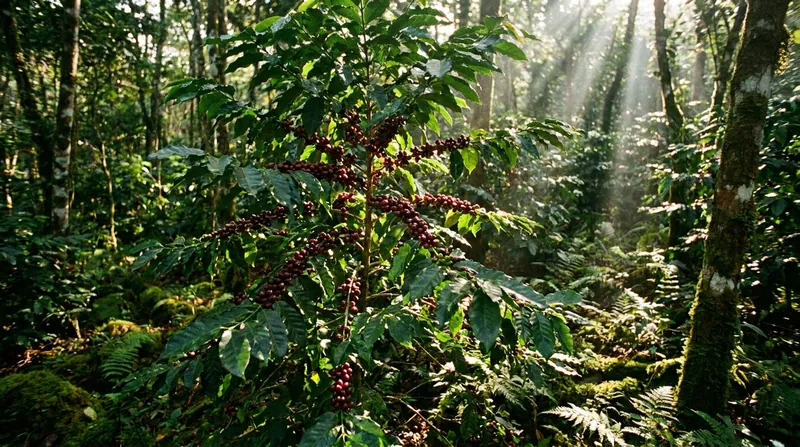
On the agricultural front, researchers are turning their attention to Coffea liberica and its close relative, Coffea excelsa. Historically relegated to the margins of plantations as boundary markers or shade trees, these species possess exactly the traits needed to survive a hotter, drier future. Liberica thrives in diverse conditions, from humid lowlands to drier, warmer regions that would easily wither a traditional Arabica crop. Excelsa, meanwhile, boasts a deep taproot system that provides exceptional drought tolerance and allows the plant to endure prolonged dry spells without sacrificing its cherry production.[1][3]
The botanical revival gained significant momentum in May 2026, when researchers at the Royal Botanic Gardens, Kew, formally identified a new natural hybrid of Liberica and Excelsa. Dubbed Coffea × libex, or Libex, the hybrid appears to capture the best agronomic traits of both parent plants. Field data indicates that Libex combines Liberica’s superior heat tolerance with Excelsa’s higher yields and robust resistance to devastating diseases like coffee leaf rust. For agronomists, it represents a plug-and-play alternative that could keep farmers in business as traditional crops fail under climate stress.[1][2]
This transition is already moving from the laboratory to the soil. At the South India Coffee Company’s estates in Karnataka, farmers have been systematically evaluating Excelsa and Liberica across trial plots to test their resilience against erratic monsoons.
Because these species have longer growing periods, they can be harvested in March and April, safely dodging the unseasonal rains that increasingly rot Arabica cherries on the branch. Similar shifts are occurring in Uganda, where farmers cultivating Excelsa report that the species is proving more productive and profitable than the region’s traditional Robusta crops.[1]
The primary hurdle for these alternative species has always been consumer acceptance. Liberica’s flavor profile is frequently described as unfamiliar, carrying woody or floral notes that differ sharply from the classic Arabica cup. However, modern processing techniques and careful roasting are beginning to unlock milder, highly agreeable flavors from Excelsa and Liberica beans. Some experts predict that within a decade, these resilient species will become supermarket staples, either blended into instant coffees to provide a stable base or celebrated as distinct specialty roasts in high-end cafes.[1][2]
While botanists work to adapt the plant, a parallel ecosystem of food-tech startups is asking a more radical question: what if we simply stop growing the bean? Companies like Minus Coffee and Compound Foods are pioneering the concept of 'beanless coffee,' utilizing precision fermentation to recreate the exact sensory experience of a morning brew without touching a single coffee plant. This approach treats coffee not as an agricultural product, but as a specific chemical profile that can be reverse-engineered from the ground up.[4][5]
The mechanism behind beanless coffee relies on exhaustive molecular mapping. Scientists first isolate and identify the more than 800 volatile and non-volatile compounds that give traditional coffee its characteristic aroma, acidity, and flavor. Once the molecular blueprint is established, they use engineered yeasts and microbes to ferment upcycled agricultural byproducts—such as date seeds, sunflower husks, and grape seeds—into a liquid that perfectly mimics the chemical profile of cold brew or espresso. This upcycling process also prevents agricultural waste from rotting in landfills and emitting methane.[4]
The environmental math behind this synthetic approach is highly compelling. Traditional coffee cultivation is intensely resource-heavy; every cup consumed in the United States accounts for roughly 140 times its volume in water and 17 times its weight in carbon emissions. By shifting production from vulnerable tropical rainforests to controlled, localized bioreactors, precision fermentation companies claim they can produce coffee using 95% less water and 92% less land, effectively halting the deforestation driven by expanding plantations.[5]
Taste tests suggest the biotech approach is rapidly closing the quality gap with traditional agriculture. In blind trials conducted alongside Purdue University, 60% of participants actually preferred Compound Foods’ beanless formulation over premium traditional brands like Blue Bottle. Because the fermentation process is highly controllable, producers can also dial caffeine levels up or down with absolute precision, offering customized formulations that traditional agriculture cannot match, all while maintaining a perfectly consistent flavor profile batch after batch.[4]
Yet, the rise of synthetic coffee introduces profound socioeconomic uncertainties that the industry must navigate carefully. Over 25 million smallholder farmers globally rely on coffee cultivation for their livelihoods, often operating on razor-thin margins. If lab-grown alternatives achieve price parity and capture significant market share, it could devastate rural economies in the Global South that are already reeling from climate impacts. Proponents of beanless coffee argue that their technology is meant to supplement, rather than entirely replace, traditional farming—filling the massive supply gaps that climate change will inevitably create.[3]
Ultimately, the coffee of the future will likely be a hybrid of both solutions, ensuring that the global demand is met without destroying the planet. For the purist, the morning cup may be brewed from a hardy Libex or Stenophylla bean, grown by farmers who successfully adapted their estates to a warmer world.
For the mass market, the iced latte of 2035 might be drawn from a bioreactor, engineered for perfect consistency and zero deforestation. In either scenario, the science ensures that while the source of the brew is changing, the ritual itself will survive.
Key points
- Climate change threatens to render 50% of current coffee-growing land unsuitable by 2050, severely impacting Arabica yields.
- Botanists are reviving climate-resilient species like Liberica and Excelsa, and have identified a promising new hybrid called Libex.
- Food-tech startups are using precision fermentation to brew 'beanless coffee' from upcycled agricultural waste, reducing water use by 95%.
- The future of coffee will likely rely on a combination of hardy alternative crops and synthetic biology to meet global demand.
What we don’t know
- Whether mass-market consumers will fully embrace the slightly different flavor profiles of Liberica and Excelsa beans.
- If precision fermentation can scale economically enough to compete with commodity coffee prices on a global level.
- How the rise of lab-grown coffee will impact the livelihoods of the 25 million smallholder farmers who depend on traditional cultivation.
How we got here
2022
Minus Coffee launches its first consumer product, a beanless cold brew, utilizing precision fermentation.
2024
Global coffee prices hit multi-decade highs as severe droughts in Brazil slash Arabica yields by 12%.
April 2025
Compound Foods officially launches its proprietary platform for scalable beanless coffee and cocoa ingredients.
May 2026
Researchers at Kew Royal Botanic Gardens formally identify Coffea × libex, a promising climate-resilient hybrid of Liberica and Excelsa.
- Agricultural Adaptation Advocates
- Focuses on reviving resilient plant species like Liberica and Excelsa to keep coffee farming viable.
- Synthetic Biology Pioneers
- Focuses on precision fermentation and upcycling to decouple coffee from vulnerable supply chains entirely.
Perspectives this story doesn't cover
- Smallholder farmers in regions entirely unsuitable for alternative species
- Traditional coffee roasters and cafe owners
Sources
Source coverage
5 outlets
2 viewpoints surfaced





- [1]MongabayAgricultural Adaptation Advocates
The search for climate resilient coffee in a warming world
Read on Mongabay → - [2]Fresh Cup MagazineAgricultural Adaptation Advocates
Climate-Resistant Libex Could Be the Future of Coffee Cultivation
Read on Fresh Cup Magazine → - [3]ResearchGateAgricultural Adaptation Advocates
Climate requirements for cultivated Liberica coffee and consequences for its use
Read on ResearchGate → - [4]Compound FoodsSynthetic Biology Pioneers
Compound Foods launches beanless coffee and cocoa ingredient platform
Read on Compound Foods → - [5]Lowercarbon CapitalSynthetic Biology Pioneers
Minus: Lowercarbon Capital Portfolio
Read on Lowercarbon Capital →
More in Food & Drink
See all →Coffee Science
The 40% CO2 Loss in the First 7 Days: How Degassing Dictates Optimal Brewing Time and Crema Formation
7 sources
Food Science
The Science of Decaffeination: How Chemistry and Engineering Rescued Decaf Coffee
2 sources
Food Tech
The Science of Beanless Coffee: How Upcycling and Bioreactors Are Future-Proofing the Morning Cup
2 sources
Crop Science
Beyond Arabica: The Forgotten Coffee Species Making a Climate-Resilient Comeback
3 sources
Comments
Every angle. Every day.
Get Food & Drink stories with full source coverage and perspective breakdowns, free every day.