
Generational Shift Defines the 2026 World Cup as Messi and Ronaldo Make Final Bows
As the expanded 48-team World Cup unfolds across North America, the tournament is highlighting a profound transition between legendary veterans and emerging teenage stars.
By Factlen Editorial Team
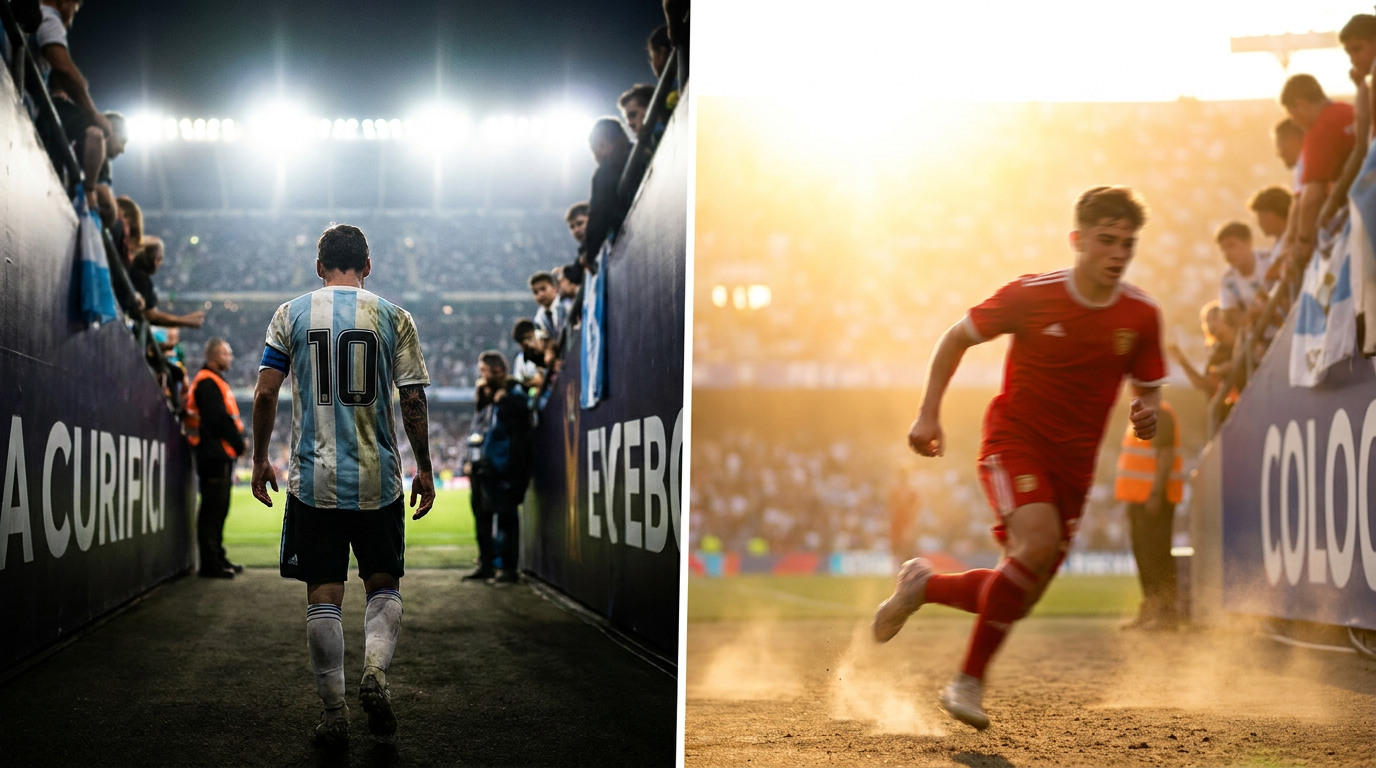
- Veteran Icons
- Focuses on the historical weight of Messi and Ronaldo's final appearances.
- The Next Generation
- Highlights the emergence of young prodigies and prime-age stars taking over the sport.
- Emerging Nations
- Emphasizes the opportunities and upsets created by the expanded 48-team format.
What's not represented
- · Host Nation Supporters
- · Domestic Club Managers
Why this matters
The 2026 World Cup marks a historic transition in global sports, offering fans a final opportunity to witness the defining players of the 21st century while simultaneously introducing the prodigies who will shape the game's future.
Key points
- Lionel Messi is set to make his 200th appearance for Argentina as they aim for back-to-back titles.
- Cristiano Ronaldo is playing in a record-breaking sixth World Cup at age 41.
- 18-year-old Lamine Yamal made his debut for Spain against 40-year-old Cape Verde goalkeeper Vozinha.
- France's Kylian Mbappé needs five goals to break the all-time World Cup scoring record.
- The expanded 48-team format has allowed debutants like Cape Verde to secure historic results.
The 2026 FIFA World Cup has officially kicked off across North America, bringing a historic, expanded 48-team field to stadiums across the United States, Canada, and Mexico. But beyond the sheer scale of the 104-match format and the sprawling geography of the host cities, the tournament is already being defined by a profound generational crossroads. For the first time in the sport's modern history, the defining icons of the last two decades are sharing the global stage with a new cohort of teenage prodigies who were barely born when these veterans made their international debuts. This overlapping of eras has transformed the group stage into a living museum of footballing history, where farewell tours intersect with breakout campaigns.[8]
For nearly twenty years, the global football narrative has been overwhelmingly dominated by Lionel Messi and Cristiano Ronaldo. Now, as the group stage unfolds in front of record-breaking crowds, fans are witnessing what is universally expected to be the final World Cup appearance for both legendary forwards. Their presence in North America serves as the ultimate anchor for the tournament's historical weight, drawing immense global viewership as supporters tune in to watch the twilight of two careers that fundamentally reshaped the statistical boundaries of the sport.[3][7]
The most anticipated individual milestone of the opening week arrives on Thursday evening in Kansas City, where 38-year-old Lionel Messi is set to make his 200th international appearance for Argentina. Taking the pitch against Algeria in their Group J opener, Messi will reach a cap milestone that few outfield players ever approach, doing so while wearing the captain's armband for the defending world champions. His performance remains the focal point of an Argentine squad that has largely retained its core from the triumphant 2022 campaign in Qatar.[1][6]
Messi’s objective in North America is monumental: leading La Albiceleste to back-to-back World Cup titles. If successful, Argentina would become the first nation to successfully defend the men's crown since the great Brazilian sides of 1958 and 1962. Manager Lionel Scaloni has built a pragmatic, defensively resilient system designed to minimize the physical demands on his aging talisman, allowing Messi to conserve his energy for decisive, match-winning moments in the final third of the pitch. The weight of expectation is immense, as the team carries not just the hopes of a nation, but the pressure of cementing their status as one of the greatest international dynasties in the history of the sport.[2]

Meanwhile, 41-year-old Cristiano Ronaldo is rewriting the longevity record books for Portugal. The Portuguese captain is appearing in his sixth World Cup—an unprecedented milestone for a male player that underscores his legendary physical conditioning and enduring relevance. While his role within the national team has evolved, his desire to capture the one major international trophy that has eluded his glittering career remains a central storyline. His presence alone guarantees that every Portuguese fixture will be treated as a high-stakes event by global broadcasters and traveling supporters alike.[3][7]
Meanwhile, 41-year-old Cristiano Ronaldo is rewriting the longevity record books for Portugal.
Yet, even as these iconic veterans take their final bows on the world stage, the next generation is already making its mark. On Monday, 18-year-old Spanish sensation Lamine Yamal made his World Cup debut, stepping onto the pitch as one of the most highly touted teenagers in the tournament. Having already established himself as a vital creative force for both Barcelona and the Spanish national team, Yamal represents a shift toward fearless, highly technical wingers who are entrusted with starting roles at major tournaments before they even leave their teenage years.[1]
Yamal's debut perfectly encapsulated the tournament's overlapping eras. In Spain's opening match against Cape Verde, the 18-year-old shared the pitch with the African nation's 40-year-old goalkeeper, Vozinha. The match ended in a stunning 0-0 draw, a historic result for the World Cup debutants against the reigning European champions. The stark age gap between the attacking prodigy and the veteran shot-stopper served as a visual representation of the 2026 tournament's unique demographic spread, where seasoned experience frequently collides with raw, untested potential.[1][4]

In the prime-age bracket, France's Kylian Mbappé arrives in North America with his eyes firmly set on the ultimate individual prize. At just 27 years old, the French captain is no longer the breakout teenager of 2018; he is the undisputed focal point of a fearsome French attack and is actively chasing Miroslav Klose's all-time World Cup goalscoring record. Despite facing intense scrutiny and navigating a challenging domestic season with Real Madrid, Mbappé's pedigree on the international stage remains entirely unmatched among his peers.[3][5]
Mbappé currently sits at 12 career World Cup goals, a tally heavily bolstered by his spectacular Golden Boot performance in 2022. He needs just five more goals during this tournament to surpass Klose's long-standing mark of 16. Given the expanded format and the potential for a deep French run into the knockout stages, breaking the record is a highly attainable target. Surpassing Klose would cement Mbappé's legacy as arguably the greatest individual performer in the history of the competition, long before his career even enters its twilight.[5]
The expansion to 48 teams has also injected fresh, uplifting storylines into the group stage, proving that the gap between traditional European or South American powerhouses and emerging nations is steadily narrowing. Debutants like Cape Verde, Uzbekistan, and Jordan are utilizing the expanded format to showcase their tactical discipline and domestic development. Cape Verde's resilient draw against Spain demonstrated that these newly qualified teams are not merely making up the numbers; they are highly organized units capable of frustrating the world's most talented attacking rosters.[3][8]

As the grueling 39-day, 104-match marathon continues its march toward the July 19 final in New Jersey, the 2026 World Cup is shaping up to be a beautiful, unpredictable collision of eras. It is simultaneously a celebration of the legendary figures who built the modern commercial game and a proving ground for the young stars ready to inherit it. For fans watching around the globe, this generational overlap offers a rare, poignant viewing experience: the chance to say goodbye to the sport's greatest icons while immediately greeting its future.[8]
How we got here
Dec 2022
Lionel Messi leads Argentina to their third World Cup title in Qatar.
Mar 2023
FIFA officially approves the expanded 48-team format and 104-match schedule for 2026.
Jun 11, 2026
The 2026 World Cup kicks off at the Estadio Azteca in Mexico City.
Jun 15, 2026
18-year-old Lamine Yamal debuts for Spain in a 0-0 draw against debutants Cape Verde.
Jun 18, 2026
Lionel Messi is scheduled to make his 200th international appearance against Algeria.
Viewpoints in depth
Veteran Icons' Legacy
The focus on Messi and Ronaldo cementing their historical standing in their final tournament.
For supporters of the traditional powerhouses, the 2026 tournament is a farewell tour for the two players who have defined 21st-century football. Analysts note that while Messi has already secured his World Cup legacy in Qatar, leading Argentina to back-to-back titles would elevate his status into uncharted territory. Meanwhile, Ronaldo's presence at age 41 is viewed as a testament to unprecedented physical longevity, with his supporters hoping for a final, defining moment on the global stage.
The New Guard
The anticipation surrounding young stars like Yamal and prime-age leaders like Mbappé.
Tactical analysts and youth development advocates are closely watching the passing of the torch. Kylian Mbappé is no longer the young prodigy of 2018; he is now the veteran leader of a fearsome French squad, actively hunting the all-time scoring record. Simultaneously, the emergence of teenagers like Spain's Lamine Yamal highlights a shift toward fearless, highly technical wingers who are entrusted with starting roles at major tournaments before they even turn 20.
Emerging Nations
The impact of the 48-team expansion on global football development.
For the expanded field of debutants, the narrative isn't about individual records, but about national milestones. Cape Verde's stunning 0-0 draw against Spain validated FIFA's decision to expand the tournament, proving that smaller nations can compete tactically with European giants. Advocates for global football equality argue that these moments of exposure will drive funding, infrastructure, and grassroots development in regions historically locked out of the 32-team format.
What we don't know
- Whether Argentina can overcome the historical difficulty of defending a World Cup title.
- If Kylian Mbappé will secure the five goals needed to break Miroslav Klose's scoring record this summer.
- How far debutant nations like Cape Verde can advance in the newly expanded 32-team knockout stage.
Key terms
- Cap
- An appearance made by a player for their national team in an international match.
- La Albiceleste
- The nickname for the Argentina national football team, referring to their white and sky-blue striped jerseys.
- Golden Boot
- The award given to the top goalscorer of the FIFA World Cup tournament.
- Knockout Stage
- The phase of the tournament following the group stage where teams are eliminated after a single loss.
Frequently asked
How many teams are in the 2026 World Cup?
The 2026 World Cup features 48 teams, an expansion from the 32-team format used in previous tournaments.
Who holds the all-time World Cup scoring record?
Germany's Miroslav Klose holds the record with 16 goals. France's Kylian Mbappé is currently chasing the record with 12 goals.
Where is the 2026 World Cup being held?
The tournament is being jointly hosted by the United States, Canada, and Mexico across 16 different cities.
Sources
Source coverage
8 outlets
3 viewpoints surfaced








[1]BeSoccerEmerging Nations
FIFA World Cup 2026 news: Latest updates
Read on BeSoccer →[2]Sports IllustratedVeteran Icons
The Four Biggest Storylines for Argentina at the 2026 World Cup
Read on Sports Illustrated →[3]The Big LeadThe Next Generation
10 biggest storylines heading into the 2026 World Cup
Read on The Big Lead →[4]Al JazeeraEmerging Nations
World Cup 2026 | Today's latest from Al Jazeera
Read on Al Jazeera →[5]NBC SportsThe Next Generation
2026 World Cup preview: Key storylines, predictions as epic tournament set to begin
Read on NBC Sports →[6]Olympics.comEmerging Nations
FIFA World Cup 2026 - Every match result on Tuesday 16 June - Live scores
Read on Olympics.com →[7]Planet SoccerVeteran Icons
2026 World Cup: 7 storylines to follow this year
Read on Planet Soccer →[8]WikipediaEmerging Nations
2026 FIFA World Cup
Read on Wikipedia →

More in sports
See all 7 stories →Injury
Stanley Cup Finals Injury Report: Resilience and Depth Define Crucial Game 6
0 sources
Standings
Global Ice Hockey Standings: Hurricanes Hoist the Stanley Cup as 2026 Championship Season Peaks
0 sources
Injury
Midsummer Reinforcements: All-Star Returns Inject Life Into June Baseball
0 sources
Standings
White Sox and Mariners Surge in Mid-June MLB Standings as Underdogs Take Center Stage
0 sources
Every angle. Every day.
Get sports stories with full source coverage and perspective breakdowns delivered to your inbox.