
Consumer Sleep Trackers: What the Evidence Says About Oura, Whoop, and Apple Watch Accuracy
A review of peer-reviewed validation studies reveals that while consumer sleep trackers are highly accurate at detecting when you fall asleep, their ability to identify specific sleep stages remains flawed.
By Factlen Editorial Team
- Clinical Sleep Specialists
- Medical professionals who rely on gold-standard brain wave data and warn against over-interpreting consumer metrics.
- Quantified-Self Enthusiasts
- Users and reviewers who leverage wearable data to optimize daily performance and recovery.
- Wearable Manufacturers
- Companies developing the hardware and machine learning algorithms to track sleep continuously.
What's not represented
- · Individuals with diagnosed sleep disorders whose data falls outside normal algorithmic models
Why this matters
Millions of people use wearable sleep data to dictate their daily exercise, diet, and rest. Understanding the scientific limitations of these devices prevents 'orthosomnia'—sleep anxiety caused by tracking—and helps users focus on the metrics that actually improve their health.
Key points
- Consumer wearables detect sleep versus wake states with greater than 95% sensitivity.
- Sleep stage classification (light, deep, REM) is significantly less accurate, ranging from 50% to 86%.
- Even trained human sleep technicians only agree on sleep stages about 83% of the time.
- Hyper-fixating on wearable sleep scores can lead to orthosomnia, a form of tracking-induced insomnia.
- Wearables are best used for tracking long-term baselines in resting heart rate and HRV, not single-night diagnostics.
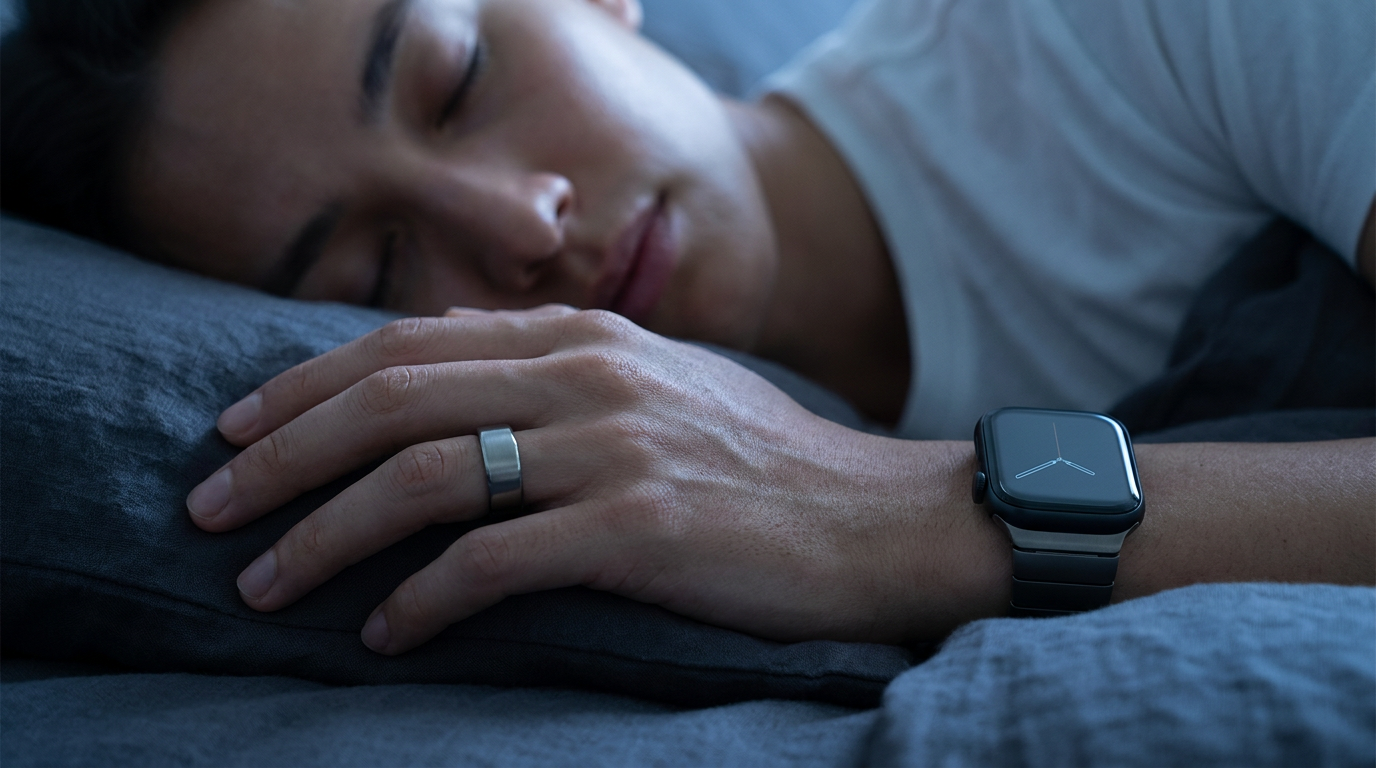
Millions of people wake up, reach for their smartphones, and let an algorithm tell them how well they slept before their feet even hit the floor. Consumer sleep trackers—led by popular devices like the Oura Ring, Whoop strap, and Apple Watch—have fundamentally transformed sleep from a subjective morning feeling into a quantified, scannable daily score. For many users, these metrics dictate daily decisions, influencing everything from how hard they push themselves in a workout to whether they prioritize an early bedtime. But as these wearables become increasingly integrated into our daily routines and health management, a critical question remains: exactly how accurate is the data on your wrist or finger?[4][7]
To answer this, researchers continuously evaluate consumer wearables against polysomnography (PSG), which serves as the clinical gold standard for sleep medicine. A clinical PSG study involves wiring a patient with multiple electrodes to directly measure brain waves (EEG), muscle activity (EMG), and eye movement (EOG) throughout the night. Consumer trackers, by contrast, must guess what your brain is doing based entirely on what your physical body is doing. They rely heavily on photoplethysmography (PPG) sensors to track heart rate and blood oxygen levels, combined with highly sensitive accelerometers to measure micro-movements, and occasionally skin temperature sensors.[1][4][6]

Because they lack direct access to neurological data, these devices must run physical signals through complex machine learning algorithms to infer your state of rest. When it comes to the most basic question—are you asleep or awake?—the scientific evidence shows that modern wearables are exceptionally accurate. A comprehensive 2024 multicenter validation study evaluating 11 different consumer devices found that wearables can detect sleep versus wake states with greater than 95% sensitivity. If you simply want to know how long you spent in bed and roughly how many total hours you slept, devices like the Apple Watch, Fitbit, and Oura Ring are highly reliable tools.[1][5]
These devices easily detect the distinct drop in heart rate and the complete cessation of physical movement that accompany sleep onset. However, the scientific evidence becomes significantly weaker when trackers attempt to divide that total sleep time into specific neurological stages: light sleep, deep sleep, and rapid eye movement (REM) sleep. Because wearables cannot measure the brain waves that actually define these stages, their classification accuracy drops significantly, typically ranging from 50% to 86% depending on the specific device and the sleep stage being measured.[2][5]

A 2024 peer-reviewed study published in the journal Sensors compared the Oura Ring, Fitbit Sense, and Apple Watch directly against clinical polysomnography. The researchers found that wrist-based devices often struggled with precise stage categorization; for example, the Apple Watch overestimated light sleep by an average of 45 minutes and underestimated deep sleep by 43 minutes. The same study, which was notably funded by Oura, reported that the Oura Ring achieved a 79% agreement with PSG for four-stage sleep classification, outperforming the wrist-based competitors.[2][6]
A 2024 peer-reviewed study published in the journal Sensors compared the Oura Ring, Fitbit Sense, and Apple Watch directly against clinical polysomnography.
Independent studies have similarly noted that the ring form factor can offer slightly better signal quality for certain cardiovascular metrics due to the sensor's direct proximity to the digital artery in the finger. Yet, other independent research highlights the ongoing inconsistency across the broader wearable market. A 2025 study in the Journal of Community Hospital Internal Medicine Perspectives evaluated six devices and found that while the Fitbit Sense and Apple Watch Series 8 demonstrated clinically acceptable accuracy for total sleep time, significant discrepancies remained across deeper sleep metrics.[3][5]
The Whoop 4.0, a device heavily favored by high-performance athletes for its proprietary recovery algorithms, has shown strong independent validation for overall sleep and wake agreement. However, independent testing reveals that it still struggles with perfect stage categorization when compared strictly to clinical equipment. When evaluating all of these accuracy numbers, context is absolutely crucial. Even the clinical gold standard of polysomnography is not entirely flawless, which changes how we should view wearable data.[3][6]
Research shows that when two highly trained human sleep technicians score the exact same clinical PSG data, they only agree about 83% of the time. Expecting a consumer wearable to achieve 100% accuracy in sleep staging is therefore an impossible standard, as the clinical benchmark itself inherently contains a margin of human subjectivity. Because of this, clinical sleep specialists increasingly warn that hyper-fixating on specific sleep stage numbers can lead to unintended negative consequences for users.[2][7]

This hyper-fixation has given rise to 'orthosomnia'—a modern psychological condition where the quest for perfect wearable sleep data actually causes anxiety, which in turn leads to genuine insomnia. If your tracker says you only received 45 minutes of deep sleep, but you woke up feeling completely rested and energized, medical experts strongly advise trusting your own body over the algorithm. The device may have simply misclassified a period of physical stillness as light sleep instead of deep sleep.[4][5][7]
Where consumer wearables truly shine is in establishing long-term personal baselines rather than providing flawless single-night diagnostics. While the absolute number of REM sleep minutes on a random Tuesday might be inaccurate, a sudden 30% drop in your average heart rate variability (HRV) or an unexplained spike in your resting heart rate is a highly reliable indicator of physical stress, overtraining, or an impending illness. These devices are incredibly powerful tools for tracking relative changes in your own body over time.[6][7]

Ultimately, the scientific consensus suggests that consumer sleep trackers are best viewed as directional compasses rather than definitive diagnostic tools. They are excellent at highlighting broad behavioral trends—such as demonstrating exactly how a late-night meal or an evening glass of alcohol negatively impacts your resting heart rate. However, they cannot replace a formal medical sleep study for diagnosing serious conditions like sleep apnea, and their data should be used to empower your daily routine rather than dictate your peace of mind.[1][5][7]
Viewpoints in depth
Clinical Sleep Specialists
Medical professionals who rely on gold-standard brain wave data.
Clinicians emphasize that while wearables are excellent for encouraging healthy habits, they are fundamentally limited because they cannot measure the brain (EEG). They caution patients against taking sleep stage data literally, warning that 'orthosomnia'—insomnia driven by the anxiety of poor wearable scores—is becoming a prevalent issue in sleep clinics.
Wearable Manufacturers
The companies developing the hardware and machine learning algorithms.
Manufacturers argue that continuous, multi-night tracking provides a more holistic picture of a user's health than a single, uncomfortable night in a clinical sleep lab. By leveraging massive datasets and increasingly sophisticated sensors (like temperature and blood oxygen), they believe their algorithms are rapidly closing the gap with clinical polysomnography.
Quantified-Self Enthusiasts
Users who leverage wearable data to optimize daily performance.
For athletes and biohackers, the absolute accuracy of a specific sleep stage is less important than the relative baseline. This camp relies heavily on metrics like Heart Rate Variability (HRV) and resting heart rate to dictate their daily training strain, arguing that directional consistency is enough to make meaningful lifestyle improvements.
What we don't know
- How proprietary, closed-source algorithms from companies like Apple and Whoop specifically weight different physical signals.
- Whether upcoming sensor technologies, like continuous blood pressure monitoring, will significantly improve sleep stage accuracy.
Key terms
- Polysomnography (PSG)
- The clinical gold standard for sleep testing, using electrodes to measure brain waves, eye movement, and muscle activity.
- Photoplethysmography (PPG)
- An optical sensor technology used in wearables to measure heart rate and blood flow by shining light into the skin.
- Heart Rate Variability (HRV)
- The variation in time between consecutive heartbeats, used by trackers as a key indicator of physical recovery and nervous system balance.
- Epoch
- A standard 30-second window of time used by sleep researchers and algorithms to classify sleep stages.
- Orthosomnia
- An unhealthy obsession with achieving perfect sleep metrics, often caused by over-reliance on wearable tracker data.
Frequently asked
Can a smart watch or ring diagnose sleep apnea?
No. While devices can track blood oxygen drops and breathing disturbances that suggest sleep apnea, a clinical polysomnography (PSG) study is required for an actual medical diagnosis.
Why does my tracker say I get very little deep sleep?
Consumer wearables often struggle to accurately distinguish between light and deep sleep because they rely on movement and heart rate rather than brain waves. If you feel rested, the device may simply be misclassifying your sleep stages.
Which is more accurate for sleep: a ring or a watch?
Several studies suggest that smart rings have a slight edge in sleep tracking because the blood vessels in the finger provide a clearer signal for optical sensors than the wrist, and rings are less prone to shifting during the night.
Should I worry if my sleep score is low?
Experts advise using sleep scores to spot long-term trends rather than stressing over a single night. Fixating on daily scores can actually increase anxiety and make it harder to sleep.
Sources
Source coverage
7 outlets
3 viewpoints surfaced






[1]JMIR mHealth and uHealthClinical Sleep Specialists
Accuracy of 11 Wearable, Nearable, and Airable Consumer Sleep Trackers
Read on JMIR mHealth and uHealth →[2]SensorsWearable Manufacturers
Accuracy of Three Commercial Wearable Devices for Sleep Tracking in Healthy Adults
Read on Sensors →[3]Journal of Community Hospital Internal Medicine PerspectivesClinical Sleep Specialists
Performance of six consumer sleep trackers in comparison with polysomnography
Read on Journal of Community Hospital Internal Medicine Perspectives →[4]The Sleep ConsultantQuantified-Self Enthusiasts
Sleep Tracker Accuracy: What Oura, Whoop, and Apple Watch Are Actually Measuring
Read on The Sleep Consultant →[5]Wearable Wellness GuideQuantified-Self Enthusiasts
Sleep Trackers and Therapy Device Guide (2026): Physician-Reviewed Accuracy
Read on Wearable Wellness Guide →[6]Kygo App ResearchQuantified-Self Enthusiasts
Most Accurate Wearable: Master Summary by Metric
Read on Kygo App Research →[7]Factlen Editorial TeamQuantified-Self Enthusiasts
Synthesis by Factlen editorial team
Read on Factlen Editorial Team →


Every angle. Every day.
Get shopping stories with full source coverage and perspective breakdowns delivered to your inbox.