
How AI is Breaking the Ultimate Language Barrier: Decoding Animal Communication
Advances in deep learning and foundation models are allowing scientists to translate the complex languages of whales, crows, and elephants, opening a new frontier in interspecies empathy.
By Factlen Editorial Team
- Conservation Biologists
- Focus on using AI to monitor ecosystem health and protect vulnerable habitats.
- AI Researchers
- Focus on the technical challenge of building universal foundation models for biological data.
- Ethicists & Philosophers
- Focus on the moral implications of recognizing non-human sentience and avoiding anthropocentrism.
What's not represented
- · Indigenous Knowledge Keepers
- · Marine Policy Regulators
Why this matters
Understanding animal communication fundamentally shifts humanity's relationship with nature. By decoding the ecological needs and social structures of other species, we can design radically more effective conservation strategies and foster a deeper, empathy-driven approach to sharing the planet.
Key points
- AI foundation models are successfully decoding the complex communication of whales, elephants, and crows.
- Self-supervised learning allows AI to find the structural 'shapes' of language without a translation key.
- New source-separation algorithms solve the 'cocktail party problem,' isolating individual animal voices in noisy environments.
- Project CETI uses non-invasive drones to tag sperm whales, gathering high-resolution acoustic data.
- The technology aims to revolutionize conservation by providing real-time acoustic monitoring of ecosystem health.
- Researchers emphasize the goal is to listen and expand human empathy, not to talk back to animals.
For centuries, the rich acoustic world of the animal kingdom was largely impenetrable to human ears. We recognized that birds sang to claim territory and whales clicked to navigate the abyss, but the underlying grammar, syntax, and meaning of these signals remained locked away. The idea of translating these complex biological broadcasts was relegated to science fiction and children's stories, treated as an impossible fantasy rather than a serious scientific pursuit. Human understanding was fundamentally limited by our own biological perception, leaving us deaf to the intricate conversations happening all around us.[1]
In 2026, that historical barrier is fracturing. Driven by the same explosive advancements in large language models and neural networks that gave us conversational chatbots, a coalition of biologists, cryptographers, and artificial intelligence researchers is successfully decoding non-human communication. This is not about teaching animals to speak English or commanding them to perform tasks; it is about using massive computational power to map the hidden structures of their native languages. By applying the latest AI architectures to vast datasets of animal behavior, science is crossing a threshold that fundamentally alters our relationship with the natural world.[2][6]
The breakthrough relies on a critical shift from task-specific algorithms to generalized foundation models. Previously, researchers had to manually label their data, painstakingly identifying a specific species or a known call type before the computer could recognize it. Today, self-supervised learning allows AI to ingest raw, unlabeled audio and discover the structural shapes of the language on its own. The models analyze billions of data points to find patterns, correlations, and syntactic rules that human researchers could never spot manually, transforming bioacoustics into a data-driven discovery engine.[2][5]
Aza Raskin, co-founder of the Earth Species Project, recently highlighted this paradigm shift at the SXSW 2026 conference. He explained that artificial intelligence can now translate across modalities without needing a traditional Rosetta Stone to guide the way. By mapping the complex relationships between sounds, physical movements, and environmental contexts, the AI builds a universal representation of communication. This means the system does not just hear a sound; it understands the shape of the interaction, allowing it to bridge the gap between entirely different biological systems.[5]
One of the most significant technical hurdles the field had to overcome was the notorious cocktail party problem. In the wild, animals rarely speak politely one at a time. A coral reef or a dense rainforest is a chaotic cacophony of overlapping signals, wind, and water noise. Historically, researchers had to discard up to 97 percent of their acoustic data because it was simply too noisy to isolate and analyze. This massive loss of information kept the field of animal communication bottlenecked for decades.[6]

Modern AI source-separation models have finally solved this bottleneck. Advanced algorithms can now isolate individual voices from a crowded, noisy soundscape, allowing scientists to track specific conversations within a massive flock of birds or a pod of dolphins. This capability has transformed bioacoustics from a data-poor field into a data-rich environment, perfectly suited for the hungry neural networks of deep learning. Suddenly, the 97 percent of data that was previously thrown away is yielding unprecedented insights into the social dynamics of the animal kingdom.[2][6]
The resulting discoveries are already reshaping our understanding of animal intelligence and social complexity. Researchers have found that elephants call out to each other using distinct, individual names, demonstrating a level of cognitive abstraction previously thought unique to humans. Female beluga whales utilize a specific, urgent call to coax wandering calves back to safety when they stray too far. Even crows, long known for their problem-solving intelligence, have been shown to possess a vast vocabulary of quiet calls that previously went entirely unnoticed by human observers.[2][5]
The resulting discoveries are already reshaping our understanding of animal intelligence and social complexity.
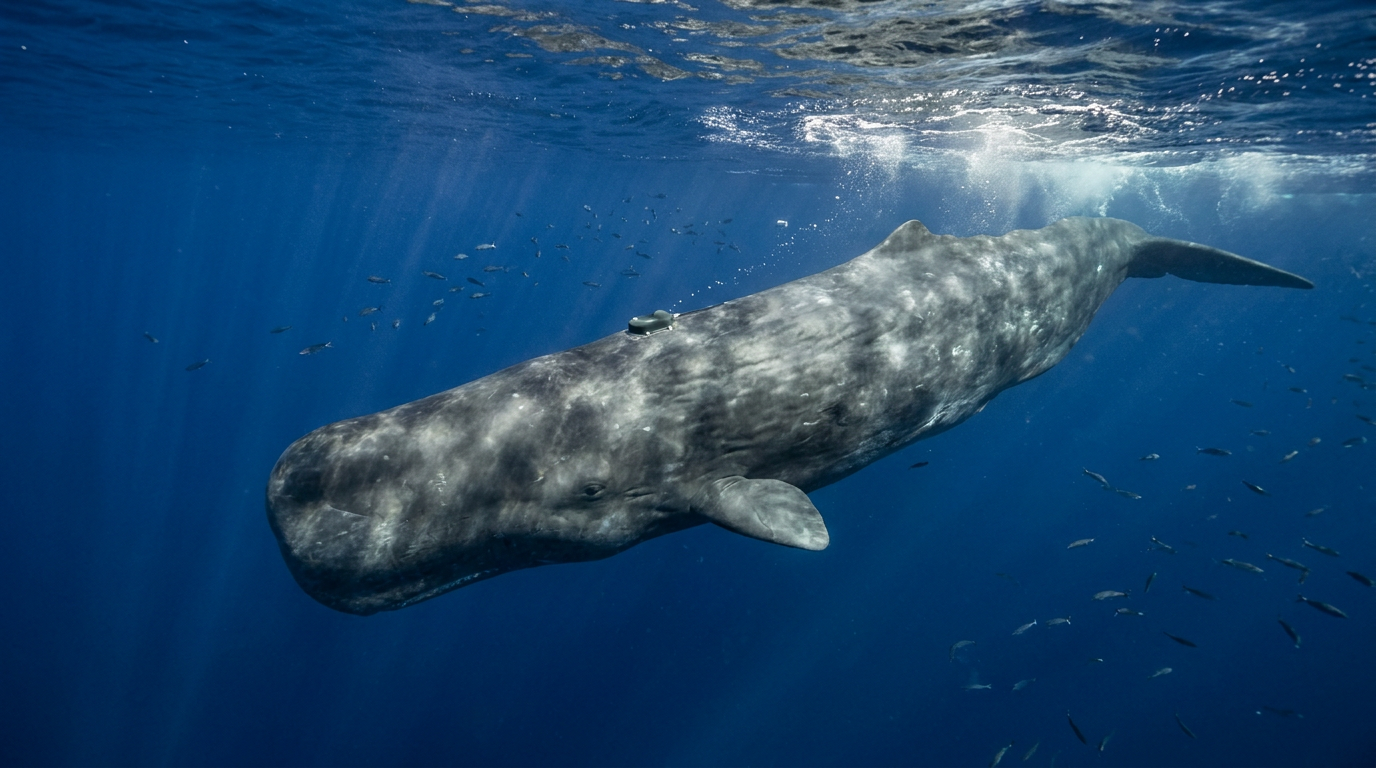
Project CETI, the Cetacean Translation Initiative, is leading one of the most ambitious efforts in this space, focusing entirely on the complex clicking language of sperm whales off the coast of Dominica. Sperm whales possess the largest brains on Earth and live in deeply structured, matriarchal societies that span oceans. Their communication relies on rhythmic sequences of clicks called codas, which they use to identify themselves, coordinate hunting, and maintain social bonds across vast underwater distances. Decoding these codas requires an unprecedented fusion of marine biology and machine learning.[3]
To gather the massive, high-fidelity datasets required to train their artificial intelligence models, Project CETI had to innovate directly in the field. Traditional tagging methods, which often involve approaching the massive animals by boat and applying sensors with long poles, could be invasive and disruptive to the whales' natural behavior. In response, the research team developed a novel tap-and-go approach using customized First Person View racing drones to deploy the sensors from the air. This allows the team to tag the animals swiftly and safely, minimizing human interference.[4]

These agile drones gently apply suction-cup acoustic sensors to the whales as they surface to breathe, allowing researchers to collect high-resolution audio and movement data without causing distress or altering the pod's dynamics. This non-invasive approach is crucial for the integrity of the project; it ensures that the artificial intelligence is learning from authentic, undisturbed communication rather than the animals' stress responses to human presence. The tags eventually detach naturally and float to the surface for data retrieval.[4]
The implications of this technology extend far beyond biological curiosity or academic achievement. As Stanford artificial intelligence experts note, 2026 marks the year AI moves away from pure hype and toward rigorous, real-world evaluation and utility. In the realm of global conservation, understanding animal communication provides a direct, unfiltered read on ecosystem health. It shifts environmental monitoring from a reactive science to a proactive dialogue with the natural world, allowing us to measure the impact of human activity through the very voices of the animals experiencing it.[5][7]
If conservationists can decode the specific distress calls of a marine species, they can detect the immediate impact of underwater noise pollution, shipping traffic, or temperature shifts long before population numbers begin to decline. It offers a form of word-of-mouth insight directly from the inhabitants of the ecosystem. Instead of waiting years to count dwindling populations, policymakers could receive real-time acoustic alerts that a habitat is under stress, enabling rapid, targeted interventions to protect vulnerable areas. This real-time acoustic feedback loop could revolutionize how marine protected areas are managed and enforced globally.[5][6]
Furthermore, this research fundamentally challenges humanity's deeply entrenched anthropocentric view of intelligence. As Raskin noted during his presentation, humans have only explored about five percent of the world's oceans, and our understanding of the planet is severely limited by our own biological perception. We cannot naturally hear the infrasonic rumbles of elephants that travel miles through the savanna, nor can we process the ultrasonic clicks of bats and dolphins. For millennia, our inability to perceive these signals led us to assume they lacked complexity.[2][5]

Artificial intelligence acts as a digital prosthesis, throwing open the doors of perception to reveal a world that is awash in complex signals, negotiations, and social bonds. It proves that we are not the only species on Earth with rich internal lives and complex societies. By visualizing the hidden architecture of animal language, AI forces us to confront the reality that human language is just one specific evolutionary solution among many, rather than the undisputed pinnacle of biological achievement.[5]
The ultimate goal of organizations like the Earth Species Project and Project CETI is not to build a translation device so we can talk back to the animals, but rather to teach humanity how to listen. By decentering our own species and recognizing the diverse, ancient intelligences that share our planet, scientists hope to foster a new era of regenerative practices. This approach is rooted in interspecies empathy, using technology to bridge the gap between human industry and ecological preservation.[3][5]
Nature has been successfully navigating the infinite game of life for 85 times longer than our species has even existed. Ecosystems have survived mass extinctions, climate shifts, and geological upheavals through complex, interconnected communication networks. As artificial intelligence continues to unlock the languages of the natural world, humanity may finally be in a position to stop imposing our will on the planet and start asking it for directions. By learning to interpret the vast, invisible web of biological communication, we are taking the first crucial steps toward becoming better stewards of the Earth. The ultimate promise of this AI breakthrough is not just scientific discovery, but the profound realization that we have never truly been alone in our ability to understand the world.[1][5]
How we got here
2020
The Earth Species Project is founded with the goal of applying natural language processing to non-human communication.
2024
AI models successfully solve the 'cocktail party problem' for animal sounds, allowing researchers to isolate individual voices in noisy environments.
2025
Project CETI successfully deploys 'tap-and-go' drone tagging to non-invasively monitor sperm whales in the Caribbean.
Early 2026
Researchers unveil universal representation models capable of translating across biological modalities without a 'Rosetta Stone'.
Viewpoints in depth
Conservation Biologists
Focus on using AI to monitor ecosystem health and protect vulnerable habitats.
For conservationists, the ability to decode animal communication is a game-changer for non-invasive monitoring. Instead of relying on physical tagging or visual surveys, researchers can deploy acoustic sensors to listen to the health of an ecosystem. By understanding specific distress calls or changes in vocalization patterns, biologists can detect the impact of climate change, noise pollution, or poaching in real-time, allowing for faster and more targeted interventions.
AI Researchers
Focus on the technical challenge of building universal foundation models for biological data.
From a computational perspective, animal communication presents a unique frontier. AI researchers are moving away from human-centric language models toward multi-modal systems that can process audio, movement, and environmental data simultaneously. The goal is to build self-supervised foundation models that can discover the underlying 'shapes' of language without any pre-existing dictionaries, proving that deep learning can uncover structural truths across entirely different biological domains.
Ethicists and Philosophers
Focus on the moral implications of recognizing non-human sentience and avoiding anthropocentrism.
Ethicists caution against the urge to 'talk back' to animals or force human linguistic frameworks onto non-human intelligence. They argue that the true value of this technology lies in decentering humanity—using AI to expand our empathy rather than our dominance. If we definitively prove that other species possess complex languages, names, and cultures, it fundamentally challenges the moral frameworks that have historically justified the exploitation of the natural world.
What we don't know
- Whether AI can fully capture the emotional or subjective meaning behind animal vocalizations.
- How the discovery of complex animal languages will impact international laws regarding animal rights and habitat protection.
- If the structural 'shapes' of language discovered by AI are truly universal across all species on the Tree of Life.
Key terms
- Foundation Model
- A large-scale AI system trained on vast amounts of unlabeled data that can be adapted to a wide range of specific tasks.
- Bioacoustics
- The scientific study of the production, transmission, and reception of animal sounds.
- Cocktail Party Problem
- The challenge of isolating a single voice or sound source from a noisy environment with multiple overlapping signals.
- Self-Supervised Learning
- A machine learning technique where the AI learns the underlying structure of data without needing humans to manually label it.
- Codas
- Rhythmic sequences of clicks used by sperm whales to communicate with one another.
Frequently asked
Will AI let us talk to animals like in the movies?
No. The goal is not to have human-like conversations with animals, but to understand their complex signals, social structures, and ecological needs by listening deeply.
How does AI translate a language without a dictionary?
Modern AI uses self-supervised learning to map the relationships between sounds, movements, and contexts, discovering the structural 'shapes' of a language without needing a pre-existing translation key.
Why is this breakthrough happening now in 2026?
The exponential growth in computational power and the development of foundation models have finally allowed AI to process massive, noisy datasets of animal audio that were previously impossible to analyze.
Sources
Source coverage
7 outlets
3 viewpoints surfaced







[1]Factlen Editorial TeamEthicists & Philosophers
Synthesis by Factlen editorial team
Read on Factlen Editorial Team →[2]Earth Species ProjectAI Researchers
Animal Language Processing: An AI Convergence In Animal Communication
Read on Earth Species Project →[3]Project CETIConservation Biologists
Decoding the language of sperm whales
Read on Project CETI →[4]PLOS OneConservation Biologists
Drone-Based Application of Whale tags: A 'Tap-and-Go' Approach
Read on PLOS One →[5]VMLEthicists & Philosophers
SXSW 2026: Wild intelligence
Read on VML →[6]ParleyEthicists & Philosophers
The Organization Using Artificial Intelligence to Unlock Communication With the Animal Kingdom
Read on Parley →[7]Stanford HAIAI Researchers
Stanford AI Experts Predict What Will Happen in 2026
Read on Stanford HAI →

Every angle. Every day.
Get ai stories with full source coverage and perspective breakdowns delivered to your inbox.