
US and Iran Reach Preliminary Peace Agreement, Opening 60-Day Window for Nuclear Talks
The United States and Iran have digitally signed a memorandum of understanding to end a three-and-a-half-month war, extending a ceasefire by 60 days and moving to reopen the Strait of Hormuz. A formal signing ceremony is scheduled for Friday in Geneva as both sides prepare for complex negotiations over Tehran's nuclear program and sanctions relief.
By Factlen Editorial Team
- U.S. Administration
- Views the deal as a definitive victory that permanently prevents a nuclear Iran, opens the Strait of Hormuz toll-free, and ends the war through strength.
- Iranian Leadership
- Emphasizes the end of military operations and the unfreezing of assets, while asserting the right to manage the Strait of Hormuz and charge transit fees.
- Global Market Watchers
- Cautiously optimistic about the reopening of the Strait of Hormuz and falling oil prices, but skeptical of the tight 60-day timeline for complex negotiations.
- Regional Security Skeptics
- Highlights the fragile nature of the ceasefire, unresolved proxy conflicts in Lebanon, and the difficulty of verifying nuclear compliance.
What's not represented
- · Lebanese civilians affected by the Israel-Hezbollah front
- · Commercial shipping companies navigating the Strait of Hormuz
Why this matters
This agreement pauses a major geopolitical conflict that has choked off 20% of the world's oil supply and destabilized the Middle East. If the 60-day negotiation window succeeds, it could fundamentally reshape global energy markets and nuclear non-proliferation; if it fails, the region risks plunging back into a devastating multi-front war.
Key points
- The U.S. and Iran have digitally signed a preliminary agreement to end their three-and-a-half-month war.
- A formal signing ceremony will take place in Geneva on Friday, attended by U.S. VP JD Vance.
- The deal establishes a 60-day window to negotiate the elimination of Iran's highly enriched uranium.
- The agreement aims to reopen the Strait of Hormuz, though mine-clearing will take weeks.
- Iran may receive access to frozen assets and a $300 billion reconstruction fund if it complies.
- Israel has distanced itself from the deal, maintaining its military operations in southern Lebanon.
The United States and Iran have reached a preliminary agreement to end a devastating three-and-a-half-month war, setting the stage for a formal signing ceremony this Friday in Geneva. The memorandum of understanding (MOU), which was electronically signed over the weekend, establishes a 60-day ceasefire and paves the way for complex technical negotiations over Iran's nuclear program and regional security.[2][3][7]
The conflict, which began in late February with joint U.S. and Israeli strikes on Iranian targets, had effectively closed the Strait of Hormuz. The blockade choked off roughly a fifth of the world's oil supply, sending global energy markets into turmoil and dragging down international economic growth projections.[3][7][8]
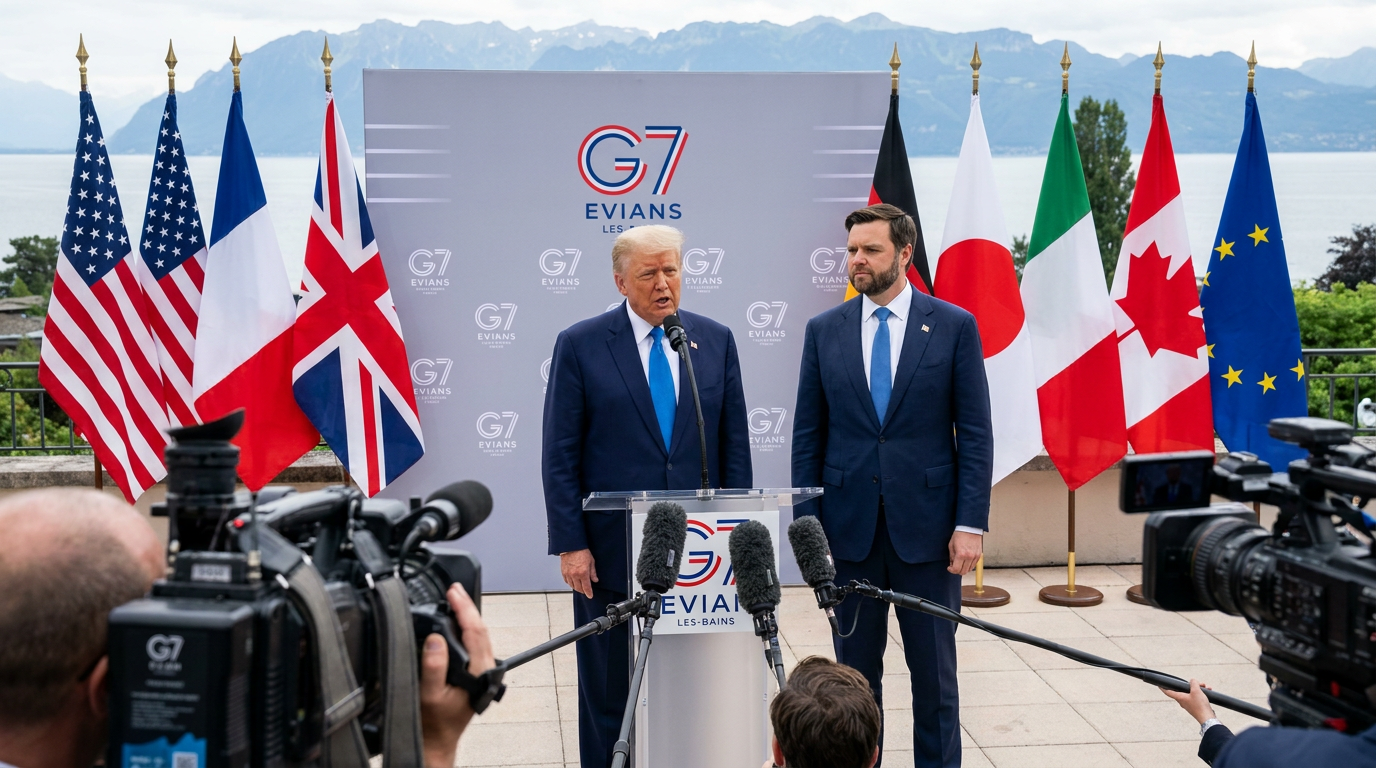
President Donald Trump, speaking from the G7 summit in Evian-les-Bains, France, declared the deal "all signed" and emphasized that the primary objective of the initial military campaign had been achieved. "The only thing that really matters to me is Iran will never have a nuclear weapon, and it says it loud and clear," Trump told reporters, warning of severe consequences if Tehran violated the terms.[4][5][7]
Vice President JD Vance, who will lead the U.S. delegation in Geneva alongside Iranian parliament speaker Mohammad Bagher Ghalibaf, stated that Tehran has agreed to eliminate its stockpile of highly enriched uranium. Under the proposed framework, international inspectors would be allowed back into the country to verify the dilution or removal of the nuclear material.[1][6]
In exchange for these verifiable nuclear concessions, the U.S. is floating a massive economic package. The incentives reportedly include the unfreezing of billions in Iranian assets held abroad, significant sanctions relief, and a potential $300 billion reconstruction fund financed by neighboring Gulf allies to rebuild the war-battered nation.[3][7]

However, the exact sequencing of these economic benefits remains a major point of contention. U.S. officials insist that all financial relief will be strictly tied to Iran's performance and compliance with nuclear inspections, with Vance explicitly stating that "no funds are being released for simply signing a deal."[1][6][7]
Conversely, Iranian state media and officials have signaled expectations for immediate access to frozen funds during the 60-day negotiation window. Tehran is framing the preliminary agreement as a strategic victory against Western economic isolation, setting up a high-stakes diplomatic clash over the timeline of sanctions relief.[2][8]
Conversely, Iranian state media and officials have signaled expectations for immediate access to frozen funds during the 60-day negotiation window.
The most immediate global impact of the MOU is the anticipated reopening of the Strait of Hormuz. Oil prices plummeted to their lowest levels since early March following the announcement, reflecting market relief that the vital shipping lane would soon resume operations.[3][7]

Yet, the terms of the strait's reopening are already heavily disputed. The U.S. administration insists the waterway will be permanently open and "toll-free." Meanwhile, Iranian media suggests Tehran will only pause transit fees for the 60-day negotiation period and intends to resume charging "service fees" thereafter, while jointly managing the strait with Oman.[4][8]
Shipping companies and maritime security firms remain highly cautious. Industry experts note that clearing the heavily mined strait will take weeks, and confidence in the waterway's safety will not return overnight, regardless of the political declarations made in Geneva.[3][7]

Regional security also remains a volatile wildcard. The draft agreement reportedly calls for an end to hostilities on all fronts, which would theoretically include the ongoing conflict between Israel and Hezbollah in Lebanon.[4][8]
Israeli Prime Minister Benjamin Netanyahu has distanced himself from the U.S.-brokered deal. He stated that Israeli forces will remain in southern Lebanon as long as necessary to degrade Hezbollah, and he retained the right to strike Iran unilaterally if Israel deems Tehran is moving toward a nuclear weapon.[4][8]
European allies and diplomatic analysts have expressed deep concern over the ambitious 60-day timeline. They note that Iranian negotiators are highly skilled at buying time, and that dismantling a nuclear program requires extensive, long-term verification protocols that are difficult to finalize in just two months.[5][8]
Back in Washington, the agreement faces domestic political hurdles. Several Republican senators have expressed frustration over being kept in the dark regarding the deal's specifics, demanding a congressional vote to make any final treaty permanent and legally binding.[1]
As the Friday signing ceremony at the Palais des Nations approaches, the world watches to see if this fragile framework can translate into a lasting transformation of Middle Eastern geopolitics, or if it will unravel under the weight of its own contradictions before the 60-day clock expires.[2][3][8]

How we got here
Feb 28, 2026
The U.S. and Israel launch joint military strikes on Iranian targets, sparking a regional war.
March 2026
The Strait of Hormuz is effectively closed, cutting off 20% of global oil supplies and spiking energy prices.
April 2026
A tenuous, temporary ceasefire is announced but is repeatedly violated by regional proxies.
June 14, 2026
U.S. and Iranian leaders digitally sign a memorandum of understanding to end the war.
June 19, 2026
A formal signing ceremony is scheduled to take place in Geneva, Switzerland.
Viewpoints in depth
U.S. Administration's view
The deal is a historic victory that secures global energy markets and permanently neutralizes Iran's nuclear threat.
U.S. officials, led by President Trump and Vice President Vance, frame the agreement as a total vindication of their military and diplomatic strategy. They argue that the initial strikes forced Tehran to the table, resulting in an agreement where Iran must completely eliminate its highly enriched uranium stockpile. The administration insists that the U.S. is giving up no taxpayer money, and that any sanctions relief or unfreezing of assets is strictly conditional on intrusive, long-term international inspections. Furthermore, they view the reopening of the Strait of Hormuz as a permanent, toll-free victory for global commerce.
Iranian Leadership's view
The agreement is a triumph over Western economic isolation that secures vital reconstruction funds and sanctions relief.
Iranian officials and state media portray the 60-day ceasefire as a necessary pivot to rebuild the country's economy while maintaining sovereignty. They emphasize the immediate end to military operations and the expectation that billions in frozen assets will be released during the negotiation window. Crucially, Tehran disputes the U.S. narrative regarding the Strait of Hormuz, suggesting that the pause on transit fees is only temporary and asserting Iran's continued right to jointly manage the vital waterway with Oman.
Global Energy Markets' view
The ceasefire brings immediate relief to oil prices, but long-term stability remains highly uncertain.
Market analysts and shipping executives are breathing a sigh of relief, evidenced by the sharp drop in Brent crude prices following the announcement. However, the maritime industry remains deeply cautious. Security firms warn that the Strait of Hormuz is heavily mined, and clearing operations will take weeks or months. Shippers are hesitant to resume normal transit until the safety of the corridor is guaranteed, and many fear that the tight 60-day negotiation window could collapse, plunging energy markets back into chaos.
Israeli Government's view
The U.S.-Iran deal does not constrain Israel's security imperatives, particularly regarding Hezbollah and nuclear proliferation.
Prime Minister Benjamin Netanyahu has explicitly distanced Israel from the U.S.-brokered memorandum. Israeli leadership views the 60-day window with deep suspicion, arguing that Iranian negotiators will use the time to regroup rather than disarm. Israel has stated unequivocally that it will not adhere to a ceasefire in Lebanon until Hezbollah is sufficiently degraded, and it retains the unilateral right to strike Iranian nuclear facilities if it determines Tehran is using the diplomatic pause to advance a weapons program.
What we don't know
- Whether Iran will actually allow international inspectors to verify the destruction of its highly enriched uranium.
- How quickly the Strait of Hormuz can be cleared of mines and deemed safe for commercial shipping.
- If the $300 billion reconstruction fund will materialize, and which Gulf nations will actually contribute to it.
- How the ongoing conflict between Israel and Hezbollah will impact the broader U.S.-Iran ceasefire.
Key terms
- Strait of Hormuz
- A vital maritime chokepoint between the Persian Gulf and the Gulf of Oman through which roughly 20% of the world's global oil supply passes.
- Highly Enriched Uranium (HEU)
- Uranium that has been processed to a concentration level suitable for use in nuclear weapons, which the U.S. is demanding Iran eliminate.
- Memorandum of Understanding (MOU)
- A formal, non-binding agreement outlining the broad terms of a deal before a final, detailed treaty is negotiated and signed.
Frequently asked
When will the Strait of Hormuz reopen?
The U.S. expects the strait to open immediately following the Friday signing, but maritime experts warn that clearing the waterway of mines could take weeks.
What happens during the 60-day ceasefire?
U.S. and Iranian officials will engage in technical negotiations to finalize the dismantling of Iran's highly enriched uranium stockpile and establish a timeline for sanctions relief.
Will Iran receive financial compensation?
A $300 billion reconstruction fund financed by Gulf allies has been proposed, along with the unfreezing of Iranian assets, but the U.S. insists these are strictly tied to verifiable nuclear compliance.
How does this affect the conflict in Lebanon?
While the draft agreement calls for an end to hostilities on all fronts, Israel has stated it will not withdraw from southern Lebanon until Hezbollah is degraded.
Sources
Source coverage
8 outlets
4 viewpoints surfaced








[1]Fox NewsU.S. Administration
Vance reveals Trump lesson guiding Iran deal strategy as Tehran faces 60-day deadline
Read on Fox News →[2]Al JazeeraIranian Leadership
Geneva to host Iran-US deal event: What other pacts have been signed there?
Read on Al Jazeera →[3]ReutersGlobal Market Watchers
U.S.-Iran deal promises end to war but how it will work remains unclear
Read on Reuters →[4]The GuardianRegional Security Skeptics
US president says strait of Hormuz will be open from Friday but questions remain over waterway fees
Read on The Guardian →[5]Al-MonitorU.S. Administration
Trump: Iran deal says 'loud and clear' that Tehran won't have a nuclear weapon
Read on Al-Monitor →[6]NewsweekU.S. Administration
JD Vance Says Iran Will Eliminate Enriched Uranium in Peace Deal
Read on Newsweek →[7]The Business TimesGlobal Market Watchers
Trump says US-Iran deal is 'all signed', but details remain unclear
Read on The Business Times →[8]Council on Foreign RelationsRegional Security Skeptics
Trump's Iran Deal: What We Know, What's Contested, and What Remains Unresolved
Read on Council on Foreign Relations →

More in news politics
See all 14 stories →Geopolitics
The 2026 US-Iran Security Pact: Mechanisms, Regional Impact, and Enforcement
0 sources
Civic Innovation
Fact Check: Can Citizens' Assemblies Actually Cure Political Polarization?
0 sources

U.S.-Iran Relations
U.S. and Iran Reach Framework Peace Deal to End War and Reopen Strait of Hormuz
0 sources
US-Iran Peace Deal
U.S. and Iran Reach Tentative Peace Deal to End 100-Day War: What the Agreement Covers and Where It Could Fail
0 sources
Every angle. Every day.
Get news politics stories with full source coverage and perspective breakdowns delivered to your inbox.