
Why Neighborhoods Are Trading Ownership for Access in the 'Library of Things' Movement
Communities worldwide are launching shared libraries for tools, camping gear, and appliances, saving households money while drastically reducing environmental waste.
By Factlen Editorial Team
- Circular Economy Advocates
- Focus on the environmental necessity of reducing manufacturing demand and neighborhood waste.
- Community Organizers
- Focus on social cohesion, skill-building, and providing equitable access to resources.
- Pragmatic Consumers
- Focus on the immediate financial savings and spatial efficiency of borrowing over buying.
What's not represented
- · Traditional Retailers
- · Tool Manufacturers
Why this matters
By shifting from individual ownership to community access, households can save hundreds of dollars annually on rarely used items while actively reducing the carbon footprint of their neighborhoods.
Key points
- The average power drill is used for just 13 minutes in its lifetime, highlighting the inefficiency of household ownership.
- Roughly 2,000 formal 'Libraries of Things' now operate globally, lending tools, camping gear, and appliances.
- Borrowing instead of buying saves individual households hundreds of dollars annually while reducing neighborhood waste.
- Beyond environmental benefits, these libraries serve as vital community hubs that host repair cafes and combat social isolation.
The modern residential garage has largely become a museum of underutilized assets, storing expensive equipment that sees the light of day only once or twice a year. Consider the standard power drill: a ubiquitous staple of homeownership that, according to circular economy researchers, is used for an average of just 13 minutes over its entire operational lifetime. Despite this remarkably brief window of utility, millions of households continue to purchase their own individual drills, store them in bulky plastic cases, and let them gather dust on shelves for decades. This staggering inefficiency—multiplied across lawnmowers, camping tents, pressure washers, and pasta makers—represents a massive drain on both household finances and global resources. Recognizing the absurdity of this hyper-consumption, a quiet but profound revolution is taking root in neighborhoods worldwide, challenging the fundamental assumption that access requires ownership.[2][8]
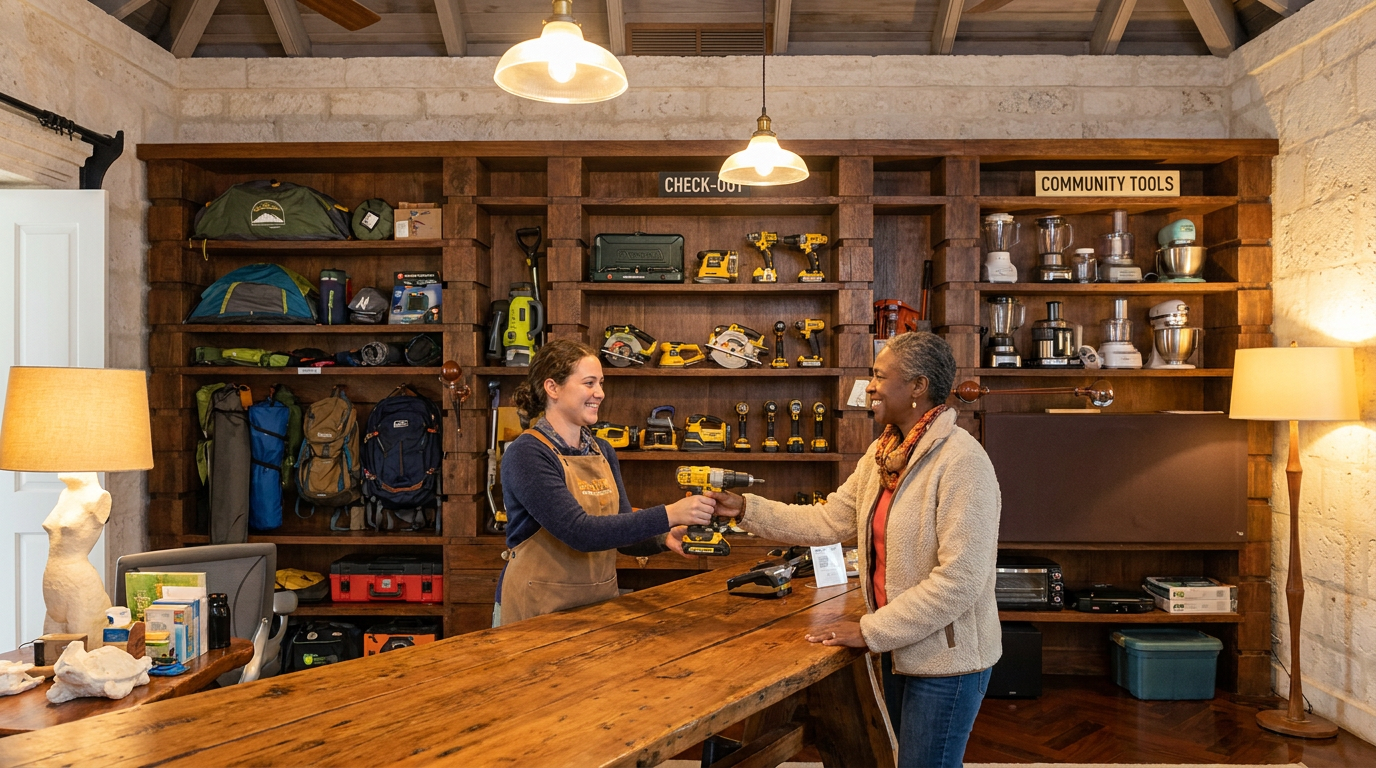
Enter the "Library of Things" (LoT) movement, a localized antidote to the excesses of the modern retail economy. Reimagining the traditional civic infrastructure of book lending, these community hubs lend out physical resources that people need occasionally but do not need to own permanently. Instead of wandering the aisles of a big-box hardware store to buy a tile saw for a single weekend bathroom renovation, residents can simply check one out from their local community center. The concept is scaling rapidly from a niche environmental passion project into a mainstream civic utility. Today, there are roughly 2,000 formal Libraries of Things operating globally. These range from small, volunteer-run sheds operating out of repurposed shipping containers to highly sophisticated, publicly funded programs integrated directly into municipal public library systems.[1][3]

The mechanics of these sharing libraries are simple, yet they fundamentally transform how neighborhoods interact with material goods. Members typically pay a small, sliding-scale annual fee—or simply use their existing free public library card—to gain access to a comprehensive digital inventory of hundreds or thousands of items. Modern iterations of the concept have streamlined the borrowing process to rival the convenience of commercial e-commerce platforms. Patrons can browse catalogs and reserve items online, pick them up during designated community hours, or even access them via automated, self-serve smart lockers installed in accessible locations like shopping malls and transit hubs. This frictionless user experience is crucial for adoption, proving that sustainable consumption does not have to come at the cost of modern convenience.[7]
The immediate economic relief for participating households is substantial, particularly amid rising global costs of living and persistent inflation. For the price of renting a single specialized tool at a commercial hardware store, a member gains year-round access to an entire warehouse of equipment, effectively eliminating the need for high-interest debt or large, infrequent purchases. Data from the Gold Coast Tool Library in Australia vividly illustrates this financial impact at the household level. The organization reports that its members save an average of $600 each by borrowing items instead of purchasing them outright. When aggregated across an entire community, this retained wealth allows families to redirect their spending toward essential needs, local services, or savings, rather than sinking capital into depreciating physical assets.[1][6]

The immediate economic relief for participating households is substantial, particularly amid rising global costs of living and persistent inflation.
This economic model is proving viable far beyond dense, urban centers. In the United Kingdom, the Share Shed operates as the world's first mobile library of things, traveling in a customized van between rural towns in South Devon to bring resources directly to isolated communities. Since its inception, the Share Shed reports saving its users over £420,000 in foregone purchases, demonstrating that the sharing economy can thrive in diverse geographic contexts. Beyond individual household savings, these libraries actively lower the barriers to entry for local economic opportunity. Aspiring tradespeople, landscapers, hobbyists, and small business owners can access professional-grade equipment to launch their ventures without taking on crippling upfront debt, transforming the library into an incubator for grassroots entrepreneurship.[1][5][6]
Equally compelling is the movement's environmental mandate. The sharing economy model directly targets the "material intensity" of modern neighborhoods, challenging the deeply ingrained consumer habit that every home requires its own independent, fully stocked inventory of goods. By pooling resources, communities drastically reduce the aggregate demand for the manufacturing, shipping, and packaging of rarely used items. A single high-quality jigsaw shared among fifty neighbors effectively eliminates the ecological footprint of producing, transporting, and eventually disposing of forty-nine redundant tools. The environmental metrics generated by these initiatives are highly tangible and rigorously tracked. The Share Shed alone estimates it has prevented 275 tons of carbon dioxide emissions simply by keeping a curated inventory of durable products in high-rotation circulation, diverting countless tons of future e-waste and plastic from local landfills.[2][5][8]

Yet, for many organizers and patrons, the most profound impact of the movement is social, extending far beyond ecological metrics or household financial savings. Libraries of Things are increasingly serving as vital "third places"—neutral, welcoming community spaces where neighbors interact, share advice, and build local trust outside of home and work. Many of these spaces host regular repair cafes and skill-building workshops, where experienced volunteers teach residents how to maintain tools, fix broken appliances, and mend clothing. By fostering these intergenerational exchanges of knowledge, the libraries transform passive consumers into capable makers and fixers, combating the isolation of modern suburban life and weaving a tighter, more resilient social fabric.[3][6][7]
These community hubs also champion social inclusion and equity in highly innovative ways. In Lithuania, a network of Libraries of Things has expanded its inventory to provide specialized sensory kits, musical instruments, and educational tools specifically designed for neurodivergent children. By offering these items for free, the libraries remove significant financial barriers for families who might otherwise struggle to afford expensive developmental resources, ensuring that all children have access to the tools they need to thrive. Despite this organic momentum and clear societal benefit, the movement faces structural hurdles. Maintaining a fleet of power tools and complex electronics requires dedicated repair volunteers, and the threat of volunteer burnout is a persistent challenge for independent, grassroots operations.[1][2][4]

Securing affordable commercial space, managing liability insurance, and funding the administrative software required to track thousands of moving parts are constant pressures for volunteer-led libraries operating on shoestring budgets. To ensure long-term survival and scale, many independent sharing libraries are now pursuing strategic partnerships, integrating directly with established public libraries or municipal governments. By embedding the sharing economy into permanent, publicly funded civic infrastructure, these programs can secure stable funding and reach a vastly wider demographic. As the dual pressures of household financial fragility and global ecological crisis continue to converge, the Library of Things offers a highly localized, actionable antidote: a future where community access ultimately triumphs over individual ownership.[1][3][8]
How we got here
1979
The Berkeley Public Library launches a tool lending library in California, pioneering the modern municipal sharing model.
Mid-2010s
The concept expands beyond tools, with independent Libraries of Things opening in Europe and North America to lend varied household goods.
2017
The Share Shed launches in the UK as the world's first mobile, traveling library of things, bringing resources directly to rural towns.
2020s
The movement accelerates post-pandemic as communities seek resilient, localized solutions to supply chain disruptions and inflation.
2024–2026
Major public library systems globally begin formally integrating Library of Things collections and self-serve smart lockers into their standard offerings.
Viewpoints in depth
Circular Economy Advocates
Focus on the environmental necessity of reducing manufacturing and waste.
This camp argues that the current model of hyper-consumption is ecologically unsustainable. By pointing to statistics like the 13-minute average lifespan of a power drill, they emphasize that communities must transition from ownership to access. Their primary goal is lowering the "material intensity" of neighborhoods, keeping products in circulation longer, and drastically reducing the carbon emissions tied to shipping and packaging rarely used goods.
Community Organizers
Focus on social cohesion, skill-building, and equitable access.
For organizers, the environmental benefits are secondary to the social impact. They view Libraries of Things as vital civic infrastructure that combats isolation and builds local resilience. By hosting repair cafes and offering free access to educational or sensory tools, they argue these spaces democratize opportunity. Their focus is on creating inclusive "third places" where neighbors interact, share knowledge, and support one another regardless of income.
Pragmatic Consumers
Focus on the immediate financial and spatial benefits of borrowing.
This perspective is driven by household economics and convenience. Pragmatic users are drawn to the sharing economy because it saves them hundreds of dollars a year and frees up valuable storage space in their homes. They value the practical utility of accessing a pressure washer or a dehydrator for a weekend without the burden of maintenance, upfront costs, or long-term storage, viewing the library primarily as a smart financial utility.
What we don't know
- How the insurance and liability landscape will adapt to cover high-risk shared items like chainsaws or heavy machinery at scale.
- Whether major tool manufacturers will actively oppose the sharing economy or pivot to support commercial leasing models.
Key terms
- Library of Things (LoT)
- A community-based lending system that allows people to borrow physical resources—like tools and appliances—instead of purchasing them.
- Circular Economy
- An economic model focused on minimizing waste and making the most of resources by sharing, repairing, and recycling existing products.
- Material Intensity
- The total amount of physical materials and resources required to support a household or community's lifestyle.
- Repair Cafe
- A community gathering where volunteers with technical skills help neighbors fix broken household items for free.
- Third Place
- A social environment separate from the two usual social environments of home and the workplace, crucial for community building.
Frequently asked
What exactly can I borrow from a Library of Things?
While inventories vary, most offer power tools, gardening equipment, camping gear, kitchen appliances, and party supplies. Some also provide specialized items like sensory kits or musical instruments.
How much does it cost to join?
Many are entirely free, especially those integrated into public library systems. Independent community libraries typically charge a small annual membership fee or operate on a pay-as-you-go model.
Who pays for the broken tools?
Most libraries factor general wear and tear into their operating budgets and rely on volunteer repair cafes to fix items. Members are rarely charged for accidental breakage, though chronic misuse may lead to suspended privileges.
How do these libraries get their inventory?
The vast majority of items are donated by community members decluttering their homes. Libraries also use grant funding to purchase high-demand, durable goods.
Sources
Source coverage
8 outlets
3 viewpoints surfaced






[1]ShareableCommunity Organizers
Library of Things Toolkit
Read on Shareable →[2]Ellen MacArthur FoundationCircular Economy Advocates
How tool sharing could become a public utility
Read on Ellen MacArthur Foundation →[3]SBS AustraliaPragmatic Consumers
Make-Do library of things
Read on SBS Australia →[4]European UnionCommunity Organizers
The Library of Things
Read on European Union →[5]Share Shed UKCircular Economy Advocates
The world's first travelling library of things
Read on Share Shed UK →[6]Gold Coast Tool LibraryPragmatic Consumers
Our Impact
Read on Gold Coast Tool Library →[7]MediumCommunity Organizers
We want the Amazon rainforest to outlast Amazon.com
Read on Medium →[8]Factlen Editorial Team
Synthesis by Factlen editorial team
Read on Factlen Editorial Team →
Every angle. Every day.
Get community stories with full source coverage and perspective breakdowns delivered to your inbox.