
How Small Language Models Are Moving AI From the Cloud to Your Laptop
A new generation of highly efficient AI models can now run entirely offline on consumer hardware, offering ChatGPT-like capabilities without privacy risks or subscription fees.
By Factlen Editorial Team
- Enterprise & Edge Developers
- Focus on the cost savings and deployment flexibility of SLMs.
- Privacy & Security Advocates
- Value the data sovereignty of offline AI.
- Open-Source Community
- Celebrate the democratization and accessibility of AI tools.
What's not represented
- · Hardware manufacturers profiting from the push for AI-capable laptops
- · Cloud providers facing potential revenue loss from local inference
Why this matters
Running AI locally means your data never leaves your device, eliminating privacy concerns while bypassing the subscription costs of cloud-based chatbots. It democratizes access to powerful technology, allowing anyone with a standard laptop to deploy custom AI assistants.
Key points
- Small Language Models (SLMs) under 10 billion parameters can now run fully offline on standard laptops and smartphones.
- Local inference guarantees data privacy, as prompts and documents never leave the user's device.
- Running models locally eliminates the recurring API fees and subscription costs associated with cloud AI.
- Quantization technology compresses model file sizes by up to 75%, making them viable for consumer hardware.
- A hybrid approach is emerging, where local models handle daily tasks and cloud models tackle complex reasoning.
For the past four years, the generative AI revolution has been tethered to massive cloud data centers. Every prompt typed into ChatGPT, Claude, or Gemini travels to a remote server farm, processed by models so massive they require thousands of specialized graphics cards to function. But a parallel shift is rapidly decentralizing the technology. A new class of highly efficient "Small Language Models" (SLMs) has matured to the point where they can run entirely offline on standard consumer hardware.[7]
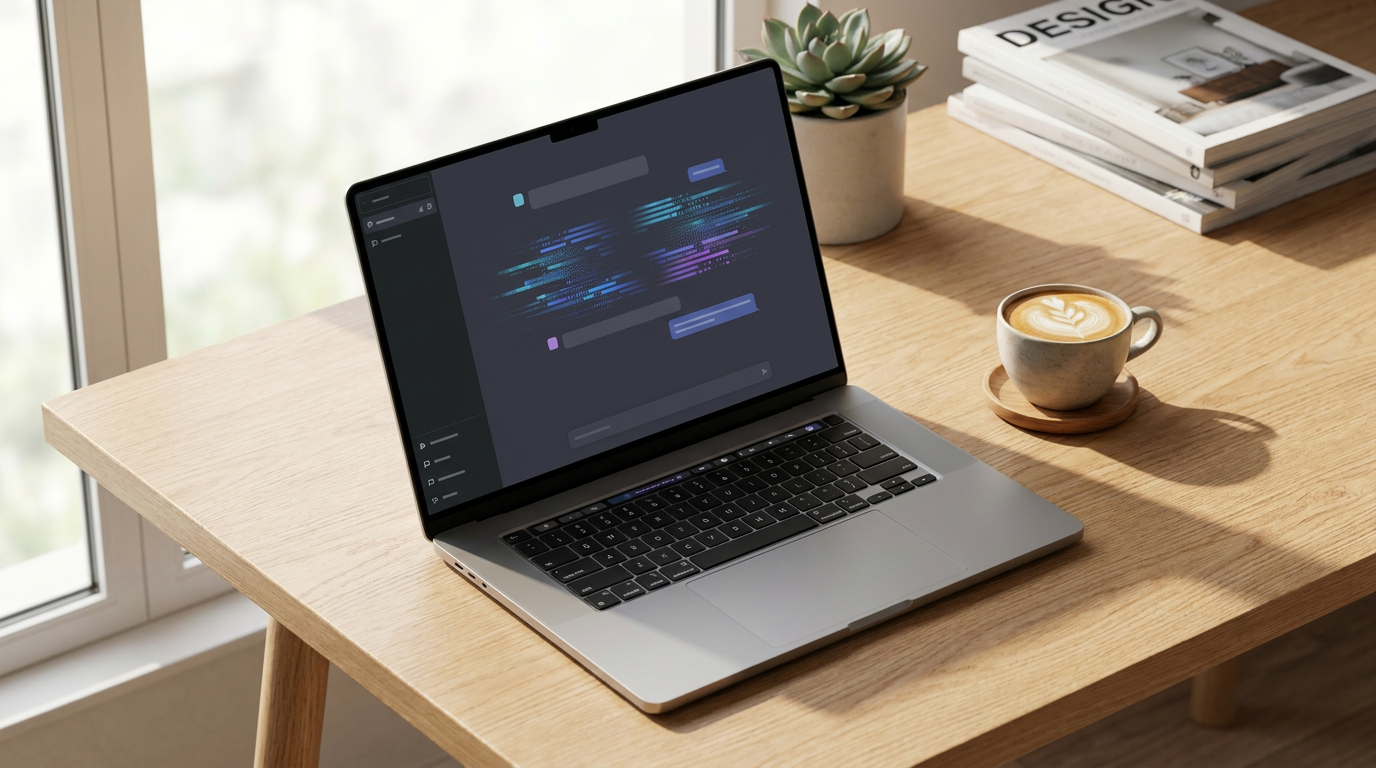
These compact models are fundamentally changing who controls AI and where it can be deployed. By shrinking the neural networks to a fraction of their original size, developers have created systems that fit comfortably on a standard 8-gigabyte laptop or a modern smartphone. The result is a ChatGPT-like experience that requires no internet connection, charges no subscription fees, and guarantees absolute data privacy.[3][5][7]
To understand the shift, it helps to look at the architecture. Frontier large language models (LLMs) often contain hundreds of billions—or even trillions—of parameters, which act as the artificial synapses storing the model's knowledge. In contrast, SLMs typically range from 1 billion to 10 billion parameters. While they sacrifice the encyclopedic world knowledge of their massive counterparts, they retain the core reasoning, summarization, and text-generation capabilities that make AI useful for daily tasks.[2][4]

The primary driver behind the local AI movement is privacy. According to industry analysts, data security remains the top barrier for enterprise AI adoption. When a user pastes proprietary code, financial documents, or personal health symptoms into a cloud-based chatbot, that data leaves their machine. Local inference solves this cleanly: because the model file lives entirely on the user's hard drive, the data never touches the internet.[5][7]
Cost is the second major catalyst. Cloud AI relies on expensive API calls or monthly subscriptions that scale with usage. For businesses running millions of inferences daily, or developers building AI-integrated applications, cloud costs can quickly become prohibitive. Small language models eliminate these recurring fees entirely, allowing users to generate unlimited text, code, or summaries using the computing power they already own.[3][4][7]
Making these models fit on consumer hardware requires a technical process called quantization. In simple terms, quantization compresses the mathematical precision of the model's weights—often reducing them from 16-bit floating-point numbers to 4-bit integers. This technique shrinks the file size by roughly 60 to 75 percent with only a negligible drop in output quality. A model that would normally require 16 gigabytes of memory can be squeezed into just 4 gigabytes, making it viable for everyday laptops.[4][5]
The software ecosystem supporting local AI has also become remarkably user-friendly, removing the technical barriers that once kept these tools in the hands of specialized engineers. In the past, running an open-source model required complex Python environments, dependency management, and command-line expertise. Today, applications like Ollama, LM Studio, and Jan act as universal "players" for AI models. Users simply download the software, select a model from an intuitive in-app menu, and begin chatting in a familiar interface that mimics the ease of commercial cloud chatbots.[5][6]
In the past, running an open-source model required complex Python environments, dependency management, and command-line expertise.
The landscape of available models in 2026 is highly competitive, with major tech companies releasing open-weight SLMs optimized for different specialized tasks. Microsoft's Phi-4 family has become a standout for logic, mathematics, and coding applications. Despite having only 3.8 billion parameters, the Phi-4-mini model consistently outperforms much larger systems on graduate-level reasoning benchmarks. This efficiency proves that highly curated, high-quality training data—often generated synthetically—can successfully trump raw parameter scale when building specialized models. Developers are increasingly adopting Phi-4-mini for complex analytical workflows where accuracy is paramount.[1][3]

Google has aggressively entered the local space with its Gemma 4 series, built on the same research foundation as its flagship Gemini models. The Gemma 4 models are multimodal, meaning they can process both text and images directly on the device without requiring external vision APIs. The 4-billion parameter variant (Gemma 4 E4B) has become particularly popular among developers for its balance of speed and capability. It runs smoothly on standard laptops while offering robust instruction following, making it an ideal candidate for personal desktop assistants.[5][6]
Meta's Llama 3.2 lineup remains a foundational pillar of the open-source community, offering a range of sizes for different hardware constraints. Their ultra-lightweight 1-billion parameter model is specifically designed for mobile and edge deployments where computing power is severely limited. Fitting into just 2 to 3 gigabytes of memory, it allows developers to build AI features directly into smartphone apps without relying on a network connection. This makes it ideal for real-time travel translation, offline virtual assistants, and privacy-first health applications.[4]
Beyond general chat, SLMs are increasingly being customized for specific workflows. Because of their small size, they are vastly cheaper and faster to "fine-tune" on proprietary data. A law firm, for example, can train a 3-billion parameter model exclusively on legal contracts, creating a highly specialized assistant that outperforms a generic cloud model on legal analysis while keeping all client data strictly in-house.[1][2][4]
Another major enterprise use case driving SLM adoption is Retrieval-Augmented Generation (RAG). In a local RAG setup, the AI is securely connected to a user's personal folders or a company's internal knowledge base. A user can ask complex questions like, "Summarize the key financial risks from last week's marketing PDFs," and the local model will scan the specific documents to generate an accurate, cited answer. Crucially, this entire process happens without uploading a single proprietary file to an external cloud server.[4][5]
Despite their rapid advancement and undeniable utility, SLMs are not a complete replacement for frontier cloud models. Because of their compressed size, they inherently struggle with tasks that require broad, obscure world knowledge; they simply do not have the parameter count to memorize the entire internet. Furthermore, they are more prone to hallucination when asked to perform complex, multi-step chain-of-thought reasoning across multiple domains simultaneously, a task where massive scale still reigns supreme.[4]
For exploratory scientific research, creative writing that requires deep thematic nuance, or highly complex coding architectures, massive models like GPT-4 or Claude 3.5 remain the necessary standard. Industry experts suggest that the future of enterprise and consumer AI is not a binary choice between local and cloud deployments, but rather a sophisticated hybrid routing approach that leverages the strengths of both paradigms. This ensures that users get the speed and privacy of local models without sacrificing the raw power of the cloud when it is truly needed.[4]

In a hybrid system, a lightweight local model acts as the first line of defense, handling 80 to 90 percent of routine daily tasks. Activities like drafting emails, summarizing text, formatting data, or answering basic questions are processed instantly and privately on the device. Only when a prompt exceeds the local model's capabilities—such as a request for advanced strategic analysis or obscure trivia—is it securely routed to a massive cloud LLM for heavy lifting.[3]
As hardware manufacturers increasingly build dedicated Neural Processing Units (NPUs) into standard laptops and smartphones, the performance and efficiency of local models will only accelerate. The era of AI existing solely as a remote, metered utility is rapidly ending. By moving the intelligence directly to the edge device, small language models are democratizing the technology—making AI more personal, more private, and universally accessible to anyone with a computer.[2][7]
How we got here
Early 2023
The release of LLaMA sparks the open-source AI movement, leading to tools that allow models to run on consumer hardware.
Late 2023
Quantization techniques like GGUF become standard, drastically reducing the RAM required for local inference.
2024
Major tech companies begin releasing official 'small' variants of their flagship models, such as Microsoft's Phi-3 and Google's Gemma.
2025
Local AI software like Ollama and LM Studio mature, providing one-click graphical interfaces for offline models.
2026
Highly capable models like Phi-4-mini and Gemma 4 launch, rivaling the performance of early cloud-based LLMs while running entirely on laptops.
Viewpoints in depth
Privacy Advocates
Focus on data sovereignty and keeping personal information off cloud servers.
For privacy advocates, local AI is the only secure path forward. They argue that sending proprietary code, financial documents, or personal health queries to cloud providers creates unacceptable data vulnerabilities. By running models locally, users achieve 'air-gapped' security, ensuring that sensitive information never leaves the physical device.
Enterprise Developers
Prioritize cost reduction, latency, and domain-specific fine-tuning.
Developers view SLMs as an economic necessity. Cloud API costs scale linearly with usage, making high-volume AI applications prohibitively expensive. By deploying quantized local models, enterprises can eliminate recurring inference fees, reduce latency by avoiding network round-trips, and easily fine-tune smaller models on their own proprietary data.
Frontier AI Labs
Maintain that massive cloud models are required for complex reasoning and broad knowledge.
The developers of massive frontier models emphasize the limitations of SLMs. They point out that while local models are excellent for summarization and basic coding, they lack the encyclopedic world knowledge and multi-step reasoning capabilities of trillion-parameter systems. They advocate for a hybrid future where local models handle basic routing, but the cloud remains the engine for heavy cognitive lifting.
What we don't know
- How quickly hardware manufacturers will standardize Neural Processing Units (NPUs) across all consumer devices to further accelerate local AI.
- Whether frontier AI labs will eventually find ways to compress broad world knowledge into small models without losing accuracy.
Key terms
- Small Language Model (SLM)
- An AI model typically under 10 billion parameters, designed to run efficiently on consumer hardware.
- Quantization
- A compression technique that reduces the mathematical precision of an AI model, shrinking its file size so it can run on devices with limited memory.
- Inference
- The process of an AI model generating a response or prediction based on a user's prompt.
- Parameters
- The internal variables or 'artificial synapses' that an AI model uses to store its training and make decisions.
- Retrieval-Augmented Generation (RAG)
- A technique where an AI model searches through a specific set of documents to find facts before generating an answer.
Frequently asked
Do I need a powerful GPU to run local AI?
No. Thanks to quantization, many modern Small Language Models can run smoothly on a standard laptop with 8GB of RAM using just the CPU.
Does local AI require an internet connection?
Only once, to download the model file and the software. After that, the AI runs completely offline, even in airplane mode.
Are local models as smart as ChatGPT?
They are highly capable for specific tasks like summarization, drafting, and basic coding, but they lack the broad encyclopedic knowledge and complex reasoning of massive cloud models.
Is it legal to use these models for business?
Most open-weight models, like Llama and Phi, come with licenses that permit both personal and commercial use, though specific terms vary by model.
Sources
Source coverage
7 outlets
3 viewpoints surfaced







[1]BentoMLEnterprise & Edge Developers
The Best Open-Source Small Language Models (SLMs) in 2026
Read on BentoML →[2]Hugging FaceOpen-Source Community
Small Language Models (SLM): A Comprehensive Overview
Read on Hugging Face →[3]Local AI MasterEnterprise & Edge Developers
Best Small Language Models 2026: 12 SLMs for 8GB RAM
Read on Local AI Master →[4]CogitXEnterprise & Edge Developers
Small Language Models (SLMs): Comprehensive Guide 2026
Read on CogitX →[5]AIThinkerLabPrivacy & Security Advocates
How to Run AI Models Locally in 2026 (8 Tested Offline Tools)
Read on AIThinkerLab →[6]Teachers TechOpen-Source Community
Google Gemma 4 Tutorial - Run AI Locally for Free
Read on Teachers Tech →[7]Factlen Editorial TeamPrivacy & Security Advocates
Synthesis by Factlen editorial team
Read on Factlen Editorial Team →


Every angle. Every day.
Get ai stories with full source coverage and perspective breakdowns delivered to your inbox.