
The Microbiology of Sourdough: How Wild Yeast and Bacteria Transform Flour and Water
A deep dive into the symbiotic ecosystem of sourdough starters, revealing how lactic acid bacteria and wild yeast cooperate to leaven bread, develop complex flavors, and improve nutritional value.
By Factlen Editorial Team
- Microbiologists & Researchers
- Focus on the ecological dynamics, microbiome diversity, and metabolic pathways of the SCOBY.
- Culinary Scientists & Bakers
- Focus on manipulating temperature, hydration, and flour types to control flavor profiles and dough mechanics.
- Factlen Editorial
- Synthesizing the bridge between laboratory analysis and practical home baking.
What's not represented
- · Commercial Yeast Manufacturers
- · Gluten-Free Bakers
Why this matters
Understanding the microbiology of sourdough elevates home baking from guesswork to applied science. By mastering the variables of temperature and hydration, bakers can actively control the flavor, texture, and nutritional benefits of their bread.
Key points
- A sourdough starter is a symbiotic culture of wild yeast and lactic acid bacteria.
- Bacteria outnumber yeast by roughly 100 to 1 in a mature, healthy starter.
- Yeast provides leavening power, while bacteria produce the acids that create flavor and preserve the culture.
- Bakers can control flavor profiles by adjusting hydration and temperature to favor either lactic or acetic acid.
- Sourdough fermentation breaks down phytic acid and gluten proteins, improving the bread's nutritional bioavailability.
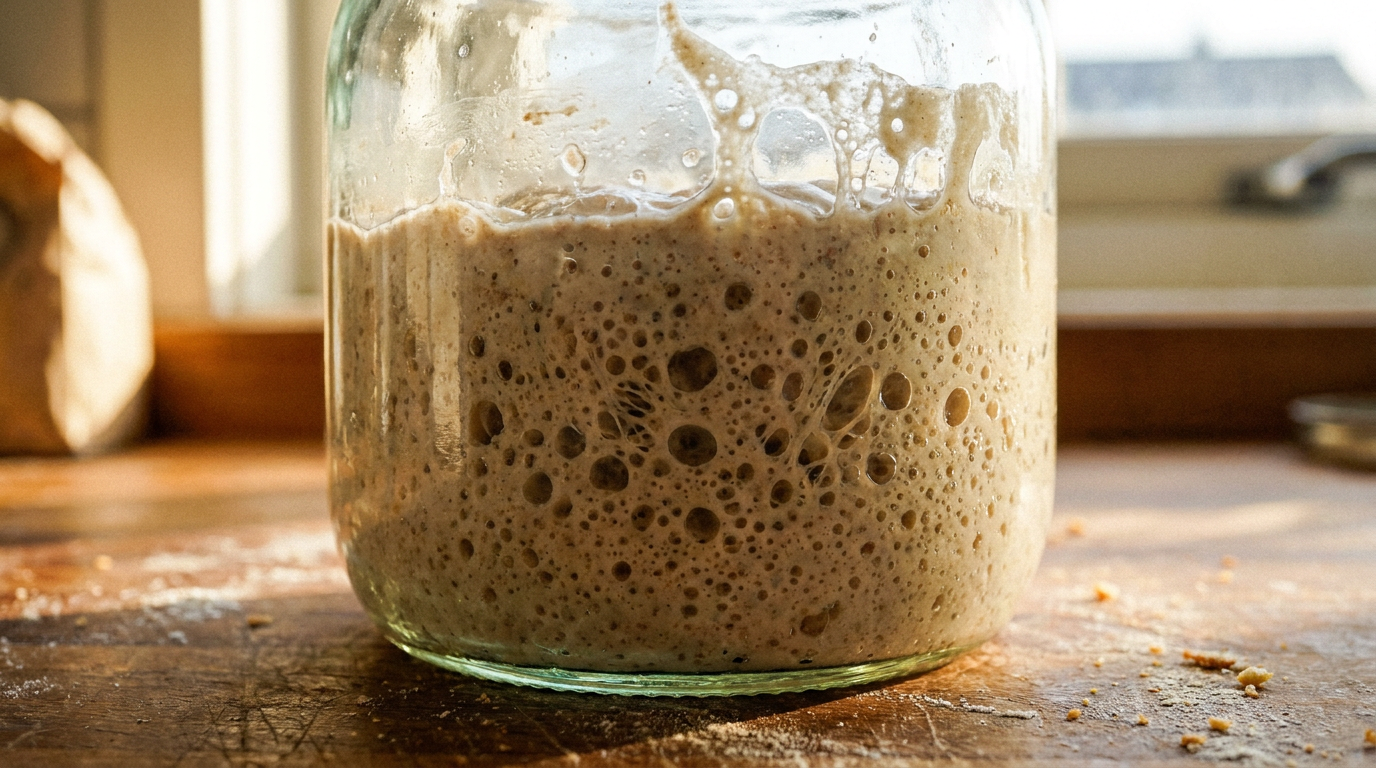
For thousands of years, bread was a wild, unpredictable collaboration between humans and invisible microbes. It wasn't until the commercialization of isolated baker's yeast in the late 19th century that baking became a standardized, rapid process. Yet, the modern culinary world is experiencing a massive resurgence in traditional sourdough baking, driven not just by a desire for artisanal aesthetics, but by a growing appreciation for the complex science occurring inside the jar. A sourdough starter is not merely a mixture of flour and water; it is a thriving, microscopic metropolis.[1][2]
At its core, a sourdough starter is a Symbiotic Culture of Bacteria and Yeast, often abbreviated as a SCOBY. When a baker mixes flour and water and leaves it at room temperature, they are setting a trap for wild microorganisms naturally present on the grain and in the environment. Over the course of a week or two, a brutal microscopic turf war takes place. Eventually, a stable, cooperative ecosystem emerges, dominated by two primary players: wild yeasts and lactic acid bacteria.[3][7]
The wild yeasts, primarily strains of Saccharomyces cerevisiae or Candida species, are the engines of leavening. Unlike commercial baker's yeast, which is bred for explosive, single-minded carbon dioxide production, wild yeasts work more slowly. As they consume the simple sugars present in the flour, they release carbon dioxide gas and ethanol. This gas becomes trapped in the dough's elastic gluten network, creating the air pockets that give bread its rise and airy crumb structure.[1][5]

However, the yeast is only a fraction of the story. The true character of a sourdough starter comes from the lactic acid bacteria, predominantly Lactobacillus species. In a healthy, mature starter, these bacteria outnumber the yeast by a staggering ratio of roughly 100 to 1. The bacterial population can reach densities of 100 million to 1 billion colony-forming units per gram, creating an incredibly dense and active microbial community.[3][6]
These bacteria are responsible for the signature sour flavor profile of the bread. As they metabolize sugars, they produce organic acids as byproducts. The specific types of acids produced—primarily lactic acid and acetic acid—dictate the final flavor profile of the bread. Lactic acid imparts a smooth, creamy, yogurt-like tang, while acetic acid provides a sharper, more pungent, vinegar-like bite. The balance between these two acids is the holy grail of artisanal baking.[1][7]
The relationship between the yeast and the bacteria is a masterpiece of evolutionary symbiosis. They manage to coexist in a confined space without outcompeting each other because they largely consume different types of carbohydrates. Furthermore, the yeast cells produce amino acids and vitamins that the bacteria need to thrive. In return, the bacteria produce acids that drop the pH of the starter to between 3.5 and 4.5.[3][4]

This highly acidic environment is crucial for the starter's survival. The low pH acts as a microscopic defense mechanism, killing off harmful pathogens, mold spores, and competing spoilage bacteria that would otherwise rot the flour mixture. The wild yeasts in the starter have evolved to tolerate this acidic environment, allowing the symbiotic pair to dominate the jar and keep the culture safe and stable for decades, or even centuries, if properly maintained.[2][6]
This highly acidic environment is crucial for the starter's survival.
For the home baker, understanding this microbiology transforms baking from blind recipe-following into applied science. By manipulating the environment of the starter, a baker can actively steer the microbial population to favor certain flavor profiles. The two most powerful levers at a baker's disposal are hydration, which is the ratio of water to flour, and temperature.[1][7]
Hydration plays a profound role in acid development. A liquid starter—one maintained with equal parts water and flour by weight—creates an environment that heavily favors the production of lactic acid. The resulting bread will have a milder, more dairy-like tang. Conversely, maintaining a stiff starter with a lower water content restricts the mobility of the microbes and increases oxygen exposure, which encourages the bacteria to produce more acetic acid, resulting in a sharper, more aggressively sour loaf.[1][2]
Temperature is equally critical. Lactic acid bacteria generally thrive at warmer temperatures, peaking in activity between 77°F and 82°F. Keeping a starter in this warm zone will accelerate bacterial fermentation and boost lactic acid production. Wild yeast, however, prefers slightly cooler temperatures. By fermenting the dough slowly in a refrigerator, a process known as cold retarding, bakers suppress bacterial acid production while allowing the yeast to continue slowly developing complex flavor compounds and carbon dioxide.[1][3]

The type of flour used to feed the starter also dictates the microbial diet. Whole grain flours, such as whole wheat or rye, contain higher levels of ash, micronutrients, and complex carbohydrates than highly refined white flour. Rye flour, in particular, is famous among bakers for acting as a superfood for a sluggish starter, providing a massive influx of nutrients and enzymes that trigger explosive bacterial and yeast growth.[2][7]
Recent advancements in high-throughput genetic sequencing have allowed scientists to map the exact microbiomes of sourdough starters from around the world. A landmark study analyzed hundreds of homemade starters and found astonishing diversity. While Saccharomyces and Lactobacillus are almost always present, the specific subspecies vary wildly depending on the geographic location, the type of flour used, and even the unique microbiome of the baker's own hands.[4][5]
This research suggests that a sourdough starter truly takes on the terroir of its environment. A starter born in a San Francisco bakery will have a distinct genetic makeup compared to one cultivated in a Parisian kitchen or a Tokyo apartment. Even if a baker transports a famous heritage starter across the globe, the local flour and environmental microbes will eventually colonize it, shifting its genetic profile over time.[4][6]
Beyond flavor and leavening, the microbial activity in sourdough provides significant nutritional benefits. The prolonged fermentation process allows the bacteria to produce enzymes like phytase, which breaks down phytic acid—a compound in wheat that inhibits the human body's absorption of minerals like iron, zinc, and magnesium. By neutralizing phytic acid, sourdough fermentation makes the bread's nutrients more bioavailable.[6][7]

Additionally, the extended bacterial fermentation begins the process of breaking down gluten proteins before the bread even enters the oven. While sourdough is not safe for individuals with celiac disease, many people with mild non-celiac gluten sensitivities report that long-fermented sourdough is significantly easier to digest than commercially yeasted bread. The organic acids also slow the rate at which the bread's starches are absorbed into the bloodstream, resulting in a lower glycemic index.[3][7]
Ultimately, the science of sourdough is a testament to the power of harnessing the invisible world. Every time a baker feeds their starter, they are tending to a microscopic flock, balancing the needs of billions of organisms. The perfect loaf of bread is not just a culinary achievement; it is the physical manifestation of a carefully orchestrated microbial symphony.[1][7]
How we got here
Pre-19th Century
All leavened bread is made using wild sourdough cultures, relying on naturally occurring yeast and bacteria.
Late 1800s
Commercial baker's yeast is introduced, prioritizing speed and consistency over complex flavor.
1990s–2000s
Artisan bakers begin reviving traditional sourdough methods, sparking a renewed interest in wild fermentation.
2020s
Advances in high-throughput genetic sequencing allow microbiologists to map the exact microbial diversity of starters worldwide.
Viewpoints in depth
Microbiologists & Researchers
Focusing on the ecological dynamics and genetic diversity of the starter microbiome.
For microbiologists, a sourdough starter is a model ecosystem for studying microbial competition and symbiosis. Researchers emphasize that the starter is not a static culture, but a highly dynamic environment that constantly adapts to its surroundings. High-throughput sequencing has revealed that while the core functional groups remain the same, the specific strains of yeast and bacteria shift based on the flour's origin, the local climate, and the microbiome of the baker's hands, making every starter genetically unique.
Culinary Scientists & Bakers
Focusing on manipulating the microbial environment to optimize flavor and dough mechanics.
Culinary professionals view the starter through the lens of applied physics and chemistry. Their primary concern is how to manipulate variables like hydration, temperature, and feeding schedules to achieve a specific culinary result. By understanding that liquid starters favor lactic acid and stiff starters favor acetic acid, bakers can engineer their bread's flavor profile. They also focus on how the organic acids affect the dough's rheology—specifically how acidity tightens the gluten network, requiring careful timing to prevent the dough from degrading before it hits the oven.
Factlen Editorial
Synthesizing the bridge between laboratory analysis and practical home baking.
The true magic of sourdough lies at the intersection of these two disciplines. While the genetic mapping of microbes provides fascinating insights into the 'terroir' of bread, it is the practical application of this science that empowers the home baker. By demystifying the SCOBY and explaining the 'why' behind the 'how,' we move away from the rigid dogma of traditional recipes and allow bakers to intuitively guide their microbial flocks, resulting in better, more consistent, and healthier bread.
What we don't know
- The exact degree to which a baker's personal hand microbiome influences the long-term genetic makeup of their starter.
- How rapidly a heritage starter fully adapts and changes its microbial profile when moved to a new geographic location.
- The precise mechanisms by which certain rare yeast strains survive the highly acidic environment created by the bacteria.
Key terms
- SCOBY
- An acronym for Symbiotic Culture of Bacteria and Yeast, referring to the cooperative microbial ecosystem that powers a sourdough starter.
- Lactic Acid Bacteria (LAB)
- A broad group of bacteria that ferment carbohydrates into lactic acid, responsible for the characteristic tang and preservative qualities of sourdough.
- CFU/g
- Colony-Forming Units per gram, a scientific measurement used to quantify the number of viable bacterial or fungal cells in a sample.
- Hydration
- In baking, the ratio of water to flour by weight, which significantly impacts the metabolic activity and acid production of the starter.
- Phytic Acid
- A compound found in the bran of whole grains that binds to minerals, preventing their absorption in the human digestive tract; it is broken down by sourdough fermentation.
Frequently asked
Why does my sourdough starter smell like nail polish remover?
A smell of acetone or nail polish remover indicates that the starter is hungry and the yeast is stressed. It means the microbes have exhausted their food supply and are producing alternative byproducts; it can be fixed with a regular feeding schedule.
Can a sourdough starter really be hundreds of years old?
Yes, if continuously fed, the microbial lineage can survive indefinitely. However, the specific strains of bacteria and yeast will evolve and change over time as they adapt to new flours and environments.
Why is my starter producing a dark liquid on top?
This liquid, known as 'hooch,' is primarily alcohol and water produced by the yeast when the starter runs out of food. It is harmless and can be poured off or stirred back in before feeding.
Is sourdough bread actually gluten-free?
No. While the long fermentation process breaks down some of the gluten proteins, making it easier to digest for those with mild sensitivities, sourdough still contains gluten and is not safe for people with celiac disease.
Sources
Source coverage
7 outlets
3 viewpoints surfaced







[1]Serious EatsCulinary Scientists & Bakers
The Science of Sourdough Starters: How Temperature and Hydration Affect Flavor
Read on Serious Eats →[2]WiredCulinary Scientists & Bakers
The Complex, Microscopic Ecosystem Inside Your Sourdough Starter
Read on Wired →[3]American Society for MicrobiologyMicrobiologists & Researchers
The Microbial Ecology of Sourdough Fermentation
Read on American Society for Microbiology →[4]NatureMicrobiologists & Researchers
Microbiome diversity in homemade sourdough starters
Read on Nature →[5]Applied and Environmental MicrobiologyMicrobiologists & Researchers
Quantitative Profiling of Fungal Communities in Sourdough Starters
Read on Applied and Environmental Microbiology →[6]Harvard Science in the NewsMicrobiologists & Researchers
The Sourdough Microbiome: The Science of Artisanal Bread
Read on Harvard Science in the News →[7]Factlen Editorial TeamFactlen Editorial
Synthesis by Factlen editorial team
Read on Factlen Editorial Team →
Every angle. Every day.
Get food drink stories with full source coverage and perspective breakdowns delivered to your inbox.