
From Chatbots to Digital Workers: How Agentic Workflows and Multi-Agent Systems are Rewiring AI
Artificial intelligence is moving beyond conversational chatbots to autonomous 'agentic workflows' that can plan, execute, and self-correct. By deploying teams of specialized AI agents, organizations are automating complex tasks that previously required human intervention.
By Factlen Editorial Team
- Enterprise Integrators
- Focused on replacing brittle automation with resilient, ROI-driven AI systems.
- AI Developers & Researchers
- Focused on architectural frameworks and the iterative path toward artificial general intelligence.
- Workflow Automation Builders
- Focused on democratizing multi-agent capabilities for everyday knowledge workers.
- Factlen Editorial Team
- Synthesizing the broader shift from chatbots to digital workers.
What's not represented
- · Entry-level knowledge workers whose routine tasks are being automated
- · Cybersecurity professionals managing the expanded attack surface of autonomous agents
Why this matters
The shift from single-prompt chatbots to autonomous AI agents means software can now handle complex, multi-step tasks without constant human hand-holding. This transition is turning AI from a brainstorming tool into an execution engine, fundamentally changing how businesses operate and how knowledge workers spend their time.
Key points
- Agentic workflows allow AI to plan, execute, and self-correct rather than just answering prompts.
- Multi-agent systems divide complex tasks among specialized AI models to increase speed and accuracy.
- Iterative reasoning allows older, smaller AI models to outperform newer models using single prompts.
- Frameworks like AutoGen use conversational collaboration, while CrewAI uses rigid role-based structures.
- Enterprise adoption is accelerating, with 40% of applications expected to feature AI agents by 2026.
The era of the chatbot is quietly ending, making way for something far more capable. For the past three years, the dominant way to interact with artificial intelligence has been strictly conversational: a human types a prompt, and a Large Language Model generates a response. But this "zero-shot" approach is fundamentally limited by its linear nature. It is the equivalent of asking a human to write a complex essay from the first word to the last without ever being allowed to use the backspace key. While impressive as a parlor trick, it is a brittle foundation for enterprise software. In 2026, the technology industry is undergoing a massive architectural shift toward "agentic workflows"—systems where AI does not just answer questions, but actively plans, executes, and refines complex tasks over time. Instead of acting as a static digital encyclopedia, the AI is evolving into an autonomous digital worker capable of navigating ambiguity.[9]
To understand the magnitude of this leap, it is helpful to look at traditional automation tools like Robotic Process Automation, which have powered corporate efficiency for the last decade. These systems are highly effective but entirely rigid, operating on strict "if this, then that" rules. If an incoming invoice is missing a standard field, or a vendor website changes its layout, the automation simply breaks, throwing an error code and requiring human intervention to fix the pipeline. Traditional automation acts like a conveyor belt: it moves items perfectly along a fixed path, but it possesses zero capacity to improvise when a package falls off the line.[1][3]
Agentic workflows introduce a dynamic reasoning layer to this process, fundamentally changing how software handles failure. When an AI agent encounters an unexpected error or a missing piece of data, it does not simply crash. Instead, it observes the failure, reasons about why it happened, selects a different tool from its available arsenal, and tries a new approach. This shift from a fixed path to a dynamic loop allows AI to handle the 70 to 80 percent of complex business processes that are far too unpredictable for traditional automation. The agent holds a goal, observes the current state, and chains decisions together until the objective is met.[3][7]

AI pioneer and Stanford professor Andrew Ng has been a vocal advocate for this transition, arguing that iterative refinement is the key to unlocking the next level of artificial intelligence. Ng has demonstrated that older, smaller language models utilizing agentic workflows—drafting, reviewing, and revising their own work—can actually outperform newer, vastly more powerful models that rely on single-prompt generation. By allowing the AI to reflect on its own output and correct its mistakes before presenting a final answer, developers are achieving unprecedented levels of accuracy without needing to wait for the next generation of trillion-parameter models.[4]
This iterative process closely mirrors human problem-solving and professional workflows. A human software developer does not write a complex application perfectly on the first try. They write a rough draft, run the code, identify the bugs, read the error logs, and rewrite the broken sections until the program compiles. Agentic workflows grant AI systems this exact same capacity for reflection and self-correction. The system is given the autonomy to call external tools, search the live internet for missing documentation, and test its own solutions in a secure sandbox before declaring a task complete. This represents a move from execution by rigid rules to execution guided by contextual judgment.[4][9]
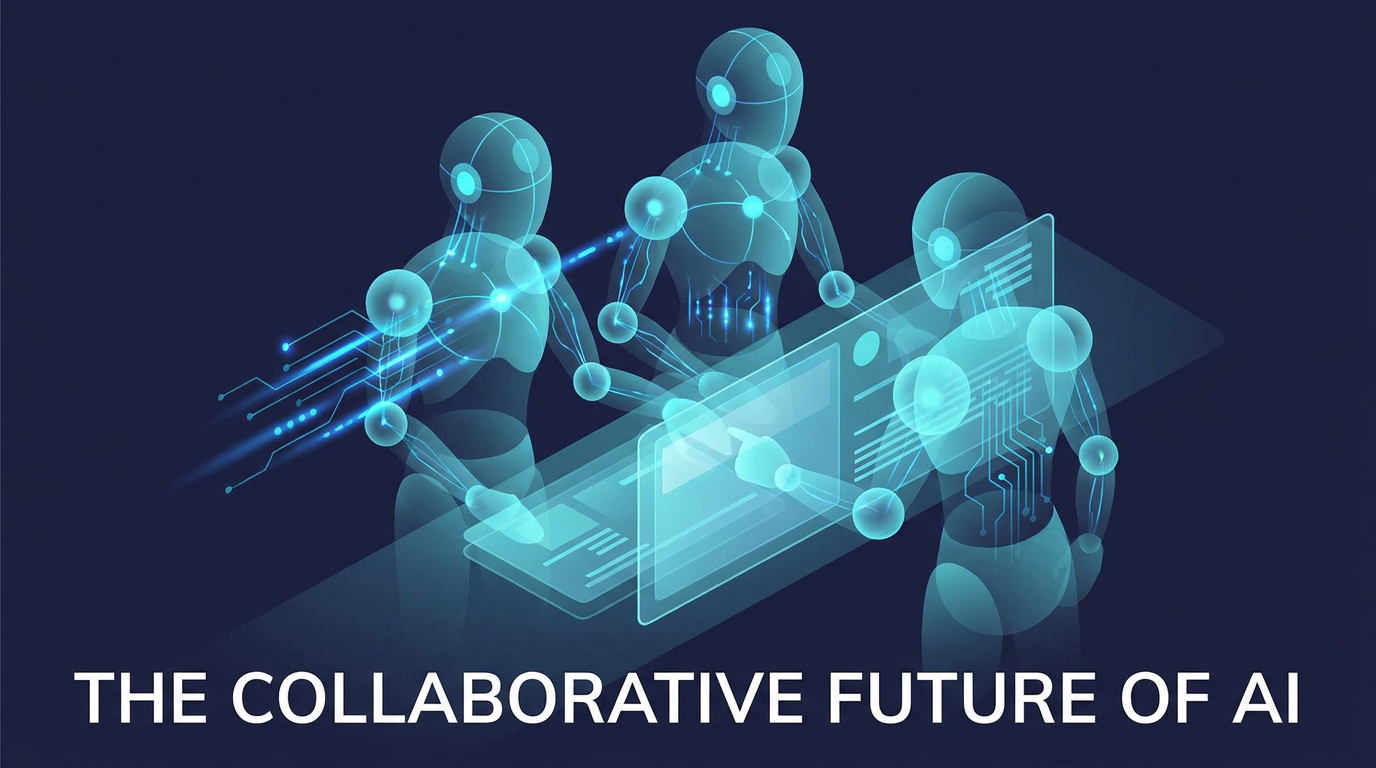
But the true breakthrough of 2026 is not just giving a single AI the ability to iterate; it is the rapid rise of Multi-Agent Systems. As enterprise tasks become increasingly complex, a single AI model—even a highly capable one equipped with reasoning loops—can become overwhelmed, losing context or hallucinating details when juggling too many variables. The solution that the industry has embraced is to divide and conquer. In a multi-agent system, specialized AI agents collaborate to achieve an overarching goal, communicating with one another to coordinate their efforts.[2][6]
This approach mimics the structure of a human corporate team. A user might submit a broad request to a "Triage Agent," which breaks the project down and delegates specific subtasks. A "Researcher Agent" might be dispatched to scour the web and internal databases for relevant context. Simultaneously, an "Analysis Agent" processes that data, while a "Quality Assurance Agent" reviews the final output against a strict set of compliance rules. Because these agents operate in parallel and maintain deep specialization in their specific domains, they can handle complexity that would easily break a single-agent architecture.[8]
This approach mimics the structure of a human corporate team.
The performance gains from this collaborative approach are striking. Industry data indicates that multi-agent systems can finish complex tasks three to five times faster than single-agent setups, while simultaneously reducing error rates by 40 to 60 percent. By having agents cross-check each other's work—for instance, a reviewer agent aggressively testing the code written by a coder agent—the system naturally filters out hallucinations and logical leaps. Furthermore, distributing the workload across smaller, specialized models is proving to be up to 90 percent cheaper than routing every single query through a massive, generalized frontier model.[8]

Two primary architectural philosophies have emerged to orchestrate these digital teams, each serving different use cases. Frameworks like Microsoft's AutoGen rely heavily on a conversational model, where agents literally chat with one another in natural language to negotiate solutions, debug code, and divide labor autonomously. This open-ended approach offers immense flexibility for research, development, and creative problem-solving, allowing the agents to dynamically figure out the best path forward without strict human micro-management. It is highly effective for experimental workflows where the exact steps to solve a problem are not known in advance.[5]
Conversely, frameworks like CrewAI take a much more structured, role-based approach to orchestration. In these systems, agents are assigned highly specific jobs, rigid goals, and detailed backstories, functioning much like a traditional corporate organizational chart. The workflow is deterministic, meaning the sequence of hand-offs between agents is tightly controlled. This structured design is highly favored by enterprise integrators and compliance officers who require predictable, repeatable outcomes for critical business operations, ensuring that the AI does not wander off-topic during a sensitive financial or legal process.[5]
The enterprise adoption of these multi-agent systems is accelerating at a pace that has surprised even optimistic industry analysts. Research firm Gartner predicts that by the end of 2026, fully 40 percent of enterprise applications will include task-specific AI agents embedded directly into their architecture. Looking slightly further ahead to 2030, that number is expected to reach 50 percent for cross-functional supply chain management solutions, pointing to a steady, irreversible shift toward software systems that can act and coordinate entirely on their own.[2]

In the financial sector, multi-agent systems are already transforming risk management and compliance. Instead of relying on human analysts to manually pull data from disparate systems, banks are deploying specialized agentic teams. One agent continuously monitors global transactions for statistical anomalies, a second agent cross-references those flagged items against rapidly shifting international compliance regulations, and a third agent drafts a comprehensive, fully-cited risk report for a human supervisor to review and approve. This ensures that human experts spend their time making high-level strategic decisions rather than copying and pasting data between spreadsheets.[2][9]
Similarly, in software engineering, "agentic coding" has moved from an experimental concept to a standard operational practice. Teams of specialized agents can now ingest a user's feature request, write the necessary code, run automated test suites, identify the bugs they just created, and iteratively rewrite the code until all tests pass. This entire cycle happens autonomously, often completing in minutes, long before a human developer ever looks at the pull request to merge the final code into the main project.[4][5]
However, this transition to autonomous execution is not without its significant challenges and risks. Multi-agent systems require robust orchestration, strict governance protocols, and high-quality underlying data to function safely. Without proper oversight and guardrails, a network of autonomous agents can quickly spiral into cascading failures, burning through massive amounts of cloud computing resources as they get stuck in infinite loops of debugging or miscommunication. Furthermore, if the agents are granted too much access to internal databases without strict least-privilege permissions, a single hallucination could result in the deletion or corruption of critical business records. Trust in these systems must be explicitly engineered, not assumed.[6][9]

To mitigate these operational risks, organizations are increasingly implementing "agentic command centers." These are centralized observability dashboards where human operators can monitor agent activity in real-time, audit the reasoning logs of specific decisions, enforce strict permission boundaries, and manually step in when the AI encounters an edge case it truly cannot solve. By externalizing the decision points and maintaining a clear audit trail of every tool call and API request, enterprises can deploy autonomous systems while satisfying strict regulatory and compliance requirements. This ensures that while the execution of the work is automated, the ultimate accountability and strategic direction remain firmly in human hands.[6]
Ultimately, the rise of agentic workflows and multi-agent systems represents a fundamental redefinition of human-computer interaction. We are rapidly moving away from a paradigm where humans must micromanage software execution step-by-step, and toward a model where humans act more like managers. In this new dynamic, workers set the high-level goals, provide the necessary tools and constraints, and supervise the output of autonomous digital teams. It is a shift that promises to make organizations vastly more capable, freeing human workers to focus on the creativity, empathy, and strategic judgment that machines cannot replicate.[6][9]
How we got here
2023
Early multi-agent frameworks like AutoGen are released, enabling basic LLM-driven agent collaboration.
Early 2024
AI pioneer Andrew Ng popularizes the concept of 'agentic workflows,' demonstrating they beat zero-shot prompting.
2025
Enterprise adoption accelerates as frameworks introduce better governance, memory, and observability.
2026
Multi-agent architectures become mainstream, shifting AI from conversational chatbots to autonomous execution engines.
Viewpoints in depth
Enterprise Integrators
Focused on replacing brittle automation with resilient, ROI-driven AI systems.
For enterprise leaders, the appeal of agentic workflows lies in their ability to handle the 'messy middle' of business operations. Traditional Robotic Process Automation (RPA) handles highly structured data perfectly, but fails the moment a process requires contextual judgment. Integrators view multi-agent systems as the bridge that finally allows AI to execute end-to-end workflows—like supply chain rebalancing or compliance auditing—without requiring constant human hand-holding. Their primary concern is establishing robust governance and observability to ensure these autonomous systems remain secure and predictable.
AI Developers & Researchers
Focused on architectural frameworks and the iterative path toward artificial general intelligence.
The developer community is currently navigating a Cambrian explosion of orchestration frameworks, debating the merits of conversational models like AutoGen versus role-based structures like CrewAI. For researchers, agentic workflows represent a fundamental shift away from simply building larger language models. By teaching smaller models to plan, use external tools, and reflect on their own mistakes, developers are achieving frontier-level performance at a fraction of the compute cost. Many in this camp, including Andrew Ng, view this iterative reasoning loop as a critical stepping stone toward true Artificial General Intelligence.
Workflow Automation Builders
Focused on democratizing multi-agent capabilities for everyday knowledge workers.
Platform builders are working to abstract away the complex code required to orchestrate AI agents, bringing these capabilities to non-technical users. They argue that the true revolution happens when a marketing manager or a sales director can spin up a custom 'crew' of AI agents using natural language, rather than relying on an engineering team. This camp emphasizes speed and accessibility, pointing to data showing that multi-agent collaboration can complete complex research and writing tasks up to five times faster than a human working alongside a standard chatbot.
What we don't know
- How quickly regulatory bodies will adapt to fully autonomous AI agents executing financial and legal workflows.
- Whether conversational agent frameworks (like AutoGen) or structured role-based frameworks (like CrewAI) will ultimately dominate enterprise architecture.
- The long-term impact on entry-level knowledge work as AI agents take over routine research, coding, and data analysis tasks.
Key terms
- Agentic Workflow
- An AI system that adds a reasoning layer on top of fixed automation, allowing it to adapt to exceptions without predefined rules.
- Multi-Agent System (MAS)
- An architecture where multiple specialized AI agents collaborate, often taking on specific roles like researcher, writer, or reviewer.
- Zero-Shot Prompting
- Asking an AI model to complete a task in a single attempt without iterative refinement or examples.
- Robotic Process Automation (RPA)
- Traditional software automation that follows strict, predefined 'if-then' rules and breaks when encountering unexpected inputs.
- Hallucination
- When an AI model confidently generates false or nonsensical information.
Frequently asked
How is an agentic workflow different from Zapier or Make?
Traditional automation runs a fixed path and stops if an input doesn't match the plan. An agentic workflow can read the situation, reason about the error, and improvise a recovery.
Why use multiple AI agents instead of one smart model?
Single models can lose track of complex tasks or hallucinate. Multi-agent systems assign specific roles (like coder and reviewer) to cross-check work, improving accuracy and speed.
Are these systems replacing human workers?
Currently, they are replacing brittle automation software and handling repetitive execution. Human roles are shifting toward supervision, goal-setting, and strategic judgment.
Sources
Source coverage
9 outlets
4 viewpoints surfaced









[1]IBMEnterprise Integrators
What are Agentic Workflows?
Read on IBM →[2]TheNoah.aiEnterprise Integrators
Multi-Agent AI Systems: Future of Enterprise Automation 2026
Read on TheNoah.ai →[3]TaskadeWorkflow Automation Builders
Agentic Workflows Explained: Build Self-Running AI Systems
Read on Taskade →[4]EmergetechAI Developers & Researchers
AI's Future: Agentic Workflows with Andrew Ng
Read on Emergetech →[5]AiGenVerseAI Developers & Researchers
CrewAI Vs AutoGen: A Complete Comparison of Multi-Agent AI Frameworks
Read on AiGenVerse →[6]Axisto GroupEnterprise Integrators
AI and Agentic Automation in 2026
Read on Axisto Group →[7]MindStudioAI Developers & Researchers
Agentic Workflows Explained: Conditional Logic, Loops & Branching
Read on MindStudio →[8]RuhWorkflow Automation Builders
Multi-Agent Collaboration: The Smart Way to Build AI Systems in 2026
Read on Ruh →[9]Factlen Editorial TeamFactlen Editorial Team
Synthesis by Factlen editorial team
Read on Factlen Editorial Team →

More in ai
See all 9 stories →Medical AI
AI's 2026 Medical Breakthrough Isn't Just New Drugs—It's Rescuing the Healthcare System
0 sources

Photonic Computing
How Photonic Chips Are Using Light to Break the AI Energy Bottleneck
0 sources

Open Source AI
Open-Weight AI Reaches New Milestone as MiniMax M3 Outperforms Proprietary Models in Coding
0 sources

Edge AI
How Small Language Models Reached the 'Reasoning Threshold' in 2026
0 sources

Every angle. Every day.
Get ai stories with full source coverage and perspective breakdowns delivered to your inbox.