
The Science of "Risky Play": Why Pediatricians Are Prescribing Scrapes and Thrills
New pediatric guidelines and psychological research suggest that allowing children to engage in "adventurous play" is crucial for building resilience and preventing childhood anxiety.
By Factlen Editorial Team
- Pediatric & Psychological Researchers
- Argue that physical risk is a biological necessity for brain development, citing evidence that exposure to manageable fear prevents clinical anxiety.
- Parents & Educators
- Face the practical friction of balancing the developmental benefits of adventurous play against institutional liability and societal judgment.
- Child Safety Advocates
- Emphasize that promoting risky play must not become a license for negligence, focusing on the critical distinction between a risk and a hazard.
What's not represented
- · Insurance and liability underwriters
- · Urban planners and playground architects
Why this matters
As rates of childhood anxiety continue to rise, parents and educators are searching for actionable solutions. Understanding the developmental necessity of physical risk allows caregivers to foster independence and emotional resilience in children without compromising their true safety.
Key points
- Pediatricians are shifting away from "as safe as possible" to "as safe as necessary" regarding childhood play.
- Children who engage in adventurous play show significantly lower rates of anxiety and depression.
- Risky play helps children habituate to the physiological sensations of fear, building emotional resilience.
- Experts distinguish between "risks" (challenges a child can assess) and "hazards" (hidden dangers).
- The mental health benefits of adventurous play are most pronounced in children from lower-income families.
For decades, the prevailing wisdom in playground design and modern parenting was to eliminate danger. Across the developed world, asphalt and gravel were replaced by shock-absorbing rubberized mats. Towering metal jungle gyms were swapped for low-to-the-ground plastic structures. Supervision became constant, and the cultural mandate for caregivers was clear: keep children as safe as possible at all times.[6]
While this shift successfully reduced catastrophic injuries, pediatricians and developmental psychologists are now identifying a hidden cost to this hyper-vigilance. A growing body of evidence suggests that stripping childhood of physical risk may be inadvertently fueling a different kind of crisis. By protecting children from every scrape and fall, adults may be depriving them of the exact experiences they need to build emotional resilience, self-confidence, and the ability to manage anxiety.[1][5]
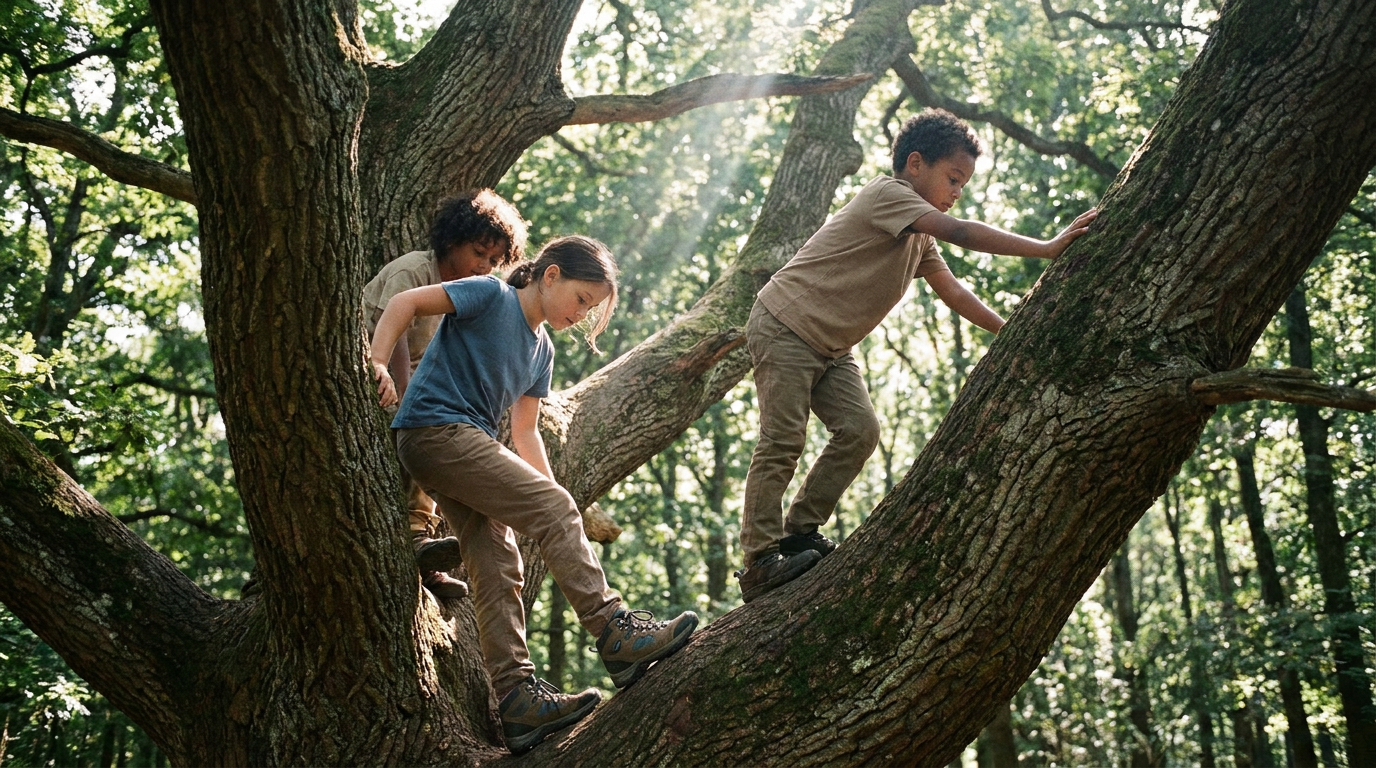
In response, a quiet revolution is taking place in pediatric health. Experts are increasingly prescribing what is known as "risky play" or "adventurous play." This is defined as thrilling, exciting forms of child-led free play that involve uncertainty of outcome and a genuine possibility of minor physical injury. Rather than viewing risk as a failure of supervision, researchers now recognize it as a biological necessity for healthy brain development.[1][3][5]
The Canadian Paediatric Society (CPS) recently formalized this shift in a landmark position statement, urging a fundamental change in how society views outdoor play. The CPS advises that children should be kept "as safe as necessary," rather than "as safe as possible." The organization explicitly encourages risky play as a public health strategy to help prevent and manage common childhood issues, including obesity, behavioral challenges, and elevated anxiety.[1]
To implement this safely, pediatricians draw a sharp distinction between a "risk" and a "hazard." A risk is a challenge that a child can see, assess, and decide whether to undertake based on their own perceived skills—such as deciding how high to climb a tree or how fast to run down a steep hill. A hazard, conversely, is a danger that is hidden or beyond the child's capacity to recognize, such as an improperly anchored slide, a rotten branch, or nearby street traffic. The goal of risky play is to remove the hazards while leaving the risks intact.[1][6]

The mental health benefits of this approach are becoming increasingly quantifiable. In a major study led by the University of Exeter, researchers surveyed nearly 2,500 parents of children aged five to eleven. The team sought to test the theory that adventurous play—such as riding bikes fast, jumping from high surfaces, or playing out of adult sight—offers learning opportunities that protect against psychological distress.[2][3]
The mental health benefits of this approach are becoming increasingly quantifiable.
The findings were striking. Children who spent more time engaged in adventurous outdoor play exhibited significantly fewer "internalizing problems," a clinical category that encompasses symptoms of anxiety and depression. Furthermore, these children demonstrated higher levels of positive affect and emotional stability during periods of high stress, such as the lockdowns of the COVID-19 pandemic.[2][3]
Notably, the Exeter study revealed an important equity dimension to risky play. The mental health benefits were found to be most pronounced for children from lower-income families. Because adventurous play is free, instinctive, and requires no specialized equipment or paid coaching, researchers emphasize that protecting access to wild spaces and adventure playgrounds is a crucial public health intervention for disadvantaged communities.[2][3]
But what is the actual mechanism? Why does climbing a wobbly branch translate to lower anxiety? Psychologists point to the "antiphobic theory" of play. When children engage in thrilling activities, they deliberately expose themselves to fear-provoking situations. Their heart rate elevates, and they experience the physiological sensations of stress and uncertainty.[1][5]
By navigating that physical thrill and surviving it, children practice coping with their own physiological arousal. They learn that fear is a temporary state that they can manage and overcome. When a child is entirely shielded from physical thrills, their first encounter with a racing heart might be during a math test or a social conflict, where the unfamiliar sensation can quickly spiral into a panic response.[5][6]
Furthermore, the skills developed on the playground appear to transfer directly to real-world survival. A 2026 study published in the Journal of Environmental Psychology found that children who regularly engage in risky play develop superior risk-management skills for non-play scenarios. In simulated tests, children who took more physical chances during playtime were able to make safer, faster decisions when navigating high-consequence hazards, such as crossing a busy intersection.[4]

Developmental psychologists have categorized risky play into eight distinct types. These include play at great heights, play at high speeds, rough-and-tumble play, play near dangerous elements like water or fire, and play where children go exploring alone without adult supervision. Observations of toddlers and young children show that when left to their own devices in natural environments, they naturally gravitate toward these activities, carefully testing their own boundaries.[5]
Despite the overwhelming scientific consensus, translating this research into practice faces steep cultural barriers. Parental anxiety, institutional liability concerns at schools, and a broader cultural aversion to risk mean that many children are still heavily restricted. Educators report that restrictive schoolyard rules often override a child's natural instinct to explore their physical limits.[1][5]

To counter this, movements advocating for childhood independence are gaining traction, encouraging schools and municipalities to introduce "loose parts"—such as crates, tires, and ropes—into playgrounds to foster creativity and manageable risk. Ultimately, the science suggests that scraped knees and muddy clothes are not signs of parental negligence, but rather the essential byproducts of a child building the resilience they will need for the rest of their life.[1][6]
Viewpoints in depth
Pediatric & Psychological Researchers
Argue that risk is a biological necessity for brain development and emotional resilience.
Developmental psychologists and pediatricians point to evolutionary biology to explain why children naturally seek out thrills. They argue that the "antiphobic theory" of play proves that exposure to manageable fear prevents clinical anxiety. By navigating physical risks, children build a mental map of their capabilities and learn to regulate their own nervous systems, skills that transfer directly to real-world hazard assessment.
Child Safety Advocates
Emphasize that promoting risky play must not become a license for negligence.
While acknowledging the developmental benefits of adventurous play, safety advocates focus heavily on the critical distinction between a "risk" and a "hazard." They argue that adults still have a fundamental duty to inspect environments for hidden dangers—such as broken equipment, toxic materials, or traffic proximity—that a child lacks the cognitive maturity to recognize. Their goal is to ensure environments are "as safe as necessary" without being sterile.
Parents & Educators
Face the practical friction of implementing these guidelines in a risk-averse culture.
For those on the front lines of child-rearing, the science of risky play often collides with modern cultural expectations. Educators must balance the developmental benefits of adventurous play against strict institutional liability policies and schoolyard rules. Meanwhile, parents report feeling societal pressure and judgment when they allow their children to engage in unsupervised or physically challenging play, making the transition from "helicopter parenting" to "free-range parenting" practically difficult.
What we don't know
- How to effectively reform institutional liability laws to allow schools to embrace risky play without fear of lawsuits.
- The exact threshold of risk exposure required to yield optimal mental health benefits in different age groups.
Key terms
- Risky play
- Thrilling, child-led free play that involves uncertainty of outcome and a genuine possibility of minor physical injury.
- Internalizing problems
- Psychological issues characterized by inner distress, such as anxiety, depression, and social withdrawal.
- Antiphobic theory
- The psychological concept that children naturally seek out thrilling, fear-inducing play to habituate themselves to fear and prevent the development of phobias.
- Perception-action loop
- The continuous cognitive cycle where a child perceives a physical challenge, takes action, and updates their mental map of their own capabilities.
- Loose parts
- Unstructured play materials—such as crates, tires, ropes, and planks—that children can move, build with, and use to create their own physical challenges.
Frequently asked
What is the difference between a risk and a hazard?
A risk is a challenge a child can see and assess, like climbing a tree. A hazard is a hidden danger beyond their ability to recognize, like an improperly anchored slide.
Does risky play mean leaving children unsupervised?
No. It means adjusting supervision to be "as safe as necessary." Adults should remove hidden hazards but allow children the freedom to test their physical limits within that safe environment.
How does risky play help prevent anxiety?
By engaging in thrilling activities, children experience the physiological sensations of fear in a playful context. This helps them learn to cope with uncertainty and emotional arousal.
What are examples of risky play?
Common examples include playing at heights, moving at high speeds, rough-and-tumble play, and exploring a neighborhood or woods out of direct adult sight.
Sources
Source coverage
6 outlets
3 viewpoints surfaced






[1]Canadian Paediatric SocietyPediatric & Psychological Researchers
Healthy childhood development through outdoor risky play
Read on Canadian Paediatric Society →[2]The GuardianParents & Educators
Adventurous play helps boost children's mental health, study finds
Read on The Guardian →[3]National Institute for Health and Care ResearchPediatric & Psychological Researchers
Adventurous play linked to lower anxiety in children
Read on National Institute for Health and Care Research →[4]PsyPostParents & Educators
Risky play helps children navigate real-world hazards, study finds
Read on PsyPost →[5]National Library of MedicinePediatric & Psychological Researchers
Benefits and Affordances of Nature-Based Risky Play
Read on National Library of Medicine →[6]Factlen Editorial TeamParents & Educators
Synthesis by Factlen editorial team
Read on Factlen Editorial Team →
Every angle. Every day.
Get lifestyle stories with full source coverage and perspective breakdowns delivered to your inbox.