
Spain's 2026 World Cup Tactical Evolution: How Luis de la Fuente Modernized La Roja
Spain has transformed its traditional possession-heavy style into a lethal, vertical system driven by dynamic wingers. Despite an early stumble, their tactical foundation makes them a formidable contender in North America.
By Factlen Editorial Team
- Tactical Analysts
- Focus on the structural shift from slow possession to verticality.
- National Team Management
- Emphasize squad reliability and long-term tactical consistency.
- Tournament Skeptics
- Highlight vulnerabilities against low blocks and questionable lineup rotations.
What's not represented
- · Opposing Managers
- · Grassroots Spanish Coaches
Why this matters
Understanding Spain's tactical shift offers a masterclass in modern football evolution. For fans and analysts, it reveals how elite teams adapt to overcome deeply entrenched defensive strategies on the world's biggest stage.
Key points
- Spain has evolved from a pure possession-based team to a more vertical, incisive attacking unit.
- The system relies heavily on the 'attract to isolate' principle, using central passing to free up dynamic wingers.
- A 0-0 draw against Cape Verde highlighted the team's ongoing struggles to break down deeply entrenched defensive blocks.
- Manager Luis de la Fuente remains committed to the tactical blueprint, backed by a 32-match unbeaten streak.
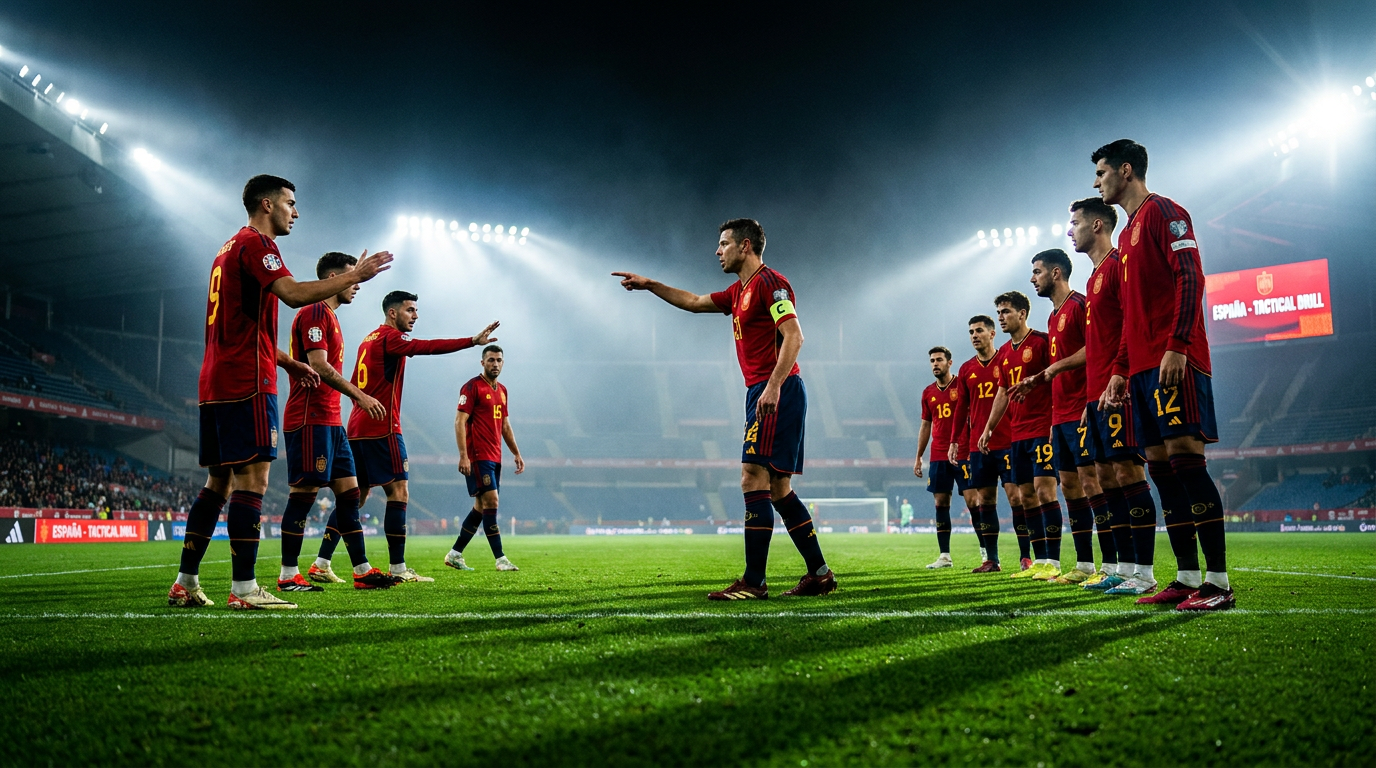
Spain arrived at the 2026 FIFA World Cup as the reigning European champions and arguably the most technically fluent national team in the tournament. Under the guidance of head coach Luis de la Fuente, La Roja has undergone a significant tactical evolution, shedding the slower, sometimes sterile possession of the late 2010s for a more incisive, vertical approach.[4][2]
The foundation of Spain's system remains rooted in positional play, utilizing a fluid 4-3-3 formation that frequently shifts into a 4-2-3-1 in possession. However, the modern iteration of this squad uses the ball not just to control the rhythm of the match, but to actively move the opposition and attack the resulting spaces with urgency.[2][1]
A core tenet of De la Fuente's philosophy is the 'attract to isolate' principle. By overloading central areas with intricate, short passing combinations, Spain forces opposing defenses to narrow their shape. This deliberate congestion creates vast pockets of space on the flanks, setting the stage for their most dangerous attacking weapons.[1][4]

The wide areas are where this Spanish side truly excels, relying heavily on the blistering pace and one-on-one ability of wingers like Lamine Yamal and Nico Williams. Their capacity to stretch defenses and consistently beat fullbacks isolates defenders and provides a direct, vertical threat that previous Spanish squads often lacked.[2][1]
When opponents attempt to defend deeper to avoid being played through centrally, Spain relies on these creative wide players to unbalance compact blocks. Yamal, in particular, has become a focal point; the team frequently moves the ball forward quickly to allow him to cut inside onto his favored left foot and disrupt the defensive line.[1][2]
When opponents attempt to defend deeper to avoid being played through centrally, Spain relies on these creative wide players to unbalance compact blocks.
Anchoring this dynamic attack is a midfield trio built around control and intelligence. Rodri serves as the tactical metronome and defensive pivot, dictating the tempo while providing essential cover for the backline. Ahead of him, players like Pedri operate in the half-spaces, receiving the ball under pressure and seamlessly connecting the midfield to the forward line.[2][6]
Defensively, Spain employs a highly proactive approach, utilizing an aggressive high press to recover possession as close to the opponent's goal as possible. The defensive line, featuring Pau Cubarsí and Aymeric Laporte, pushes exceptionally high, compressing the pitch and suffocating opposing build-up play before it can materialize.[2][6]
However, this aggressive structure is not without its vulnerabilities. Because the fullbacks often push high to provide width or invert into the midfield, the half-spaces behind them can become exposed. If an opponent successfully bypasses the initial counter-press, Spain's center-backs are left defending large areas of space, making them susceptible to rapid counterattacks.[6][2]

These tactical nuances were put to the test in Spain's opening match of the 2026 World Cup, which resulted in a surprising 0-0 draw against 67th-ranked Cape Verde. Despite dominating the ball with an overwhelming 74% possession, Spain struggled to break down a resolute, deeply entrenched defensive block, managing only seven shots on target over 90 minutes.[3]
The match highlighted the risks of De la Fuente's system when the primary wide threats are altered. Opting to manage Yamal's workload following recent injury concerns, the manager deployed Ferran Torres on the right and utilized central midfielder Gavi as a left winger. This decision, intended to create central superiority, ultimately blunted Spain's ability to stretch the pitch and bypass the low block.[3]

In the aftermath of the draw, De la Fuente fiercely defended his tactical blueprint, pointing to the team's extraordinary reliability and a 32-match unbeaten streak. He emphasized that the squad will not abandon the path that brought them to North America, though he acknowledged the pressing need for better penetration and clinical finishing in the final third.[3]
As the tournament progresses, Spain's challenge is clear: they must consistently convert their territorial dominance into goals. If they can maintain their defensive balance while fully unleashing the verticality of their wingers, La Roja possesses the tactical sophistication and depth to challenge for their second World Cup title.[5][2]
How we got here
Jan 2023
Luis de la Fuente is appointed head coach, beginning the modernization of Spain's tactical approach.
Jul 2024
Spain wins the European Championship, validating their shift toward a more vertical, winger-driven system.
Jun 2026
Spain finalizes their 2026 World Cup squad, emphasizing youth, technical control, and direct wide players.
Jun 15, 2026
Spain draws 0-0 against Cape Verde in their World Cup opener, sparking debate over lineup rotations and low-block struggles.
Viewpoints in depth
Tactical Analysts
Focus on the structural shift from slow possession to verticality.
Tactics writers and analysts praise the modernization of the Spanish system under Luis de la Fuente. By integrating direct, one-on-one wingers like Lamine Yamal and Nico Williams, Spain has solved its historical vulnerability to low blocks. Analysts argue that the 'attract to isolate' principle makes La Roja far more lethal in transition, transforming them from a team that merely controls the ball into one that actively punishes defensive shifts.
National Team Management
Emphasize squad reliability and long-term tactical consistency.
From the perspective of the coaching staff, the current tactical model is validated by an extraordinary 32-match unbeaten streak. Luis de la Fuente and his staff maintain that their high-pressing, possession-based approach provides the ultimate defensive security by starving the opponent of the ball. They view early tournament struggles against deep defensive blocks as execution issues rather than systemic flaws, insisting that the core philosophy will not change.
Tournament Skeptics
Highlight vulnerabilities against low blocks and questionable lineup rotations.
Critics and skeptical observers point to the opening 0-0 draw against Cape Verde as evidence that Spain still struggles to convert territorial dominance into goals. They argue that resting key creative outlets and deploying central midfielders on the wings blunts the team's primary attacking threat. Furthermore, skeptics warn that Spain's aggressively high defensive line leaves the half-spaces exposed, making them highly susceptible to rapid counterattacks against elite opposition.
What we don't know
- Whether Luis de la Fuente will abandon his lineup rotations and start his strongest XI in the remaining group stage matches.
- How Spain's high defensive line will hold up against elite counter-attacking teams in the knockout rounds.
- If the squad can consistently convert their overwhelming territorial dominance into goals when facing compact defenses.
Key terms
- Positional Play
- A tactical philosophy focused on occupying specific zones on the pitch to create numerical advantages and control the ball.
- Half-spaces
- The vertical channels on the pitch between the center and the wide areas, often exploited by attacking midfielders.
- Low Block
- A defensive strategy where a team defends deep in their own half, prioritizing compactness to deny space behind the defensive line.
- Counter-press
- The tactic of immediately attempting to win the ball back high up the pitch as soon as possession is lost.
Frequently asked
What formation does Spain use in the 2026 World Cup?
Spain primarily utilizes a fluid 4-3-3 formation that frequently shifts into a 4-2-3-1 in possession, designed to overload the midfield and isolate wingers.
Why didn't Lamine Yamal start against Cape Verde?
Manager Luis de la Fuente opted to manage the teenager's workload following recent injury concerns, bringing him on as a substitute in the second half.
What is Spain's current unbeaten streak?
Spain entered the 2026 World Cup carrying an extraordinary 32-match unbeaten streak under Luis de la Fuente.
Sources
Source coverage
6 outlets
3 viewpoints surfaced






[1]Tactical Football AnalysisTactical Analysts
Luis de la Fuente tactics at Spain 2026: Tactical analysis
Read on Tactical Football Analysis →[2]World Soccer TalkTournament Skeptics
Spain 2026 World Cup squad, tactical shifts, and group-stage outlook
Read on World Soccer Talk →[3]Hindustan TimesTournament Skeptics
Spain drift away from their blueprint of success as Luis de la Fuente's selection calls blunt their attack
Read on Hindustan Times →[4]FWC LiveTactical Analysts
Spain 2026 Style, Strengths, and Tournament Outlook
Read on FWC Live →[5]Russ SpainNational Team Management
Spain National Team Prepares Squad for 2026 World Cup
Read on Russ Spain →[6]CBS SportsTactical Analysts
Spain's GENIUS World Cup 2026 Tactics | Tactical Analysis
Read on CBS Sports →

More in sports
See all 7 stories →Injury
Stanley Cup Finals Injury Report: Resilience and Depth Define Crucial Game 6
0 sources
Standings
Global Ice Hockey Standings: Hurricanes Hoist the Stanley Cup as 2026 Championship Season Peaks
0 sources

Injury
Midsummer Reinforcements: All-Star Returns Inject Life Into June Baseball
0 sources

Standings
White Sox and Mariners Surge in Mid-June MLB Standings as Underdogs Take Center Stage
0 sources

Every angle. Every day.
Get sports stories with full source coverage and perspective breakdowns delivered to your inbox.