
Steam Deck OLED vs. ASUS ROG Ally X: The Definitive 2026 Handheld PC Comparison
Valve's Steam Deck OLED and the ASUS ROG Ally X represent the pinnacle of portable PC gaming, but they cater to entirely different types of players. This side-by-side analysis breaks down the trade-offs in performance, display quality, and software to help you choose the right device.
By Factlen Editorial Team
- Console Purists
- Value a frictionless, pick-up-and-play experience without operating system troubleshooting.
- Power Maximizers
- Prioritize raw graphical performance, 1080p resolutions, and universal game compatibility.
What's not represented
- · Budget-conscious gamers looking at sub-$300 retro handhelds
- · Developers optimizing games specifically for handheld hardware
Why this matters
Choosing the right handheld gaming PC is a significant investment that dictates not just how your games look, but which games you can actually play. Understanding the trade-offs between Valve's seamless ecosystem and ASUS's raw Windows power ensures you buy the device that actually fits your daily routine.
Key points
- The Steam Deck OLED features a vibrant 7.4-inch HDR display and a highly efficient custom operating system.
- The ASUS ROG Ally X offers superior raw performance, a 1080p 120Hz screen, and a massive 80Wh battery.
- SteamOS provides a seamless, console-like experience but requires workarounds for non-Steam games.
- Windows 11 on the Ally X allows native access to all game launchers and multiplayer anti-cheat software.
- The Steam Deck OLED starts at $549, while the ROG Ally X demands a premium at $799.
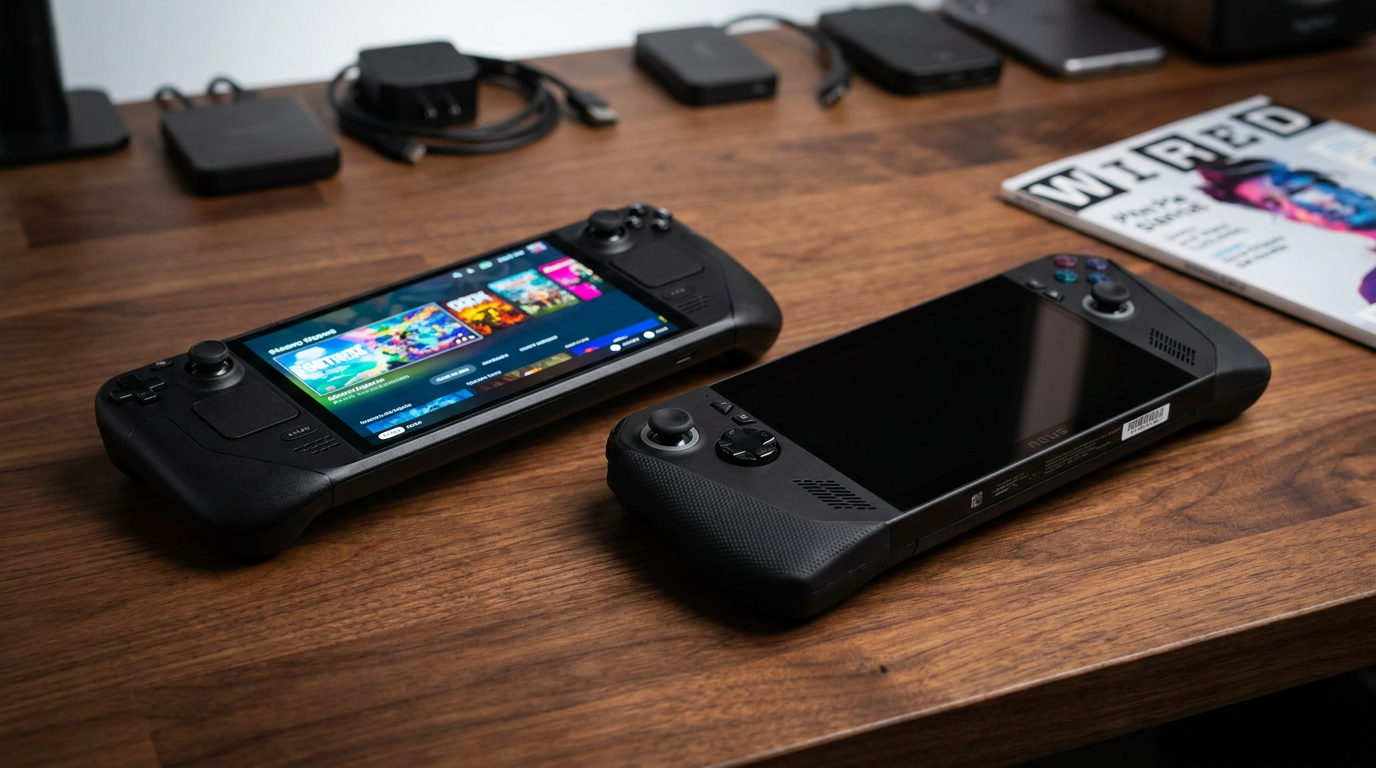
The golden age of portable PC gaming has arrived, transforming how players engage with their libraries on the go. At the forefront of this movement in 2026 are two undisputed heavyweights: Valve's Steam Deck OLED and the ASUS ROG Ally X. Rather than a simple race for the highest specifications, the choice between these two devices represents a fundamental divergence in design philosophy. One prioritizes a seamless, console-like user experience, while the other leans into raw, unbridled Windows computing power. Reviewers and enthusiasts alike agree that both machines are triumphs of modern engineering, yet they cater to entirely different types of gamers. By examining their displays, performance metrics, battery efficiency, and software ecosystems, prospective buyers can navigate the trade-offs and find the exact right fit for their entertainment needs.[1][2][7]
When evaluating the displays, the trade-offs are immediately apparent and heavily debated. The Steam Deck OLED features a 7.4-inch HDR OLED panel that delivers perfect blacks, vibrant colors, and a peak brightness of 1,000 nits. This allows games to visually pop despite the screen's lower 1280x800 resolution and 90Hz refresh rate. In contrast, the ASUS ROG Ally X utilizes a 7-inch IPS LCD screen. While it lacks the infinite contrast and deep blacks of an OLED, it counters with a sharper 1080p resolution, a faster 120Hz refresh rate, and Variable Refresh Rate (VRR) technology. VRR is a crucial addition for the Ally X, as it smooths out frame pacing and eliminates screen tearing during demanding gameplay, making motion appear incredibly fluid even when frame rates fluctuate.[1][4][5]
The argument for the ROG Ally X centers heavily on its sheer performance capabilities and internal hardware. Equipped with the AMD Ryzen Z1 Extreme processor and a massive 24GB of fast LPDDR5 memory, it is designed to brute-force modern AAA titles. Benchmarks show the Ally X capable of running demanding games like Cyberpunk 2077 at 1080p with ultra settings while maintaining playable frame rates, a feat the Steam Deck simply cannot match. The additional RAM also provides a significant bottleneck relief, allowing the system to allocate more memory to the integrated GPU without starving the operating system. For players who demand the highest graphical fidelity on a handheld and want to push modern engines to their limits, the Ally X provides a definitive and quantifiable edge.[2][4]

Conversely, the case against the Ally X—and the strongest argument for the Steam Deck OLED—lies in software friction and overall usability. The Steam Deck utilizes SteamOS, a custom Linux-based operating system that offers a frictionless, Switch-like interface. Games launch instantly, shader compilation is handled seamlessly in the background, and the system's sleep/wake function works flawlessly, allowing players to pause a game and resume days later without crashing. The Ally X runs on Windows 11, which, while granting access to every game launcher including Xbox Game Pass and Epic Games, remains notoriously clunky to navigate on a 7-inch touchscreen. Windows updates, background processes, and the lack of a reliable quick-resume feature mean the Ally X requires more patience and troubleshooting from the user.[3][5]
Conversely, the case against the Ally X—and the strongest argument for the Steam Deck OLED—lies in software friction and overall usability.
Battery life presents another fascinating contrast in engineering approaches, with both companies solving the portability problem from opposite directions. Valve achieved longevity through extreme efficiency; the Steam Deck OLED uses a 50Wh battery paired with a highly optimized 6nm chip, allowing it to sip power at lower wattages. This efficiency yields anywhere from three to twelve hours of playtime depending on the title. ASUS took the brute-force route, packing a massive 80Wh battery into the Ally X to offset the power-hungry nature of Windows and the Z1 Extreme chip. While the Ally X can now sustain heavy 1080p gaming for several hours—a massive improvement over its predecessor—the Steam Deck remains the undisputed king of low-power indie gaming efficiency.[3][4][5]

Ergonomics and build quality also divide the two camps, as physical comfort is paramount for a device meant to be held for hours. The Steam Deck OLED is wider to accommodate its dual trackpads, which are essential for playing mouse-heavy strategy games or navigating desktop mode. Reviewers consistently praise its durable plastic shell, excellent weight distribution, and satisfying button feel. The ROG Ally X, weighing in slightly heavier at 678 grams, features deeper, controller-style grips that make it incredibly comfortable for traditional analog-stick gaming. While the Ally X feels remarkably like a premium Xbox controller split in half, some users note its plastic chassis feels slightly softer and more prone to minor cosmetic wear compared to Valve's utilitarian hardware.[4][5]
Pricing further quantifies the divide between the two systems, forcing buyers to evaluate their exact needs. The Steam Deck OLED offers a compelling value proposition, starting at $549 for the 512GB model and scaling up to $649 for the 1TB version. The ASUS ROG Ally X demands a premium, retailing at $799 for its single 1TB configuration. This significant price gap means consumers must weigh exactly how much they value the Ally's extra horsepower, universal game compatibility, and larger battery over Valve's highly polished, out-of-the-box simplicity. For many, the Steam Deck's lower barrier to entry makes it the definitive entry point into portable PC gaming.[3][4]

Ultimately, the Steam Deck OLED fits perfectly when a player wants a seamless, console-like experience, prioritizes battery efficiency for indie titles, and plays almost exclusively from their existing Steam library. It is the ideal companion for travel, offering unparalleled ease of use and a stunning screen that elevates the visual impact of any game. However, it does not fit well when a user relies heavily on subscription services like Xbox Game Pass, plays competitive multiplayer shooters that require Windows-level anti-cheat software, or demands 1080p resolutions for modern AAA releases. For those specific use cases, the Linux-based SteamOS becomes a barrier rather than a benefit.[1][5][6]
On the other hand, the ASUS ROG Ally X fits exceptionally well when a user wants maximum performance, prefers a sharper 1080p display with VRR, and needs the flexibility to install any PC game launcher or modification without complex workarounds. It is a true handheld computer that rewards power users willing to tinker with settings to extract every frame of performance. It does not fit well when a buyer is on a strict budget, desires the infinite contrast of an OLED screen, or has zero tolerance for the occasional troubleshooting required by a Windows operating system. Both devices represent the pinnacle of current handheld technology, ensuring that no matter which philosophy a gamer chooses, they are guaranteed a spectacular portable experience.[2][4][8]
How we got here
Feb 2022
Valve launches the original Steam Deck, proving the viability of the modern handheld PC market.
Jun 2023
ASUS releases the first ROG Ally, introducing a powerful Windows-based alternative.
Nov 2023
Valve releases the Steam Deck OLED, featuring a vastly improved screen, better battery, and refined ergonomics.
Jul 2024
ASUS launches the ROG Ally X, doubling the battery capacity and increasing RAM to 24GB.
Viewpoints in depth
The Console Purists
Gamers who value a frictionless, pick-up-and-play experience above all else.
This camp strongly advocates for the Steam Deck OLED. They argue that a handheld device should feel like a dedicated console, not a miniature laptop. For these users, SteamOS is the killer feature, offering instant game suspension, seamless background updates, and a unified interface that doesn't require a mouse and keyboard to navigate. They are willing to sacrifice access to certain multiplayer games and non-Steam launchers in exchange for an operating system that never crashes or interrupts a session with a Windows update.
The Power Maximizers
Enthusiasts who want the highest possible frame rates and universal game compatibility.
This perspective champions the ASUS ROG Ally X. These users view handhelds as true portable PCs and are perfectly comfortable navigating Windows 11 to unlock its full potential. They point to the Ally X's ability to run demanding titles like Cyberpunk 2077 at 1080p, its native support for Xbox Game Pass, and its compatibility with anti-cheat software required for games like Call of Duty and Valorant. For this camp, the occasional software friction is a minor tax to pay for uncompromised graphical power and complete platform freedom.
What we don't know
- Whether Microsoft will release a dedicated, handheld-optimized version of Windows to improve the Ally X's user interface.
- How long the current generation of handheld processors will be able to keep up with increasingly demanding Unreal Engine 5 titles.
Key terms
- Variable Refresh Rate (VRR)
- A display technology that syncs the screen's refresh rate with the game's frame rate, eliminating visual tearing and stuttering.
- TDP (Thermal Design Power)
- The maximum amount of heat generated by a computer chip that the cooling system is designed to dissipate, often used as a proxy for how much power the device is consuming.
- SteamOS
- A Linux-based operating system developed by Valve specifically optimized for gaming and handheld navigation.
- Anti-Cheat Software
- Security programs used by competitive multiplayer games to prevent hacking, many of which are currently incompatible with Linux-based systems like the Steam Deck.
Frequently asked
Can the Steam Deck play games from Xbox Game Pass?
Not natively. While you can stream Game Pass titles via the cloud on a Steam Deck, downloading and playing them locally requires installing Windows, which removes the benefits of SteamOS.
Does the ROG Ally X have an OLED screen?
No, the ROG Ally X uses a 7-inch IPS LCD screen. While it lacks the perfect blacks of an OLED, it offers a higher 1080p resolution and a faster 120Hz refresh rate.
Which device is better for travel?
The Steam Deck OLED is generally better for travel due to its superior low-power efficiency for indie games and its flawless sleep/wake function, though the Ally X's massive 80Wh battery makes it a strong contender for shorter, high-performance sessions.
Sources
Source coverage
8 outlets
2 viewpoints surfaced








[1]Tom's HardwareConsole Purists
Steam Deck OLED Review: Console-Style Upgrade
Read on Tom's Hardware →[2]IGNPower Maximizers
Asus ROG Ally X Review
Read on IGN →[3]Tom's GuideConsole Purists
Steam Deck OLED review: The best handheld just got even better
Read on Tom's Guide →[4]PC GamerPower Maximizers
Asus ROG Ally X review
Read on PC Gamer →[5]Pocket-lintConsole Purists
The ROG Ally X is great, but the Steam Deck OLED easily beats it in 4 key ways
Read on Pocket-lint →[6]Retro HandheldsConsole Purists
Steam Deck OLED: An Unhinged, Freaky Fresh Review
Read on Retro Handhelds →[7]Rock Paper ShotgunPower Maximizers
The best handheld PCs
Read on Rock Paper Shotgun →[8]PCMagPower Maximizers
Steam Deck and Beyond: The Best Handheld Gaming PCs We've Tested for 2026
Read on PCMag →


Every angle. Every day.
Get shopping stories with full source coverage and perspective breakdowns delivered to your inbox.