
Meta Quest 3 vs. Quest 3S: The 2026 Buyer's Guide
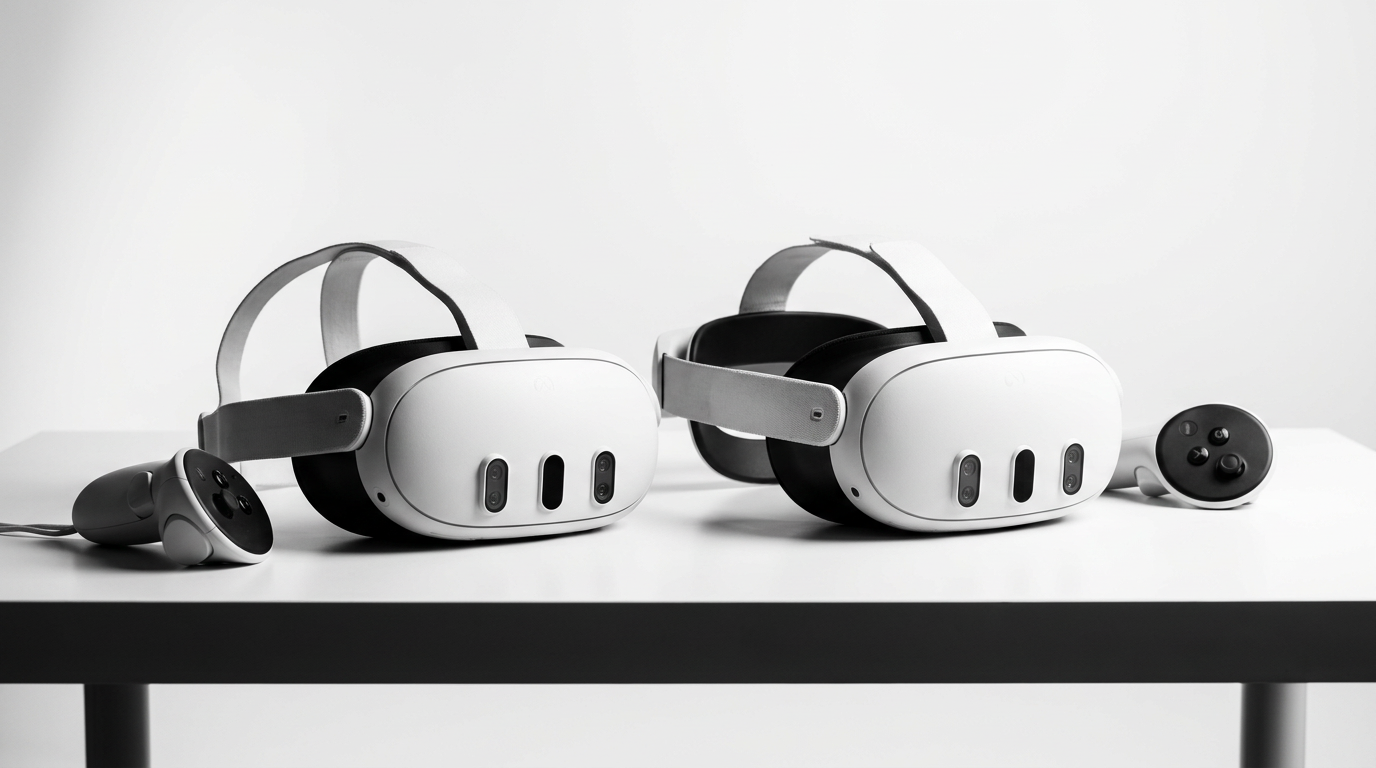
Meta's two-tier VR lineup forces buyers to choose between the optical perfection of the $599 Quest 3 and the unmatched value of the $349 Quest 3S.
By Factlen Editorial Team
- Value-Conscious Gamers
- Prioritize the $250 savings, arguing the identical processor and game library make the cheaper headset the smarter buy.
- Premium VR Enthusiasts
- Prioritize optical clarity, eye comfort, and the ability to use the headset for productivity and high-end PC VR.
- XR Developers
- Focus on the balance between building on premium hardware and testing for the mass-market reality.
- Industry Analysts
- Focus on Meta's market dominance and how the two-tier strategy effectively corners the sub-$1,000 consumer market.
What's not represented
- · Sony PlayStation VR2 Users
- · Enterprise XR Adopters
Why this matters
Choosing the right VR headset dictates whether your entry into spatial computing becomes a daily habit or an expensive paperweight. Understanding the exact trade-offs between processing power and optical clarity ensures you don't overpay for features you won't use, or underpay for a screen that causes eye strain.
Key points
- The $599 Quest 3 and $349 Quest 3S share the exact same Snapdragon XR2 Gen 2 processor and 8GB of RAM.
- Both headsets offer full-color mixed reality passthrough and run the identical library of Horizon OS games and apps.
- The Quest 3 justifies its premium price with pancake lenses, offering edge-to-edge clarity and a massive optical sweet spot.
- The Quest 3S uses older fresnel lenses and features 28 percent fewer pixels, making it less ideal for reading text or productivity.
The virtual reality landscape in 2026 has crystallized into a two-horse race, and both horses belong to Meta. With the legendary Quest 2 officially retired to the history books, consumers looking to enter the spatial computing ecosystem are faced with a stark, binary choice: the premium Meta Quest 3 at $599, or the budget-friendly Meta Quest 3S at $349. On paper, the $250 price chasm suggests two entirely different tiers of hardware. In reality, the decision is far more nuanced, forcing buyers to weigh identical processing power against vastly different optical experiences.[1][3][6]
To understand the trade-offs between the two devices, one must first look at what they share. Meta made the highly unusual decision to equip its budget headset with the exact same brain as its flagship model. Both the Quest 3 and the Quest 3S are powered by the Qualcomm Snapdragon XR2 Gen 2 chipset, paired with 8GB of RAM. This means that when it comes to raw computational horsepower, there is zero difference between the two.[2][3][6]
Because they share the same architecture, the software experience is identical. A game downloaded on the Quest 3 will load just as fast, run at the exact same frame rate, and feature the same graphical assets on the Quest 3S. Neither headset is locked out of exclusive titles, and both receive the same Horizon OS software updates. For value-conscious gamers, this processor parity is the ultimate selling point, offering flagship-level performance at an entry-level price.[2][3][4][5]
The similarities extend to mixed reality capabilities. Both headsets feature dual RGB color cameras and depth sensors, allowing them to pass a full-color video feed of the physical world into the screens. This enables users to play tabletop board games on their actual dining tables or watch a virtual television anchored to their living room wall. While the Quest 3's passthrough is slightly sharper, the Quest 3S delivers a highly functional mixed reality experience that fundamentally outclasses anything previously available at the $350 mark.[2][3][6]

The divergence between the two headsets begins—and largely ends—with their eyes. The Meta Quest 3 justifies its premium price tag through the inclusion of pancake lenses. This modern optical technology folds light multiple times within a thinner profile, resulting in a headset that sits closer to the face and feels less front-heavy. More importantly, pancake lenses provide edge-to-edge visual clarity, eliminating the blurry periphery that plagued older VR hardware.[1][3][6]
Behind those premium lenses, the Quest 3 boasts a fast-switch LCD display pushing 2064 by 2208 pixels per eye. This high pixel density makes the Quest 3 a viable tool for productivity. Text is crisp and legible, allowing users to comfortably read web pages, write emails, or spawn multiple virtual monitors for remote work. The "sweet spot"—the area where the image is perfectly in focus—is massive, meaning you can glance around with your eyes rather than having to turn your entire head.[3][4][6]
Behind those premium lenses, the Quest 3 boasts a fast-switch LCD display pushing 2064 by 2208 pixels per eye.
The Quest 3S achieves its aggressive price point by reverting to older optical technology. It utilizes fresnel lenses, the exact same concentric-ring lenses found in the discontinued Quest 2. Fresnel lenses are cheaper to manufacture but come with inherent compromises. They require more physical space, making the headset slightly bulkier, and they suffer from a notoriously small sweet spot. If the headset shifts slightly on your face, the image quickly degrades into a blur.[2][3][6]
The display behind the Quest 3S's fresnel lenses is also downgraded, offering 1832 by 1920 pixels per eye. This represents roughly 28 percent fewer pixels than the Quest 3. In fast-paced, colorful games like Beat Saber or Gorilla Tag, this resolution drop is easily ignored. However, when trying to read fine text, watch a high-definition movie in a virtual cinema, or navigate complex user interfaces, the screen-door effect and softer image become immediately apparent.[3][4][6]

Ergonomics and adjustability present another critical point of comparison. Human faces vary wildly, and the distance between our pupils—known as Interpupillary Distance (IPD)—must match the lenses to prevent eye strain. The Quest 3 features a continuous, physical IPD slider ranging from 58 to 71 millimeters, allowing for millimeter-perfect alignment. The Quest 3S, conversely, relies on a rudimentary three-position mechanical adjustment. For families sharing a single headset, the Quest 3's continuous slider removes a significant layer of daily friction.[3][6]
Storage capacity acts as a hidden variable in the pricing equation. The base $349 Quest 3S typically ships with 128GB or 256GB of internal storage, depending on the retail bundle. The premium Quest 3, meanwhile, now standardizes around a massive 512GB drive. With modern VR games frequently exceeding 20GB in size, heavy users may find the cheaper headset's storage restrictive, forcing them to constantly uninstall and redownload titles.[2][3]
The developer community has largely embraced this two-tier ecosystem, though it requires a dual-device strategy. Because the Meta XR SDK treats both headsets as identical targets, developers do not need to write separate code paths. However, studios generally prefer to build and debug their applications on the Quest 3 to minimize eye fatigue during long coding sessions, while rigorously testing the final product on the Quest 3S to ensure UI elements remain legible for the mass market.[5]
Meta's dominance in this space is largely a function of the broader market landscape. While the Apple Vision Pro offers vastly superior micro-OLED displays and eye-tracking, its $3,499 price tag keeps it firmly in the enterprise and enthusiast luxury category. Similarly, PC-tethered headsets like the HTC Vive Pro 2 cater to a niche audience of simulation racers and flight enthusiasts. In the standalone, sub-$1,000 consumer market, Meta is effectively competing only with itself.[1][2][4][6]

Ultimately, choosing between the two headsets requires an honest assessment of how the device will be used. The Meta Quest 3 fits perfectly for users who prioritize visual fidelity, plan to use the headset for productivity or media consumption, or intend to stream high-end PC VR games via Air Link. It is an investment in eye comfort and edge-to-edge clarity that pays dividends during multi-hour sessions.[1][3][4][6]
The Meta Quest 3S, on the other hand, is the definitive choice for budget-conscious buyers, families with younger users, and those dipping their toes into spatial computing for the first time. It fits perfectly for active, movement-heavy gaming where optical perfection takes a back seat to wireless freedom and raw performance. By offering 90 percent of the flagship experience for nearly half the price, the Quest 3S stands as the most compelling value proposition in the 2026 consumer tech landscape.[1][3][4]
How we got here
Late 2023
Meta launches the Quest 3 at $499, introducing pancake lenses and full-color mixed reality to the mainstream.
Late 2024
The Quest 3S is introduced as a budget alternative, effectively replacing the aging Quest 2.
2025
Meta phases out the Quest 2 entirely, solidifying its two-tier hardware strategy.
Early 2026
The Quest 3 and 3S dominate the consumer market as competitors struggle to match Meta's price-to-performance ratio.
Viewpoints in depth
Value-Conscious Gamers
Focusing on the identical processing power and game library.
For budget-focused buyers and families, the $250 price gap is the defining metric. Because both headsets utilize the exact same Snapdragon XR2 Gen 2 chipset, the Quest 3S delivers identical frame rates, load times, and software compatibility. This camp argues that while the visual downgrade to fresnel lenses is noticeable in side-by-side tests, it fades into the background during fast-paced, active gaming. For them, paying a premium for edge-to-edge text clarity is unnecessary when the core interactive experience remains entirely unchanged.
Premium VR Enthusiasts
Prioritizing optical clarity, eye comfort, and long-term use.
Enthusiasts and power users view the Quest 3's pancake optics as a non-negotiable baseline for modern virtual reality. They point out that the 28 percent increase in pixel density and the elimination of the fresnel 'sweet spot' fundamentally changes how the headset can be used. For this group, the Quest 3 is not just a gaming console but a spatial computer capable of replacing physical monitors for productivity, reading text, and watching high-definition media—use cases where the Quest 3S's blurred edges and lower resolution introduce unacceptable eye strain.
XR Developers
Balancing the premium development experience with mass-market reality.
Software developers find themselves straddling both devices. While the Meta XR SDK treats both headsets as the same target platform, developers prefer building and debugging on the Quest 3 due to its superior visual clarity, which reduces eye fatigue during long coding sessions. However, they acknowledge that the Quest 3S represents their largest actual user base. Consequently, the prevailing studio strategy in 2026 is to write code on the premium hardware but rigorously QA test on the budget device to ensure UI elements remain legible on lower-resolution screens.
What we don't know
- Whether Meta plans to introduce a mid-tier headset to bridge the $250 price gap between the two current models.
- How quickly upcoming mixed-reality applications will push the limits of the shared Snapdragon XR2 Gen 2 chipset.
Key terms
- Pancake Lenses
- A modern optical technology that folds light multiple times, allowing for thinner headset designs and edge-to-edge visual clarity without blurring.
- Fresnel Lenses
- An older lens design using concentric circular ridges to focus light, which is cheaper to produce but often results in a smaller clear 'sweet spot' and blurred edges.
- IPD (Interpupillary Distance)
- The physical distance between the centers of your eyes, which must be matched by the headset's lenses to prevent eye strain and ensure a clear image.
- Color Passthrough
- The use of external cameras on a VR headset to display a real-time, full-color video feed of the user's physical surroundings inside the device.
- Mixed Reality (MR)
- Experiences that blend physical and digital worlds, allowing virtual objects to interact with the user's actual physical environment.
Frequently asked
Can the Quest 3S play all the same games as the Quest 3?
Yes. Both headsets use the exact same Snapdragon XR2 Gen 2 processor and 8GB of RAM, meaning they share the identical game and app library with the same performance.
What are pancake lenses?
Pancake lenses use folded optics to bounce light back and forth within a thinner profile. They provide edge-to-edge visual clarity and eliminate the 'sweet spot' blurring common in older VR headsets.
Does the Quest 3S support mixed reality?
Yes. Like the more expensive model, the Quest 3S features full-color passthrough cameras that allow you to see your physical room while interacting with digital objects.
Is the Quest 2 still worth buying in 2026?
No. Meta has officially discontinued the Quest 2, and the Quest 3S has fully replaced it as the entry-level option with vastly superior processing power.
Sources
Source coverage
6 outlets
4 viewpoints surfaced






[1]VR.orgIndustry Analysts
Best VR Headsets 2026: Buyer's Guide & Comparison
Read on VR.org →[2]CNETValue-Conscious Gamers
Best VR Headsets of 2026: My Favorite Hardware Right Now
Read on CNET →[3]NexraGearValue-Conscious Gamers
Meta Quest 3 vs 3S (2026): Which One Should You Buy?
Read on NexraGear →[4]PCMagPremium VR Enthusiasts
The Best VR Headsets We've Tested for 2026
Read on PCMag →[5]Reality AtlasXR Developers
Meta Quest 3 vs Quest 3S for Developers: 2026 Guide
Read on Reality Atlas →[6]MIXED Reality NewsPremium VR Enthusiasts
Is the Meta Quest 3 Still Worth Buying in 2026, or Should You Wait for Quest 4?
Read on MIXED Reality News →
Every angle. Every day.
Get meta stories with full source coverage and perspective breakdowns delivered to your inbox.