
The Rise of 'New Collar' Apprenticeships and Stackable Credentials in 2026
As technological shifts accelerate, employers are increasingly dropping four-year degree requirements in favor of skills-based hiring. Stackable micro-credentials and corporate apprenticeships are emerging as the new currency for career mobility.
By Tiago Sousa

In short
- The traditional four-year degree is no longer the sole pathway to high-paying careers, as 'new collar' jobs prioritize practical skills.
- Micro-credentials allow workers to learn in-demand skills quickly, keeping them employed while they upskill.
- Stackable credentials act as building blocks, enabling learners to combine short courses into larger, recognized qualifications over time.
For decades, the four-year bachelor's degree served as the undisputed, rigid gatekeeper to the American middle class, dictating who had access to lucrative careers and who was left behind. But in 2026, a quiet revolution in how workers learn and how companies hire has reached a definitive tipping point. The traditional linear pipeline—high school, college, career—is rapidly being replaced by a more dynamic, accessible model of continuous education.
At the center of this structural shift are two concepts that have migrated from niche workforce development experiments to boardroom-level talent strategies: the rise of 'new collar' jobs and the implementation of 'stackable credentials.' This transformation is fundamentally rewriting the rules of economic mobility, offering fresh hope to millions of adult learners.[5][6]
The urgency behind this transition is driven largely by the blistering pace of rapid technological change. As generative artificial intelligence, advanced automation, and green energy technologies reshape entire industries, the half-life of professional skills is shrinking dramatically. The World Economic Forum projects that nearly 40 percent of existing skill sets will change or become entirely obsolete by the end of the decade.
In response to this pressure, employers are realizing that traditional university curricula are often too slow and rigid to adapt to these shifting requirements. They desperately need workers who can upskill in real-time, acquiring new competencies without having to leave the workforce for years at a time to pursue a formal degree.[5][6]
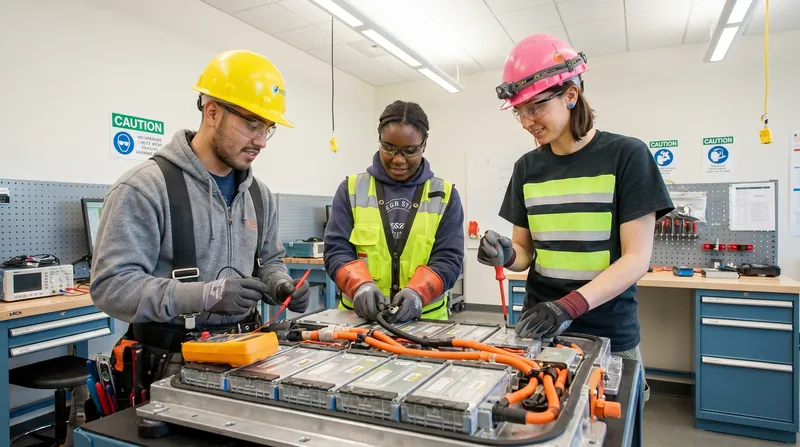
This unprecedented demand has given rise to the 'new collar' job—a term originally popularized by technology giants but now ubiquitous across diverse sectors like healthcare, advanced manufacturing, and green energy infrastructure. Unlike traditional white-collar roles that strictly require a bachelor's degree, or blue-collar roles centered primarily on physical labor, new collar positions prioritize practical capabilities, adaptability, and targeted technical skills.
These are often lucrative, future-proof careers in critical fields such as cybersecurity, cloud computing, data analysis, and digital design. Many of these emerging roles offer six-figure earning potential, proving that financial success is no longer exclusively tied to a traditional academic pedigree.[1][4]
To effectively fill these new collar roles, the educational landscape has introduced and refined the concept of the micro-credential. Broadly defined by international bodies like the OECD and the European Commission, micro-credentials are rapid, highly focused training programs designed to verify specific competencies.
They are meticulously structured to be completed in a fraction of the time it takes to earn a traditional diploma, allowing learners to gain in-demand skills quickly and demonstrate real, verifiable results to prospective employers. For an adult learner balancing full-time work and family responsibilities, a micro-credential offers a flexible, affordable pathway to pivot careers, secure a promotion, or enter an entirely new industry without taking on crippling student debt.[3]
However, the true transformative power of this educational model emerges when these individual micro-credentials become 'stackable.' Rather than existing as isolated, dead-end certificates, stackable credentials act as modular building blocks within a larger educational framework. A worker might complete a short, intensive course in data analytics, followed months later by a module in project management or cloud architecture.
Over time, these individual achievements can be seamlessly stacked together to form a larger, universally recognized qualification—even applying as formal credits toward a full associate or bachelor's degree. This innovative architecture keeps workers actively employed and earning a salary while they learn, fundamentally altering the traditional economics of higher education.[2][5]
The shift toward stackable credentials is not just a theoretical academic concept; it is being actively deployed and funded by some of the world's largest corporations. Technology leaders like IBM have established extensive, highly competitive apprenticeship programs under their New Collar initiatives.
These earn-and-learn models explicitly target individuals who do not possess four-year degrees, offering them full-time salaries, comprehensive benefits, and dedicated mentorship while they train for complex roles as app developers, data scientists, or cybersecurity technicians. The rallying cry for these corporate programs is simple, direct, and highly appealing to a broad demographic: 'No degree? No problem!'[4]
This corporate embrace is part of a much broader, systemic movement known as Skills-Based Hiring (SBH). By 2025, comprehensive industry data indicated that an astonishing 85 percent of companies had utilized skills-based hiring methods, actively stripping arbitrary degree requirements from their job descriptions in order to widen their talent pools. Employers are increasingly finding that by focusing intensely on what a candidate can actually do—rather than where they spent four years studying—they can build more adaptable, diverse, and resilient workforces capable of navigating unpredictable market shifts.[1][5][6]
The financial premium placed on these targeted, verifiable skills is substantial and growing. Industry analysts report that a vast majority of employers now offer significantly higher starting pay for candidates holding relevant micro-credentials, particularly in high-demand, future-facing areas like artificial intelligence, machine learning, and data literacy.
For modern job seekers, earning industry-recognized certifications has become a highly efficient, strategic way to signal immediate job readiness. This approach often requires far less time, expense, and opportunity cost than navigating a traditional academic route, providing a faster return on investment for the learner.[1][5]
Public policy and government institutions are also racing to catch up with this new economic reality. Governments worldwide are increasingly recognizing that accessible, lifelong learning is absolutely essential for long-term economic stability and global competitiveness. The OECD has prominently highlighted the urgent need for national vocational education and training systems to become significantly more flexible.
They are actively advocating for shorter courses, increased modularization, and the formal, standardized recognition of prior learning and on-the-job experience. This flexibility is particularly crucial for older workers who need to remain engaged in the labor market, as well as for younger populations seeking accessible, debt-free pathways into meaningful employment.[3]
In North America, regional and provincial governments are actively building the digital and administrative infrastructure necessary to support this thriving ecosystem. For example, the Government of Alberta has comprehensively integrated micro-credentials into its cross-government collaboration strategies, explicitly designing portals to help citizens navigate their lifelong career journeys. These public platforms help individuals strategically identify which specific micro-credentials will best serve their long-term career goals, whether they are looking to transition into a hybrid corporate role or specialize in an emerging, hands-on field like commercial solar panel installation.
Despite the widespread enthusiasm and clear economic benefits, the transition to a fully skills-based economy is not without structural friction. The RAND Corporation has extensively studied the implementation of stackable credentials and notes that building the necessary, robust infrastructure requires significant, sustained coordination between educational institutions, state governments, and private employers. There is a pressing, unresolved need for standardized taxonomies and universal frameworks so that a credential earned in one state or at one specific company is universally recognized, trusted, and valued by employers across different regions and industries.[2]
Furthermore, there is an ongoing, healthy debate among labor economists about the true scalability and accessibility of these corporate apprenticeships. While flagship programs at Fortune 500 companies generate significant media headlines and offer life-changing opportunities for participants, they remain relatively small in scale compared to the overall size of the global workforce.
Critics also point out that many of these 'no degree required' apprenticeships still demand foundational technical skills, self-taught coding abilities, or expensive bootcamp experience. This means they may not be immediately accessible to the typical high school graduate without some form of intermediate, preparatory training.[4][6]
To effectively bridge this accessibility gap, educational strategists and workforce planners are advocating for a 'braided river' approach to career pathways, deliberately moving away from the rigid, linear pipeline metaphor of the past. In a braided river model, there are multiple, fluid entry and exit points throughout a person's life.
A student might earn an industry-recognized credential in high school, enter the workforce immediately, return for a specialized micro-credential a few years later, and eventually stack those diverse experiences into a formal degree. This fluid, adaptable model acknowledges that modern career development is rarely a straight line.[2][6]
Traditional universities, which were initially viewed by some analysts as potential casualties of the micro-credential boom, are increasingly becoming vital, proactive partners in this ecosystem. Forward-thinking academic institutions are actively collaborating with major employers to design custom learning solutions, tailor-made short courses, and rigorous assessment frameworks.
This emerging symbiosis allows universities to maintain their cultural and economic relevance in a rapidly shifting market, while simultaneously providing employers with the rigorous, high-quality training their workforces require to stay competitive. By breaking their traditional four-year degrees into modular, stackable components, these institutions are finding new ways to serve adult learners who previously would have been priced out of higher education.[5]
The rapid integration of artificial intelligence into the learning process itself is further accelerating this trend toward modular education. AI-enabled tutoring tools, sophisticated digital skills assessments, and predictive analytics are now being used to precisely match workers with the specific micro-credentials they need to close their personal skills gaps.
This hyper-personalized approach to education ensures that adult learners are not wasting valuable time or money on material they already know. Instead, the upskilling process becomes highly efficient, deeply engaging, and directly aligned with the immediate demands of the local labor market.[3]
Ultimately, the meteoric rise of new collar jobs and stackable credentials represents a profound democratization of career mobility and economic opportunity. It directly challenges the long-held, exclusionary assumption that a traditional, expensive degree is the only valid proof of human competence and potential. By making durable skills visible, verifiable, and portable, this new educational architecture empowers workers from all backgrounds to take control of their professional trajectories. It allows them to adapt to sudden economic shifts and technological disruptions with unprecedented agility and confidence.[1][5][6]
As the global economy continues to evolve at a breakneck pace, the ability to learn, unlearn, and relearn will undoubtedly be the most critical professional competency of all. The robust infrastructure being built today—from paid corporate apprenticeships to standardized, government-backed micro-credentials—is laying the permanent groundwork for a future where education is no longer viewed as a one-time event completed in early adulthood. Instead, it is being recognized as a continuous, lifelong journey that evolves in tandem with a worker's ambitions and the market's needs.[2][3][6]
For the adult learner navigating the complex job market of 2026, the overarching message is overwhelmingly positive and clear: the path to a fulfilling, high-paying career is no longer restricted to a single, prohibitively expensive route.
With the right combination of targeted technical skills, practical hands-on experience, and a steadfast willingness to embrace continuous learning, the opportunities within the thriving new collar economy are vast, lucrative, and more accessible than ever before. The power has shifted back into the hands of the worker, transforming the pursuit of knowledge into a lifelong, empowering advantage.[1]
Definitions
- Micro-credential
- A short, focused training program that verifies a learner has mastered a specific skill or competency, often completed in a fraction of the time of a traditional degree.
- Stackable credential
- A modular educational model where multiple short-term courses or certificates can be combined over time to build toward a higher-level qualification.
- New collar job
- A career role that requires specialized technical skills—often acquired through bootcamps, apprenticeships, or certifications—rather than a traditional four-year bachelor's degree.
- Skills-based hiring
- A recruitment strategy where employers evaluate candidates based on their practical abilities and verifiable skills rather than their formal educational background.
Questions & answers
What exactly is a 'new collar' job?
A new collar job is a role that prioritizes practical skills and technical capabilities over a traditional four-year college degree. These positions are common in fast-growing fields like cybersecurity, cloud computing, and advanced manufacturing.
How do stackable credentials work?
Stackable credentials allow learners to complete short, focused courses (micro-credentials) that can be combined over time. These smaller achievements 'stack' together to form a larger, recognized qualification, such as an industry certificate or even a bachelor's degree.
Are companies actually hiring people without degrees?
Yes. By 2025, data showed that 85% of companies were utilizing skills-based hiring methods, actively removing degree requirements from job descriptions to focus on candidates' actual abilities and certifications.
Do I need prior experience to join a corporate apprenticeship?
While programs like IBM's explicitly do not require a degree, many tech apprenticeships still look for foundational skills or self-taught knowledge. Candidates often complete bootcamps or short online courses before applying.
Analysis by camp
Skills-First Employers
Corporations prioritizing practical capabilities over traditional academic pedigrees.
Major technology and manufacturing firms argue that the pace of innovation has outstripped the traditional university curriculum. By removing degree requirements and investing in internal apprenticeships, they believe they can build a more agile and diverse workforce. These employers view micro-credentials as a more accurate signal of a candidate's immediate job readiness than a four-year diploma.
Public Policy & Education Strategists
Government and research bodies focused on equitable infrastructure for lifelong learning.
Organizations like the OECD and the RAND Corporation emphasize that while the shift to skills-based hiring is promising, it requires robust public infrastructure to succeed. They argue for standardized credential taxonomies so that a certificate earned in one region is recognized globally. Their focus is on ensuring that these new pathways do not inadvertently create new barriers for marginalized workers who lack access to foundational digital training.
Factlen Editorial Team
Synthesizing the broader economic shift toward continuous, modular education.
The transition from a degree-based economy to a skills-based one represents a fundamental rewiring of social mobility. While the 'new collar' model offers unprecedented flexibility and lower barriers to entry for high-paying roles, its ultimate success will depend on whether these micro-credentials hold their value during economic downturns. The integration of AI-driven personalized learning suggests this trend will only accelerate, making continuous upskilling a permanent feature of the modern career.
- Skills-First Employers
- Corporations prioritizing practical capabilities over traditional academic pedigrees.
- Public Policy & Education Strategists
- Government and research bodies focused on equitable infrastructure for lifelong learning.
- Factlen Editorial Team
- Synthesizing the broader economic shift toward continuous, modular education.
Perspectives this story doesn't cover
- Organized Labor / Trade Unions
- Recent Four-Year College Graduates
Sources
Source coverage
6 outlets
3 viewpoints surfaced






- [1]ForbesSkills-First Employers
Five Impending NBA Free Agency Decisions With Biggest 2026-27 Impact
Read on Forbes → - [2]RAND CorporationPublic Policy & Education Strategists
Promising Practices for Building Stackable Credential Infrastructure
Read on RAND Corporation → - [3]OECDPublic Policy & Education Strategists
Harnessing the skills of adults at all life stages
Read on OECD → - [4]IBMSkills-First Employers
IBM Apprenticeship Program: New Collar Jobs
Read on IBM → - [5]Capital Analytics AssociatesSkills-First Employers
Micro-credentials move from workforce development experiment to boardroom-level talent strategy
Read on Capital Analytics Associates → - [6]Factlen Editorial TeamFactlen Editorial Team
Synthesis by Factlen editorial team
Read on Factlen Editorial Team →

More in Education
See all →Micro-Credentials
How Stackable Micro-Credentials Are Replacing the Traditional Master's Degree
6 sources

Micro-Credentials
Stackable Micro-Credentials: How "Agile Upskilling" is Rewiring Career Pivots
2 sources

Green Collar Jobs
The Rise of the Green-Collar Workforce: How Clean Energy is Rewriting Vocational Education
4 sources
Prior Learning Assessment
Workplace Portfolios Must Prove Course-Level Competencies, Not Years on the Job, to Convert Professional Experience into Degree Credit
4 sources

Comments
Every angle. Every day.
Get Education stories with full source coverage and perspective breakdowns, free every day.