
Commercial Shipping's Wind-Powered Fleet Surpasses 100 Vessels
A century after diesel engines replaced canvas, high-tech rotor and wing sails are returning to global trade routes to slash fuel costs and emissions.
By Factlen Editorial Team
- Maritime Technology Developers
- Focus on the aerodynamic efficiency, automated deployment, and rapid return on investment of modern wind systems.
- Commercial Shipowners
- View wind propulsion as a crucial hedge against volatile bunker fuel prices and a tool for regulatory compliance.
- Industry Analysts
- Track the macro-level decarbonization impact, fleet penetration rates, and the safety certifications required for scale.
What's not represented
- · Port Authorities
- · Seafarers Unions
Why this matters
Maritime transport handles 80% of global trade but generates massive greenhouse gas emissions. The rapid commercialization of wind propulsion proves that the industry can decarbonize using free, renewable energy without disrupting global supply chains.
Key points
- The global fleet of large commercial ships equipped with wind propulsion has surpassed 100 vessels.
- These installations are currently saving an estimated 100,000 tonnes of CO2 equivalent annually.
- Rotor sails and rigid wing sails are the dominant technologies, offering automated, low-maintenance thrust.
- Shipowners are seeing fuel savings of 5% to 25%, driven by tightening emissions regulations and high fuel costs.
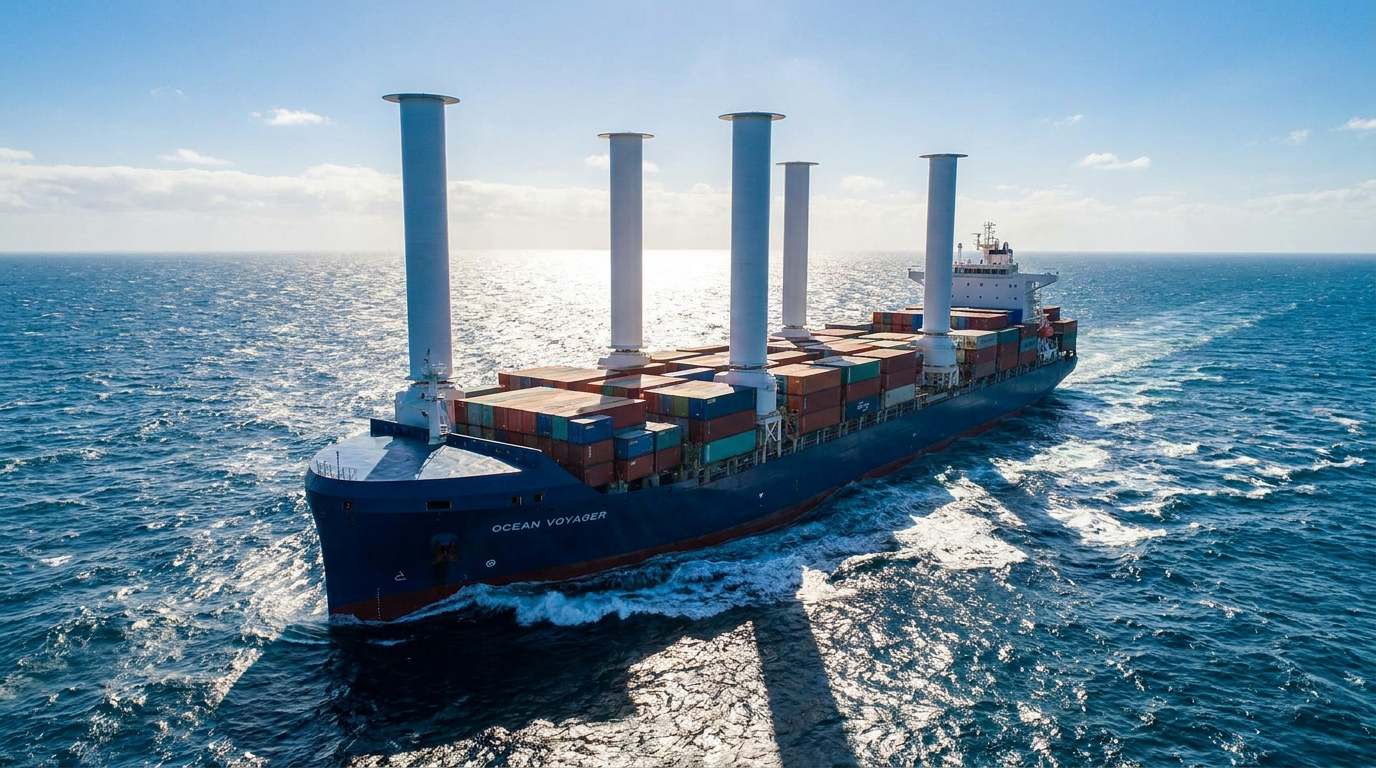
A century after diesel engines banished canvas sails from commercial trade routes, wind power is making a massive, high-tech return to the open ocean. In mid-2026, the maritime industry crossed a historic threshold: more than 100 large commercial cargo ships are now actively operating with wind-assisted propulsion systems. These are not the rigged galleons of the past, but massive bulk carriers, oil tankers, and roll-on/roll-off vehicle transports equipped with towering, automated aerodynamics.[1]
The International Windship Association (IWSA) confirmed that the active wind-assisted fleet now exceeds 5 million deadweight tonnes (DWT) of cargo-carrying capacity. Across these vessels, more than 230 individual wind propulsion systems have been installed, delivering measurable environmental dividends. The IWSA estimates that these installations are currently stripping more than 100,000 tonnes of CO2 equivalent from the atmosphere every year, alongside steep reductions in sulfur and nitrogen oxide pollutants.[1]
The pace of adoption is accelerating exponentially. In May 2022, only 21 large commercial vessels utilized wind technologies. Four years later, that figure has increased nearly fivefold, and industry analysts project the fleet will double again to roughly 200 ships by mid-2027. This surge is driven by a convergence of tightening environmental regulations, volatile bunker fuel prices, and the sudden commercial maturity of the hardware itself.[1]

The most dominant technology in this new era is the rotor sail, also known as a Flettner rotor. These are large, vertical cylinders mounted on a ship's deck that are mechanically spun by a small electric motor. As wind flows around the spinning cylinder, it accelerates on one side and decelerates on the other. This pressure differential creates a powerful aerodynamic thrust known as the Magnus effect, which pushes the ship forward.[6]
Rotor sails have captured the largest share of the market because they occupy a remarkably small footprint on crowded decks. Leading manufacturers like Norsepower and Anemoi Marine Technologies have developed systems that are fully automated and require virtually no crew intervention. China State Shipbuilding Corp (CSSC) recently unveiled one of the world's largest rotor sails, measuring 5 meters in diameter and 35 meters in height, capable of producing over 355 kilonewtons of thrust.[4][6][7]
Rigid wing sails represent the second major pillar of modern wind propulsion. Functioning exactly like an airplane wing stood on end, these solid, asymmetrical structures generate forward lift as crosswinds pass over them. Oceanbird, a joint venture between Alfa Laval and Wallenius Lines, recently launched its first full-scale rigid wing sail, the 40-meter-high Wing 560, in Landskrona, Sweden.[2]

Rigid wing sails represent the second major pillar of modern wind propulsion.
Constructed with a high-strength steel core and an aerodynamic surface made from glass fiber composites and recycled plastics, the Wing 560 is designed to fold down to clear bridges and survive extreme weather. The first commercial installation of this massive wing is slated for early 2026 aboard Wallenius Wilhelmsen's car carrier, the Tirranna. Oceanbird's engineers calculate that a single wing can reduce fuel consumption by 10 percent, with multi-wing arrays capable of far greater savings.[2]
While most vessels use wind to assist traditional engines, some operators are pushing toward primary wind propulsion. CMA CGM recently deployed the Neoliner Origin on a commercial trans-Atlantic route between France and North America. Rigged with 32,000 square feet of sail on two 295-foot masts, the diesel-wind hybrid vessel relies on wind for 60 to 70 percent of its propulsion, reducing greenhouse gas emissions by up to 90 percent compared to conventional ships of its size.[3]
Specialized cargo is also getting a bespoke wind treatment. VELA, a French maritime startup, is preparing to launch a custom-built, 220-foot wind-powered trimaran in 2026. Designed to transport high-value, temperature-sensitive goods like pharmaceuticals and luxury items across the Atlantic, the vessel will rely entirely on wind propulsion while at sea, completing the crossing in under 15 days.[5]

Integrating these systems onto complex vessels like oil tankers has historically posed a severe engineering challenge due to hazardous deck zones and strict loading clearances. However, recent breakthroughs have solved these bottlenecks. Anemoi Marine Technologies recently secured approval for folding, explosion-rated rotor sails designed specifically for medium-range tankers. The folding mechanism allows the sails to lie flat during port operations, ensuring they do not interfere with cargo cranes.[4]
The scale of deployment is also expanding to the largest vessels on the ocean. Norsepower recently signed a landmark agreement with Idemitsu Tanker to equip two newbuild Very Large Crude Carriers (VLCCs) with rotor sails. Scheduled for delivery in 2028, these behemoths will feature 35-meter-tall explosion-proof rotors, marking the first time wind propulsion has been applied to the VLCC class.[7]
The economics of wind propulsion have shifted from a green public relations exercise to a hard-nosed financial strategy. Depending on the vessel type, route, and number of sails, operators are reporting average fuel savings between 5 and 25 percent. In an era of expensive low-carbon fuels, these savings translate to a return on investment of just three to five years, making wind one of the most cost-effective decarbonization levers available.[1][6]

Regulatory pressure is acting as the final catalyst. The International Maritime Organization's (IMO) Carbon Intensity Indicator (CII) and the inclusion of shipping in the European Union's Emissions Trading System (ETS) mean that ships burning heavy fuel oil now face steep financial penalties. Wind-assisted propulsion directly improves a vessel's CII rating, allowing older ships to remain compliant and profitable without requiring total engine replacements.[4][7]
As the fleet sails past the 100-vessel mark, the industry is transitioning from pilot projects to serial production. With shipyards in China and Europe scaling up assembly lines for rotor and wing sails, wind energy has cemented its role in the future of global trade. By harnessing the oldest fuel on earth, the maritime sector is charting a viable, profitable course toward a zero-emission horizon.[1][2]
How we got here
1920s
Anton Flettner invents the rotor sail, though cheap diesel fuel prevents widespread adoption.
May 2022
Only 21 large commercial vessels are operating with modern wind-assisted propulsion.
August 2025
Oceanbird launches its first full-scale, 40-meter rigid wing sail prototype in Sweden.
June 2026
The International Windship Association announces the commercial fleet has surpassed 100 wind-assisted vessels.
Viewpoints in depth
Maritime Technology Developers
Engineering firms are focused on maximizing thrust while minimizing the deck footprint.
For the engineers designing these systems, the primary goal is aerodynamic efficiency combined with operational invisibility. Developers like Oceanbird and Norsepower emphasize that modern sails require virtually no crew intervention. Automated sensors detect wind speed and direction, adjusting the rotation of Flettner rotors or the angle of rigid wings to optimize thrust. When weather becomes too severe, or when the ship approaches a low bridge, the systems automatically power down or fold away. This 'plug-and-play' automation is critical for convincing conservative shipowners to adopt the technology.
Commercial Shipowners
Operators view wind power as a financial hedge and a regulatory lifeline.
For the companies actually moving global freight, the appeal of wind propulsion is heavily rooted in economics. With the European Union's Emissions Trading System (ETS) now taxing maritime carbon, and the IMO enforcing strict Carbon Intensity Indicator (CII) ratings, burning traditional heavy fuel oil is becoming prohibitively expensive. Shipowners note that wind-assisted systems offer a predictable 5 to 25 percent reduction in fuel consumption. Because wind is free and immune to geopolitical price shocks, these installations often pay for themselves in under five years, providing a rare financial win-win in the costly transition to green shipping.
Industry Regulators
Classification societies and regulators are focused on safety, stability, and standardized emissions accounting.
Organizations like DNV and the International Maritime Organization are tasked with ensuring that strapping massive sails to cargo ships does not compromise safety. Regulators are deeply focused on the structural integrity of the deck mounts, the stability of the vessel in high winds, and the safety of operating electrical equipment in hazardous zones, such as the decks of oil tankers. Furthermore, regulators are working to standardize exactly how wind-derived fuel savings are calculated and verified, ensuring that shipowners receive accurate carbon credits and CII score improvements for their investments.
What we don't know
- How quickly global shipyards can scale up manufacturing to meet the surging demand for rotor and wing sails.
- The long-term maintenance costs of massive aerodynamic structures exposed to decades of corrosive saltwater and extreme weather.
- How effectively artificial intelligence can optimize global weather routing to maximize wind assistance on variable trade lanes.
Key terms
- Wind-Assisted Ship Propulsion (WASP)
- Technologies that harness wind to supplement a vessel's main engine, reducing overall fuel consumption.
- Rotor Sail (Flettner Rotor)
- A large, spinning vertical cylinder that uses the Magnus effect to generate forward thrust from crosswinds.
- Magnus Effect
- The aerodynamic phenomenon where a spinning object drags air around itself, creating a pressure difference that results in a perpendicular force.
- Rigid Wing Sail
- A solid, vertical airfoil resembling an airplane wing that generates forward lift when wind passes over its asymmetrical surface.
- Deadweight Tonnage (DWT)
- A measure of how much weight a ship can safely carry, including cargo, fuel, and crew.
Frequently asked
Do these wind-assisted ships still have engines?
Yes. Most are 'wind-assisted,' meaning they use traditional engines but rely on sails to reduce the engine's load, saving fuel and cutting emissions.
What happens when there is no wind?
The automated systems detect the lack of wind and power down the rotors or adjust the wings, allowing the ship's main engines to take over completely.
Can these massive sails fit under bridges?
Many modern wind propulsion systems, including certain rotor sails and rigid wings, are designed to tilt or fold flat to the deck to clear bridges and port cranes.
Sources
Source coverage
7 outlets
3 viewpoints surfaced







[1]Bunker IndexIndustry Analysts
Wind-assisted commercial fleet passes 100-vessel milestone
Read on Bunker Index →[2]The Maritime ExecutiveMaritime Technology Developers
Oceanbird Wing Sail Reaches for the Sky in Demonstration
Read on The Maritime Executive →[3]FreightWavesCommercial Shipowners
Back to the future: New wind-powered ship joins trans-Atlantic service
Read on FreightWaves →[4]The Motor ShipIndustry Analysts
New certifications and tanker designs demonstrate wind propulsion's growing viability
Read on The Motor Ship →[5]CleanTechnicaCommercial Shipowners
Wind-Powered Trimaran Cargo Ship To Be Launched In 2026
Read on CleanTechnica →[6]China DailyMaritime Technology Developers
CSSC's rotor sail aims to drive global green ship tech
Read on China Daily →[7]NorsepowerMaritime Technology Developers
Norsepower and Idemitsu Tanker to equip world's first VLCCs with Rotor Sails
Read on Norsepower →
Every angle. Every day.
Get transportation stories with full source coverage and perspective breakdowns delivered to your inbox.