
The Science of Digital Resistance: How Smart Gyms Compare to Free Weights
Electromagnetic cable machines are replacing traditional iron in home gyms, using algorithms to generate constant tension and eccentric overload. But can digital motors build muscle as effectively as free weights?
By Factlen Editorial Team
- Digital Fitness Advocates
- Prioritize algorithmic efficiency, safety, and the benefits of constant tension.
- Traditional Iron Purists
- Believe physical mass is essential for functional strength and stabilizer engagement.
- Sports Science Researchers
- Focus on the physiological mechanisms of muscle hypertrophy regardless of equipment.
What's not represented
- · Commercial gym owners facing competition from high-end home equipment
- · Physical therapists utilizing digital resistance for controlled rehabilitation
Why this matters
Home fitness equipment is a major investment, and the shift from physical weights to digital subscriptions changes both the economics and the physiology of working out. Understanding the science behind electromagnetic resistance helps consumers decide if a $3,000 smart gym will actually deliver better results than a $300 set of dumbbells.
Key points
- Smart gyms use electromagnetic motors to generate resistance, replacing traditional iron weight plates.
- Digital resistance eliminates momentum, providing constant tension throughout the entire exercise.
- Algorithms can automatically add weight during the lowering phase, a muscle-building technique called eccentric overloading.
- Built-in sensors act as a digital spotter, automatically reducing weight if a user struggles mid-rep.
- While highly space-efficient, smart gyms require a significant upfront investment and often mandate ongoing software subscriptions.
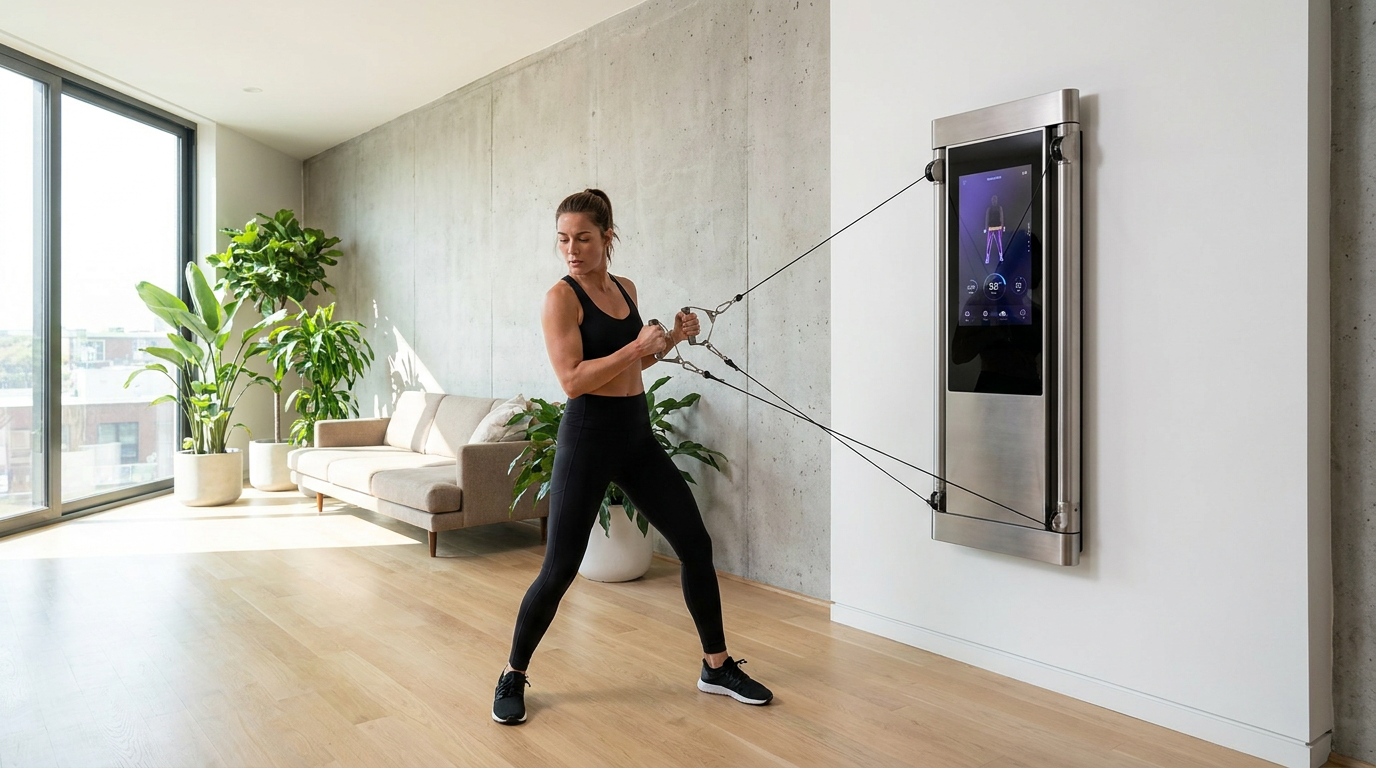
The home gym landscape is undergoing a fundamental shift. For decades, building strength at home meant dedicating a garage to a power rack, a heavy bench, and hundreds of pounds of cast iron. Today, a new category of fitness equipment is replacing gravity with algorithms, promising a full-body workout in the footprint of a yoga mat.[1]
Known as smart gyms or digital resistance machines, devices like Tonal, Vitruvian, and Speediance are moving away from physical weight plates entirely. Instead, they use advanced electromagnetic motors to generate force. This shift from physical mass to digital tension is sparking a debate among fitness enthusiasts and sports scientists about the most effective way to build muscle.[1][2]
To understand the debate, it is essential to look at how traditional free weights work. Dumbbells and barbells rely entirely on gravity. When a lifter performs a bicep curl, the movement is hardest at the midpoint when the forearm is parallel to the floor. At the top and bottom of the movement, the mechanical tension drops significantly.[4]
Furthermore, free weights allow lifters to use momentum. By slightly swinging the hips or shoulders, a lifter can cheat physics, using inertia to move a weight that might otherwise be too heavy. While this allows for heavier lifts on paper, it momentarily takes the mechanical tension off the target muscle, reducing the efficiency of the exercise.[4][5]

Digital resistance operates on an entirely different physical principle. Inside a smart gym, computer chips control coils that generate an electromagnetic field. As the user pulls on a cable, they are fighting the motor's pull, not gravity. The machine performs thousands of calculations per second to emulate the physics of traditional weights while eliminating their flaws.[2]
Because the resistance is generated by an algorithm, there is zero momentum. If the screen is set to 50 pounds, the motor delivers exactly 50 pounds of resistance at every millimeter of the range of motion. This constant tension means the muscle never gets a micro-rest at the top or bottom of the lift.[4][5]
This lack of inertia is why digital weight often feels significantly heavier than traditional iron. A lifter who routinely curls 40-pound dumbbells may find themselves struggling with 30 pounds of digital resistance. The constant tension dramatically increases the "time under tension" (TUT), a critical driver for muscle hypertrophy and muscular endurance.[2][5]
This lack of inertia is why digital weight often feels significantly heavier than traditional iron.
Beyond constant tension, digital motors unlock a physiological advantage that is difficult to achieve safely with free weights: eccentric overloading. Muscle contractions have two phases—concentric (lifting the weight) and eccentric (lowering the weight).[4]
Research consistently shows that the eccentric phase causes more micro-tears in the muscle fibers, which is the primary catalyst for muscle growth during the recovery process. However, human muscles are naturally stronger in the eccentric phase. To fully fatigue the muscle on the way down, a lifter actually needs more weight than they can lift on the way up.[2][4]

In a traditional commercial gym, eccentric overloading requires two human spotters to lift a heavy barbell, allowing the trainee to slowly lower it on their own. Smart gyms automate this complex technique. The algorithm can dynamically add 20 percent more resistance the moment the user begins to lower the cable, maximizing the hypertrophic stimulus without requiring a partner.[2][4]
These machines also act as digital spotters. If the sensors detect that a user's rep speed is slowing down or that they are stuck mid-lift, the motor instantly reduces the resistance by a few pounds so the user can complete the rep safely. This allows individuals training alone in their living rooms to push to absolute muscular failure without the risk of being pinned under a heavy barbell.[2][5]
Despite the technological advantages, traditional iron purists argue that free weights offer benefits that cables cannot replicate. Lifting a barbell requires the lifter to balance the weight in three-dimensional space, heavily engaging the core and smaller stabilizer muscles to keep the body upright.[5]
While digital cable machines allow for free motion and do engage stabilizers more than fixed-path commercial gym machines, the anchor point of the cable still provides a degree of stability that a free-floating dumbbell does not. For athletes training for functional, real-world strength, moving physical mass remains the gold standard.[5]
The most significant barrier to the digital resistance revolution is the cost. While a comprehensive set of adjustable dumbbells can be purchased for a few hundred dollars, smart gyms typically range from $2,500 to $4,000 for the hardware alone.[5][6]

Furthermore, the hardware is often tied to mandatory monthly software subscriptions, which can add hundreds of dollars a year. If a user cancels the subscription, or if the manufacturer goes out of business, the expensive machine may lose its interactive features, guided workouts, and advanced algorithmic spotting, effectively becoming a basic cable pulley.[6]
For those with limited space, however, the trade-off is often worth the premium. Wall-mounted units take up zero floor space when not in use, while floor-based platforms can be slid under a couch. They replace an entire room of equipment with a footprint that fits seamlessly into a modern apartment.[6]
Ultimately, sports scientists emphasize that muscles cannot see the equipment being used; they only respond to mechanical tension and progressive overload. Whether that tension comes from a piece of cast iron or an electromagnetic motor, consistent training will yield results. The choice increasingly comes down to budget, space constraints, and how much technology a user wants integrated into their daily workout.[2][5][6]
How we got here
Late 2010s
The first generation of wall-mounted digital resistance machines, such as Tonal, enter the consumer market.
2020–2021
The pandemic-driven home gym boom accelerates the adoption of smart fitness equipment.
2023–2024
Floor-based digital platforms like Vitruvian gain popularity, offering high resistance without requiring wall mounting.
2026
Digital resistance technology matures, with machines offering up to 440 lbs of algorithmic tension and advanced AI spotting.
Viewpoints in depth
Digital Fitness Advocates
Proponents of smart gyms who prioritize algorithmic efficiency and safety.
This camp argues that digital resistance is objectively superior to gravity-based weights because it eliminates momentum and maximizes time under tension. They highlight features like algorithmic spotting and eccentric overloading as game-changers that allow solo users to train to failure safely. For these advocates, the high upfront cost is justified by the space savings and the efficiency of the workouts, which they claim can build muscle faster than traditional methods.
Traditional Iron Purists
Lifters and coaches who believe physical mass is essential for functional strength.
Traditionalists maintain that moving actual physical mass through three-dimensional space is the only way to build true functional strength. They argue that while digital cables provide constant tension, they artificially stabilize the lifter, failing to fully engage the core and micro-stabilizer muscles required to balance a heavy barbell. Furthermore, they criticize the reliance on expensive monthly subscriptions, noting that a cast-iron dumbbell will last a lifetime without requiring a software update.
Sports Science Researchers
Academics focused on the physiological mechanisms of muscle hypertrophy.
Researchers take a pragmatic view, emphasizing the principle of mechanical tension. They note that muscle fibers cannot distinguish between gravity and electromagnetism; they only respond to the stress placed upon them. While they acknowledge that the constant tension and eccentric overloading capabilities of digital machines are highly effective for hypertrophy, they stress that progressive overload and consistency remain the true drivers of fitness, regardless of the equipment used.
What we don't know
- Whether long-term reliance on digital cable machines leads to underdeveloped stabilizer muscles compared to decades of free-weight training.
- How the secondary market for smart gyms will evolve as older hardware becomes obsolete or unsupported by software updates.
- If the subscription-heavy business model of smart fitness companies will remain sustainable as the market becomes more saturated.
Key terms
- Digital Resistance
- Tension generated by electromagnetic motors and computer algorithms rather than physical mass and gravity.
- Eccentric Overloading
- Applying more resistance during the lengthening (downward) phase of a muscle contraction to stimulate greater muscle growth.
- Time Under Tension (TUT)
- The total duration a muscle is actively working and resisting force during a set of exercises.
- Concentric Phase
- The lifting or shortening phase of a muscle contraction, such as curling a dumbbell upward.
- Progressive Overload
- The gradual increase of stress placed upon the body during exercise training to continuously build muscle and strength.
Frequently asked
Does 50 lbs of digital resistance equal 50 lbs of free weights?
Yes, in terms of the actual force required. However, digital resistance often feels heavier because it eliminates momentum and provides constant tension throughout the entire movement.
Can you build as much muscle with a smart gym as with free weights?
Yes. Muscles respond to mechanical tension, not the source of the weight. The constant tension and eccentric overloading features of smart gyms can be highly effective for hypertrophy.
What happens if the smart gym company goes out of business?
This is a recognized risk. Many smart gyms rely on cloud servers and paid subscriptions for their interactive features; without them, the machine may lose functionality or become a basic cable pulley.
Do I need a spotter when using a digital resistance machine?
No. Most smart gyms feature algorithmic spotting that automatically reduces the weight if it senses you are struggling or stuck mid-rep.
Sources
Source coverage
7 outlets
3 viewpoints surfaced






[1]Men's HealthSports Science Researchers
The Best Smart Home Gym Equipment for 2026
Read on Men's Health →[2]TonalDigital Fitness Advocates
What Is Adaptive Weight and How Does It Work?
Read on Tonal →[3]ResearchGateSports Science Researchers
Digital Resistance Training Technologies and Muscle Hypertrophy
Read on ResearchGate →[4]GXMmatTraditional Iron Purists
Digital Resistance vs. Free Weights: The Science
Read on GXMmat →[5]AEKETraditional Iron Purists
The 2026 Comparison: Digital Resistance vs Traditional Weights
Read on AEKE →[6]FitTransformerDigital Fitness Advocates
Comparing the Top Smart Gyms of 2026
Read on FitTransformer →[7]Factlen Editorial TeamSports Science Researchers
Synthesis by Factlen editorial team
Read on Factlen Editorial Team →


Every angle. Every day.
Get fitness stories with full source coverage and perspective breakdowns delivered to your inbox.