
AI Decodes Sperm Whale 'Phonetic Alphabet,' Revealing Complex Grammar and Dialects
Using advanced machine learning and deep-sea bio-loggers, scientists have identified a highly structured language in sperm whale communications, opening the door to interspecies dialogue.
By Factlen Editorial Team
- Marine Biologists & Technologists
- Scientists focused on the mechanics of decoding animal communication using advanced AI.
- Environmental & Legal Advocates
- Conservationists using the discovery of whale language to push for expanded marine protections.
- AI Skeptics & Ethicists
- Observers cautioning against over-interpreting the data or interfering with wild populations.
What's not represented
- · Indigenous Coastal Communities
- · Commercial Fishing Industry
Why this matters
Understanding that another species possesses a complex, structured language fundamentally shifts humanity's relationship with the natural world. It provides powerful new scientific leverage for marine conservation and challenges our long-held assumptions about intelligence.
Key points
- Artificial intelligence has identified a 'phonetic alphabet' of 156 distinct codas used by sperm whales.
- Machine learning models achieved over 95% accuracy in recognizing specific whale dialects and click patterns.
- Advanced bio-loggers engineered by Harvard researchers captured the high-fidelity audio and behavioral data needed to train the AI.
- The breakthrough provides powerful scientific evidence for marine conservationists advocating for cetacean legal rights.
- Researchers are now preparing non-intrusive playback experiments to test basic two-way communication with the whales.
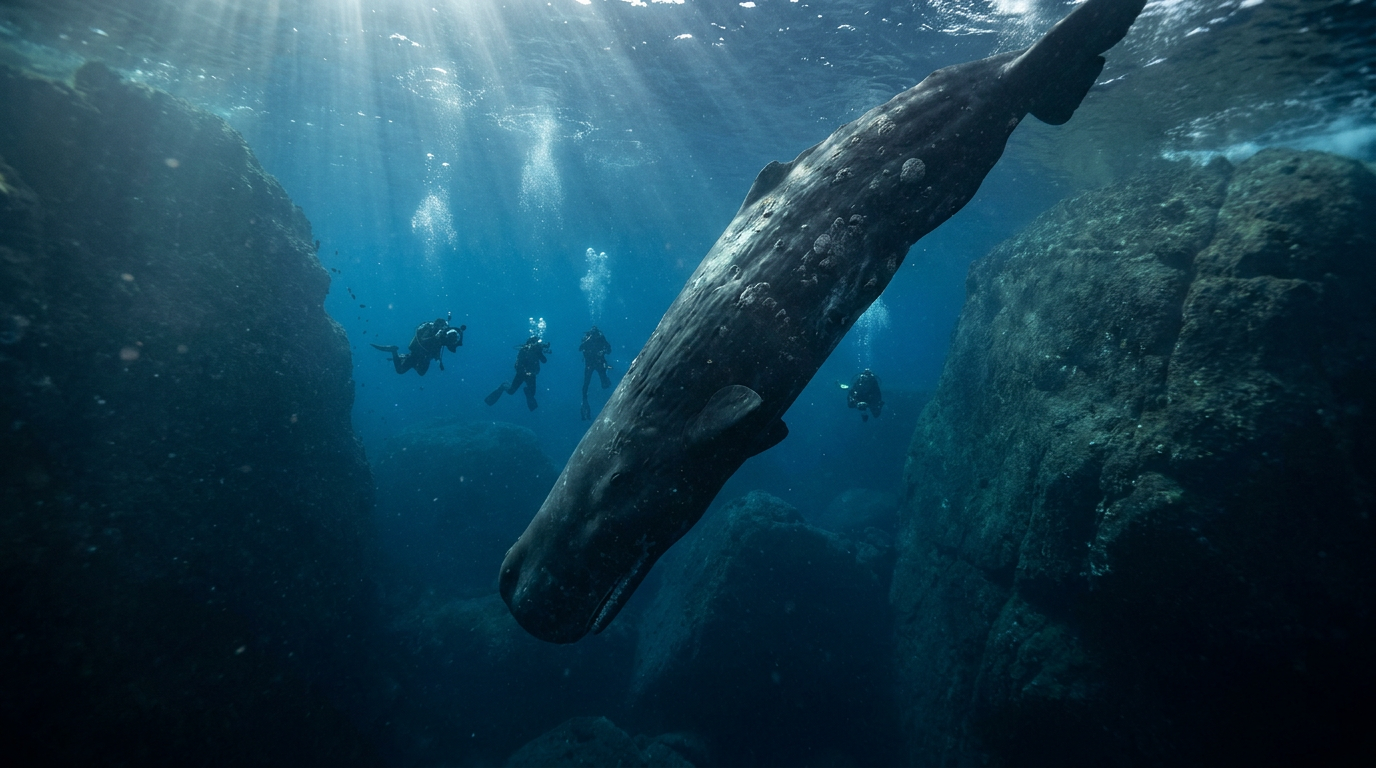
The ocean is no longer silent to human understanding. For the first time, artificial intelligence has successfully decoded the intricate, rhythmic clicking patterns of sperm whales, revealing a highly structured communication system that rivals human language in its complexity.[1][2]
The breakthrough, spearheaded by the Cetacean Translation Initiative (Project CETI), marks a watershed moment in marine biology and computer science. By applying unsupervised machine learning to millions of underwater recordings, researchers have identified what they describe as a "phonetic alphabet" used by the deep-diving mammals.[1][4]
Sperm whales communicate using rapid bursts of clicks known as "codas." For decades, scientists knew these sounds were social, but the sheer volume and acoustic density of the recordings made it impossible for human researchers to map the underlying grammar or syntax.[5]
Enter modern AI. Leveraging models similar to those that power large language models, CETI researchers processed vast datasets of whale audio gathered off the coast of Dominica. The algorithms were tasked with finding patterns without any pre-existing "Rosetta Stone" to guide them.[1][4]

The results were unprecedented. The AI identified 156 distinct codas, demonstrating that the whales combine these base units into complex phrases. The machine learning models achieved a 99.5% accuracy rate in isolating individual whale clicks from the cacophony of background ocean noise.[2][4]
Even more remarkably, the system proved capable of categorizing 23 specific types of click patterns and recognizing regional whale dialects with 95.3% accuracy. The data revealed that sperm whales use vowel-like sounds and diphthongs, altering the tempo and rhythm of their codas depending on the conversational context.[4][5]
Even more remarkably, the system proved capable of categorizing 23 specific types of click patterns and recognizing regional whale dialects with 95.3% accuracy.
Gathering this data required a leap in marine robotics. Harvard researchers collaborating with Project CETI engineered specialized, non-invasive bio-loggers. Inspired by the anatomy of clingfish, these devices attach to the whales using gentle suction cups.[2]
Once deployed, the bio-loggers accompany the whales on their deep-sea dives. Equipped with three synchronized hydrophones, the devices record high-fidelity audio from multiple whales simultaneously, alongside environmental data like depth, temperature, and movement, operating continuously for up to 16 hours.[2]

This contextual data was the missing link. By pairing the acoustic recordings with the exact physical movements and social groupings of the whales, the AI could begin to map semantic meaning to the sounds. For instance, researchers captured highly synchronized acoustic coordination during the birth of a new calf, involving a dozen female whales.[3]
The implications of this discovery extend far beyond marine biology. Legal and environmental scholars view the translation of cetacean language as a powerful tool for conservation. NYU Law's More Than Human Life (MOTH) program has partnered with CETI to explore how these findings might influence environmental policy.[3]
If science can definitively prove that sperm whales possess a complex culture, distinct dialects, and high-level intelligence, it dramatically strengthens the legal arguments for protecting their habitats from deep-sea mining, shipping noise, and climate change.[3][4]

The next frontier for Project CETI is even more ambitious: interactive dialogue. Having mapped the phonetic alphabet, the team is currently preparing for non-intrusive playback experiments.[1][6]
By broadcasting specific, context-appropriate codas back to the whales via underwater speakers, scientists hope to observe how the animals respond to human-initiated signals. A similar preliminary test with a humpback whale named Twain in late 2024 yielded a 20-minute conversational exchange, setting the stage for more complex interactions.[6]
While true interspecies fluency remains years away, the barrier between human and animal communication has been permanently breached. The application of artificial intelligence has transformed the ocean from a silent abyss into a vibrant, conversational world, fundamentally reshaping our understanding of intelligence on Earth.[6]
How we got here
2020
Project CETI is founded to apply advanced machine learning to sperm whale communication.
May 2024
Researchers publish findings in Nature Communications detailing the contextual and combinatorial structure of whale codas.
Oct 2024
Scientists conduct a groundbreaking 20-minute interactive playback 'conversation' with a humpback whale named Twain.
Dec 2025
Advanced Harvard-engineered bio-loggers are deployed, capturing high-fidelity audio and behavioral data.
Early 2026
AI models successfully isolate 156 distinct codas, mapping the phonetic alphabet and regional dialects of sperm whales.
Viewpoints in depth
Marine Biologists & Technologists
Scientists focused on the mechanics of decoding animal communication using advanced AI.
For the researchers at Project CETI and their academic partners, the focus is on the data and the unprecedented capability of unsupervised machine learning. They emphasize that AI can detect acoustic micro-structures—such as slight variations in click tempo and vowel-like diphthongs—that the human ear simply cannot process. Their primary goal is to build a rigorous, peer-reviewed blueprint of cetacean language, ensuring that any claims of 'grammar' or 'syntax' are backed by massive, statistically significant datasets rather than anthropomorphic projection.
Environmental & Legal Advocates
Conservationists using the discovery of whale language to push for expanded marine protections.
Groups like NYU's MOTH program view the AI translation breakthrough as a legal and ethical game-changer. They argue that demonstrating complex language, culture, and synchronized social behavior in sperm whales elevates their status beyond mere 'wildlife.' By proving that these animals have distinct regional dialects and communicative intent, advocates hope to establish stronger legal rights for cetaceans, using the data to lobby against disruptive human activities like commercial shipping traffic and deep-sea mining in critical habitats.
AI Skeptics & Ethicists
Observers cautioning against over-interpreting the data or interfering with wild populations.
While celebrating the technological achievement, some ethicists and cautious biologists warn against the hubris of 'talking back' to whales. They point out that while AI can identify patterns and structure, assigning human-like semantic meaning to those patterns is highly speculative. Furthermore, they raise ethical concerns about playback experiments, questioning whether broadcasting artificial codas into the ocean could disrupt natural social dynamics, confuse pods, or introduce unnatural behaviors into wild populations.
What we don't know
- Whether the structural grammar identified by the AI maps to complex, human-like semantic meaning or simpler behavioral triggers.
- How wild whale pods will react long-term to artificial playback experiments.
- Whether this AI translation framework can be successfully adapted to other highly intelligent species, such as dolphins or elephants.
Key terms
- Coda
- A distinct, rhythmic pattern of clicks used by sperm whales to communicate with one another.
- Bio-logger
- A non-invasive, sensor-equipped device attached to an animal to record environmental, behavioral, and acoustic data.
- Unsupervised Machine Learning
- An AI training method where the algorithm finds hidden patterns in unlabeled data without human guidance.
- Phonetic Alphabet
- A set of distinct, base-level sounds that can be combined in various ways to create complex phrases and meanings.
- Hydrophone
- An underwater microphone designed to record or listen to underwater sound.
Frequently asked
How does the AI understand the whales without a translation key?
The AI uses unsupervised machine learning to analyze millions of audio recordings. By cross-referencing the sounds with the whales' physical movements and social contexts recorded by bio-loggers, the AI identifies structural patterns and grammar rules without needing a pre-existing 'Rosetta Stone'.
Are scientists actually talking to the whales?
Not fluently yet. Researchers are currently in the phase of conducting playback experiments—broadcasting specific recorded sounds back to the whales to observe their reactions—which is the first step toward basic two-way communication.
Why study sperm whales specifically?
Sperm whales possess the largest brains on Earth and live in highly complex, tightly knit matrilineal societies. Their communication relies heavily on acoustic clicks, making their language highly structured and ideal for AI pattern recognition.
Sources
Source coverage
6 outlets
3 viewpoints surfaced






[1]Project CETIMarine Biologists & Technologists
Listening to the Whales: How CETI Works
Read on Project CETI →[2]Oceanographic MagazineMarine Biologists & Technologists
Scientists use AI to decode sperm whale communication
Read on Oceanographic Magazine →[3]NYU LawEnvironmental & Legal Advocates
Decoding Sperm Whale Communication with AI and Linguistics
Read on NYU Law →[4]The Audacious ProjectEnvironmental & Legal Advocates
Project CETI: Translating the communication of sperm whales
Read on The Audacious Project →[5]Nature CommunicationsMarine Biologists & Technologists
Contextual and combinatorial structure in sperm whale vocalisations
Read on Nature Communications →[6]Factlen Editorial TeamAI Skeptics & Ethicists
Synthesis by Factlen editorial team
Read on Factlen Editorial Team →
Every angle. Every day.
Get ai stories with full source coverage and perspective breakdowns delivered to your inbox.