
The Science of Tangzhong and Yudane: How Starch Gelatinization Transforms Bread
Two Asian baking techniques use heat and hydration to pre-gelatinize flour, creating ultra-soft loaves that resist staling for days without chemical preservatives.
By Factlen Editorial Team
- Food Scientists
- Focus on the chemical mechanisms of starch gelatinization and retrogradation.
- Artisan Bakers
- Value the techniques for improving crumb texture, hydration, and natural sweetness.
- Home Cooks
- Appreciate the accessible methods for achieving bakery-quality softness without chemical additives.
What's not represented
- · Industrial dough conditioner manufacturers, whose chemical products are often replaced by these natural pre-gelatinization techniques.
Why this matters
By understanding the chemistry of starch gelatinization, home bakers and commercial kitchens alike can produce bread that stays fresh and pillowy for nearly a week, reducing food waste and reliance on artificial preservatives.
Key points
- Tangzhong and yudane are pre-gelatinization techniques that allow bread dough to absorb significantly more water.
- Heating flour above 65°C (150°F) causes its starch granules to swell and form a moisture-trapping gel.
- The trapped moisture prevents the bread from drying out and physically blocks starches from recrystallizing, delaying staling.
- Tangzhong produces a fluffier, brioche-like crumb, while yudane yields a chewier, more resilient texture.
The holy grail of sandwich bread is a loaf that is impossibly soft, pillowy, and capable of staying fresh on the kitchen counter for days on end. For generations, commercial bakeries achieved this elusive texture by relying heavily on chemical dough conditioners, artificial softeners, and industrial preservatives. But in recent years, a pair of traditional Asian baking techniques—tangzhong and yudane—have revolutionized how artisan and home bakers approach soft breads, proving that bakery-quality tenderness can be achieved entirely through natural means.[6]
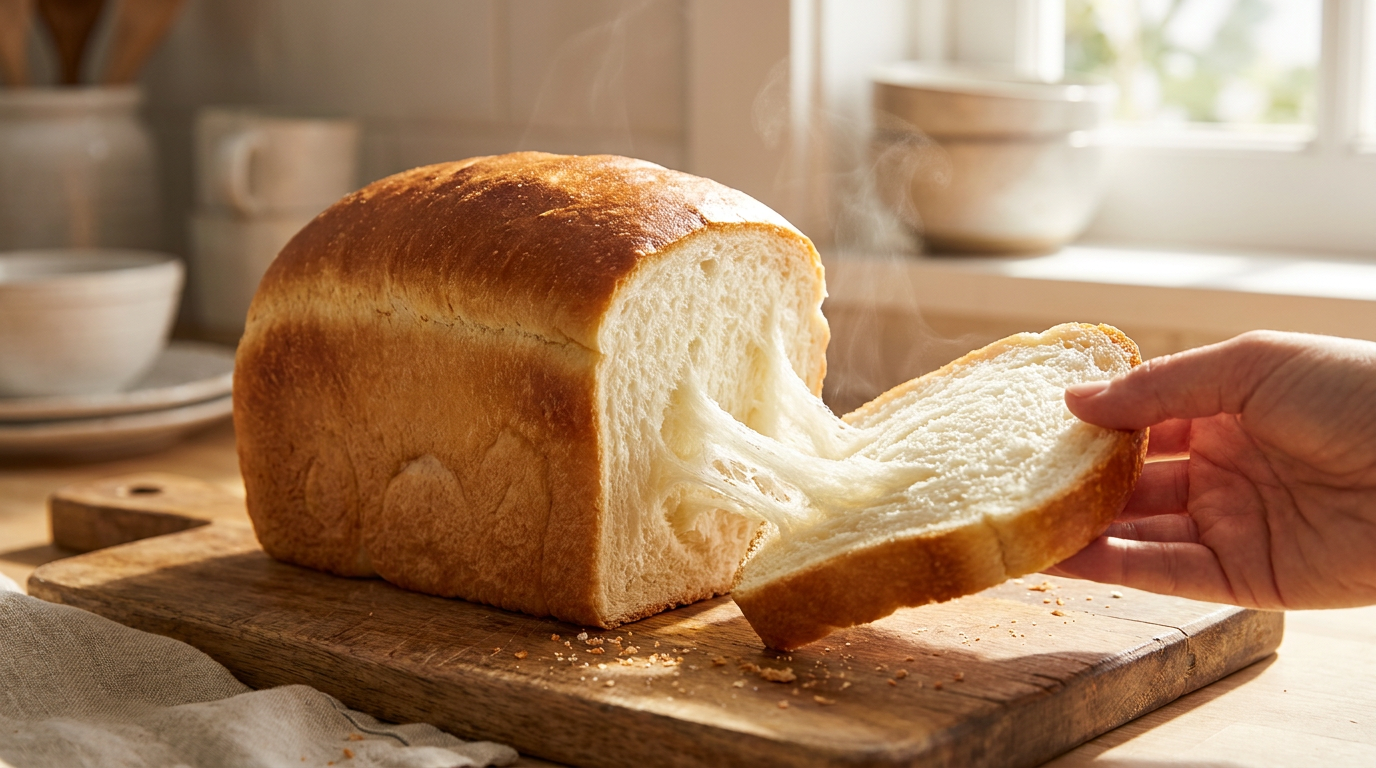
These two methods are the secret engines behind shokupan, the viral Japanese milk bread famous for its cloud-like, feathery crumb that pulls apart in satisfying, elastic strands. While tangzhong and yudane differ slightly in their execution and regional origins, both rely on a fundamental principle of food chemistry known as starch gelatinization. By manipulating how flour interacts with heat and water before the main dough is even mixed, bakers can fundamentally alter the structural destiny of the final loaf.[1][6]
To understand why these techniques work, one must look at the microscopic architecture of wheat flour. Flour is packed with tiny starch granules, which in their raw, unheated state are hard, crystalline structures. These raw granules are stubbornly resistant to moisture; they repel excess water rather than absorbing it. When a baker mixes a standard dough with cold or room-temperature water, the flour can only take on a limited amount of liquid before the mixture turns into a sticky, unmanageable puddle that is impossible to knead.[4][5]
However, when flour and liquid are heated together to a specific thermal threshold—approximately 65 degrees Celsius, or 150 degrees Fahrenheit—the architecture of the starch undergoes a radical and irreversible transformation. The heat causes the hard starch granules to swell and soften, acting like microscopic sponges that eagerly draw in surrounding moisture. In this heated, gelatinized state, the flour can absorb up to twice as much liquid as it could at room temperature, locking the water away inside a thick, viscous gel matrix.[1][2]

When this gelatinized paste is cooled and subsequently added to a main bread dough, it brings a massive payload of hydration along with it. In traditional bread baking, pushing a dough's hydration to such extreme levels would inevitably result in a slack, sticky mess that clings to the hands and refuses to hold its shape. But because the extra water is safely trapped within the pre-cooked starch gel, the dough remains remarkably smooth, cohesive, and easy to handle, allowing bakers to achieve ultra-high moisture levels without the usual structural compromises.[1][4]
Tangzhong, a technique that was widely popularized across Asia in 2007 by Taiwanese pastry chef Yvonne Chen, involves whisking a small portion of the recipe's flour and liquid together in a pan. Typically utilizing a ratio of one part flour to five parts liquid, the mixture is cooked gently over a stovetop until it thickens into a pudding-like roux. The process is quick, taking only a few minutes, and the resulting paste can be used as soon as it cools to room temperature.[4][5]
Typically utilizing a ratio of one part flour to five parts liquid, the mixture is cooked gently over a stovetop until it thickens into a pudding-like roux.
Yudane, which originated in Japan and received a commercial patent in 2001, takes a slightly different, more passive approach to achieving the same chemical end. Instead of cooking the mixture on a stove, bakers pour boiling water directly over a portion of the flour in a one-to-one ratio. This scalding water is stirred into a stiff, dough-like paste, which is then tightly covered and left to rest and hydrate, often overnight in the refrigerator, allowing the starches to swell gradually.[1][5]
While both methods yield exceptionally soft bread, their differing thermal treatments produce distinct textural nuances in the final bake. Because tangzhong is cooked over sustained, direct heat on a stovetop, it completely denatures the gluten-forming proteins in that specific portion of the flour. Without those proteins contributing to the dough's overall elastic network, the resulting bread possesses an exceptionally fluffy, delicate, and tender crumb that closely mimics the luxurious texture of a rich brioche, even when baked with significantly less butter and egg.[4][6]

In contrast, yudane's boiling-water scald only partially denatures the gluten proteins, leaving behind a degree of structural integrity within the paste. When incorporated into the final dough, this preserved structure gives the baked loaf a slightly chewier, more resilient bite. Fans of the yudane method often describe the resulting crumb as having a subtle, mochi-like elasticity that provides a satisfying tear, making it the preferred technique for robust sandwich loaves that need to hold up to heavy fillings without falling apart.[3][5]
Beyond their immediate impact on texture and handling, both pre-gelatinization techniques offer a powerful, natural defense against bread's greatest enemy: staling. Bread goes stale not simply because it dries out from exposure to the ambient air, but because its starches undergo an inevitable chemical process known as retrogradation. As a baked loaf cools and sits on the counter over time, the starches naturally attempt to recrystallize, reverting to their hard, rigid state and turning the once-soft crumb dry, firm, and crumbly.[2][3]
The pre-gelatinized starches introduced by tangzhong and yudane physically impede this recrystallization process. Because the starches in the roux were already fully swollen and saturated with water before the dough ever entered the oven, they form a highly stable gel matrix that stubbornly holds onto its moisture. This internal hydration barrier dramatically slows the rate of retrogradation, allowing a homemade loaf of milk bread to remain incredibly soft, springy, and fresh-tasting for up to a week without the need for any artificial preservatives or dough conditioners.[2][3]
Furthermore, the application of heat during the preparation of these starters triggers an enzymatic reaction that breaks down some of the complex starches into maltose, a simple sugar. This subtle chemical shift naturally sweetens the dough from within, enhancing the bread's flavor profile and reducing the need for added refined sugars. By harnessing the elegant chemistry of heat and hydration, tangzhong and yudane prove that the softest, longest-lasting breads don't require a laboratory of additives—just a deeper understanding of flour and water.[3][6]

For bakers looking to adapt their favorite existing recipes, the math behind these techniques is surprisingly straightforward. To convert a standard bread recipe to use tangzhong, a baker simply takes five to ten percent of the recipe’s total flour weight and whisks it with a corresponding amount of the recipe’s liquid. This mixture is cooked into the roux, cooled, and then added back into the mixing bowl along with the remaining ingredients, instantly upgrading a standard white loaf or cinnamon roll dough into a bakery-tier creation.[1][4]
The yudane conversion follows a similar logic but utilizes a different ratio. Bakers typically reserve twenty percent of the recipe's total flour and mix it with an equal weight of boiling water. Because yudane requires a resting period to fully hydrate the starches, it demands a bit more forethought, but rewards the baker with a dough that is exceptionally strong and easy to shape. Both methods seamlessly integrate into modern baking workflows, offering a low-effort, high-reward pathway to superior bread.[1][5]
How we got here
2001
The yudane method receives a commercial patent in Japan, formalizing the boiling-water technique for large-scale bakeries.
2007
Taiwanese pastry chef Yvonne Chen publishes '65°C Bread Doctor', popularizing the tangzhong method across Asia.
2010s
Japanese Milk Bread (shokupan) gains viral popularity globally, introducing Western bakers to Asian water-roux techniques.
Viewpoints in depth
Commercial Bakeries
Focus on scalability and extending shelf life.
For large-scale operations, the yudane method is often preferred over tangzhong. Pouring boiling water over flour in massive industrial mixers is significantly easier to scale than cooking a delicate roux on a stovetop. Furthermore, the extended shelf life provided by starch gelatinization drastically reduces food waste and allows commercial bakeries to ship products further without relying on artificial preservatives.
Home Bakers
Prioritize speed, accessibility, and delicate textures.
Home bakers frequently gravitate toward the tangzhong method because it can be prepared and used in a single baking session, whereas yudane typically requires an overnight rest. The tangzhong roux is highly effective at transforming standard all-purpose or bread flour into ultra-plush cinnamon rolls, dinner rolls, and sandwich loaves, offering a brioche-like tenderness without the expense of heavy butter and eggs.
Food Scientists
Study the rheological properties and chemical mechanisms of the dough.
Food rheologists analyze how pre-gelatinization alters the structural matrix of the dough. Their research demonstrates that the heat treatment not only traps water but also fundamentally inhibits amylopectin retrogradation—the chemical recrystallization responsible for staling. They also study how the thermal breakdown of complex starches into maltose naturally sweetens the crumb, altering the fermentation dynamics of the yeast.
What we don't know
- While the baseline ratios of 1:5 and 1:1 are standard, the exact optimal hydration percentage for pre-gelatinizing different heritage wheat varieties remains an active area of baking experimentation.
- The precise degree to which yudane's boiling water denatures specific gluten-forming proteins compared to stovetop tangzhong is still being mapped by food rheologists.
Key terms
- Starch Gelatinization
- The process where starch granules swell and absorb liquid when heated, forming a thick, viscous gel.
- Retrogradation
- The recrystallization of starches after baking, which is the primary chemical cause of bread staling.
- Shokupan
- A Japanese everyday white bread known for its exceptionally soft, fluffy, and slightly sweet crumb.
- Hydration
- The ratio of liquid to flour in a dough, which dictates the crumb openness and moisture of the final bread.
Frequently asked
Can I use Tangzhong in any bread recipe?
Yes, you can convert most yeast bread recipes by taking 5-10% of the total flour and cooking it with a portion of the recipe's liquid.
Do I have to use milk?
No. While milk adds fat and flavor, both techniques work perfectly with water, making them excellent for vegan baking.
Which method is better?
Neither is strictly better. Tangzhong yields a fluffier, more delicate crumb, while Yudane produces a slightly chewier, more resilient texture.
Sources
Source coverage
6 outlets
3 viewpoints surfaced





[1]King Arthur BakingArtisan Bakers
A closer look at tangzhong and yudane
Read on King Arthur Baking →[2]American Chemical SocietyFood Scientists
Starch gelatinization, retrogradation, and the world's fluffiest white bread
Read on American Chemical Society →[3]Food Science and Technology ResearchFood Scientists
The Staling and Texture of Bread Made Using the Yudane Dough Method
Read on Food Science and Technology Research →[4]The Perfect LoafArtisan Bakers
How To Make and Use Tangzhong and Yudane
Read on The Perfect Loaf →[5]ChainBakerHome Cooks
Tangzhong & Yudane Explained, Bread Improvers
Read on ChainBaker →[6]Factlen Editorial TeamHome Cooks
Synthesis by Factlen editorial team
Read on Factlen Editorial Team →
Every angle. Every day.
Get food drink stories with full source coverage and perspective breakdowns delivered to your inbox.