
OLED vs. Mini-LED TVs: The 2026 Trade-Off Analysis
As Mini-LED panels cross 5,000 nits of brightness and OLEDs improve their durability, the choice between the two leading TV technologies now hinges entirely on room lighting and viewing habits.
By Factlen Editorial Team
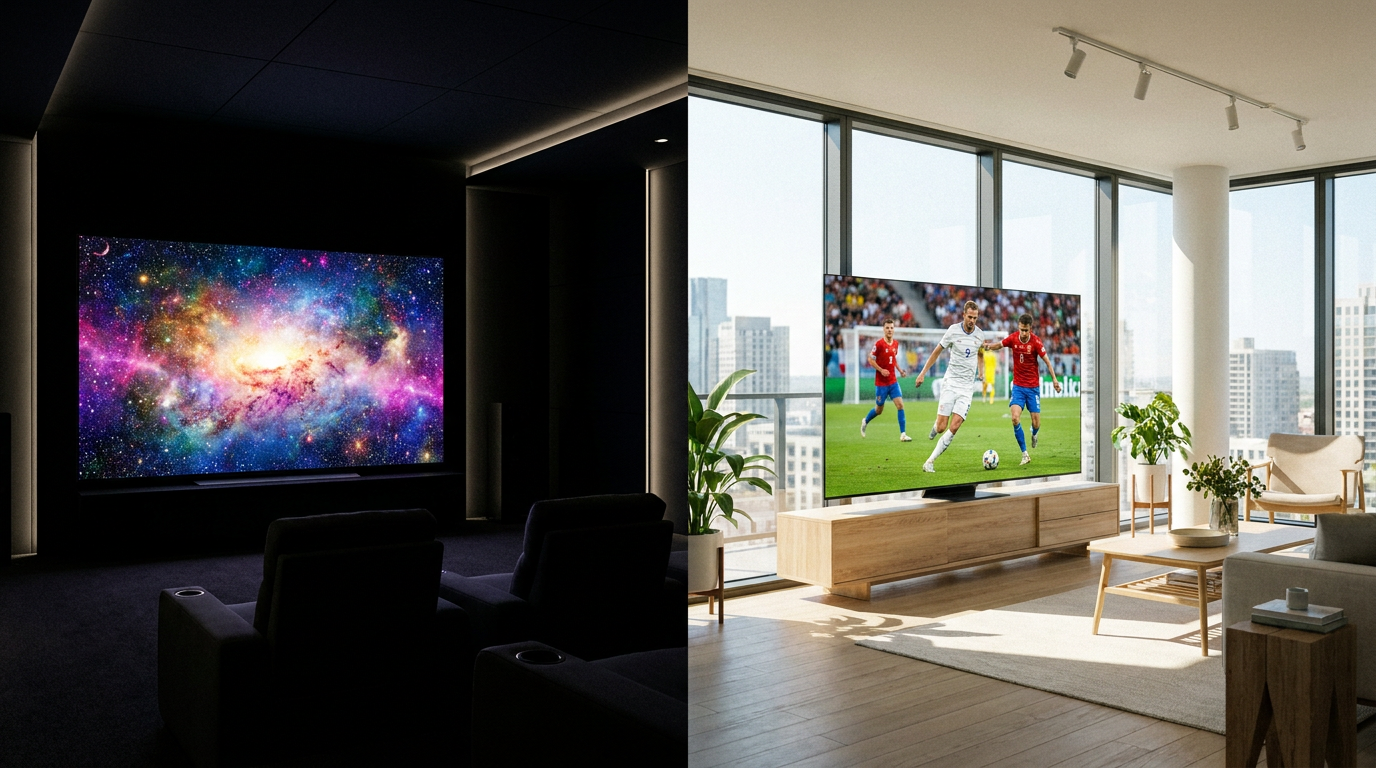
- Cinematic Purists
- Advocates for OLED's unmatched contrast and pixel-level precision.
- High-Ambient Viewers
- Advocates for Mini-LED's raw brightness and glare-defeating power.
- Power Users & Gamers
- Focused on the intersection of motion clarity, UI longevity, and burn-in.
- Neutral Analysts
- Focuses on the objective trade-offs and conditional recommendations based on room environment.
What's not represented
- · Budget-conscious buyers looking at standard LED
- · Projector home-theater enthusiasts
Why this matters
A premium television is a multi-year investment that dictates how you experience movies, sports, and gaming. Choosing the wrong panel technology for your specific room lighting and viewing habits can result in frustrating glare or unnecessary burn-in anxiety.
Key points
- OLED relies on self-emissive pixels for infinite contrast, while Mini-LED uses thousands of inorganic backlight zones.
- Premium 2026 Mini-LEDs can exceed 5,000 nits of peak brightness, making them ideal for sunlit rooms.
- OLED panels offer superior viewing angles and a near-instant 0.03ms response time for gaming.
- Mini-LED carries zero risk of burn-in, making it the safer choice for PC monitors and static gaming HUDs.
- Mini-LED scales more cost-effectively at massive screen sizes like 85 and 98 inches.
Buying a premium television in 2026 often feels like navigating a maze of marketing acronyms, but the decision ultimately boils down to a choice between two distinct display technologies: OLED and Mini-LED. For years, the conventional wisdom was simple: OLED offered superior picture quality for dark rooms, while Mini-LED provided the necessary brightness for sunlit spaces. However, rapid engineering advancements have blurred these lines, turning what was once a straightforward choice into a nuanced trade-off analysis. Today, both technologies have addressed their historical weaknesses, meaning consumers must look closely at their specific living room environments and daily viewing habits to make the right choice.[1][2]
To understand the stakes, one must look at the underlying physics. OLED, or Organic Light-Emitting Diode, relies on carbon-based materials that generate their own light when an electric current is applied. Because each of the 8.3 million pixels in a 4K display is self-emissive, they can be turned off completely, resulting in perfect, infinite black levels. Mini-LED, conversely, is an evolution of traditional LCD technology. It uses a liquid crystal layer to produce color, illuminated from behind by thousands of microscopic, inorganic Gallium Nitride diodes grouped into distinct dimming zones.[1][2][3][6]
The most dramatic battleground in 2026 is peak brightness, measured in nits. Mini-LED has historically dominated this category, and current flagship models easily push past 5,000 nits in small HDR highlights, with some reaching even higher. This immense luminous flux allows Mini-LED panels to render specular highlights—like the glint of sun on a car bumper or a stadium floodlight—with blinding realism. More importantly, Mini-LEDs can sustain high brightness across the entire screen indefinitely, making them uniquely capable of overpowering glare in rooms with massive windows or intense overhead lighting.[1][3][4][5]
OLED manufacturers have not stood still in the face of this brightness deficit. The introduction of Micro Lens Array (MLA 3.0) and fourth-generation QD-OLED panels has pushed OLED peak brightness past the 2,000-nit threshold, a massive leap from just a few years ago. However, because organic pixels generate heat, OLED TVs still rely on an Auto Brightness Limiter (ABL). If a scene is too bright for too long—such as a hockey game or a snowscape—the TV's processor will automatically dim the entire panel to protect the organic compounds from thermal damage.[5][6]

While Mini-LED wins the raw brightness war, OLED remains the undisputed king of contrast and pixel-level precision. Because Mini-LED relies on a backlight shining through an LCD layer, it has historically suffered from blooming—a visible halo effect around bright objects on dark backgrounds. In 2026, premium Mini-LEDs feature upwards of 20,000 local dimming zones, which shrinks these halos to near-invisibility in most viewing conditions. Yet, in a pitch-black home theater, the absolute pixel-level control of an OLED still provides a visibly superior, three-dimensional depth that backlight zones cannot perfectly replicate.[1][2][4][5]
While Mini-LED wins the raw brightness war, OLED remains the undisputed king of contrast and pixel-level precision.
Viewing angles present another stark divergence between the two panel types. OLED pixels emit light uniformly in all directions, meaning the color and contrast remain perfect even if you are sitting 70 degrees off-axis. Mini-LED panels, constrained by the physical structure of their liquid crystal layers, inevitably suffer from some degree of color shift and contrast degradation when viewed from the side. For wide, horseshoe-shaped living room seating where guests are spread out, OLED maintains a distinct structural advantage in delivering a uniform picture to everyone in the room.[1][2][4]
For gamers and esports enthusiasts, the performance metrics split between motion clarity and durability. OLED panels boast a near-instantaneous pixel response time of roughly 0.03 milliseconds, completely eliminating motion blur and ghosting during fast-paced gameplay. This makes them the holy grail for competitive shooters and racing simulators where every frame matters. Mini-LEDs have improved significantly, dropping to around 1 millisecond, which is excellent for casual gaming but still mathematically slower than OLED, leaving a microscopic amount of blur in the fastest panning shots.[3][6]

However, gaming also introduces the specter of burn-in—the permanent degradation of organic pixels caused by static elements like health bars, minimaps, or persistent UI taskbars. Extensive 10,000-hour stress tests on 2026 OLED panels reveal that while deuterium stabilization and pixel-shifting algorithms have drastically reduced the risk, cumulative wear remains a physical reality for heavy users. Mini-LEDs, built with inorganic diodes, carry effectively zero burn-in risk, making them the safer default for PC users, coders, or gamers who play the same title for thousands of hours.[3][6]
Thermal management and environmental resilience also favor the inorganic approach. OLEDs are prized for their razor-thin profiles, but this aesthetic choice leaves minimal room for internal airflow. High-end models now incorporate copper heat sinks, yet they remain sensitive instruments that can struggle in hot environments. Mini-LED chassis are generally thicker, allowing for robust ventilation and larger power supplies, which translates to better long-term hardware reliability in warm climates, humid environments, or areas with inconsistent power grids where electronics are under constant stress.[6][7]
Pricing dynamics in 2026 have shifted the value proposition, particularly in the large-format market. While 55-inch and 65-inch models see fierce price parity between the two technologies, Mini-LED scales much more cost-effectively as screen sizes increase. For buyers seeking massive 85-inch, 98-inch, or even 115-inch displays, Mini-LED offers flagship-tier performance at a fraction of the cost of a comparable OLED, making it the undisputed champion of the ultra-large home theater segment where OLED prices become prohibitively expensive.[4][5]
Ultimately, the choice requires an honest assessment of your viewing environment and habits. OLED fits well when the TV is placed in a light-controlled room or dedicated home theater. It is the definitive choice for cinematic purists who prioritize perfect blacks, wide viewing angles, and the absolute best motion clarity for varied gaming and movie watching. It does not fit well when placed opposite a massive, unshaded window, or if it will be used primarily as a PC monitor displaying static taskbars for twelve hours a day.[1][4][7]

Conversely, Mini-LED fits well when the television lives in a sun-drenched living room where daytime viewing is the norm. It is the optimal choice for sports fans who need sustained full-screen brightness, PC users who require absolute immunity from burn-in, and buyers looking to maximize screen size without stretching their budget. It does not fit well when absolute pixel-level precision is demanded in a pitch-black room, or for wide, horseshoe-shaped seating arrangements where off-axis color shift becomes noticeable to guests.[3][4][7]
How we got here
2013
The first large-format OLED TVs enter the consumer market, establishing a new benchmark for black levels.
2019
Mini-LED technology begins appearing in premium consumer televisions, offering a brighter alternative to OLED.
2023
OLED manufacturers introduce Micro Lens Array (MLA) and QD-OLED tech to significantly boost peak brightness.
2026
Flagship Mini-LEDs cross the 20,000 dimming zone threshold, while OLEDs achieve 10,000-hour durability milestones.
Viewpoints in depth
Cinematic Purists
Advocates for OLED's unmatched contrast and pixel-level precision.
For home theater enthusiasts, the absence of light is just as important as the light itself. Cinematic purists argue that no amount of local dimming zones can replicate the three-dimensional depth of a self-emissive OLED pixel turning completely off. They point to the perfect viewing angles and the elimination of blooming around subtitles or starfields as non-negotiable requirements for preserving a director's true intent in a dark room.
High-Ambient Viewers
Advocates for Mini-LED's raw brightness and glare-defeating power.
This camp argues that perfect black levels are irrelevant if the screen is obscured by reflections from a living room window. High-ambient viewers prioritize the sheer luminous flux of Mini-LED, which can sustain full-screen brightness during a daytime sports broadcast without triggering an Auto Brightness Limiter. For them, the ability to punch through environmental glare makes Mini-LED the more practical choice for everyday, mixed-use living spaces.
Power Users & Gamers
Focused on the intersection of motion clarity, UI longevity, and burn-in.
Gamers and PC users are split by specific use cases. Competitive esports players often lean toward OLED for its 0.03ms response time, which eliminates motion blur entirely. However, productivity users and gamers who log thousands of hours with static HUDs or taskbars argue that Mini-LED's inorganic structure provides essential peace of mind. For this camp, the elimination of burn-in risk outweighs the microscopic differences in pixel response.
What we don't know
- Whether future Micro-LED technology will become affordable enough to replace both OLED and Mini-LED.
- Exactly how many years a 2026 OLED panel will last under moderate mixed-use before noticeable degradation occurs.
Key terms
- Self-emissive
- A display technology where each individual pixel generates its own light and can turn completely off, creating perfect black levels.
- Local Dimming Zones
- Specific clusters of backlights in a Mini-LED TV that can dim or brighten independently to improve contrast.
- Auto Brightness Limiter (ABL)
- A protective software feature in OLED TVs that dims the screen when a bright static image is displayed for too long to prevent overheating.
- Nits
- A unit of measurement for screen brightness; one nit is roughly equivalent to the light of one candle per square meter.
- Blooming
- A visual artifact where light bleeds from a bright object into surrounding dark areas, common in backlit displays.
Frequently asked
Does OLED still suffer from burn-in in 2026?
While 2026 OLEDs use advanced cooling and pixel-shifting to drastically reduce the risk, burn-in remains a physical possibility for users who display static UI elements for thousands of hours.
What is blooming on a Mini-LED TV?
Blooming is a faint halo of light around bright objects on a dark background. Premium 2026 Mini-LEDs minimize this with over 20,000 dimming zones, but it can still be visible off-angle.
Which TV is better for a bright living room?
Mini-LED is significantly better for bright rooms. It can reach over 5,000 nits of peak brightness and sustain full-screen brightness without dimming, easily overpowering window glare.
Is OLED or Mini-LED better for gaming?
It depends on the game. OLED offers superior motion clarity (0.03ms response time), while Mini-LED offers brighter HDR highlights and zero risk of burn-in from static health bars.
Sources
Source coverage
7 outlets
4 viewpoints surfaced







[1]RTINGSHigh-Ambient Viewers
Which Panel Technology Is Better?
Read on RTINGS →[2]TechRadarCinematic Purists
OLED vs mini-LED: contrast and color
Read on TechRadar →[3]PCWorldPower Users & Gamers
It's time to look beyond OLED to Mini-LED. Here's why.
Read on PCWorld →[4]Data Wire SolutionsHigh-Ambient Viewers
Best TVs for 2026: 10 OLED and Mini-LED Picks by Room, Brightness, and Install Reality
Read on Data Wire Solutions →[5]EcoPicksGoCinematic Purists
LG G5 OLED vs LG QNED9M Mini LED Comparison (2026 Buyer's Guide)
Read on EcoPicksGo →[6]KTCPlayPower Users & Gamers
OLED for Long-Term Productivity: A 10,000-Hour Burn-In Update
Read on KTCPlay →[7]Factlen Editorial TeamNeutral Analysts
Synthesis by Factlen editorial team
Read on Factlen Editorial Team →

Every angle. Every day.
Get shopping stories with full source coverage and perspective breakdowns delivered to your inbox.