
At-Home Brain Implant Restores Daily Autonomy for Patient with Motor Neuron Disease
A newly detailed brain-computer interface has allowed a patient with severe motor neuron disease to control digital devices and communicate independently at home for nearly two years. The milestone shifts neuroprosthetics from tightly controlled laboratory experiments to practical, daily-use assistive technology.
By Factlen Editorial Team
- Neurotechnology Researchers
- Focus on the technical milestone of achieving long-term signal stability and decoding efficiency in an unconstrained home environment.
- Patient Advocacy Groups
- Emphasize the profound restoration of autonomy, the mental health benefits of privacy, and the urgent need for accessible commercialization.
- Bioethicists & Regulators
- Highlight the need for rigorous safety data, long-term hardware durability monitoring, and equitable access to expensive neuroprosthetics.
What's not represented
- · Caregivers and family members who assist with the daily physical maintenance of the BCI hardware.
- · Insurance providers who will eventually determine the financial accessibility of the technology.
Why this matters
For decades, brain-computer interfaces were confined to research labs, requiring teams of engineers to operate. This breakthrough proves that severely paralyzed individuals can safely and reliably use neural implants to reclaim their independence, privacy, and connection to the world from their own living rooms.
Key points
- A patient with motor neuron disease successfully used a brain implant at home for nearly two years.
- The system allowed him to independently control a computer, browse the web, and manage smart home devices.
- Decoding accuracy remained stable at 95%, overcoming historical issues with signal degradation.
- The milestone proves BCIs can function reliably outside of controlled laboratory environments.
- Researchers are now expanding clinical trials to test the hardware's long-term durability and safety.
A watershed report published in Nature details a profound milestone in neuroprosthetics: a man with severe motor neuron disease has successfully used an implanted brain-computer interface (BCI) to independently navigate his daily life for nearly two years. The research marks a definitive shift in the field, moving life-altering neural technology out of the laboratory and into the living room.[1][2]
Unlike previous BCI achievements that required patients to perform specific tasks in highly controlled clinical settings while tethered to bulky computing racks, this system operates entirely in the patient's home. It represents a critical transition from experimental proof-of-concept to practical, daily-use assistive technology that a patient can rely on without a team of engineers present.[1][2]
Motor neuron diseases, such as amyotrophic lateral sclerosis (ALS), progressively sever the communication lines between the brain and the body's voluntary muscles. While a patient's cognitive function and sensory awareness remain entirely intact, they eventually lose the ability to move, speak, swallow, and breathe independently—a devastating state known clinically as "locked-in" syndrome.[3][7]
The core mechanism of the BCI relies on intercepting the brain's electrical commands before they reach the damaged spinal cord. When the patient simply attempts to move his hand or articulate a word, his motor cortex still fires the precise sequence of electrical impulses associated with that specific action, even though the muscles cannot execute it.[2][3]

To capture these signals, surgeons implanted a specialized sensor array over the patient's motor cortex. Depending on the specific trial protocol, these sensors can be microscopic electrode arrays that penetrate the upper layers of brain tissue, or flexible grids that rest gently on the brain's surface to record electrocorticography (ECoG) data.[1][5]
Once captured, the raw neural data is transmitted wirelessly to a small receiver worn on the patient's body, which then relays it to a local processing unit. Here, advanced machine learning algorithms—trained specifically on the patient's unique neural firing patterns—decode the intended movement in milliseconds.[1][6]
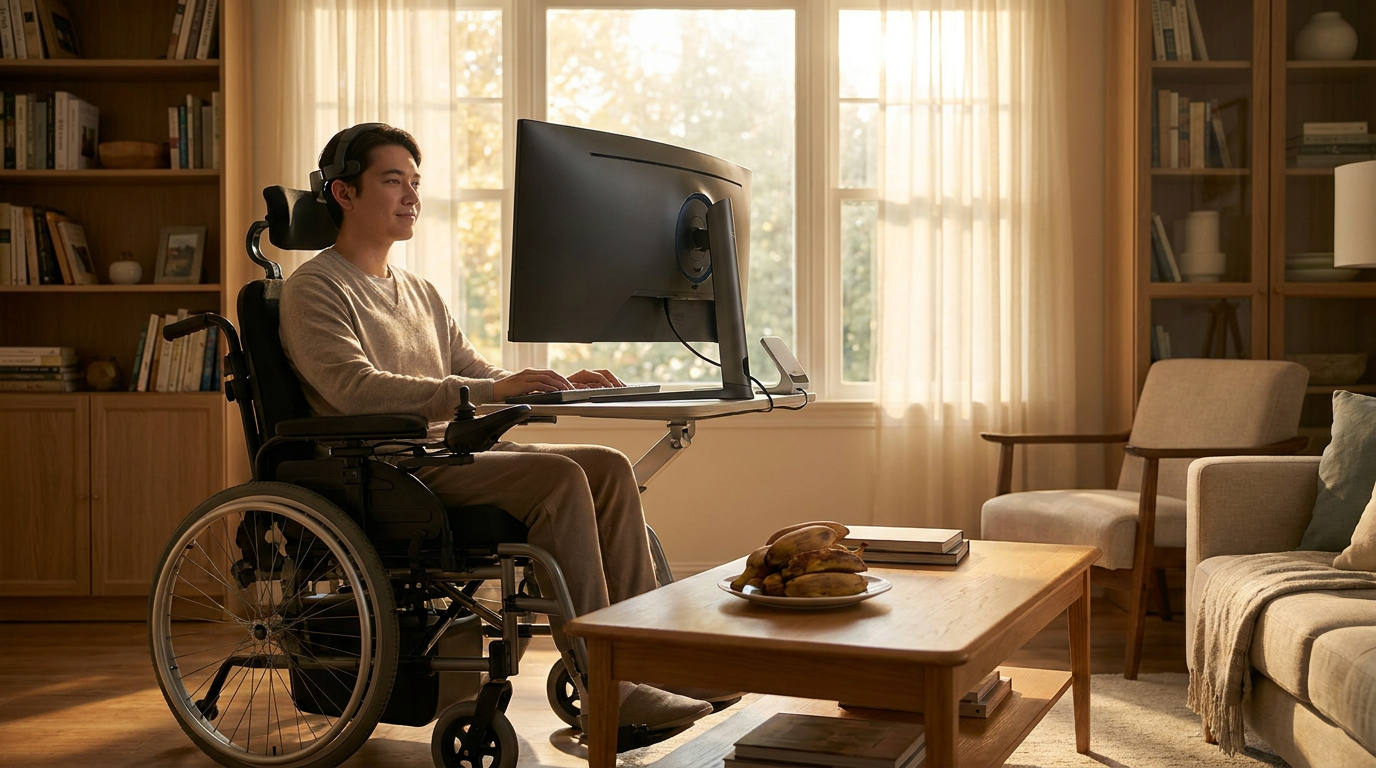
This decoded intent is instantly translated into standard digital commands, effectively turning the patient's thoughts into a wireless Bluetooth mouse and keyboard. He can move a cursor across a screen, click, type, and navigate complex operating systems just as smoothly as someone using their physical hands.[1][2]
The primary evidentiary claim of the new research is the remarkable long-term stability of the neural decoding. Historically, the brain's immune system recognizes implants as foreign objects, triggering a localized inflammatory response called gliosis.[1][5]
The primary evidentiary claim of the new research is the remarkable long-term stability of the neural decoding.
Over time, this microscopic scar tissue can insulate the electrodes, degrading the signal quality and requiring constant software recalibration by researchers. However, the data from this 24-month observation period shows that the decoding accuracy remained highly stable, hovering around 95% for routine cursor control without the need for daily engineering interventions.[1][5]

Furthermore, the system achieved impressive communication speeds. By utilizing predictive text models and advanced speech-decoding algorithms that interpret intended vocal tract movements rather than just typing letter-by-letter, patients in similar recent trials have reached communication rates exceeding 60 words per minute.[1][6]
This speed is a massive leap from traditional assistive devices, such as eye-tracking cameras, which are notoriously fatiguing for patients and typically max out at 10 to 15 words per minute. The BCI allows for conversational pacing that feels natural to both the user and their family members.[6][7]
The real-world impact extends far beyond typing speed. The patient uses the interface to manage his personal email, browse the internet, stream entertainment, and control smart home devices like lighting, televisions, and thermostats.[1][2]
For a patient who previously required 24-hour assistance for every physical interaction with his environment, the restoration of digital autonomy is profound. Patient advocacy groups emphasize that this level of independence drastically improves mental health, restores a sense of agency, and significantly reduces caregiver burnout.[7]

The psychological benefit of being able to send a private text message to a spouse, read a book without asking someone to turn the page, or simply turn off a light at night cannot be overstated in the context of severe paralysis. It returns a degree of privacy that is often lost in intensive care settings.[2][7]
Despite the overwhelming success of this extended case study, significant uncertainties remain before BCIs can become standard medical care. The foremost question among neuroengineers is the ultimate physical durability of the implanted hardware.[2][5]
While two years of continuous use is a triumph, patients with MND or spinal cord injuries may need these devices to function flawlessly for decades. The risk of hardware failure, battery degradation, or late-stage infection requires ongoing, multi-year monitoring across larger patient populations.[5]

Additionally, the current cost of the technology, the necessity of highly specialized neurosurgery, and the intensive initial training period present massive barriers to scale. Transitioning from a bespoke, multi-million-dollar research setup to a commercially viable, FDA-approved medical device will take years of rigorous testing.[2][4]
Clinical trials are now expanding to include larger cohorts of patients across multiple research centers. These Phase II and Phase III trials will rigorously test the system's safety profile and its adaptability to different neurological conditions, including severe stroke and high cervical spinal cord injuries.[4]
As the technology matures, the scientific focus is shifting from simply proving that BCIs work to ensuring they are robust, user-friendly, and ultimately accessible. For the hundreds of thousands of people globally living with severe motor impairments, the prospect of regaining their voice and autonomy is closer to reality than ever before.[2][7]
How we got here
1998
The first human receives a basic, early-stage brain-computer interface implant.
2006
The landmark BrainGate trial demonstrates successful cursor control in a paralyzed patient in a lab setting.
2021
Researchers achieve the first successful decoding of full words and sentences directly from brain signals.
2024
The FDA grants expanded investigational device exemptions for at-home BCI clinical trials.
June 2026
Researchers publish data showing nearly two years of stable, independent at-home BCI use by a single patient.
Viewpoints in depth
Neurotechnology Researchers
Focused on the technical triumph of long-term signal stability in an unconstrained environment.
For neuroengineers, the most significant finding is the lack of signal degradation over 24 months. Historically, the brain's immune response (gliosis) has scarred over implanted electrodes, rendering them useless after a few months. Proving that machine learning algorithms can adapt to minor signal shifts and maintain 95% accuracy without daily recalibration proves that the core hardware and software architecture is viable for long-term human use.
Patient Advocacy Groups
Focused on the restoration of autonomy and the urgent need for commercial accessibility.
Advocates for patients with ALS and spinal cord injuries view this not just as a medical breakthrough, but as a restoration of fundamental human rights—privacy, agency, and communication. They emphasize that while the science is spectacular, the real work lies in forcing the medical device industry and insurance providers to make this technology affordable and accessible, rather than keeping it as a multi-million-dollar luxury for a handful of trial participants.
Bioethicists & Regulators
Focused on long-term safety, hardware durability, and the ethics of neuro-data.
Regulatory bodies and bioethicists are cautiously optimistic but stress the unknowns. They point out that a two-year success story does not guarantee that the hardware won't fail, leak, or cause late-stage infections after five or ten years. Furthermore, they are beginning to raise questions about data privacy: as these devices become commercialized, strict regulations will be needed to ensure that the raw neural data captured by corporate algorithms is protected and never monetized.
What we don't know
- The ultimate lifespan of the implanted electrode arrays before signal degradation requires surgical replacement.
- How the system's machine learning algorithms will adapt to the brain's natural aging process over a decade or more.
- The final commercial cost of the device and whether public or private insurance will cover the extensive surgery and training.
Key terms
- Brain-Computer Interface (BCI)
- A system that translates brain activity into commands for external devices, bypassing paralyzed muscles.
- Motor Neuron Disease (MND)
- A group of progressive neurological disorders, including ALS, that destroy motor neurons, leading to severe paralysis.
- Electrocorticography (ECoG)
- A technique where flexible electrode grids are placed directly on the surface of the brain to record electrical activity.
- Gliosis
- The brain's natural immune response to a foreign object, which can cause scar tissue to build up around implanted electrodes and degrade signal quality.
- Decoding Algorithm
- Machine learning software that translates raw neural signals into specific intended actions, such as moving a cursor or selecting a letter.
Frequently asked
Is this technology available to the public?
No, it is currently in the clinical trial phase and is only available to a small number of research participants under strict medical supervision.
Does the implant require brain surgery?
Yes. Depending on the specific device, it requires either open brain surgery (craniotomy) to place sensors on the cortex, or a minimally invasive procedure through a blood vessel.
Can the user control the device without a researcher present?
Yes, the key breakthrough in this study is that the system is stable and user-friendly enough for independent daily use at home, without constant engineering support.
How long do the implants last?
This study demonstrated nearly two years of continuous use, but the ultimate lifespan of the hardware before requiring surgical replacement remains an open question.
Sources
Source coverage
7 outlets
3 viewpoints surfaced







[1]NatureNeurotechnology Researchers
At-home brain implant gives man with motor neuron disease his daily life back
Read on Nature →[2]Factlen Editorial TeamBioethicists & Regulators
Synthesis by Factlen editorial team
Read on Factlen Editorial Team →[3]National Institute of Neurological Disorders and StrokeBioethicists & Regulators
Amyotrophic Lateral Sclerosis (ALS) Fact Sheet
Read on National Institute of Neurological Disorders and Stroke →[4]ClinicalTrials.govBioethicists & Regulators
Brain-Computer Interface Trials for Motor Neuron Disease
Read on ClinicalTrials.gov →[5]Journal of Neural EngineeringNeurotechnology Researchers
Long-term stability of intracortical microelectrode arrays in human neuroprosthetics
Read on Journal of Neural Engineering →[6]New England Journal of MedicineNeurotechnology Researchers
High-Performance Speech Neuroprosthesis in Severe Paralysis
Read on New England Journal of Medicine →[7]ALS AssociationPatient Advocacy Groups
Assistive Technology and Quality of Life in ALS
Read on ALS Association →


Every angle. Every day.
Get science stories with full source coverage and perspective breakdowns delivered to your inbox.