
How 'Freestyle Chess' is Saving the Game from Memorization
By scrambling the starting position of the pieces, a revitalized format is forcing the world's best players to abandon computer-memorized openings and rely on pure creativity.
By Factlen Editorial Team
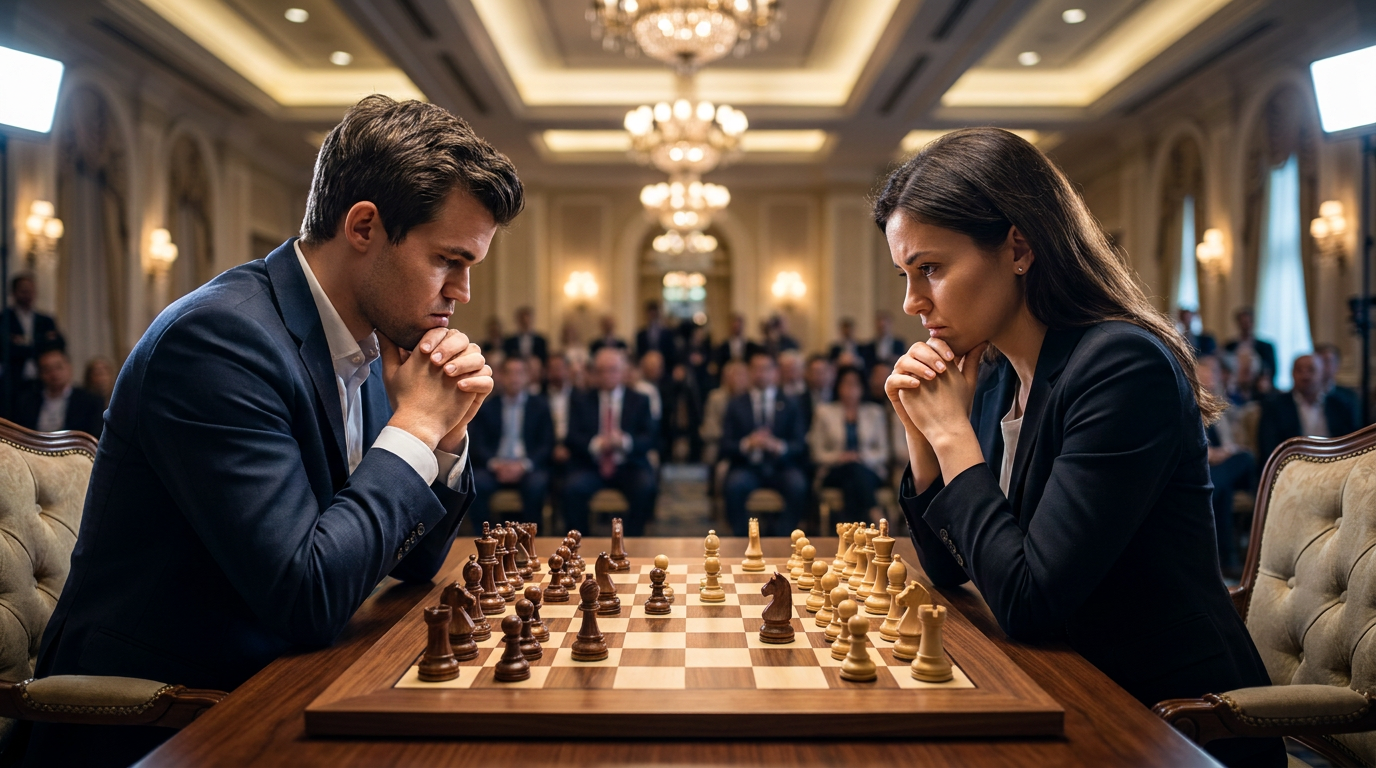
- Top-Tier Grandmasters
- Advocates for the format as a way to escape computer preparation and return to pure calculation.
- Scholastic & Club Players
- Everyday players and coaches who view the format as a great tool for building genuine tactical skills.
- Classical Purists
- Traditionalists who prefer the deep history, established theory, and aesthetic harmony of standard chess.
What's not represented
- · Chess AI developers whose engines are rendered less dominant in the opening phase by the randomized format.
Why this matters
For decades, artificial intelligence and rote memorization have threatened to make elite chess a battle of computer preparation rather than human ingenuity. Freestyle chess resets the board, leveling the playing field and returning the game to its creative roots.
Key points
- Freestyle Chess (Chess960) scrambles the back row of pieces into one of 960 possible starting positions.
- The format prevents players from relying on computer-analyzed opening memorization.
- Magnus Carlsen won the first official FIDE Freestyle Chess World Championship in February 2026.
- Players are given the starting position just 15 minutes before the match begins.
- The variant was originally formalized in the 1990s by former World Champion Bobby Fischer.
For 1,500 years, every game of chess has begun exactly the same way. The rooks sit in the corners, the knights beside them, then the bishops, with the queen and king holding the center. Because the starting position never changes, the first dozen moves of a high-level match are rarely invented on the spot. Instead, they are recited from memory, heavily analyzed by artificial intelligence engines long before the players ever sit at the board.[4][6]
This reliance on "opening theory"—the exhaustive memorization of computer-approved sequences—has led to a growing frustration among the game's elite. Top grandmasters spend months memorizing lines up to move 20 or 30, turning the early phase of a match into a test of recall rather than a battle of wits. When both players perfectly execute their engine preparation, the result is often a sterile, mechanical draw.[3][4]
Enter "Freestyle Chess." Also known historically as Chess960 or Fischer Random, the format offers a deceptively simple fix: scramble the pieces on the back row. The pawns remain in their usual defensive line, but the major pieces are randomized into one of 960 possible configurations. The only rules are that the bishops must land on opposite colors, and the king must be placed somewhere between the two rooks to allow for castling.[3][6]

The impact of this single rule change is profound. Because the starting position is drawn at random just 15 minutes before the clock starts, players cannot consult computer engines or rely on pre-memorized files. They must evaluate the board, formulate a strategy, and calculate tactics entirely on their own from move one. It strips away the armor of preparation, leaving only raw chess ability.[4][5]
The format was originally formalized in the 1990s by the 11th World Champion, Bobby Fischer, who famously complained that classical chess was being ruined by rote memorization. For decades, it existed primarily as a niche variant or an online novelty. But in recent years, it has undergone a massive renaissance, rebranded as "Freestyle Chess" and championed by the game's biggest modern star: Magnus Carlsen.[3][4]
For decades, it existed primarily as a niche variant or an online novelty.
Carlsen, widely considered the greatest player in history, has been vocal about his burnout with classical opening theory. Seeking a return to pure, intuitive play, he partnered with German entrepreneur Jan Henric Buettner to launch the Freestyle Chess Grand Slam Tour in 2025. The high-stakes circuit proved that top-tier grandmasters were hungry for a format that rewarded on-the-spot problem solving over database recall.[2][4]

The movement reached a historic milestone in February 2026, when the International Chess Federation (FIDE) hosted the first official FIDE Freestyle Chess World Championship at the Weissenhaus resort in Germany. The event featured a $300,000 prize fund and gathered eight of the world's best players, including Carlsen, Fabiano Caruana, and rising stars like Nodirbek Abdusattorov and Vincent Keymer.[1][2]
In a fitting conclusion to the inaugural championship, Carlsen defeated Caruana in the final match, securing his 21st world title across all chess formats. The games were characterized by wild, unbalanced positions and deep tactical complications that rarely appear in classical chess. Without the safety net of known theory, even the world's best players made fascinating human errors, leading to dynamic and highly entertaining matches.[1][2]

The rise of Freestyle Chess is also democratizing the game's competitive pipeline. In classical chess, reaching the elite level requires expensive coaching and access to massive databases to build an opening repertoire. By eliminating the advantage of memorization, Freestyle Chess levels the playing field, allowing players with exceptional raw talent and calculation skills to compete without needing a decade of theoretical study.[4][5]
However, the format is not without its critics. Some purists argue that the beauty of classical chess lies precisely in its rich history and the deep, strategic understanding built over centuries of opening theory. Furthermore, certain randomized starting positions can give the player with the white pieces a slightly larger advantage than the standard setup, though tournament formats often mitigate this by having players play both sides of the same starting position.[3][5][6]
Despite these debates, the momentum behind Freestyle Chess is undeniable. Online platforms have seen a surge in Chess960 games, and specialized tools are emerging to help players practice the principles of the variant. For a game that has survived for over a millennium, the willingness to scramble the board represents a bold, necessary evolution—ensuring that chess remains a test of human creativity rather than a contest of computer memory.[3][5]
How we got here
1996
Former World Champion Bobby Fischer formally introduces 'Fischer Random Chess' to combat rote memorization.
2024
The Freestyle Chess G.O.A.T. Challenge is held in Germany, sparking renewed elite interest in the format.
2025
The Freestyle Chess Grand Slam Tour launches, featuring multiple high-stakes events across the globe.
Feb 2026
Magnus Carlsen wins the inaugural FIDE Freestyle Chess World Championship in Weissenhaus, Germany.
Viewpoints in depth
Top-Tier Grandmasters
Elite players seeking an escape from exhaustive computer preparation.
For players at the absolute pinnacle of the game, classical chess has become a grueling test of memory. Grandmasters spend countless hours with powerful AI engines, mapping out opening lines 20 to 30 moves deep. If both players remember their preparation perfectly, games often fizzle into lifeless draws. For this camp, Freestyle Chess is a breath of fresh air. It strips away the homework and forces opponents to actually play chess from the very first move, rewarding intuition, adaptability, and raw calculation.
Classical Purists
Traditionalists who value the rich history and deep theory of standard chess.
Not everyone is eager to scramble the board. Classical purists argue that the standard starting position is perfectly balanced and has birthed centuries of beautiful, deeply understood strategic concepts—like the Ruy Lopez or the Sicilian Defense. To this camp, opening theory isn't a burden; it's a shared language and a historical tapestry. They also point out that some of the 960 random setups can be aesthetically awkward or give White an outsized first-mover advantage, lacking the natural harmony of the traditional setup.
Scholastic & Club Players
Everyday competitors who find the format levels the playing field.
For amateur and club-level players, Freestyle Chess offers a unique equalizer. In standard tournaments, a player with less natural talent but a better memory for opening traps can often defeat a superior tactician. Freestyle removes that shortcut. However, coaches caution that the format is not for absolute beginners. Without a solid grasp of fundamental chess principles—like piece development, center control, and king safety—navigating a chaotic, randomized board can be overwhelming rather than liberating.
What we don't know
- Whether Freestyle Chess will eventually surpass classical chess in viewership and prize money.
- How the format will impact the long-term training regimens of young chess prodigies who currently rely heavily on engine analysis.
Key terms
- Chess960
- The original name for Freestyle Chess, referring to the 960 possible legal starting positions for the pieces.
- Opening Theory
- Established sequences of initial chess moves that have been deeply analyzed by computers and memorized by players.
- Castling
- A special move involving the king and a rook. In Freestyle Chess, the pieces end up on their traditional castled squares regardless of where they started.
- FIDE
- The International Chess Federation, the governing body of global chess competition.
Frequently asked
Can beginners play Freestyle Chess?
Yes, but it is generally recommended for players who already understand basic chess principles. Without knowing how to develop pieces and control the center, the randomized setups can be confusing.
How does castling work if the king and rooks are scrambled?
Players can still castle. When they do, the king and the chosen rook jump to the exact same final squares they would occupy after castling in a standard game of chess.
Why did top players push for this format?
Many elite players have expressed burnout with the heavy reliance on computer memorization in classical chess. They prefer a format that tests live calculation and intuition from the very first move.
Sources
Source coverage
6 outlets
3 viewpoints surfaced






[1]FIDETop-Tier Grandmasters
Magnus Carlsen is the 2026 FIDE Freestyle Chess World Champion
Read on FIDE →[2]Wikipedia
FIDE Freestyle Chess World Championship 2026
Read on Wikipedia →[3]Chess.comClassical Purists
Freestyle Chess: All About It & How to Play
Read on Chess.com →[4]Plain EnglishTop-Tier Grandmasters
'Freestyle' chess scrambles the board
Read on Plain English →[5]Intchess AsiaScholastic & Club Players
Conclusion: The Next Step for Serious Chess Players
Read on Intchess Asia →[6]Factlen Editorial TeamScholastic & Club Players
Synthesis by Factlen editorial team
Read on Factlen Editorial Team →
More in sports
See all 14 stories →Tactics
Spain's 2026 World Cup Tactical Evolution: How Luis de la Fuente Modernized La Roja
0 sources
Preview
USMNT 2026 World Cup Preview: Expectations, Tactics, and the Path to the Quarterfinals
0 sources
Roster
Trevoh Chalobah Receives Dramatic Late World Cup Call-Up for England
0 sources
Ski Mountaineering
The Anatomy of SkiMo: Inside the Olympics' Most Exhausting New Sport
0 sources
Every angle. Every day.
Get sports stories with full source coverage and perspective breakdowns delivered to your inbox.