
The Science of Heat Pump Maintenance: How to Maximize Efficiency and Lifespan
Heat pumps offer unparalleled energy efficiency for home heating and cooling, but their year-round operation demands consistent upkeep. Understanding the mechanics of airflow, filtration, and refrigerant cycles can save homeowners hundreds of dollars annually while preventing premature system failure.
By Factlen Editorial Team
- Energy Efficiency Advocates
- Focus on the macro-level environmental and grid impacts of maintenance.
- HVAC Engineers
- Focus on system longevity and thermodynamic efficiency.
- Consumers
- Focus on comfort, indoor air quality, and cost savings.
- Editorial Synthesis
- Synthesizing technical guidelines and consumer data into actionable advice.
What's not represented
- · HVAC Installers & Technicians
- · Home Builders
Why this matters
A neglected heat pump can lose up to 25% of its energy efficiency, driving up utility bills and accelerating the wear on expensive components like the compressor. Proper maintenance ensures you actually capture the financial and environmental benefits of this technology.
Key points
- Heat pumps transfer heat rather than generating it, making them highly efficient but subject to year-round wear.
- Neglecting maintenance can reduce a heat pump's energy efficiency by 10% to 25%.
- Filters with a MERV rating of 8 to 13 offer the best balance of air cleaning and system airflow.
- Outdoor condenser units require at least two feet of clearance to exchange heat effectively.
- Annual professional inspections are crucial for catching refrigerant leaks and electrical issues before they cause breakdowns.
- New EPA regulations are phasing out older refrigerants, making the maintenance of existing systems more financially important.
Heat pumps have rapidly become the centerpiece of modern home climate control, replacing traditional furnaces and air conditioners with a single, highly efficient system. Unlike conventional heating methods that burn fossil fuels to generate warmth, heat pumps operate by transferring heat from one place to another. During the winter, they extract ambient thermal energy from the outside air and pump it indoors; in the summer, the cycle reverses, pulling heat out of the house to cool the interior. This thermodynamic process allows them to deliver up to three to five times more energy than the electricity they consume. However, because they handle both heating and cooling duties, these systems operate year-round, subjecting their mechanical components to constant wear and tear.[2][4]
The impressive efficiency of a heat pump is not a permanent guarantee; it is highly dependent on consistent, proper maintenance. According to the U.S. Department of Energy, the difference in energy consumption between a well-maintained heat pump and a severely neglected one ranges from 10 to 25 percent. When a system is forced to operate with restricted airflow or compromised refrigerant levels, it must run longer cycles to achieve the target indoor temperature. This overexertion not only drives up monthly utility bills but also places immense strain on the compressor, which is the most expensive component to replace. Homeowners who treat their heat pumps as "set it and forget it" appliances often find their expected energy savings entirely wiped out by degraded performance.[1]
One of the most common mistakes homeowners make involves the system's air filtration, specifically regarding Minimum Efficiency Reporting Value (MERV) ratings. In an effort to improve indoor air quality, many consumers purchase the highest-rated filters available, such as MERV 14 or above, assuming that catching more microscopic particles is inherently better. However, these densely woven filters create significant air resistance, known as a pressure drop. When the heat pump's blower motor struggles to pull air through a highly restrictive filter, the system's overall efficiency plummets. The equipment is forced to work overtime, which can lead to overheating, frozen evaporator coils, and premature mechanical failure.[6]

To balance air quality with mechanical efficiency, industry experts generally recommend using filters with a MERV rating between 8 and 13 for residential heat pumps. Filters in this range are highly effective at capturing common household pollutants—such as dust mites, mold spores, and pet dander—without suffocating the system's airflow. It is crucial to consult the manufacturer's specifications, as some newer variable-speed heat pumps are designed to handle higher-resistance filters, while older single-stage systems are not. Regardless of the rating, the physical condition of the filter matters more than its theoretical filtration capacity once it becomes saturated with debris.[1][6]
Routine filter replacement is the single most impactful maintenance task a homeowner can perform. Standard one-inch pleated filters typically need to be replaced every 30 to 90 days, though homes with multiple pets, high dust levels, or residents with severe allergies may require monthly changes. A visual inspection is usually sufficient: if the filter appears dark gray or black, or if light cannot pass through it, the material is clogged. Beyond increasing energy consumption, a severely blocked filter can cause the indoor coil to freeze during the summer or trigger the system's high-limit safety switch during the winter, resulting in a complete and sudden shutdown of the climate control system.[1]

Routine filter replacement is the single most impactful maintenance task a homeowner can perform.
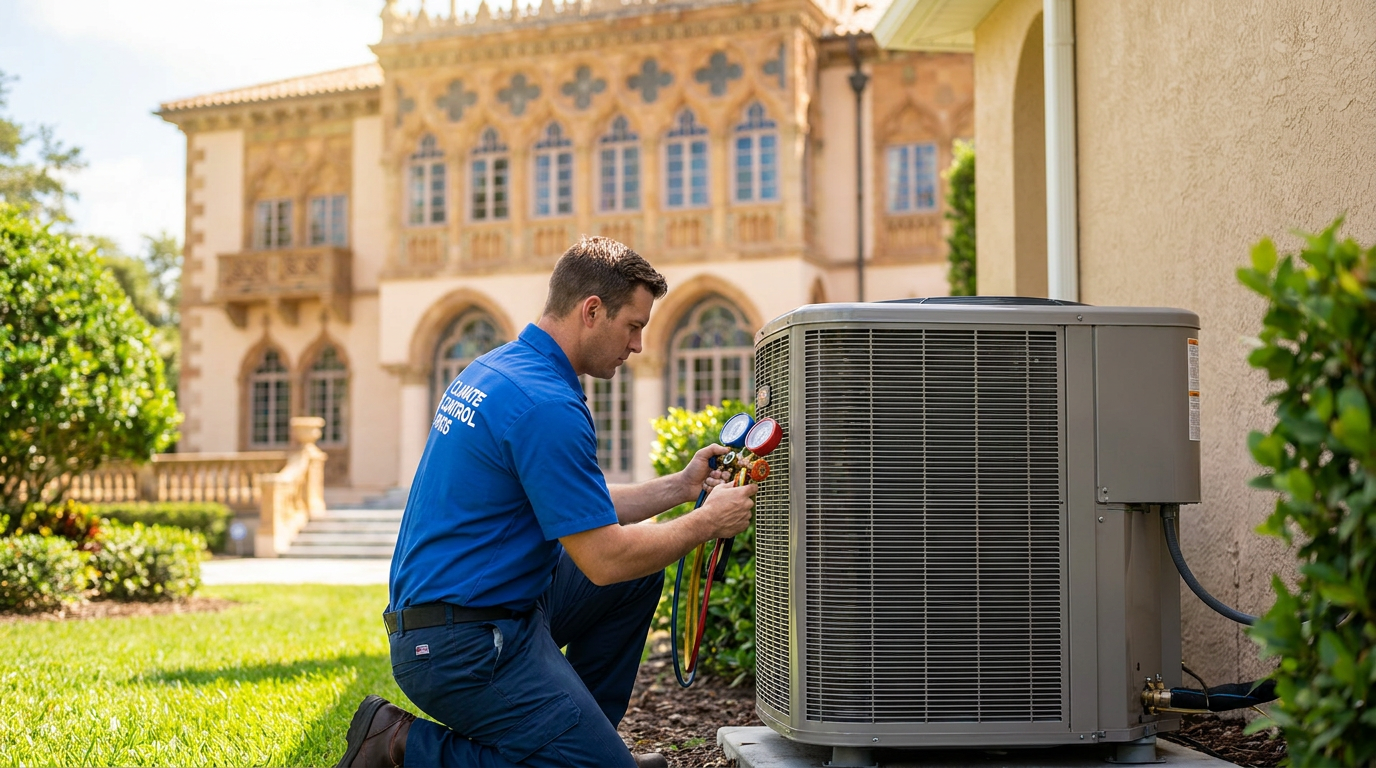
While indoor filtration manages the air circulating through the home, the outdoor condenser unit requires equal attention to facilitate proper heat exchange. The outdoor unit needs to "breathe" freely to absorb or dissipate heat effectively. Homeowners should ensure a minimum clearance of two feet around the entire perimeter of the condenser, keeping it free from encroaching shrubs, tall grass, and accumulated debris like fallen leaves or snow. When the aluminum fins on the outdoor coil become caked with dirt, pollen, or grass clippings, the system's ability to transfer thermal energy is severely handicapped.[1]
The financial penalty for ignoring the outdoor unit's cleanliness is substantial. The International Energy Agency notes that operating a heat pump with dirty coils can add roughly $100 per year to a household's energy costs simply because the system must run longer to compensate for the reduced heat transfer rate. Furthermore, the delicate aluminum fins on the coils can easily become bent by hail, flying debris, or aggressive power washing. Bent fins block airflow just as effectively as dirt, and they must be carefully straightened using a specialized tool called a fin comb to restore the unit's aerodynamic efficiency.[1][4]
Winter operation introduces a unique set of challenges, particularly the accumulation of frost on the outdoor unit. It is entirely normal for a heat pump to develop a light coating of white frost during cold weather, as moisture in the air condenses and freezes on the cold coils. To combat this, the system is equipped with an automatic defrost cycle that temporarily reverses the refrigerant flow, sending hot gas to the outdoor coil to melt the ice. However, if the unit becomes encased in a thick, solid block of ice, it indicates a malfunction. This severe icing is typically caused by a failing defrost control board, a bad sensor, or critically low refrigerant levels, and it requires immediate professional intervention.[1][3]

While homeowners can manage filter changes and basic exterior cleaning, the mechanical complexity of a heat pump necessitates annual professional servicing. Consumer Reports emphasizes that an annual inspection should include flushing the condensate drain line to prevent water backups, testing electrical terminals, and verifying that the thermostat is communicating correctly with the air handler. Most importantly, a certified technician will measure the system's airflow and check the refrigerant charge. Even a minor refrigerant leak can drastically reduce the system's heating and cooling capacity, forcing the compressor to run continuously and significantly shortening its operational lifespan.[3]
The longevity of a heat pump is directly tied to the consistency of this professional maintenance. Reliability data from Consumer Reports indicates that heat pump failure rates climb significantly after the eighth year of operation, with compressor failures and refrigerant leaks becoming the most common major issues. Because heat pumps operate year-round, an eight-year-old heat pump has roughly the same number of runtime hours as a sixteen-year-old central air conditioner. Regular professional tune-ups serve as preventative medicine, allowing technicians to identify and replace worn contactors, failing capacitors, or degraded wiring before they cause a catastrophic breakdown during extreme weather.[3]

The importance of maintaining existing systems has been further amplified by recent regulatory shifts in the HVAC industry. The Environmental Protection Agency's phasedown of hydrofluorocarbons has mandated a transition away from the long-standard R-410A refrigerant. Starting in the mid-2020s, new residential heat pumps are required to use A2L refrigerants, such as R-454B, which have a significantly lower global warming potential. As the production of R-410A decreases, the cost of servicing older, leaking systems is rising steadily. Consequently, preventing leaks through proactive maintenance is now more financially critical than ever for homeowners operating legacy equipment.[5]
Ultimately, a heat pump represents a significant financial investment in a home's infrastructure and comfort. By understanding the basic mechanics of airflow, respecting the limits of filtration, and committing to both seasonal DIY upkeep and annual professional inspections, homeowners can maximize their return on that investment. A meticulously maintained heat pump will not only deliver the promised reductions in carbon emissions and energy consumption but will also provide reliable, whisper-quiet comfort through a decade or more of shifting seasons.[1][7]
How we got here
Every 30-90 days
Homeowners should inspect and replace the indoor air filter to maintain proper airflow.
Spring
Clear vegetation and debris from around the outdoor condenser unit before the heavy cooling season begins.
Fall
Schedule an annual professional inspection to check refrigerant levels and electrical components before winter heating demands.
Year 8
Statistical point where major component failure rates, such as compressor issues, begin to climb significantly.
2025-2026
EPA regulations mandate the shift to lower-emission A2L refrigerants in new residential heat pumps.
Viewpoints in depth
HVAC Engineers & Manufacturers
Focus on system longevity and thermodynamic efficiency.
Engineers emphasize that a heat pump is a finely tuned thermodynamic loop. They argue that homeowners often inadvertently sabotage their systems by prioritizing extreme filtration (high MERV ratings) over adequate airflow. From a manufacturing perspective, the system is designed to operate within specific static pressure limits, and exceeding those limits through neglected filters or blocked outdoor units is the primary cause of premature compressor death.
Energy Efficiency Advocates
Focus on the macro-level environmental and grid impacts of maintenance.
Organizations like the IEA and DOE view heat pump maintenance as a critical component of national energy strategy. They point out that if millions of heat pumps operate at a 25% efficiency deficit due to poor maintenance, it places unnecessary strain on the electrical grid and diminishes the carbon-reduction benefits of electrification. For these advocates, routine maintenance is not just a personal financial issue, but a collective environmental responsibility.
Homeowners & Consumers
Focus on comfort, indoor air quality, and cost savings.
Consumers are primarily concerned with the immediate impacts of their HVAC systems: utility bills, indoor comfort, and air quality. Many homeowners lean toward high-MERV filters to combat allergies or wildfire smoke, sometimes unaware of the mechanical trade-offs. Their perspective highlights the need for better consumer education from installers, ensuring that the desire for pristine indoor air doesn't lead to a $3,000 compressor repair bill.
What we don't know
- How the transition to new A2L refrigerants will impact long-term maintenance costs for systems installed after 2025.
- The exact lifespan impact of running variable-speed heat pumps with high-MERV filters, as newer blower motors can compensate for pressure drops but may wear out faster doing so.
Key terms
- MERV Rating
- Minimum Efficiency Reporting Value; a scale from 1 to 20 that measures how effectively an air filter captures airborne particles.
- Compressor
- The core component of a heat pump that circulates refrigerant and facilitates the transfer of heat between the indoors and outdoors.
- Condenser Coil
- The outdoor network of tubes and fins where the heat pump releases collected heat (in summer) or absorbs ambient heat (in winter).
- Defrost Cycle
- An automatic process where the heat pump temporarily reverses operation in winter to melt frost accumulation off the outdoor unit.
- Pressure Drop
- The decrease in airflow caused by air passing through a restrictive filter, which forces the system's blower motor to work harder.
Frequently asked
Can I use a MERV 16 filter in my heat pump?
Generally, no. Unless your system was specifically designed for high-resistance filtration, a MERV 16 filter will severely restrict airflow, reducing efficiency and potentially damaging the blower motor.
Is it normal for my heat pump to have ice on it in winter?
A light coating of frost is normal during cold weather. However, if the unit is encased in a solid block of ice, the defrost cycle has likely failed, and you should call a professional.
Why do heat pumps need more maintenance than furnaces?
Unlike a furnace that only runs in the winter, a heat pump provides both heating and cooling, meaning it operates year-round and accumulates wear and tear twice as fast.
How much clearance does the outdoor unit need?
The outdoor condenser unit requires a minimum of two feet of unobstructed clearance on all sides to allow for proper airflow and heat exchange.
Sources
Source coverage
7 outlets
4 viewpoints surfaced







[1]U.S. Department of EnergyEnergy Efficiency Advocates
Operating and Maintaining Your Heat Pump
Read on U.S. Department of Energy →[2]ENERGY STAREnergy Efficiency Advocates
Air Source Heat Pumps
Read on ENERGY STAR →[3]Consumer ReportsConsumers
Heat Pump Buying Guide and Reliability
Read on Consumer Reports →[4]International Energy AgencyEnergy Efficiency Advocates
The Future of Heat Pumps
Read on International Energy Agency →[5]Environmental Protection AgencyEnergy Efficiency Advocates
Phasedown of Hydrofluorocarbons and Refrigerant Transitions
Read on Environmental Protection Agency →[6]ASHRAEHVAC Engineers
Filtration and Air Cleaning Systems
Read on ASHRAE →[7]Factlen Editorial TeamEditorial Synthesis
Synthesis by Factlen editorial team
Read on Factlen Editorial Team →
Every angle. Every day.
Get home stories with full source coverage and perspective breakdowns delivered to your inbox.