
U.S. and Iran Reach 60-Day Ceasefire to Reopen Strait of Hormuz and Negotiate Nuclear Deal
The United States and Iran have agreed to a preliminary ceasefire ending a three-and-a-half-month military conflict, reopening the Strait of Hormuz while triggering a 60-day window to negotiate a comprehensive nuclear agreement.
By Factlen Editorial Team
- U.S. Administration
- Aims to stabilize global energy markets while using the threat of renewed military force to compel Iranian nuclear disarmament.
- Iranian Leadership
- Claims victory in surviving the military campaign and demands sanctions relief while defending its right to civilian nuclear enrichment.
- Geopolitical Analysts
- Views the 60-day timeline as unrealistic and warns that core disputes over uranium and proxy funding remain unresolved.
What's not represented
- · Arab Gulf States (e.g., Saudi Arabia, UAE) who are directly threatened by regional instability and Iranian proxies.
- · European allies who previously brokered the 2015 nuclear deal and face severe economic fallout from energy price spikes.
Why this matters
The reopening of the Strait of Hormuz immediately eases a global energy crisis that has driven up inflation worldwide, but the fragile 60-day window leaves the ultimate threat of a nuclear-armed Iran—and the potential for renewed military conflict—unresolved.
Key points
- The U.S. and Iran signed a memorandum of understanding to halt a 3.5-month military conflict.
- The agreement immediately reopens the Strait of Hormuz, a vital artery for 20% of global oil.
- A 60-day ceasefire window has been established to negotiate a comprehensive nuclear deal.
- President Trump warned that "all hell will rain down" if Iran attempts to acquire a nuclear weapon.
- Oil prices dropped $4 per barrel following the announcement of the ceasefire.
- Analysts remain skeptical that a final nuclear agreement can be reached in just two months.
The United States and Iran have reached a preliminary agreement to halt a devastating three-and-a-half-month military conflict, lifting a U.S. naval blockade and reopening the Strait of Hormuz to global shipping. The memorandum of understanding (MOU), mediated by Pakistan, establishes a 60-day ceasefire designed to give negotiators a narrow window to resolve the standoff over Tehran's nuclear program.[3][4][7]
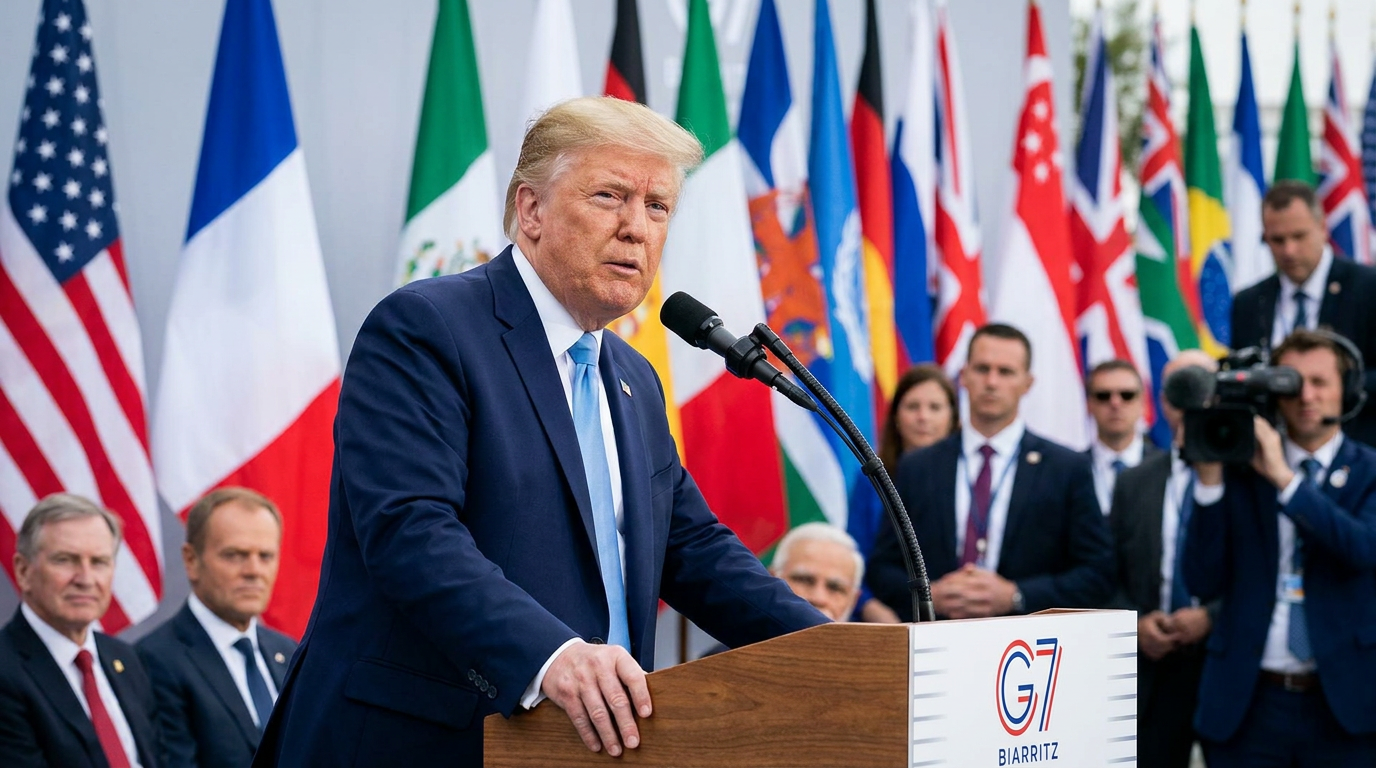
Speaking at the G7 summit in France on Tuesday, President Donald Trump confirmed the framework, issuing a stark warning to Tehran regarding its nuclear ambitions. "The only thing that really matters to me is Iran will never have a nuclear weapon, and it says it loud and clear," Trump told reporters. "All hell will rain down on them" if the Islamic Republic attempts to develop or acquire a bomb.[2][6][8]
The immediate economic relief centers on the Strait of Hormuz, a critical maritime chokepoint that handles roughly one-fifth of the world's oil and natural gas supply. The waterway had been effectively closed since the conflict erupted, sending shockwaves through global energy markets and threatening to trigger a worldwide recession.[3][7]

Celebrating the breakthrough, Trump posted on social media: "Ships of the World, start your engines. Let the oil flow!" Global markets responded instantly, with the price of crude oil dropping by $4 per barrel even before the strait was officially cleared of mines and military vessels.[4][7]
The MOU is slated to be formally signed on Friday in Switzerland, with Vice President JD Vance expected to attend alongside U.S. and Iranian negotiators. Vance indicated that progress is being made, framing the 60-day window as a critical test of whether Tehran is willing to trade decades of isolation for sanctions relief and renewed Western ties.[1][5][7]
The MOU is slated to be formally signed on Friday in Switzerland, with Vice President JD Vance expected to attend alongside U.S.
However, the specifics of the 60-day negotiating period remain highly contested. U.S. officials maintain that American military forces will remain deployed in the region during the talks, ready to resume operations if diplomacy fails. Conversely, Iran's Supreme National Security Council declared that the U.S. naval blockade had been "terminated immediately and completely," framing the ceasefire as a victory for Iranian resilience.[3][4]
Geopolitical analysts and non-proliferation experts have expressed deep skepticism that a comprehensive nuclear agreement can be forged in just two months. The core disputes—including the fate of Iran's highly enriched uranium stockpile, the timeline for lifting economic sanctions, and the status of frozen Iranian assets—have defied resolution for years.[4][7]

Furthermore, the preliminary agreement appears to sidestep several of the region's most volatile issues. Neither U.S. nor Iranian officials have clarified whether the final deal will address Iran's ballistic missile program or its funding of proxy networks, including Hezbollah in Lebanon and Hamas in Gaza.[3][7]
Observers note that the tight 60-day deadline heavily influences the strategic calculus of both nations. With the U.S. midterm elections approaching in November, some analysts suspect Tehran may attempt to drag out the technical negotiations, betting that the Trump administration will be reluctant to launch a renewed military offensive so close to election day.[4]

For now, the ceasefire offers a fragile reprieve for the Middle East and the global economy. As commercial tankers prepare to navigate the Strait of Hormuz once again, the international community watches to see if the 60-day diplomatic sprint can permanently defuse a conflict that recently brought the region to the brink of all-out war.[3][7]
How we got here
Feb 2026
A military conflict erupts between the U.S. and Iran, leading to the closure of the Strait of Hormuz.
May 2026
Pakistan begins mediating indirect talks between Washington and Tehran to establish a ceasefire.
June 14, 2026
U.S. and Iranian negotiators reach a preliminary agreement on a memorandum of understanding.
June 16, 2026
President Trump publicly confirms the deal at the G7 summit, warning Iran against nuclear armament.
June 19, 2026
The MOU is scheduled to be officially signed in Switzerland, triggering the 60-day negotiation window.
Viewpoints in depth
U.S. Administration
Focuses on reopening global trade routes while maintaining a hard line on nuclear proliferation.
The Trump administration views the preliminary agreement as a successful use of maximum pressure. By reopening the Strait of Hormuz, the U.S. achieves its immediate economic goal of stabilizing global energy markets. Simultaneously, officials emphasize that the military option remains on the table, using the 60-day window as an ultimatum for Tehran to dismantle its highly enriched uranium program or face renewed, devastating strikes.
Iranian Leadership
Frames the ceasefire as a victory of endurance while defending its right to civilian nuclear technology.
Tehran is projecting strength domestically, emphasizing that it survived a multi-month U.S. military campaign without surrendering its core infrastructure. Iranian officials highlight the immediate lifting of the naval blockade as a major concession by Washington. In the upcoming talks, Iran is expected to demand the unfreezing of billions of dollars in foreign assets and the lifting of economic sanctions, while insisting its nuclear program is strictly for civilian energy purposes.
Geopolitical Analysts
Highly skeptical that decades of nuclear disputes can be resolved in a 60-day window.
Non-proliferation experts and regional analysts warn that the 60-day timeline is politically driven rather than practically feasible. They point out that previous nuclear negotiations took years to finalize. Many suspect that Iran's strategy will be to extend the talks indefinitely, calculating that the U.S. administration will be hesitant to resume an unpopular war just weeks before the November midterm elections.
What we don't know
- Whether the final agreement will address Iran's ballistic missile program or its funding of regional proxy groups.
- If the U.S. will unfreeze billions of dollars in Iranian assets as part of the negotiations.
- What specific military consequences the U.S. would unleash if the 60-day talks collapse.
Key terms
- Strait of Hormuz
- A narrow maritime chokepoint between the Persian Gulf and the Gulf of Oman, through which roughly 20% of the world's oil passes.
- Memorandum of Understanding (MOU)
- A formal agreement between two or more parties outlining the terms and details of an understanding, often serving as the foundation for a future, legally binding contract.
- Highly Enriched Uranium (HEU)
- Uranium that has been processed to increase the concentration of the U-235 isotope, which can be used to fuel nuclear reactors or, at very high concentrations, build nuclear weapons.
Frequently asked
Is the war between the U.S. and Iran officially over?
Not permanently. The current agreement is a 60-day ceasefire designed to allow for diplomatic negotiations. If talks fail, military operations could resume.
Why is the Strait of Hormuz so important?
It is the only sea passage from the Persian Gulf to the open ocean, making it a critical chokepoint for roughly one-fifth of the world's global oil and natural gas supply.
What happens during the 60-day window?
U.S. and Iranian officials will attempt to negotiate a comprehensive agreement regarding Iran's nuclear program, highly enriched uranium stockpile, and potential sanctions relief.
Sources
Source coverage
8 outlets
3 viewpoints surfaced








[1]Fox NewsU.S. Administration
Vance reveals Trump lesson guiding Iran deal strategy as Tehran faces 60-day deadline
Read on Fox News →[2]Al JazeeraIranian Leadership
Trump warns 'all hell will rain down' if Iran tries to get a nuclear weapon
Read on Al Jazeera →[3]The Washington PostGeopolitical Analysts
U.S. and Iran reach preliminary deal to halt war, reopen Strait of Hormuz
Read on The Washington Post →[4]The GuardianGeopolitical Analysts
US-Iran peace deal hinges on shipping, sanctions relief and deferred nuclear talks
Read on The Guardian →[5]AxiosGeopolitical Analysts
Scoop: U.S. and Iran reach deal but need Trump's final approval, officials say
Read on Axios →[6]The Times of IsraelU.S. Administration
Trump: 'All hell will rain down' on Iran if it tries to obtain nuclear weapons
Read on The Times of Israel →[7]Council on Foreign RelationsGeopolitical Analysts
What to Know About the U.S.-Iran Ceasefire and Nuclear Talks
Read on Council on Foreign Relations →[8]The HinduU.S. Administration
All hell will rain down if Iran acquires nuclear weapon, says Trump
Read on The Hindu →
More in news politics
See all 8 stories →US-Iran Relations
US and Iran Reach Preliminary Peace Agreement, Opening 60-Day Window for Nuclear Talks
0 sources
U.S.-Iran Relations
U.S. and Iran Reach Diplomatic Agreement in Geneva as Congressional Republicans Demand Oversight Vote
0 sources
Domestic Terror Plot
FBI Thwarts Multi-Stage Drone and Sniper Plot Targeting White House UFC Event
0 sources

Information Ecosystem
The Science of Cognitive Immunity: What Actually Works to Stop Misinformation
0 sources

Every angle. Every day.
Get news politics stories with full source coverage and perspective breakdowns delivered to your inbox.