
How Decentralized Solar Mini-Grids Are Leapfrogging Africa's Energy Gap
With centralized grids proving too slow and costly to reach remote areas, self-contained solar networks are rapidly scaling to bring reliable, 24/7 power to rural Africa.
By Factlen Editorial Team
- Decentralized Energy Developers
- Argue that mini-grids are the fastest, most cost-effective way to achieve universal electrification and demand faster regulatory approvals.
- Global Development Finance
- Focus on the massive capital requirements and the need for blended finance to de-risk private investment in fragile regions.
- National Utility Regulators
- Balance the integration of private mini-grids with national grid planning, often moving cautiously to protect state utility revenues.
- Rural Communities & Enterprises
- Value reliability and the ability to power productive machinery over basic lighting, though affordability remains a primary constraint.
What's not represented
- · Fossil Fuel Industry Representatives
- · State-Owned Utility Executives
Why this matters
Access to reliable electricity is the foundational layer for economic growth, healthcare, and education. By bypassing slow-moving national grids, decentralized solar technology is rapidly accelerating the timeline for lifting millions out of energy poverty.
Key points
- Over 560 million people in Sub-Saharan Africa still lack access to electricity, and traditional grid extensions are proving too slow and costly.
- Decentralized solar mini-grids are leapfrogging the national grid, providing 55% of all new electricity connections in the region between 2020 and 2022.
- Unlike basic home solar kits, mini-grids provide utility-grade power capable of running heavy machinery, clinics, and agricultural processing equipment.
- The cost to build these systems has dropped 20% since 2020, driven by cheaper solar panels and the integration of digital mobile-money payments.
- The World Bank and African Development Bank aim to connect 300 million people by 2030, but the pace of mini-grid construction must increase tenfold to meet the goal.
- Regulatory bottlenecks and slow disbursement of donor funds remain the primary hurdles to scaling the technology across the continent.
For decades, the blueprint for electrifying the developing world relied on a massive, centralized architecture: build a colossal power plant, string thousands of miles of high-voltage transmission lines, and slowly extend the national grid outward. In Sub-Saharan Africa, where roughly 565 million people still live without electricity, that model is failing. Extending the main grid across vast, sparsely populated, or conflict-affected terrain is prohibitively expensive and agonizingly slow.[2]
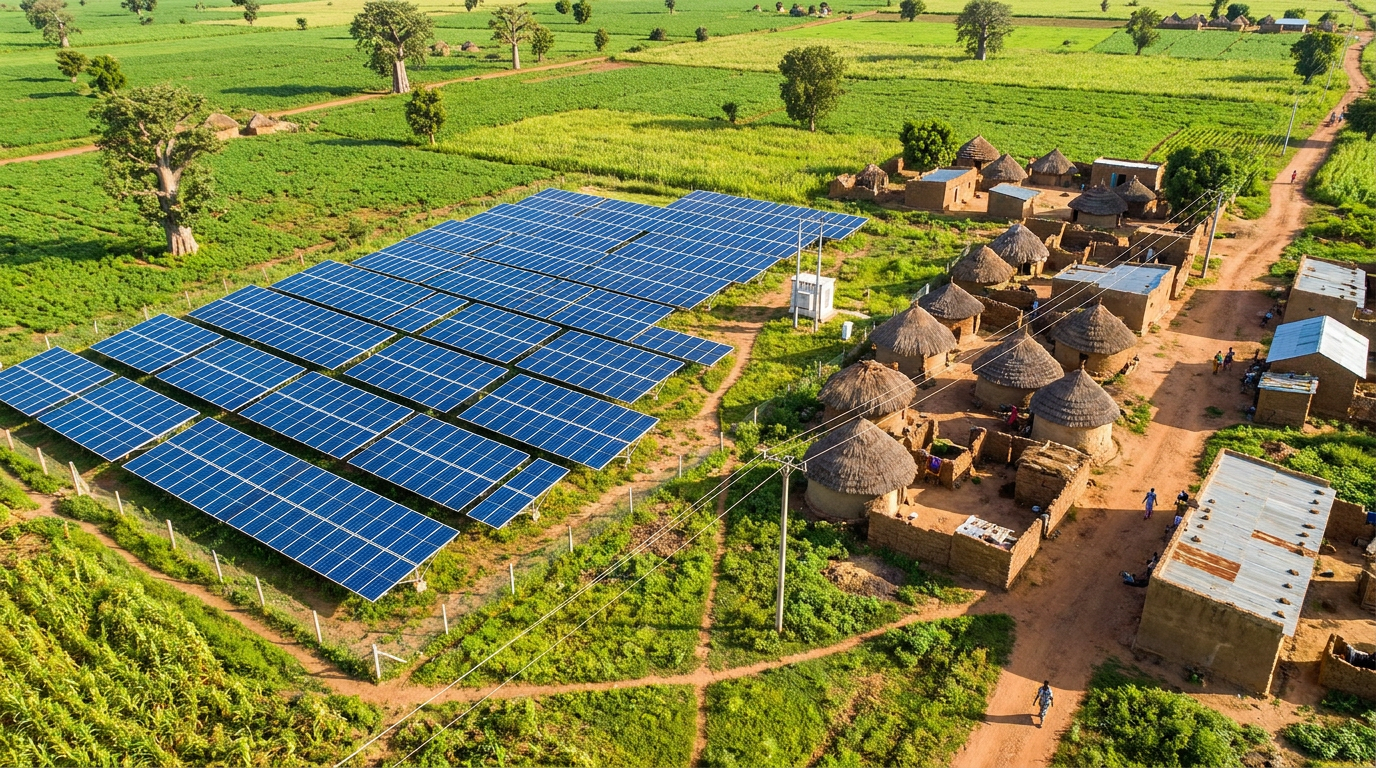
But a profound structural shift is underway. Across the continent, communities are bypassing the traditional grid entirely, leapfrogging straight to decentralized, renewable energy networks known as solar mini-grids. Just as mobile phones rendered landline infrastructure obsolete in Africa two decades ago, these self-contained power systems are proving that universal electrification does not require waiting for a centralized state utility to arrive.[1][7]
The momentum behind this shift is accelerating rapidly. Between 2020 and 2022, decentralized renewable energy solutions provided 55 percent of all new electricity connections in Sub-Saharan Africa. Recognizing this trajectory, global development institutions have pivoted. The World Bank and the African Development Bank recently launched "Mission 300," an ambitious initiative to connect 300 million people to electricity by 2030, with solar mini-grids positioned as the most capital-efficient engine for that growth.[1][2]
To understand why mini-grids are transforming the landscape, it is necessary to look at their anatomy. A mini-grid is a localized power generation and distribution network that operates independently of the national grid. While basic solar home systems—consisting of a small panel and a battery—are sufficient for charging phones and powering a few LED bulbs, they cannot drive industrial or commercial growth.[4][5]

Mini-grids bridge that gap. A typical "third-generation" installation features a centralized array of photovoltaic (PV) solar panels, a robust battery energy storage system (BESS) to ensure 24/7 reliability, and a localized distribution network of poles and wires connecting dozens or hundreds of customers. Because they generate substantial power, they can support "productive uses" of energy: welding machines, agricultural processing mills, water pumps, and commercial refrigeration.[3][7]
The technology itself has undergone a quiet revolution. As recently as 2018, diesel generators and legacy hydropower accounted for the bulk of mini-grid capacity, with solar making up just 14 percent. Today, thanks to plummeting component costs, solar PV systems account for 59 percent of all installed mini-grids. This shift has dramatically reduced both greenhouse gas emissions and the logistical nightmare of transporting diesel fuel to remote, often insecure locations.[1][3][6]

The economics of these systems have also improved significantly. According to the Africa Minigrid Developers Association (AMDA), the capital expenditure (CAPEX) required per connection has dropped by 20 percent since 2020. In many rural contexts, mini-grids are now capable of providing power at a lower cost—and with vastly superior reliability—than the struggling national utilities that serve urban centers.[1][3]
Financial viability is further enabled by the integration of digital technology. Modern mini-grids utilize smart meters and mobile money platforms, allowing customers to purchase electricity on a pay-as-you-go (PAYG) basis. This eliminates the need for manual meter reading and billing collections, drastically reducing operational overhead while accommodating the irregular cash flows of rural agricultural households.[7]
Financial viability is further enabled by the integration of digital technology.
The human impact of this reliable, localized power is immediate and profound. In the Democratic Republic of Congo, where conflict and crumbling infrastructure have left millions in the dark, companies like Nuru are deploying mini-grids that power entire neighborhoods in cities like Goma. These systems keep hospital incubators running, allow schools to operate computers, and enable small businesses to stay open long after sunset.[6]
The arrival of reliable electricity also acts as a powerful catalyst for gender equity. Across Sub-Saharan Africa, women disproportionately bear the burden of energy poverty, spending hours gathering firewood or suffering the respiratory consequences of indoor kerosene lamps. Access to mini-grid power allows women to mechanize labor-intensive tasks, extend the operating hours of female-led enterprises, and significantly improve household health outcomes.[2][6]

Despite these clear benefits, the sector faces a monumental scaling challenge. The World Bank estimates that achieving universal access in Africa will require the construction of 160,000 mini-grids, requiring an investment of approximately $91 billion. Currently, the continent is deploying fewer than 1,000 new mini-grids annually. To meet the targets of Mission 300, that deployment rate must increase nearly tenfold, reaching over 9,000 installations per year.[1][3][7]
Unlocking that scale requires overcoming severe regulatory bottlenecks. In many African nations, the policy frameworks governing electricity were written exclusively for state-owned monopolies. Private mini-grid developers often face agonizingly slow approval processes, unclear tariff regulations, and the lingering threat that the national grid might eventually extend into their territory, stranding their assets.[3][5][7]
"To meet the World Bank's target... we need a paradigm shift in regulatory approaches that accelerates project approvals and facilitates market entry," notes AMDA's recent benchmarking report. Some countries are beginning to adapt. Nigeria, for instance, has emerged as a leading market by implementing conducive, pro-mini-grid policies and streamlining the integration of large-scale concessional funding.[3]
Financing remains the other critical hurdle. While total funding for the mini-grid sector surpassed $2.5 billion recently, actual disbursements often lag years behind commitments. Furthermore, because rural customers have a limited ability to pay, private developers struggle to generate the returns required by commercial equity investors without the support of blended finance—a mix of philanthropic grants, government subsidies, and private debt.[3][5][7]

To bridge this gap, development programs are actively working to de-risk investments. The United Nations Development Programme's Africa Minigrid Program (AMP) is currently active in 21 countries, helping governments design stable business models and regulatory instruments that provide investment security to the private sector. By subsidizing the initial capital costs, these programs allow developers to charge affordable tariffs while still maintaining viable operations.[4][7]
There is also a concerted push to stimulate "productive use" demand. If a mini-grid is built but the community only uses it for evening lighting, the system will not generate enough revenue to survive. Consequently, modern electrification projects now include access to micro-finance, allowing local entrepreneurs to purchase electric sewing machines, welding equipment, or irrigation pumps that consume more power and boost the local economy.[4][5]
Supply chain inefficiencies present a final friction point. While global solar costs have plummeted, developers in Africa still face high import duties, complex customs procedures, and a lack of local manufacturing capacity. Addressing these logistical hurdles is essential to driving capital expenditures down to global benchmarks and stretching donor dollars further.[3][7]
Ultimately, the rise of the solar mini-grid represents more than just a technological upgrade; it is a fundamental reimagining of how infrastructure is delivered in the 21st century. Rather than waiting for a distant central authority to lay cables across a continent, communities are generating their own power, from the sun, exactly where it is needed.[1][6][7]
If the regulatory and financial ecosystems can evolve to match the maturity of the technology, the goal of universal electrification is entirely within reach. The blueprint has been proven, the costs have fallen, and the mandate is clear. The next five years will determine whether this decentralized revolution can scale fast enough to finally leave energy poverty in the dark.[2][3][7]
How we got here
2018
Diesel generators and legacy hydropower dominate the decentralized energy sector, with solar PV accounting for just 14% of mini-grid capacity.
2020–2022
Decentralized renewable energy solutions accelerate, providing 55% of all new electricity connections in Sub-Saharan Africa.
2023
The World Bank identifies solar mini-grids as the most capital-efficient solution to bring first-time electricity to 380 million people in Africa.
2024
The World Bank and African Development Bank launch 'Mission 300', aiming to connect 300 million people by 2030.
2024
Solar PV officially becomes the dominant technology, accounting for 59% of all installed mini-grids globally.
Viewpoints in depth
Decentralized Energy Developers
Argue that mini-grids are the fastest, most cost-effective way to achieve universal electrification and demand faster regulatory approvals.
Private developers and industry associations view the traditional model of state-led grid extension as fundamentally obsolete for rural Africa. They point to the 20% drop in capital expenditures and the success of digital pay-as-you-go models as proof that decentralized energy is commercially viable. Their primary frustration lies with governments: developers argue that agonizingly slow permitting processes, high import duties on solar components, and the lack of clear tariff regulations are artificially suppressing a market that is otherwise ready to scale massively.
Global Development Finance
Focus on the massive capital requirements and the need for blended finance to de-risk private investment in fragile regions.
Institutions like the World Bank and the UN Development Programme recognize that while the technology works, the economics of serving the world's poorest populations require structural support. They emphasize that achieving the 'Mission 300' target will require an estimated $91 billion. Because rural customers have a low ability to pay, commercial equity investors are hesitant to fund these projects without guarantees. Development banks advocate for 'blended finance'—using philanthropic grants and government subsidies to absorb the initial risks, thereby unlocking the private capital needed to build tens of thousands of grids.
National Utility Regulators
Balance the integration of private mini-grids with national grid planning, often moving cautiously to protect state utility revenues.
For government energy ministries and state-owned utilities, the explosion of private mini-grids presents a complex planning challenge. Regulators are tasked with ensuring that private tariffs remain affordable for citizens while standardizing technical quality across the country. They also face the 'arrival of the main grid' dilemma: if a state utility eventually extends its lines to a village already served by a private mini-grid, regulators must manage the integration or buyout of those stranded assets, leading them to adopt cautious, highly regulated approval processes.
Rural Communities & Enterprises
Value reliability and the ability to power productive machinery over basic lighting, though affordability remains a primary constraint.
For the end-users living in off-grid areas, the priority is utility-grade reliability that enables economic mobility. While basic solar lanterns improve quality of life, communities advocate for systems robust enough to support 'productive uses'—powering agricultural mills, welding shops, and refrigeration for clinics. However, even with falling costs, the tariffs charged by private mini-grids can still consume a significant portion of a rural household's income, making access to micro-finance and income-generating appliances a critical piece of the electrification puzzle.
What we don't know
- Whether national governments will streamline regulatory approvals fast enough to allow the deployment of 9,000+ mini-grids per year.
- How the integration of private mini-grids with state-owned national grids will be managed if the main grid eventually reaches these rural areas.
- Whether the pledged billions in donor and development finance will be disbursed quickly enough to meet the 2030 Mission 300 targets.
Key terms
- Mini-grid
- A decentralized electricity generation and distribution network that serves a localized group of consumers, operating independently from the national transmission grid.
- Battery Energy Storage System (BESS)
- Large-scale battery banks used in mini-grids to store excess solar power generated during the day for use at night or during cloudy weather.
- Productive Use of Energy
- The use of electricity to power income-generating activities, such as agricultural milling, welding, or commercial refrigeration, rather than just household lighting.
- Pay-As-You-Go (PAYG)
- A digital payment model where customers use mobile money to prepay for electricity in small increments, accommodating the irregular income of rural households.
Frequently asked
What is a solar mini-grid?
A mini-grid is a localized power network that operates independently of the main national grid. It uses a centralized array of solar panels and large batteries to generate and store electricity, which is then distributed to homes and businesses in the immediate area.
How is a mini-grid different from a solar home system?
A solar home system typically consists of a single small panel and battery meant to power a few lights and charge phones for one household. A mini-grid is a utility-scale system that can power heavy machinery, clinics, and hundreds of homes simultaneously.
Why not just extend the national power grid?
Extending the national grid across vast, sparsely populated, or difficult terrain is incredibly expensive and slow. Mini-grids bypass this infrastructure hurdle, providing power much faster and often at a lower cost per connection.
What is 'Mission 300'?
Mission 300 is a joint initiative launched by the World Bank and the African Development Bank aimed at connecting 300 million people in Sub-Saharan Africa to electricity by 2030, relying heavily on the deployment of solar mini-grids.
Sources
Source coverage
7 outlets
4 viewpoints surfaced




[1]World BankGlobal Development Finance
Solar Mini Grids Could Sustainably Power 380 Million People in Africa by 2030
Read on World Bank →[2]Energy Sector Management Assistance Program (ESMAP)Global Development Finance
Tracking SDG 7: The Energy Progress Report 2025
Read on Energy Sector Management Assistance Program (ESMAP) →[3]Africa Minigrid Developers AssociationDecentralized Energy Developers
Benchmarking Africa's Minigrids 2024
Read on Africa Minigrid Developers Association →[4]United Nations Development ProgrammeGlobal Development Finance
Africa Minigrid Program: Illuminating the Outskirts
Read on United Nations Development Programme →[5]MDPI EnergiesRural Communities & Enterprises
Mini-Grids as a Solution for Rural Electrification: A Systematic Review
Read on MDPI Energies →[6]Energy Transition AfricaDecentralized Energy Developers
Decentralised Energy: A Blueprint for Fragile States
Read on Energy Transition Africa →[7]Factlen Editorial TeamNational Utility Regulators
Synthesis by Factlen editorial team
Read on Factlen Editorial Team →
Every angle. Every day.
Get world stories with full source coverage and perspective breakdowns delivered to your inbox.