
How Radar and AI Are Quietly Revolutionizing Motorcycle Safety
Advanced Rider Assistance Systems (ARAS) are moving from luxury touring bikes to everyday commuters, using radar, cameras, and AI to create a 360-degree safety shield that prevents accidents before they happen.
By Factlen Editorial Team
- Safety Technologists
- Focus on eliminating human error and creating a 360-degree safety envelope without ruining the riding experience.
- Motorcycling Press
- Focus on how the technology translates to real-world riding, evaluating whether it feels intrusive or genuinely helpful.
- Market Analysts
- Focus on the financial growth, adoption rates, and the expansion from premium to entry-level segments.
What's not represented
- · Traditionalist Riders
- · Insurance Providers
Why this matters
Motorcyclists are historically the most vulnerable road users. By adapting automotive-grade radar and machine learning to the unique physics of two wheels, the industry is poised to drastically reduce the human errors that cause the majority of riding fatalities, making daily commuting and long-distance touring fundamentally safer.
Key points
- Advanced Rider Assistance Systems (ARAS) are shifting motorcycle safety from passive protection to active accident prevention.
- Dual-radar systems create a 360-degree safety envelope, enabling features like blind-spot detection and forward collision warnings.
- New Stop and Go adaptive cruise control can bring a motorcycle to a complete stop in heavy traffic.
- Partnerships like Valeo and Hero MotoCorp are bringing radar and camera tech to entry-level commuter bikes.
- The global market for motorcycle ARAS is projected to surpass $3.6 billion by 2035.
Motorcycling has always been an exercise in vulnerability. Unlike cars, which envelop occupants in steel cages and airbags, motorcycles rely almost entirely on the rider's skill, situational awareness, and protective gear.
But as the industry moves through 2026, a quiet revolution is taking hold. Advanced Rider Assistance Systems (ARAS) are shifting the paradigm from passive impact protection to active accident prevention.[1]
ARAS refers to a suite of electronic safety features—powered by radar, cameras, and artificial intelligence—designed to help riders anticipate and avoid potential hazards before a collision occurs.[1][3]
While this technology has been standard in passenger cars for years, adapting it to two wheels presents unique physics challenges. Motorcycles lean into corners, have a drastically smaller physical profile, and are subject to rapid shifts in rider weight.[1][3]

To solve this, companies like Bosch and Valeo have developed compact, motorcycle-specific radar systems that work in tandem with a bike's six-axis Inertial Measurement Unit (IMU). This allows the onboard computer to understand exactly how far the bike is leaning while accurately calculating the trajectory of surrounding traffic.[4][6]
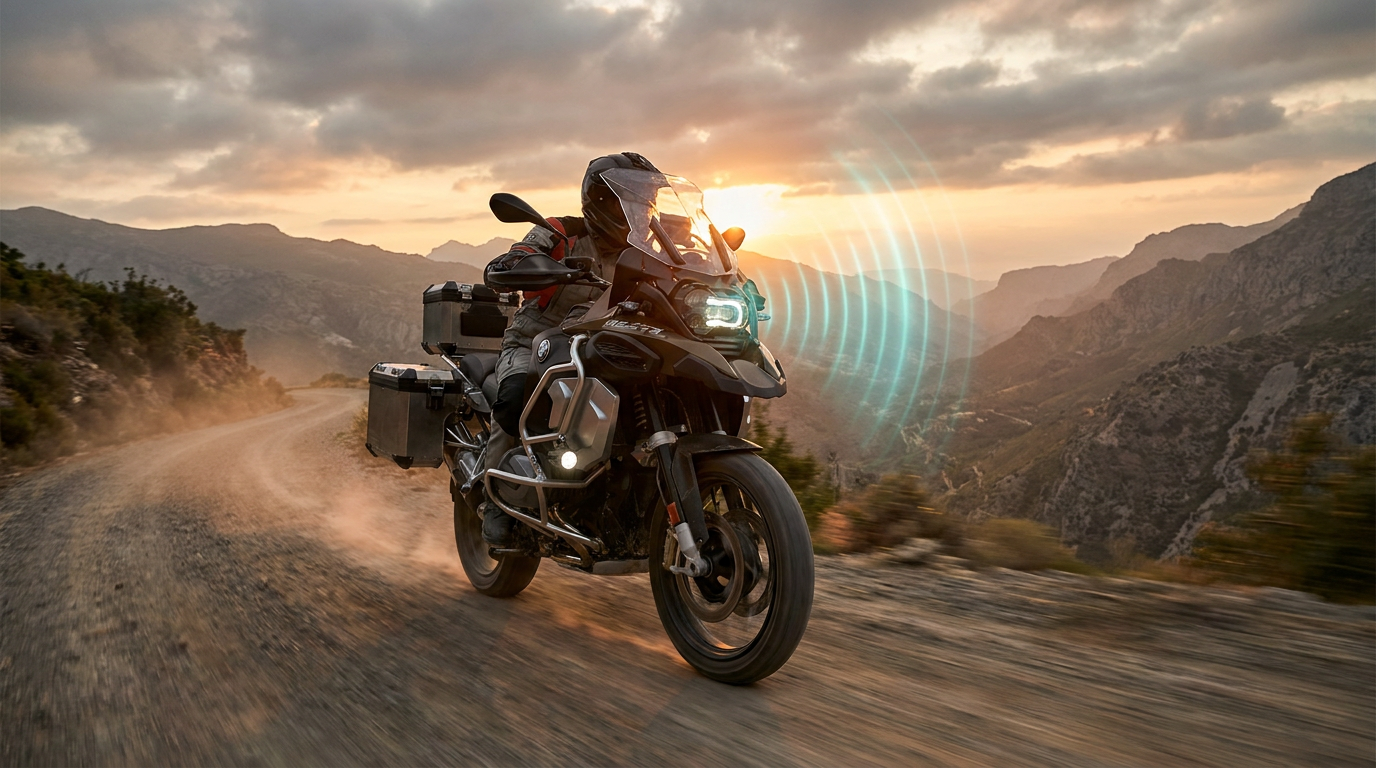
The core of the system is the "digital co-pilot" concept. By placing high-resolution radar sensors at both the front and rear, the motorcycle gains a 360-degree safety envelope that constantly monitors the environment.[2][4]
The most prominent feature of this envelope is Adaptive Cruise Control (ACC). Bosch's latest generation of ACC, which recently debuted on flagship models like the KTM 1390 Super Adventure S EVO, now includes a highly anticipated "Stop and Go" function.[7][8]
The most prominent feature of this envelope is Adaptive Cruise Control (ACC).
This system automatically adjusts the motorcycle's speed to maintain a safe distance from the vehicle ahead. When paired with an Automated Manual Transmission (AMT), it can even control the clutch and downshift on its own, bringing the bike to a complete, controlled stop in heavy traffic.[7][8]
Beyond cruising comfort, ARAS introduces critical collision avoidance tools. Forward Collision Warning uses the front radar—capable of detecting objects up to 160 meters away—to identify sudden obstacles. It alerts the rider and, if necessary, applies a series of short brake jerks to prompt an immediate reaction.[1][6]

At the rear, radar units enable blind-spot detection by monitoring adjacent lanes. If a vehicle approaches from an unseen angle, a warning light illuminates in the rearview mirror, providing a crucial safety net for urban commuters navigating dense, multi-lane traffic.[1][6]
While these systems initially debuted exclusively on premium, high-horsepower touring machines, 2026 marks the democratization of ARAS. French automotive tech giant Valeo recently partnered with Hero MotoCorp, the world's largest manufacturer of two-wheelers, to bring this technology to the masses.[2][4]
This partnership aims to integrate radar, pedestrian detection cameras, and lane departure warnings into entry-level commuters and electric scooters, proving that active safety is no longer just a luxury feature.[2][4]
The financial trajectory reflects this rapid mainstream adoption. The global market for motorcycle ARAS, valued at roughly $1.6 billion to $1.9 billion in recent years, is projected to surpass $3.6 billion by the next decade.[3][9]

Artificial intelligence is also playing a growing role in this expansion. Startups like Luna Systems have secured millions in funding to develop machine learning algorithms that anticipate future risks based on road conditions, rather than simply reacting to immediate threats.[3][5]
How we got here
1980s
Anti-lock braking systems (ABS) are first successfully adapted from passenger cars to motorcycles.
2010s
Traction control and lean-sensitive cornering ABS become standard safety features on premium motorcycles.
2023
Dual-radar systems with front and rear sensors begin appearing on flagship adventure bikes.
2024
Bosch announces next-generation radar with Stop and Go functionality for automated transmissions.
Jan 2026
Valeo and Hero MotoCorp announce a partnership to bring ARAS to entry-level commuters and scooters.
Viewpoints in depth
Safety Technologists
Engineers view ARAS as the most critical leap in motorcycle safety since the invention of ABS.
For companies like Bosch and Valeo, the physics of a motorcycle present a unique engineering puzzle. Unlike cars, bikes lean, weave, and have a tiny radar cross-section. Technologists argue that by successfully integrating radar with six-axis IMUs, they have finally cracked the code on two-wheeled active safety. Their ultimate goal is to reach 'Vision Zero'—a future with zero riding fatalities—by using a digital co-pilot to catch the split-second human errors that cause the majority of collisions.
Motorcycling Press
Reviewers and enthusiasts are balancing the undeniable safety benefits with the desire for an unfiltered riding experience.
The motorcycle press has historically been skeptical of 'nanny state' electronics that threaten to dilute the raw, mechanical connection between rider and machine. However, the consensus is rapidly shifting. Reviewers note that modern ARAS implementations are surprisingly seamless, intervening only when absolutely necessary. The addition of features like Stop and Go cruise control is being praised as a game-changer for reducing fatigue on long highway stints, proving that safety tech can actually enhance the ride rather than restrict it.
Market Analysts
Financial experts see ARAS as a multi-billion dollar growth sector driven by democratization.
Market researchers highlight that the true financial potential of ARAS lies not in $25,000 luxury touring bikes, but in the high-volume commuter market. With the global market projected to surpass $3.6 billion by 2035, analysts point to partnerships like Valeo and Hero MotoCorp as the blueprint for the future. By scaling radar and camera technology down to entry-level scooters in dense urban markets like India and Southeast Asia, manufacturers are unlocking massive new revenue streams while addressing the world's most dangerous traffic environments.
What we don't know
- How quickly riders in developing nations will adopt the technology on entry-level commuter bikes.
- Whether the presence of active safety systems will lead to rider complacency over time.
- How insurance companies will adjust premiums for motorcycles equipped with full ARAS suites.
Key terms
- ARAS
- Advanced Rider Assistance Systems, a suite of electronic safety features designed to actively prevent accidents.
- Inertial Measurement Unit (IMU)
- An electronic sensor that measures a motorcycle's pitch, roll, and yaw to calculate lean angles in real time.
- Adaptive Cruise Control (ACC)
- A radar-based system that automatically adjusts vehicle speed to maintain a safe following distance from traffic ahead.
- Automated Manual Transmission (AMT)
- A gearbox that can shift gears and control the clutch electronically, enabling features like stop-and-go cruise control.
Frequently asked
What is ARAS on a motorcycle?
Advanced Rider Assistance Systems (ARAS) use radar, cameras, and AI to provide active safety features like adaptive cruise control, forward collision warnings, and blind-spot detection.
Does radar cruise control work when a motorcycle leans?
Yes. Modern systems integrate with the motorcycle's Inertial Measurement Unit (IMU) to calculate lean angles and adjust radar tracking seamlessly through corners.
Will this technology take control away from the rider?
No. ARAS is designed as a 'digital co-pilot' to provide warnings and assist with braking or distance management, but the rider remains in full control of steering and balance.
Is radar only available on expensive luxury bikes?
While it started on premium models, partnerships between tech companies and major manufacturers are bringing the technology to entry-level commuters and scooters in 2026.
Sources
Source coverage
9 outlets
3 viewpoints surfaced









[1]Nagoya MotorMotorcycling Press
Trends Motorcycle 2026, Are You Ready? The Role of Sensors and Smart Tech
Read on Nagoya Motor →[2]VisordownMotorcycling Press
Hero and Valeo launch two-wheeled ARAS
Read on Visordown →[3]Martin & JonesMarket Analysts
Motorcycle Advanced Rider Assistance Systems
Read on Martin & Jones →[4]ValeoSafety Technologists
Valeo and Hero MotoCorp announce strategic partnership on Advanced Rider Assistance Systems
Read on Valeo →[5]Market.usMarket Analysts
Motorcycle Advanced Rider Assistance System Market Size
Read on Market.us →[6]BoschSafety Technologists
Advanced rider assistance systems (ARAS)
Read on Bosch →[7]Motorcycle.comMotorcycling Press
Bosch announces next generation radar based safety systems
Read on Motorcycle.com →[8]KTMSafety Technologists
Adaptive Cruise Control (ACC)
Read on KTM →[9]Global Growth InsightsMarket Analysts
Motorcycle Advanced Rider Assistance System (ARAS) Market Size
Read on Global Growth Insights →
Every angle. Every day.
Get automotive stories with full source coverage and perspective breakdowns delivered to your inbox.