
SNOO vs. Cradlewise: Comparing the Premium Smart Bassinets of 2026
A comprehensive trade-off analysis of the two leading smart bassinets, comparing the SNOO's FDA-authorized safety and rental flexibility against the Cradlewise's predictive technology and two-year lifespan.
By Paige Carter

In short
- The SNOO utilizes a side-to-side rocking motion and audio sensors, maxing out at six months of use.
- The Cradlewise employs a vertical bounce and predictive camera technology, converting to a mini-crib for up to 24 months of use.
- The SNOO holds a unique FDA De Novo authorization for its clip-in swaddle system that prevents infant rolling.
For new parents in 2026, uninterrupted sleep is the ultimate luxury, and technology has eagerly stepped in to act as a digital night nurse. The smart bassinet market has exploded over the last decade, promising to buy back precious hours of rest by automatically soothing fussy infants before they fully wake. These devices have transitioned from niche luxury items to highly sought-after registry staples, fundamentally changing how families navigate the grueling sleep deprivation of the fourth trimester.[4]
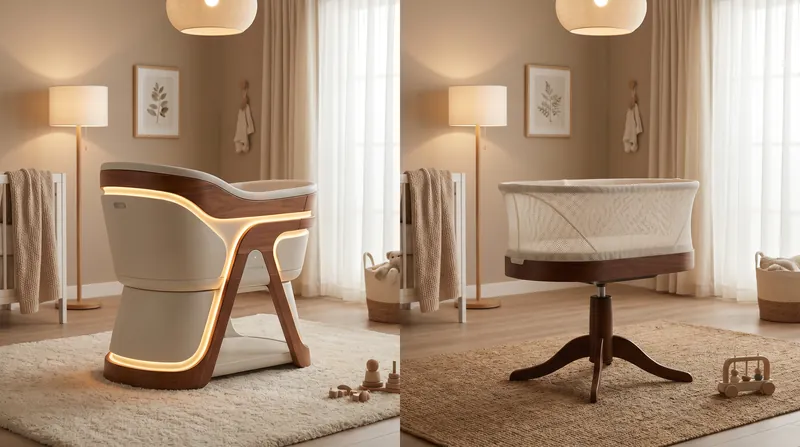
At the absolute pinnacle of this premium market sit two titans: Happiest Baby’s SNOO Smart Sleeper and the Cradlewise Smart Crib. Both devices demand a significant financial investment, and both promise to act as an extra set of hands during the night. However, their fundamental design philosophies, technological approaches, and usable lifespans are vastly different, forcing parents to choose between two distinct sleep ecosystems.[1][4]
The core mechanism of any smart bassinet is its soothing motion, and here the two devices diverge immediately. The SNOO utilizes a side-to-side rocking and jiggling motion, designed by pediatrician Dr. Harvey Karp to mimic the constant, rhythmic sway of the womb. It features five escalating speed levels that automatically respond to a baby's cries, paired with corresponding increases in white noise volume to calm the infant.[1]
In stark contrast, the Cradlewise employs a vertical, up-and-down bouncing motion. Utilizing a system of springs beneath the mattress, the crib is designed to replicate the exact sensation of a parent bouncing a baby in their arms. Like the SNOO, it offers multiple intensity levels, but the fundamental physics of the movement cater to babies who prefer vertical soothing over horizontal rocking.
The technological brains behind the soothing also represent two different eras of nursery innovation. The SNOO relies on highly calibrated audio sensors to detect when a baby is crying. Once the crying hits a certain decibel threshold, the device automatically escalates its motion and sound to calm the infant, effectively responding to the baby's distress after it has begun.[1]
Cradlewise takes a predictive approach, utilizing a built-in, overhead high-definition camera paired with artificial intelligence. Instead of waiting for the baby to cry, the Cradlewise monitors the infant's micro-movements and breathing patterns to detect early signs of stirring. It then initiates its gentle bouncing motion before the baby fully wakes, attempting to seamlessly bridge sleep cycles without the baby ever reaching a state of full distress.
Safety and sleep positioning are paramount concerns for new parents, and the SNOO holds a unique trump card in this category. The SNOO is the only bassinet on the market with an FDA De Novo authorization as a medical device, specifically authorized to keep sleeping babies safely on their backs. This is achieved through a proprietary sleep sack that physically clips into the sides of the bassinet, preventing the infant from rolling over during the night.[3]
Cradlewise opts for an open sleep surface, meeting standard JPMA and Greenguard GOLD certifications without the use of a restrictive swaddle. While it lacks the FDA medical device authorization, its built-in camera provides constant visual monitoring, and its auto-stop technology halts the bouncing motion if the baby sits up or stands, ensuring safety as the child grows more mobile.[3]
The most significant divergence between the two platforms is their longevity and footprint. The SNOO is strictly a bassinet, designed exclusively for the first six months of a baby's life, or until the infant reaches twenty-five pounds and begins to push up on their hands and knees. Once the baby hits this milestone, parents must transition them out of the SNOO and into a traditional, stationary crib.[1]
Cradlewise is built to grow with the child, converting seamlessly from a raised bassinet into a lowered mini-crib. This design extends its usable lifespan up to twenty-four months, or until the toddler reaches thirty-three pounds. For many families, this eliminates the need to purchase a secondary crib and allows the child to remain in a familiar sleep environment for their first two years.
The financial models for acquiring these devices are as different as their designs. The SNOO retails for approximately $1,695, but Happiest Baby offers a highly popular rental program that costs roughly $160 per month. Because the device is only used for six months, renting provides a significantly lower barrier to entry, and a robust market for certified pre-loved units offers additional flexibility.[2]
Cradlewise demands a steeper upfront investment, retailing for roughly $1,999, with no rental program available. However, because the Cradlewise functions as a bassinet, a mini-crib, a white noise machine, and a high-definition video monitor, proponents argue that its total cost of ownership is actually lower when factoring in the two years of use and the elimination of peripheral purchases.[2]
When evaluating the SNOO, the explicit case for the device centers on its unmatched safety profile and flexible acquisition models. The argument against the SNOO focuses heavily on its short six-month lifespan, the lack of an integrated video monitor, and the sometimes difficult transition when weaning a baby off the constant motion. The evidence supporting the SNOO is robust, anchored by its FDA De Novo authorization and years of widespread adoption that prove its efficacy in extending newborn sleep cycles.[3][4]
Conversely, the explicit case for the Cradlewise is built on its impressive two-year longevity and its predictive, camera-based soothing technology. The argument against the Cradlewise highlights its steep, inflexible upfront cost of nearly two thousand dollars, alongside a heavier, more complex assembly process that cannot match the SNOO's plug-and-play simplicity. The evidence supporting the Cradlewise points to the significant financial and spatial value of combining a bassinet, a mini-crib, a sound machine, and a high-definition video monitor into a single, cohesive ecosystem.[4]
Ultimately, the SNOO fits well when parents prioritize the absolute highest safety guarantee against infant rolling, prefer the financial flexibility of a monthly rental, or need a dedicated short-term solution for the first six months. It does not fit when families want a single piece of furniture that lasts into toddlerhood, when a baby strongly resists being swaddled, or when parents want to avoid purchasing a separate video monitor.[1][2][4]
The Cradlewise fits well when parents want a comprehensive, one-and-done sleep environment, value the ability to catch wake-ups before the baby starts crying, and have the upfront budget to invest in a two-year solution. It does not fit when families are on a strict short-term budget, plan to move the crib frequently from room to room, or prefer the specific womb-like rocking motion over a vertical bounce.[4]
In the end, neither device can guarantee a flawless night of sleep, as every infant's preferences and temperaments vary wildly. However, both the SNOO and the Cradlewise represent a massive leap forward in nursery technology, offering exhausted parents highly effective, scientifically grounded tools to navigate the most challenging months of early parenthood.[4]
Key terms
- Smart Bassinet
- An infant sleep space equipped with sensors and automated motion or sound to help soothe a baby back to sleep.
- FDA De Novo Authorization
- A regulatory pathway for novel medical devices that provides a reasonable assurance of safety and effectiveness, held by the SNOO for its back-sleeping swaddle system.
- Predictive Soothing
- Technology that uses cameras or sensors to detect early signs of a baby waking up, initiating calming motions before the baby begins to cry.
- Weaning Mode
- A setting on smart bassinets that gradually reduces the automated motion to help transition the baby to a stationary, unmoving crib.
Frequently asked
Can I rent the Cradlewise like I can the SNOO?
No, Cradlewise does not currently offer a rental program, whereas the SNOO can be rented for approximately $160 per month.
Does the SNOO have a built-in camera?
The SNOO does not include a video monitor, meaning parents will need to purchase a separate camera. The Cradlewise features an integrated HD camera.
How long can my baby use these smart bassinets?
The SNOO is designed for use up to six months or 25 pounds, while the Cradlewise converts to a mini-crib and can be used up to 24 months or 33 pounds.
Are both bassinets FDA authorized?
Only the SNOO holds an FDA De Novo authorization as a medical device designed to keep babies safely on their backs.
Viewpoints in depth
Short-Term Safety Advocates
Prioritizes the SNOO's FDA De Novo authorization, secure swaddling, and the financial flexibility of renting for the first six months.
This perspective heavily values the peace of mind that comes with the SNOO's FDA De Novo authorization. For anxious new parents, the physical guarantee that a baby cannot roll over while clipped into the SNOO sack outweighs the device's shorter lifespan. Furthermore, this camp appreciates the financial flexibility of the SNOO's rental program, arguing that paying a monthly fee for a temporary, six-month phase makes more economic sense than committing to a massive upfront purchase.
Long-Term Value Proponents
Favors the Cradlewise for its two-year lifespan, integrated video monitor, and predictive camera technology that catches early wake-ups.
Advocates for the Cradlewise argue that the device's true value lies in its longevity. By converting from a bassinet to a mini-crib, it eliminates the jarring transition to a new sleep environment at the six-month mark. This camp also praises the predictive AI technology, noting that catching a baby's micro-movements before they escalate into full-blown crying is a superior soothing method. The inclusion of a built-in HD monitor is seen as a major financial offset to the higher initial price tag.
Practical Nursery Planners
Focuses on the practical realities of assembly, budget constraints, trial periods, and the unpredictable nature of a baby's motion preferences.
This pragmatic viewpoint acknowledges that no smart bassinet is a guaranteed fix, as some babies simply prefer bouncing over rocking, or vice versa. They point out the practical hurdles of the Cradlewise, such as its heavier weight and more complex assembly, compared to the SNOO's plug-and-play simplicity. This camp heavily weighs the importance of generous trial periods and robust resale markets, ensuring parents aren't stuck with an expensive piece of furniture if their infant rejects the automated motion.
- Practical Nursery Planners
- Focuses on the practical realities of assembly, budget constraints, trial periods, and the unpredictable nature of a baby's motion preferences.
- Short-Term Safety Advocates
- Prioritizes the SNOO's FDA De Novo authorization, secure swaddling, and the financial flexibility of renting for the first six months.
- Long-Term Value Proponents
- Favors the Cradlewise for its two-year lifespan, integrated video monitor, and predictive camera technology that catches early wake-ups.
- Synthesis Analysts
- Evaluates the broader smart nursery market, weighing the trade-offs between horizontal rocking and vertical bouncing ecosystems.
Perspectives this story doesn't cover
- Pediatric Physical Therapists
- Budget-Constrained Families
Sources
Source coverage
4 outlets
4 viewpoints surfaced




- [1]BabylistPractical Nursery Planners
Snoo vs. Cradlewise: Which Smart Bassinet is Right for You?
Read on Babylist → - [2]PoppylistPractical Nursery Planners
Cradlewise vs. SNOO: Which Smart Bassinet is Best?
Read on Poppylist → - [3]One Smart CribShort-Term Safety Advocates
Cradlewise vs SNOO: The Ultimate Smart Bassinet Comparison
Read on One Smart Crib → - [4]Factlen Editorial TeamSynthesis Analysts
Synthesis by Factlen editorial team
Read on Factlen Editorial Team →
More in Shopping & Reviews
See all →Baby Gear
Smart vs. Traditional Baby Monitors: Which Actually Helps You Sleep?
5 sources
Diapering
Cloth vs. Disposable Diapers: The 2026 Guide to Cost, Health, and Environmental Impact
3 sources
Car Seat Guide
Infant vs. Convertible Car Seats: How to Choose the Right First Seat
5 sources
Nursery Tech
Smart Bassinets vs. Traditional Sleepers: The Complete Trade-Off Analysis
8 sources
Comments
Every angle. Every day.
Get Shopping & Reviews stories with full source coverage and perspective breakdowns, free every day.