
How Generative AI and Virtual Try-On Are Rewiring E-Commerce in 2026
Agentic shopping assistants and 2D-to-photorealistic virtual fitting rooms are replacing the traditional search bar, promising to slash return rates and hyper-personalize the digital retail experience.
By Madison Lane

In short
- Generative AI is replacing traditional keyword search bars with conversational, intent-driven shopping assistants.
- New 2D virtual try-on (VTO) tools eliminate the need for expensive 3D modeling, making the tech accessible to smaller brands.
- VTO technology aims to solve 'bracket buying,' potentially reducing the fashion industry's 19.3% return rate.
The traditional e-commerce experience—typing rigid keywords into a search bar and scrolling through endless grids of isolated products—is finally showing its age. For years, online shopping has placed the cognitive burden entirely on the consumer, forcing them to translate complex needs into simple search terms and guess how a garment might fit based on a heavily stylized photo of a model.[3]
This friction has created massive inefficiencies in the retail ecosystem, most notably the margin-destroying practice of "bracket buying," where shoppers order multiple sizes of the same item with the intent to return all but one. In 2025, the National Retail Federation estimated that 19.3% of all online fashion purchases were returned, a staggering volume that eats into profits and generates immense environmental waste.
But in 2026, the architecture of digital retail is undergoing a fundamental rewiring. Generative artificial intelligence is transitioning from a novelty to a foundational layer of the e-commerce tech stack, replacing static search bars with "agentic" shopping assistants and transforming expensive 3D virtual fitting rooms into accessible, photorealistic 2D try-on experiences.[3]
The most visible shift is the death of the traditional search query. Retail giants are deploying large language models (LLMs) that understand context and intent rather than just matching keywords. Walmart, for example, has rolled out a generative AI-powered search function that allows customers to type natural language prompts like "help me plan a football watch party" or "what supplies do I need for a newborn."
Instead of returning a disjointed list of chips, decorations, and beverages, the system generates a curated, mutually exclusive, and collectively exhaustive grouping of products that covers the entire mission. Walmart has also partnered with OpenAI to integrate its "Sparky" assistant directly with ChatGPT, allowing users to browse and complete purchases without ever leaving the chat interface—a move the company calls "agentic commerce."[2]
Amazon has made a similar pivot, recently rebranding its AI shopping assistant, Rufus, to "Alexa for Shopping." Powered by Amazon Bedrock and advanced models like Anthropic's Claude Sonnet, the assistant leverages a customer's individual browsing and purchase history to provide tailored recommendations, automate deal-finding, and even execute routine reorders based on conversational context.[1]
The financial incentive behind bridging this "intent gap" is massive. Industry data indicates that customers who engage with conversational AI shopping assistants convert at a 60% higher rate because the technology successfully translates what they actually want into how a retailer's inventory is organized.
Beyond search, generative AI is solving the online fashion industry's most persistent bottleneck: the fitting room. Early iterations of Virtual Try-On (VTO) technology were notoriously clunky and prohibitively expensive, requiring brands to invest heavily in custom 3D modeling for every single product in their catalog.
The breakthrough in 2026 is the application of generative AI to standard 2D imagery. Modern VTO solutions eliminate the need for 3D assets entirely. Instead, machine learning models analyze existing flat-lay or ghost-mannequin product photos, understanding the drape, lighting, and fabric of the garment.
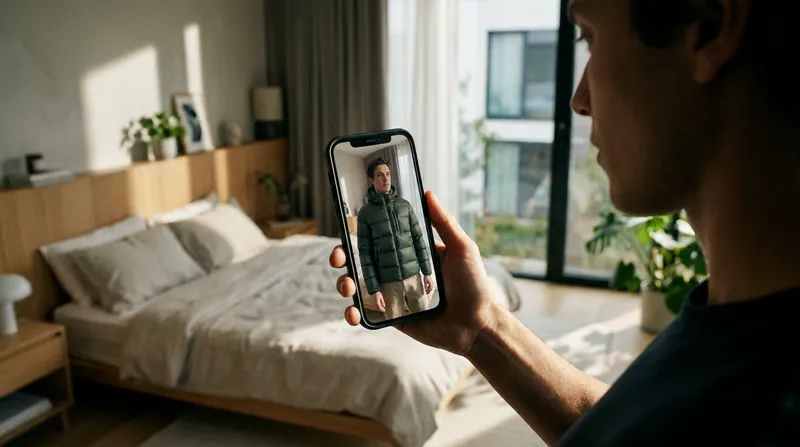
When a shopper uploads a simple photo of themselves, the AI seamlessly generates a realistic image of the customer wearing the item. This technology has advanced to the point where it can accurately account for individual skin tones, body shapes, and complex fabric draping, blurring the lines between physical products and digital twins.
The democratization of this technology means that VTO is no longer restricted to enterprise budgets. Independent brands running on platforms like Shopify can now integrate photorealistic try-on widgets in minutes, leveling the playing field and giving smaller merchants a powerful tool to build customer confidence and reduce return rates by up to 35%.
Retailers are also pushing personalization deeper into the core platform experience. Walmart recently introduced "Wallaby," a series of retail-specific LLMs trained on decades of proprietary data. This technology will soon power dynamic homepages, creating an online storefront that is uniquely tailored to each individual shopper, much like stepping into a physical store designed exclusively for them.
However, the transition to AI-mediated shopping is not without friction. As algorithms take over the curation process, concerns are rising about the transparency of the recommendations. Studies have shown that some AI shopping assistants match the actual "best product" for a consumer only 32% of the time, with the remainder being profit-optimized suggestions or sponsored placements.
There are also persistent issues with AI hallucinations in the retail space. Assistants have been caught inventing product specifications, hallucinating prices, and recommending out-of-stock items as available. For brands, this introduces a new layer of complexity: they must now optimize their product listings not just for human readers, but to ensure AI agents accurately ingest and represent their features.[3]
Ultimately, the success of generative e-commerce will hinge on trust. As the technology becomes ubiquitous, the competitive advantage will shift from simply having an AI assistant to having one that transparently serves the customer's best interests rather than solely optimizing for retail margins.
For now, the integration of agentic search and generative virtual try-on represents the most significant upgrade to the online shopping experience in a decade. By reducing the guesswork of sizing and streamlining the discovery process, AI is finally delivering on the long-promised vision of a truly personalized, frictionless digital mall.[3]
Key terms
- Agentic AI
- Artificial intelligence systems designed to autonomously take actions and complete multi-step tasks on behalf of a user, rather than just generating text.
- Bracket buying
- The practice where an online shopper purchases multiple sizes or colors of the same item with the intention of returning the ones that do not fit.
- Virtual Try-On (VTO)
- Technology that allows customers to visualize how a product, such as clothing or makeup, will look on them digitally before making a purchase.
- Large Language Model (LLM)
- A type of artificial intelligence algorithm that uses deep learning techniques and massive datasets to understand, summarize, generate, and predict new content.
- Flat-lay photography
- A style of product photography where items are arranged on a flat surface and photographed directly from above, commonly used in e-commerce.
Frequently asked
How does generative AI virtual try-on work without 3D models?
Modern systems use machine learning to analyze standard 2D product photos (like a flat-lay image). When a user uploads a photo of themselves, the AI understands the fabric, lighting, and drape, generating a realistic image of the person wearing the garment without needing a 3D asset.
What is agentic commerce?
Agentic commerce refers to AI shopping assistants that don't just answer questions, but actively take actions on behalf of the user, such as building carts, finding deals, and executing routine reorders.
Will AI shopping assistants only recommend the most expensive items?
Not necessarily the most expensive, but studies show that some AI assistants currently match the genuine 'best product' only 32% of the time, often prioritizing profit-optimized suggestions or sponsored placements instead.
Viewpoints in depth
Retail Tech Innovators
Argue that generative AI and virtual try-on are essential tools for increasing conversion, hyper-personalizing the shopping experience, and reducing wasteful returns.
For major retailers and tech developers, the integration of generative AI is a necessary evolution to solve e-commerce's most expensive bottlenecks. By shifting from keyword search to intent-based discovery, platforms can drastically increase conversion rates—sometimes by up to 60%. Furthermore, they view photorealistic virtual try-on as the ultimate cure for 'bracket buying,' arguing that giving consumers confidence in fit and style before purchase is the only sustainable way to combat the industry's nearly 20% return rate.
Consumer Advocates
Emphasize the need for transparency, warning that AI assistants often prioritize profit-optimized suggestions over the genuine best products for the consumer.
While acknowledging the convenience of AI shopping assistants, consumer protection groups and retail analysts warn of a growing 'black box' problem. They point to data showing that these assistants frequently bypass the objectively best product in favor of sponsored placements or items with higher retail margins. There is also significant concern regarding AI hallucinations—where bots invent product specs or prices—arguing that without strict transparency labels, shoppers are vulnerable to algorithmic manipulation.
Independent E-commerce Brands
View accessible 2D generative AI tools as a way to level the playing field against retail giants by offering enterprise-grade virtual try-on experiences.
For small and mid-sized merchants, the generative AI boom of 2026 is seen as a great equalizer. Previously, offering a virtual fitting room required an enterprise IT budget and weeks of custom 3D modeling. Now, independent brands can use plug-and-play apps that generate photorealistic try-ons from standard flat-lay photos. This camp argues that accessible AI tools allow them to offer the same hyper-personalized, high-conversion shopping experiences as industry titans, helping them survive in an era of rising customer acquisition costs.
- Retail Tech Innovators
- Argue that generative AI and virtual try-on are essential tools for increasing conversion, hyper-personalizing the shopping experience, and reducing wasteful returns.
- Independent E-commerce Brands
- View accessible 2D generative AI tools as a way to level the playing field against retail giants by offering enterprise-grade virtual try-on experiences.
- Consumer Advocates
- Emphasize the need for transparency, warning that AI assistants often prioritize profit-optimized suggestions over the genuine best products for the consumer.
Perspectives this story doesn't cover
- Environmental Organizations
- Data Privacy Advocates
Sources
Source coverage
3 outlets
3 viewpoints surfaced



- [1]AmazonRetail Tech Innovators
Amazon's next-gen AI assistant for shopping
Read on Amazon → - [2]CBS NewsIndependent E-commerce Brands
Walmart is using ChatGPT to let shoppers buy items directly from the AI bot
Read on CBS News → - [3]Factlen Editorial TeamConsumer Advocates
Synthesis by Factlen editorial team
Read on Factlen Editorial Team →
More in Business
See all →Trade Policy
EU Ends E-Commerce Tax Exemption, Imposing New €3 Duty on Small Parcels to Counter China Trade Imbalance
4 sources

AI Marketplaces
How AI is Fixing the Used Car Market as Carro Targets a $3 Billion US IPO
5 sources
Agentic AI
The Rise of Agentic AI: How Autonomous Assistants Are Rewriting E-Commerce
2 sources
Agentic AI
The Rise of Agentic Commerce: How AI is Autonomously Executing Purchases
5 sources

Comments
Every angle. Every day.
Get Business stories with full source coverage and perspective breakdowns, free every day.