
The Science of Pilates: How Spring Resistance and Core Control Change Body Biomechanics
Emerging clinical research validates Pilates as a powerful biomechanical tool, demonstrating how deep core activation and spring-based resistance improve joint health, athletic power, and longevity.
By Factlen Editorial Team
- Clinical Rehabilitation Specialists
- Focus on Pilates as a low-impact tool for joint health, injury recovery, and osteoarthritis pain management.
- Athletic Performance Coaches
- Value Pilates for its ability to improve neuromuscular economy, core stability, and explosive power in sports.
- General Fitness Practitioners
- Emphasize the accessibility of Mat Pilates and the body-composition benefits of the Reformer for everyday wellness.
What's not represented
- · Traditional weightlifting advocates who prioritize heavy concentric loads
- · Insurance providers evaluating the cost-effectiveness of Pilates as clinical physical therapy
Why this matters
Understanding the distinct biomechanical benefits of Mat versus Reformer Pilates allows individuals to tailor their fitness routines to specific goals—whether that is rehabilitating a joint injury, building athletic power, or ensuring pain-free mobility as they age.
Key points
- Pilates targets deep anticipatory stabilizers, like the transverse abdominis, which fire milliseconds before movement to protect the spine.
- Mat Pilates relies on gravity and body weight, requiring high internal neuromuscular control and organization.
- Reformer Pilates utilizes spring tension to provide both joint-unloading assistance and progressive resistance for muscle hypertrophy.
- Clinical studies show Pilates significantly reduces pain in osteoarthritis patients by improving joint alignment and stability.
- Athletes using Pilates demonstrate improved 'neuromuscular economy,' achieving faster performance times with less wasted muscle activation.
For decades, Pilates was viewed primarily as a niche conditioning secret for professional dancers or a trendy studio workout. Today, it has evolved into a cornerstone of evidence-based biomechanics. From clinical physical therapy clinics to elite athletic training facilities, the century-old method developed by Joseph Pilates is being prescribed to rebuild joint integrity, enhance athletic power, and promote longevity.[7]
At the heart of this shift is a growing body of scientific literature that explains exactly why the method works. Unlike traditional fitness modalities that prioritize heavy loads or high-impact cardiovascular exhaustion, Pilates operates on the principle of controlled, precise movement. The central debate for modern practitioners is no longer whether Pilates is effective, but which modality—the gravity-bound Mat or the spring-loaded Reformer—best serves their specific physiological goals.[7]
To understand the science of Pilates, one must first redefine the concept of the "core." In traditional fitness, core work often begins and ends with the rectus abdominis—the superficial "six-pack" muscles. Pilates, however, targets the "powerhouse," a deep, complex cylinder of muscular support. This includes the transverse abdominis, which wraps around the torso like a corset, the multifidus stabilizing individual vertebrae, the pelvic floor, and the diaphragm.[4][5]

Electromyography (EMG) studies have fundamentally validated this approach. Research demonstrates that Pilates exercises activate these deep stabilizing muscles more effectively than traditional crunches. More importantly, these muscles act as anticipatory stabilizers. In a healthy, well-trained body, the transverse abdominis and multifidus fire milliseconds before the arms or legs move, bracing the spine against the upcoming load. Pilates specifically trains this neurological timing, protecting the lower back from injury.[4]
This deep activation is inextricably linked to breath control. Diaphragmatic breathing, a core principle of the practice, does more than just oxygenate the blood. It regulates intra-abdominal pressure, providing a pneumatic cushion for the lumbar spine. Furthermore, controlled breathing stimulates the parasympathetic nervous system, reducing the perception of pain and lowering stress hormones—a critical factor for individuals using Pilates for injury rehabilitation.[5]
While the anatomical targets remain consistent, the physics of how those muscles are challenged depends entirely on the apparatus. The most common decision practitioners face is choosing between Mat Pilates and Reformer Pilates. While they share the same foundational principles—concentration, control, centering, precision, flow, and breath—they interact with the body's biomechanics in vastly different ways.[1][2]

Mat Pilates relies entirely on gravity and the practitioner's own body weight. Because there is no external equipment to guide the limbs or support the spine, Mat work demands an exceptionally high degree of internal neuromuscular organization. The practitioner must generate their own resistance and control their own alignment, making it a surprisingly rigorous test of proprioception and baseline strength.[3]
Mat Pilates relies entirely on gravity and the practitioner's own body weight.
The physiological adaptations to Mat Pilates are distinct. Clinical evaluations of middle-aged women participating in eight-week Mat programs have shown significant improvements in body composition, particularly in reducing waist-to-hip ratios and increasing fat-free mass. Because it requires no equipment, it remains the most accessible form of the practice, allowing for consistent, daily neuromuscular conditioning.[6]
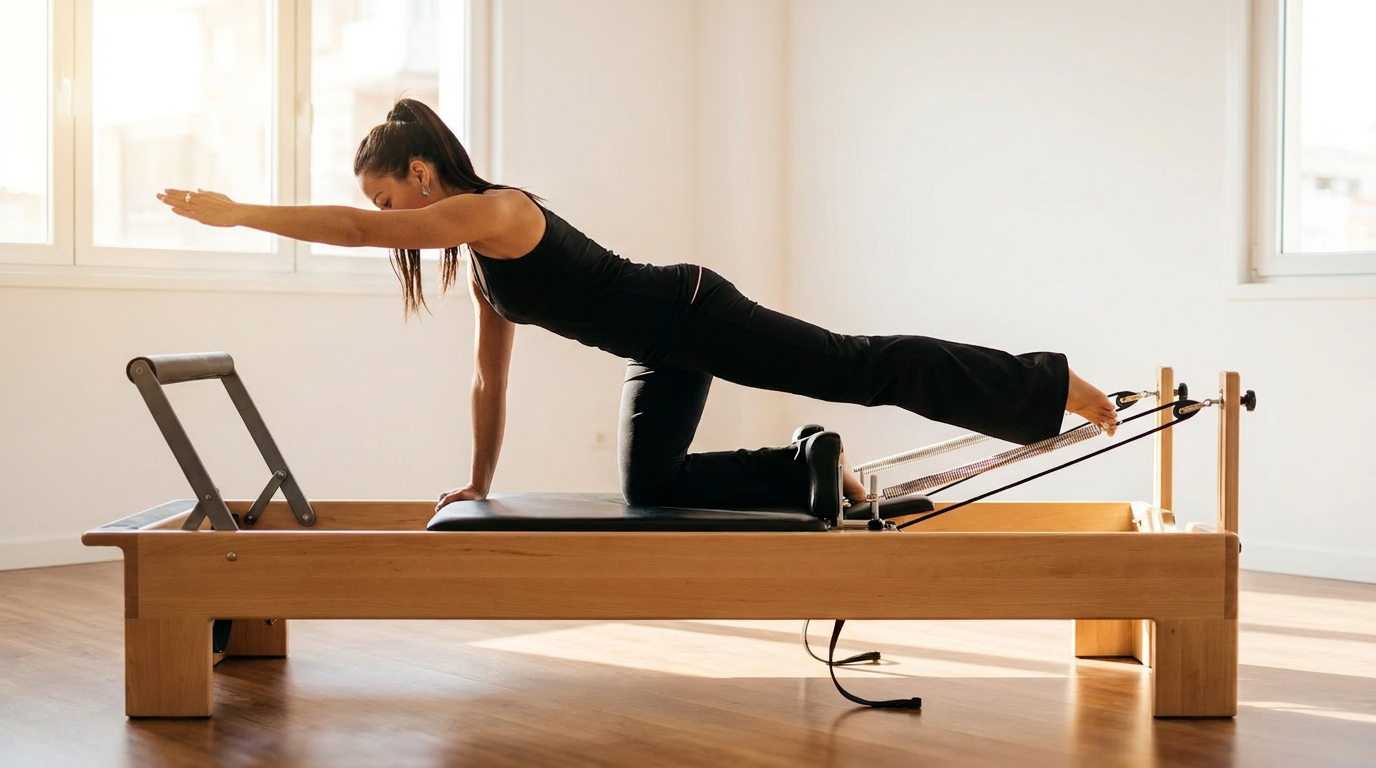
Reformer Pilates, by contrast, introduces a complex environment of external physics. The Reformer is a specialized machine featuring a sliding carriage tethered to one end of a frame by a series of color-coded springs, along with ropes and pulleys. This setup fundamentally alters the resistance curve of every movement, providing a dynamic mechanical stimulus that a static floor cannot replicate.[1][2]

The genius of the Reformer lies in the dual nature of its springs. For a beginner or someone recovering from an injury, the springs provide assistance. They can support the weight of the legs or guide the spine through a controlled range of motion, effectively unloading the joints. For an advanced practitioner, those same springs provide progressive resistance, challenging the muscles through a wider, more unstable range of movement.[3][7]
This spring-loaded resistance is particularly effective for inducing muscle hypertrophy and building explosive power. Unlike free weights, which rely on gravity and are heaviest at specific points in a lift, springs provide continuous tension. This emphasizes eccentric loading—the phase where a muscle lengthens under tension. Studies published in 2025 found that athletes using Reformer Pilates saw greater improvements in sprint times, agility, and explosive jump power compared to those doing Mat work.[1][6]
The athletic benefits extend well beyond the studio. A landmark study on experienced male runners demonstrated the profound impact of Pilates on neuromuscular economy. After 12 weeks of training, the runners significantly improved their 5K times. Crucially, EMG data showed they achieved these faster times with less overall muscle activation. By stabilizing the lumbopelvic region, Pilates eliminated wasted, compensatory movements, allowing the runners to direct all their energy into forward propulsion.[4]
Beyond athletic performance, Pilates is increasingly recognized as a vital tool for joint health and longevity. High-impact exercises can accelerate the wear-and-tear of articular cartilage. Pilates offers a low-impact alternative that strengthens the muscles surrounding vulnerable joints—like the knees, hips, and shoulders—without subjecting them to concussive force. This controlled mobility helps lubricate the joint capsule and preserve range of motion.[5]

The clinical data supporting Pilates for osteoarthritis is particularly compelling. Meta-analyses of patients with knee osteoarthritis show that Pilates interventions significantly reduce pain scores on the standard WOMAC index. By correcting postural imbalances and strengthening the quadriceps and glutes, Pilates alters the biomechanical load on the knee, distributing stress more evenly and reducing localized inflammation.[5]
The therapeutic applications of the method continue to expand. Recent clinical trials have utilized modified Pilates protocols for post-surgical rehabilitation, including total hip and knee replacements. Furthermore, the emphasis on diaphragmatic control and thoracic mobility has proven highly effective in respiratory rehabilitation, helping patients recover vital lung capacity and tidal volume following severe respiratory illnesses.[5]
Ultimately, the efficacy of Pilates—whether on the Mat or the Reformer—hinges on the mind-muscle connection. Research indicates that the neurological focus required to execute Pilates movements actually changes cortical firing patterns in the brain. Experienced practitioners do not just have stronger muscles; they have more efficient neural pathways, allowing for precise, deliberate control over their anatomy.[4][7]
The most comprehensive approach to physical longevity likely involves a synthesis of both modalities. The Reformer provides the progressive resistance necessary for building power, bone density, and hypertrophy, while the Mat demands the raw, unsupported internal control required for functional daily movement. Together, they offer a scientifically validated blueprint for a resilient, pain-free body.[3][7]
Viewpoints in depth
Clinical Rehabilitation Specialists
Focus on Pilates as a low-impact tool for joint health, injury recovery, and osteoarthritis pain management.
For physical therapists and clinical researchers, Pilates is primarily a tool for joint preservation and injury recovery. This camp points to meta-analyses showing significant reductions in WOMAC pain scores for osteoarthritis patients. They emphasize that the controlled mobility of Pilates lubricates joint capsules and strengthens the stabilizing muscles that prevent uneven wear-and-tear. In this view, the Reformer's springs are most valuable for their ability to unload weight from damaged joints, allowing patients to rebuild strength without concussive impact.
Athletic Performance Coaches
Value Pilates for its ability to improve neuromuscular economy, core stability, and explosive power in sports.
Sports scientists and athletic trainers view Pilates through the lens of performance optimization. They highlight studies demonstrating that Pilates improves 'neuromuscular economy'—the ability of the nervous system to fire only the necessary muscles for a given task, reducing fatigue. This camp favors Reformer Pilates for its capacity to provide eccentric loading, which builds the explosive power and agility required for high-level sports, while simultaneously bulletproofing the lumbopelvic region against overuse injuries.
General Fitness Practitioners
Emphasize the accessibility of Mat Pilates and the body-composition benefits of the Reformer for everyday wellness.
For the general public and studio instructors, the focus is on functional fitness, posture, and body composition. This perspective values Mat Pilates for its unmatched accessibility, allowing individuals to maintain daily core conditioning without expensive equipment. Conversely, they advocate for Reformer classes to break through strength plateaus, noting that the external resistance of the machine is highly effective at improving lean muscle mass and reducing waist-to-hip ratios in middle-aged populations.
What we don't know
- Whether long-term Reformer Pilates can match the bone-density benefits of traditional heavy barbell weightlifting.
- The exact optimal dosage (frequency and duration) of Pilates required to permanently reverse age-related paraspinal muscle atrophy.
Key terms
- Transverse Abdominis
- The deepest layer of abdominal muscle that wraps around the torso like a corset, crucial for spinal stability.
- Multifidus
- A series of small, deep muscles attached to the spinal column that help stabilize individual vertebrae.
- Eccentric Loading
- The phase of an exercise where the muscle lengthens under tension, highly effective for building strength and control.
- Proprioception
- The body's ability to sense its position and movement in space, which often degrades with joint wear or aging.
- Neuromuscular Economy
- The ability of the nervous system to activate only the necessary muscles for a movement, reducing wasted energy and fatigue.
Frequently asked
Can Pilates build muscle mass?
While Mat Pilates primarily improves muscular endurance and tone, Reformer Pilates can promote hypertrophy (muscle growth) due to the progressive external resistance provided by the springs.
Is Mat or Reformer Pilates better for beginners?
Reformer Pilates often provides more support for beginners because the springs can assist movements and guide alignment, whereas Mat Pilates requires the practitioner to support their full body weight against gravity.
How does Pilates help with joint pain?
By strengthening the deep stabilizing muscles around the joints and improving postural alignment, Pilates reduces uneven wear-and-tear and decreases localized inflammation.
What is the 'powerhouse' in Pilates?
The powerhouse refers to the deep cylinder of core muscles, including the transverse abdominis, multifidus, pelvic floor, and diaphragm, which work together to stabilize the spine.
Sources
Source coverage
7 outlets
3 viewpoints surfaced







[1]Medical News TodayGeneral Fitness Practitioners
Reformer vs. mat Pilates: What to know
Read on Medical News Today →[2]HealthlineGeneral Fitness Practitioners
Reformer Pilates vs. Mat Pilates: Which Is Better?
Read on Healthline →[3]PreventionGeneral Fitness Practitioners
Mat Pilates vs. Reformer Pilates: Which Is a Better Workout?
Read on Prevention →[4]IDEA Health & FitnessClinical Rehabilitation Specialists
The Science of Pilates Research
Read on IDEA Health & Fitness →[5]National Institutes of HealthClinical Rehabilitation Specialists
Effects of Pilates on Core Muscle Stability and Joint Health
Read on National Institutes of Health →[6]Journal of Bodywork and Movement TherapiesAthletic Performance Coaches
Effects of mat-based and reformer-based Pilates on muscle mass
Read on Journal of Bodywork and Movement Therapies →[7]Factlen Editorial TeamAthletic Performance Coaches
Synthesis by Factlen editorial team
Read on Factlen Editorial Team →

Every angle. Every day.
Get fitness stories with full source coverage and perspective breakdowns delivered to your inbox.