
How Smart Mouthguards Are Illuminating the Invisible Toll of Combat Sports
Instrumented mouthguards are moving from biomechanics labs to MMA gyms, giving fighters and coaches real-time data to track sub-concussive impacts and prevent long-term brain trauma.
By Factlen Editorial Team
- Sports Scientists & Medical Staff
- Advocates for using objective kinematic data to manage sparring loads and protect fighters' long-term neurological health.
- Biomechanics Researchers
- Focuses on the technical limitations of the sensors, warning that poor fitment and decoupling can render the data dangerously inaccurate.
- Combat Sports Coaches & Fighters
- Balances the desire for advanced safety metrics with the practical realities of gym budgets and equipment comfort.
What's not represented
- · Amateur fighters priced out of the technology
- · Traditional coaches skeptical of data analytics
Why this matters
For decades, the cumulative brain trauma absorbed during routine sparring was impossible to measure. This technology allows athletes to track their exact neurological load, potentially extending careers and preventing long-term cognitive decline.
Key points
- Instrumented mouthguards (iMGs) use embedded sensors to track the exact forces absorbed by a fighter's brain during training.
- Mouthguards provide more accurate data than helmet sensors because the upper jaw is rigidly fused to the skull.
- The technology allows coaches to practice 'load management,' reducing sparring intensity when a fighter's cumulative impact metrics get too high.
- Data accuracy relies heavily on a perfect fit; a gap of just 1-2 millimeters can introduce massive errors into the readings.
- While high costs currently limit the technology to professionals and well-funded programs, mainstream adoption is growing rapidly.
The knockout on Saturday night makes the highlight reel, but the real damage in combat sports often happens on a Tuesday afternoon. For decades, the cumulative toll of sub-concussive blows absorbed during routine sparring was a "dark figure" in mixed martial arts and boxing—impossible to quantify and dangerously easy to ignore. Fighters relied on grit and their coaches' subjective intuition to decide when a training session had crossed the line from productive to perilous.[8]
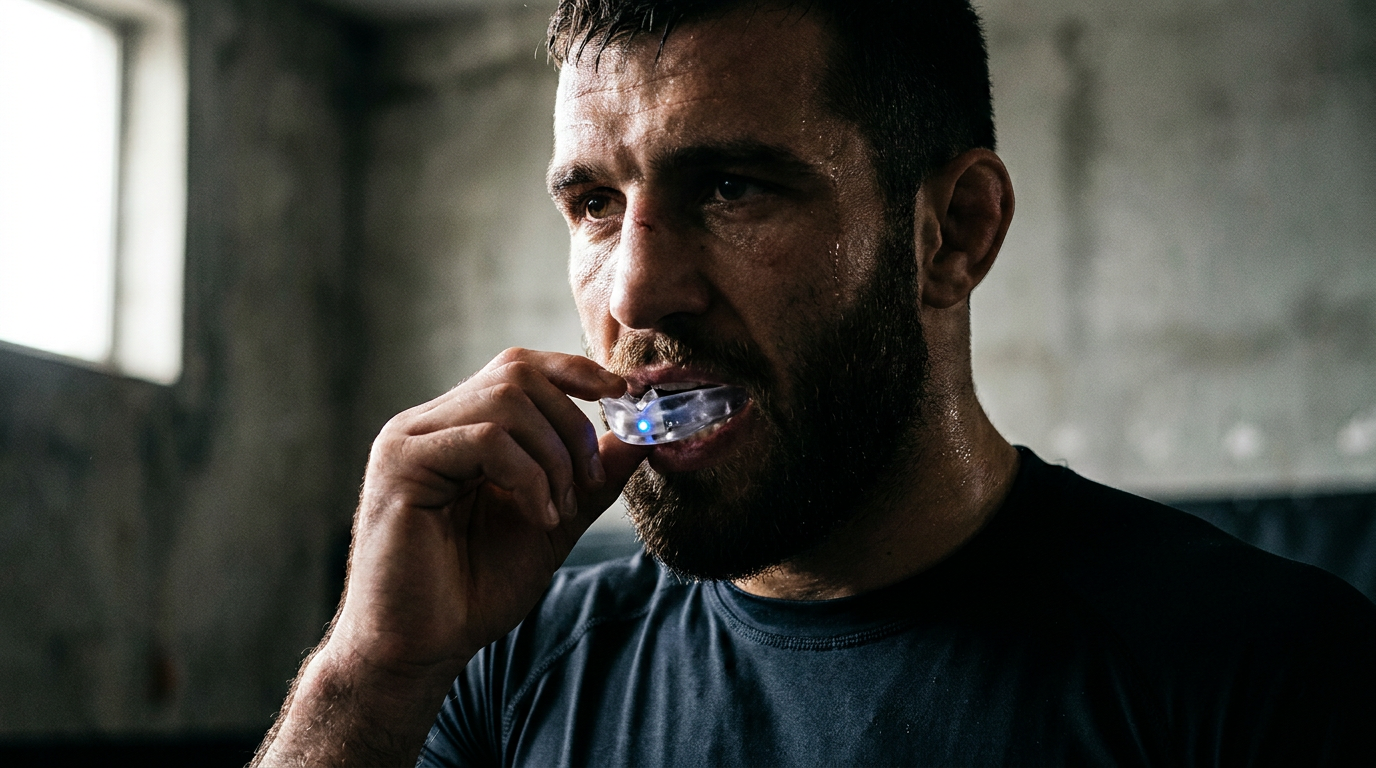
That dynamic is fundamentally changing. A quiet technological revolution is moving from university biomechanics labs into local MMA gyms, driven by a device that looks entirely ordinary from the outside: the instrumented mouthguard (iMG). By embedding micro-sensors into custom-fitted dental resin, sports scientists are finally illuminating the invisible forces rattling fighters' brains, transforming how the industry approaches athlete welfare.[4][6]
The adoption of these smart mouthguards represents a paradigm shift. Rather than relying on guesswork to determine if a sparring session was too intense, training camps can now measure exact impact loads in real-time. It functions as the equivalent of a pitch count for the human brain, alerting coaches when a fighter has absorbed too much force over a given week.[1][4]
The push toward mouth-based sensors was born out of frustration with earlier technology. For years, researchers attempted to measure head trauma using accelerometers taped behind the ear or embedded in protective headgear. However, these methods suffered from a fatal mechanical flaw: the skin, hair, and headgear move independently of the skull.[4]
When a fighter takes a left hook, a helmet sensor might register a massive spike as the foam compresses and shifts, even if the brain inside the skull barely moved. Conversely, it might completely miss the rapid rotational whip of the head that causes the most severe neurological damage. To capture true brain kinematics, researchers needed a sensor anchored directly to the skeletal structure.[4][8]
The upper jaw provided the perfect mounting point. Because the maxillary bone is rigidly fused to the rest of the skull, a tightly fitted mouthguard moves exactly as the braincase moves. By inserting tiny accelerometer chips and gyroscopes into the EVA plastic of a mouthguard, engineers created a device capable of measuring the exact forces transmitted through the skull.[4]
These devices track two primary metrics. The first is Peak Linear Acceleration (PLA), which measures the straight-line force of an impact, typically expressed in G-forces. A recent study tracking beginner boxers at the U.S. Military Academy found that average sparring impacts hovered around 16.5 Gs, though some individual strikes spiked over 70 Gs.[2]
The first is Peak Linear Acceleration (PLA), which measures the straight-line force of an impact, typically expressed in G-forces.
The second, and arguably more critical metric, is Peak Angular Acceleration (PAA). This measures the rotational whipping motion of the head. Neurologists have long known that the brain is particularly vulnerable to rotational shear forces, which stretch and tear delicate axonal fibers far more readily than straight-line impacts.[1][8]
A case study monitoring a world-class Muay Thai fighter revealed the stark difference between these two forces. Over two weeks of sparring, the fighter's linear acceleration remained relatively modest, averaging under 20 Gs per session. However, the mouthguard flagged multiple severe rotational events, with angular acceleration occasionally exceeding 26,000 rad/s² during intense clinches and head kicks.[1]

Armed with this granular data, the concept of "sparring load management" is becoming a reality. In the past, fighters often sparred hard multiple times a week, wearing down their neurological resilience before they ever stepped into the cage. Now, high-level camps can prescribe exact quantities of contact, treating head impacts like weightlifting volume.[4][8]
If a fighter's mouthguard registers a high cumulative impact load on a Monday, coaches can pivot Tuesday's session to light drilling or grappling. This objective feedback loop allows athletes to optimize their fight readiness while preserving their long-term cognitive health, ensuring they peak physically without arriving at fight night already compromised.[1][4]
However, the technology is not without significant hurdles. Biomechanics researchers warn that the accuracy of an instrumented mouthguard is entirely dependent on its fit. A recent study published in the Annals of Biomedical Engineering highlighted a phenomenon known as "decoupling," which can severely distort the data.[3]
Decoupling occurs when the mouthguard shifts slightly away from the teeth during an impact. Researchers found that a gap of just one to two millimeters between the dental mold and the teeth introduces massive errors. When the mouthguard rattles against the teeth, the sensors record high-frequency noise that can artificially inflate the severity of a hit.[3]

Frontal impacts—the most common type of strike in boxing and MMA—are particularly prone to these decoupling errors. To combat this, advanced systems developed by researchers at institutions like Stanford University now incorporate proximity sensors and machine-learning algorithms to detect when a mouthguard has slipped, filtering out spurious motion events before they reach the coach's tablet.[3][7]
Cost also remains a barrier to widespread adoption. While a standard boil-and-bite mouthguard costs less than $30, premium instrumented models from companies like OPRO and HitIQ retail for upwards of $300. For professional fighters, this is a negligible expense for career-extending data. For budget-conscious amateurs paying monthly gym fees, it remains a luxury.[5][6]
Despite the cost and technical caveats, the trajectory of combat sports is clear. As the technology scales and algorithms improve at filtering out noise, instrumented mouthguards are poised to become as standard as 16-ounce gloves. By replacing guesswork with hard data, the fight game is finally taking the invisible damage of the gym out of the dark.[6][8]
How we got here
Early 2010s
Researchers attempt to measure combat sports impacts using sensors embedded in headgear, but find the data unreliable due to skin and foam movement.
2021
The U.S. Military Academy begins using instrumented mouthguards to track head impacts in compulsory beginner boxing courses.
August 2023
Major equipment brands partner with tech firms to launch commercial smart mouthguards for the broader combat sports market.
2025–2026
Biomechanics studies reveal that while iMGs are highly accurate, even a 1-millimeter fitment gap can drastically skew impact data, prompting the development of new filtering algorithms.
Viewpoints in depth
Sports Scientists & Medical Staff
Advocates for using objective kinematic data to manage sparring loads and protect fighters' long-term neurological health.
For medical professionals, the "dark figure" of combat sports has always been the gym. While fight-night knockouts are highly visible and medically supervised, the thousands of sub-concussive blows absorbed during weekly sparring sessions often go unrecorded. Sports scientists view instrumented mouthguards as the first viable tool to quantify this hidden trauma. By tracking Peak Linear Acceleration and Peak Angular Acceleration, medical staff can establish baseline thresholds for individual athletes. This allows them to intervene before a fighter steps into the ring compromised, shifting the culture of combat sports from a "tough it out" mentality to one of evidence-based load management.
Biomechanics Researchers
Focuses on the technical limitations of the sensors, warning that poor fitment and decoupling can render the data dangerously inaccurate.
While engineers acknowledge the massive potential of iMGs, they caution against treating the data as infallible. Biomechanics researchers point out that the sensors are only as good as their anchor point. Studies have repeatedly shown that "decoupling"—when the mouthguard shifts even a fraction of a millimeter away from the teeth upon impact—creates high-frequency noise that the accelerometers misinterpret as massive force. This camp argues that until machine-learning algorithms and proximity sensors can perfectly filter out these false positives, coaches must use the data as a supplementary guide rather than an absolute diagnostic tool.
Combat Sports Coaches & Fighters
Balances the desire for advanced safety metrics with the practical realities of gym budgets and equipment comfort.
On the mats, the reception to smart mouthguards is a mix of enthusiasm and pragmatism. High-level coaches welcome the ability to objectively measure a fighter's weekly toll, using the data to justify lighter training days without questioning an athlete's work ethic. However, the $300+ price tag remains a significant hurdle for the vast majority of amateur fighters. Furthermore, some fighters express hesitation about the bulkiness of early-generation smart mouthguards, noting that any device that restricts breathing or feels unnatural during a grueling five-round sparring session will ultimately be left in the gym bag, regardless of its safety benefits.
What we don't know
- It remains unclear exactly what cumulative threshold of Peak Angular Acceleration directly correlates to long-term conditions like CTE.
- Researchers are still determining how to perfectly filter out 'decoupling' noise without accidentally discarding data from genuine, severe impacts.
Key terms
- Peak Linear Acceleration (PLA)
- The maximum straight-line force experienced by the head during an impact, typically measured in G-forces.
- Peak Angular Acceleration (PAA)
- The maximum rotational or whipping force experienced by the head, which is highly correlated with severe concussion risk.
- Instrumented Mouthguard (iMG)
- A custom-fitted dental guard embedded with micro-sensors to track head impacts in real-time.
- Decoupling
- A measurement error that occurs when a mouthguard shifts slightly away from the teeth during an impact, causing the sensors to record inaccurate, noisy data.
Frequently asked
What exactly does a smart mouthguard measure?
It uses embedded accelerometers and gyroscopes to measure the linear (straight-line) and angular (rotational) forces applied to the head during an impact.
Why put sensors in a mouthguard instead of headgear?
Headgear and skin move independently of the skull, which creates inaccurate readings. Because the upper jaw is fused to the skull, a tightly fitted mouthguard provides a true measurement of how the brain is moving.
Can these mouthguards diagnose a concussion?
No. They measure the physical force of impacts and help track cumulative trauma, but a medical professional must still diagnose a concussion based on clinical symptoms.
Sources
Source coverage
8 outlets
3 viewpoints surfaced








[1]MDPISports Scientists & Medical Staff
Instrumented Mouthguards in Combat Sports: A Case Study of a Muay Thai Fighter
Read on MDPI →[2]Oxford University PressSports Scientists & Medical Staff
Head Impact Exposure in Beginner Boxing at the U.S. Military Academy
Read on Oxford University Press →[3]OculogicaBiomechanics Researchers
Instrumented Mouthguard Decoupling Affects Measured Head Kinematic Accuracy
Read on Oculogica →[4]Science for SportSports Scientists & Medical Staff
How high-tech mouthguards are trying to fight concussion
Read on Science for Sport →[5]MMA Fight NationCombat Sports Coaches & Fighters
The Smart Mouthguard: Is OPRO's 'Impact Tracker' Worth $300 for Amateurs?
Read on MMA Fight Nation →[6]Mordor IntelligenceCombat Sports Coaches & Fighters
Mixed Martial Arts Equipment Industry Report
Read on Mordor Intelligence →[7]Stanford UniversityBiomechanics Researchers
Instrumented Mouthguard Design and Impact Detection System
Read on Stanford University →[8]Factlen Editorial TeamCombat Sports Coaches & Fighters
Synthesis by Factlen editorial team
Read on Factlen Editorial Team →

Every angle. Every day.
Get sports stories with full source coverage and perspective breakdowns delivered to your inbox.