
The Science of the Sear: How the Maillard Reaction Transforms Home Cooking
The chemical reaction responsible for the deep flavors of seared steak, roasted coffee, and baked bread is the secret to restaurant-quality meals at home.
By Factlen Editorial Team
- Culinary Scientists
- Focus on the molecular kinetics and precise manipulation of cooking environments.
- Home Cooks
- Focus on practical, accessible techniques to elevate everyday meals.
- Health Professionals
- Focus on the balance between flavor development and avoiding harmful byproducts.
What's not represented
- · Commercial Flavor Chemists
Why this matters
Understanding the Maillard reaction allows home cooks to intentionally control heat, moisture, and pH to unlock complex, savory flavors in everyday meals, elevating basic ingredients into culinary centerpieces.
Key points
- The Maillard reaction is a chemical process between amino acids and reducing sugars that creates savory flavors.
- Surface moisture prevents browning because water boils at 212°F, well below the 280°F needed for the reaction.
- Patting meat dry and using techniques like dry brining accelerate the browning process.
- Adding a pinch of baking soda raises the pH of food, which speeds up the Maillard reaction.
- Temperatures above 355°F cause pyrolysis, breaking down flavor compounds into bitter, burnt flavors.
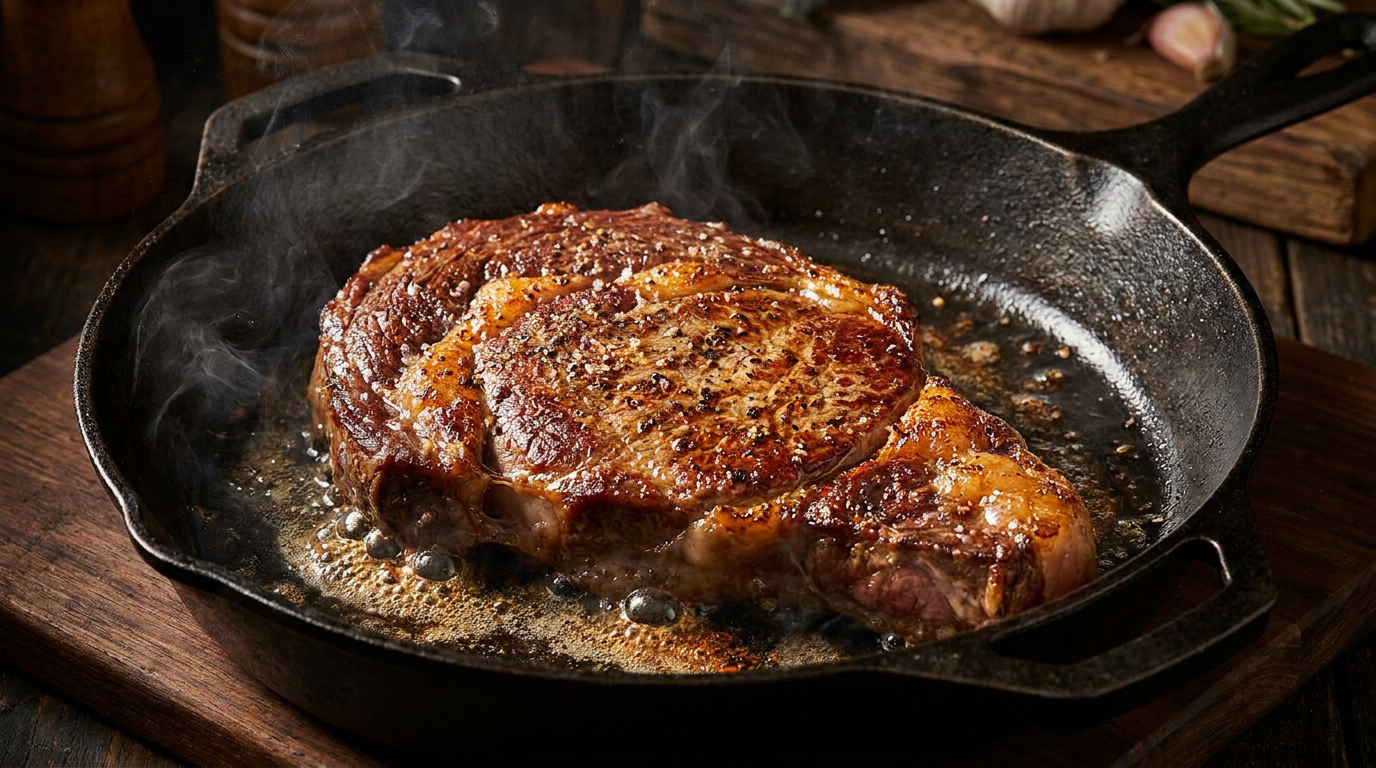
The smell of a searing steak, the golden crust of a freshly baked loaf of bread, and the deep aroma of roasted coffee all share a common chemical ancestor. It is not merely the blunt application of heat that transforms raw, pale ingredients into culinary centerpieces, but a highly specific, cascading chemical process known as the Maillard reaction. Named after the French chemist Louis-Camille Maillard, who first described the phenomenon in 1912 while attempting to reproduce biological protein synthesis, this reaction is the foundational secret to restaurant-quality cooking at home. By understanding the science behind the sear, home cooks can stop guessing and start intentionally engineering flavor.[1][2]
At its core, the Maillard reaction is a sophisticated form of non-enzymatic browning. It occurs when amino acids—the fundamental building blocks of proteins—collide with reducing sugars in the presence of intense heat. When the surface temperature of food reaches the critical threshold between 280°F and 330°F (140°C to 165°C), these molecules merge to form unstable chemical structures called glycosylamines. This initial condensation phase marks the beginning of a complex transformation, setting the stage for the development of hundreds of new flavor and aroma compounds. Unlike simple heating, this structural rearrangement fundamentally alters the chemical identity of the food's surface.[1][3]

Food scientists often describe the Maillard reaction not as a single, isolated event, but as a cascading waterfall of chemical reactions. The byproducts of the initial amino-sugar collision do not remain static; they continue to react with one another in increasingly complex and unpredictable ways. This exponential multiplication generates a vast array of molecules, each contributing distinct savory, nutty, earthy, and roasted notes to the final dish. Because these reactions happen so rapidly and simultaneously, the exact microscopic pathways remain partially mysterious to modern food science, even as their delicious, universally recognized results form the backbone of global culinary traditions.[3][5]
Understanding this chemical mechanism reveals exactly why certain cooking techniques succeed while others consistently fail. The most significant barrier to achieving the Maillard reaction in a home kitchen is surface moisture. Water boils and evaporates at 212°F (100°C), which creates an absolute thermal ceiling; as long as liquid water is present on the surface of the food, its temperature cannot exceed that boiling point. Because the Maillard reaction requires temperatures upwards of 280°F to proceed at a noticeable rate, steaming, boiling, or crowding a pan with wet meat will never produce a savory brown crust, resulting instead in pale, flavorless food.[5][6]

Understanding this chemical mechanism reveals exactly why certain cooking techniques succeed while others consistently fail.
To overcome this persistent moisture barrier, culinary experts emphasize the critical importance of surface drying before cooking. Patting a steak or a piece of fish completely dry with paper towels before it hits the pan ensures that the thermal energy goes directly into triggering the Maillard reaction, rather than being wasted on evaporating surface water. Many professional chefs take this principle a step further by leaving meat uncovered in the refrigerator overnight—a technique known as dry brining. The circulating air dehydrates the exterior while the salt seasons the interior, guaranteeing an accelerated, deeply flavorful sear the moment the protein touches hot iron.[4][5]

Temperature and moisture are not the only variables that home cooks can manipulate; the pH level of the cooking environment also plays a surprisingly critical role in flavor development. The Maillard reaction proceeds much more rapidly and efficiently in an alkaline environment. Food science researchers have demonstrated that adding a tiny pinch of baking soda—a common alkaline powder—to ground beef before browning or to pancake batter dramatically accelerates the reaction. By raising the pH, the amino groups in the proteins are deprotonated, increasing their nucleophilicity and kickstarting the flavor-building cascade significantly faster than in a neutral or acidic environment.[1][4]
A common point of confusion in the kitchen is the distinction between the Maillard reaction and caramelization. While both are non-enzymatic browning processes that require high heat to transform the color and flavor of food, their chemical requirements are entirely different. Caramelization is the breakdown of pure sugars, occurring at higher temperatures—typically above 320°F (160°C)—and producing sweet, nutty, and slightly bitter notes found in roasted carrots or crème brûlée. The Maillard reaction, by contrast, strictly requires the presence of amino acids alongside reducing sugars, resulting in the deeply savory, "meaty," and umami-rich flavors associated with roasted meats and baked breads.[2][3]

While high heat is absolutely essential for triggering the Maillard reaction, there is a strict upper thermal limit that cooks must respect. When surface temperatures exceed 355°F (180°C), the delicate flavor compounds begin to break down entirely in a destructive process known as pyrolysis, commonly recognized as burning. Pyrolysis introduces harsh, bitter, and acrid flavors that quickly overpower the palate and ruin the dish. Furthermore, excessive charring can lead to the formation of acrylamides and other blackened chemical compounds that public health professionals advise consuming only in moderation, making temperature control a matter of both taste and safety.[2][5]
Today, culinary innovators are finding entirely new ways to harness the Maillard reaction outside of traditional high-heat searing. Modernist chefs frequently utilize pressure cookers to achieve Maillard browning in moist environments; the increased atmospheric pressure raises the boiling point of water, allowing the internal temperature of a soup or stock to reach browning temperatures without evaporating the liquid. As food science continues to map the intricate kinetics of these reactions, the everyday home cook benefits from a clearer, more actionable understanding of how to build profound, restaurant-quality flavor from scratch, proving that the best cooking is simply applied chemistry.[5][7]
How we got here
1912
French chemist Louis-Camille Maillard first describes the reaction while studying biological protein synthesis.
1953
Chemist John E. Hodge publishes the definitive mechanism of the Maillard reaction, establishing its three main phases.
2000s
The rise of molecular gastronomy brings the precise manipulation of the Maillard reaction to mainstream culinary science.
Viewpoints in depth
Culinary Scientists
Focus on the molecular kinetics and precise manipulation of cooking environments.
For food scientists and molecular gastronomists, the Maillard reaction is a kinetic puzzle to be optimized. They focus on the precise manipulation of variables—temperature, time, moisture, and pH—to control the exact profile of the resulting flavor compounds. By utilizing tools like pressure cookers to raise the boiling point of water, or precisely measuring alkaline additives to accelerate deprotonation, this camp views cooking as a highly controllable laboratory experiment where flavor is engineered from the ground up.
Home Cooks
Focus on practical, accessible techniques to elevate everyday meals.
Everyday culinary practitioners prioritize actionable techniques over chemical formulas. For the home cook, understanding the Maillard reaction translates into simple, reliable habits: thoroughly drying meat before searing, pre-heating cast-iron skillets to the correct temperature, and giving food enough undisturbed time in the pan to develop a crust. This perspective values the science primarily as a tool to troubleshoot common kitchen failures, such as pale, steamed meat or soggy roasted vegetables.
Health Professionals
Focus on the balance between flavor development and avoiding harmful byproducts.
Dietitians and public health researchers view high-heat cooking through the lens of long-term health impacts. While acknowledging the sensory benefits of the Maillard reaction, they caution against pushing the process into pyrolysis. When foods—particularly starchy items like potatoes or bread—are heavily browned or charred, they can develop acrylamides, which are classified as probable human carcinogens. This camp advocates for moderate browning and avoiding the routine consumption of blackened or burnt foods.
What we don't know
- Because the Maillard reaction produces hundreds of compounds simultaneously, the exact microscopic pathways of every flavor molecule remain partially unmapped.
- The precise long-term health impacts of consuming moderate amounts of acrylamides from browned foods are still debated among nutritionists.
Key terms
- Amino Acids
- The organic molecules that serve as the building blocks of proteins, essential for initiating the Maillard reaction.
- Reducing Sugars
- Sugars containing a free reactive group, such as glucose or fructose, that can chemically bond with amino acids.
- Pyrolysis
- The chemical breakdown of organic materials at extremely high temperatures, resulting in charring and bitter flavors.
- Caramelization
- A browning process involving the breakdown of pure sugars under high heat, distinct from the protein-dependent Maillard reaction.
- Glycosylamine
- An unstable chemical compound formed in the initial stage of the Maillard reaction when a sugar and an amino acid merge.
Frequently asked
Can vegetables undergo the Maillard reaction?
Yes. Vegetables contain both proteins and natural sugars. Roasting vegetables like broccoli or carrots at high heat triggers the reaction, creating complex, savory flavors.
Why does boiled meat turn gray instead of brown?
Boiling water caps the temperature at 212°F (100°C). The Maillard reaction requires temperatures of at least 280°F (140°C) to proceed rapidly, which cannot be reached in a boiling liquid.
Does table sugar cause the Maillard reaction?
No. Table sugar (sucrose) is not a reducing sugar. While it can brown through caramelization, it does not directly participate in the protein-sugar bonding of the Maillard reaction.
How does baking soda improve browning?
Baking soda creates an alkaline environment by raising the pH. This accelerates the chemical bonding between amino acids and sugars, leading to faster and deeper browning.
Sources
Source coverage
7 outlets
3 viewpoints surfaced







[1]WikipediaHealth Professionals
Maillard reaction
Read on Wikipedia →[2]MasterClassHome Cooks
Maillard Reaction Explained: What Is the Maillard Reaction?
Read on MasterClass →[3]Serious EatsCulinary Scientists
What Is the Maillard Reaction? The Science of Flavor
Read on Serious Eats →[4]America's Test KitchenHome Cooks
How Does Baking Soda Contribute to Browning?
Read on America's Test Kitchen →[5]Modernist CuisineCulinary Scientists
Using the Maillard Reaction in Cooking
Read on Modernist Cuisine →[6]American Chemical SocietyCulinary Scientists
The Chemistry of Flavor and the Maillard Reaction
Read on American Chemical Society →[7]Factlen Editorial TeamHome Cooks
Synthesis by Factlen editorial team
Read on Factlen Editorial Team →
Every angle. Every day.
Get food drink stories with full source coverage and perspective breakdowns delivered to your inbox.