
How Biomimetic Dentistry is Regrowing Tooth Enamel Without the Drill
Advances in nano-hydroxyapatite and self-assembling peptides are allowing dentists to biologically rebuild early tooth decay, offering a powerful alternative to traditional drill-and-fill methods.
By Factlen Editorial Team
- Biomimetic Innovators
- Researchers and material scientists focused on regenerating natural tooth structure rather than patching it.
- Traditional Dental Consensus
- Public health officials and traditional dentists who prioritize decades of proven efficacy.
- Holistic & Pediatric Patients
- Consumers and parents seeking effective, non-toxic alternatives to traditional dental chemicals.
What's not represented
- · Dental Insurance Providers
- · Commercial Fluoride Toothpaste Manufacturers
Why this matters
Tooth decay is the most common chronic disease globally. The ability to biologically regrow enamel rather than drilling and filling it could eliminate dental anxiety, reduce lifetime dental costs, and provide non-toxic preventative alternatives for pediatric care.
Key points
- Nano-hydroxyapatite (nHA) is a synthetic mineral that biomimetically fills microscopic defects in tooth enamel.
- Recent clinical trials prove nHA is statistically non-inferior to fluoride in preventing cavities.
- Self-assembling peptides can create a 3D matrix inside a tooth to grow new enamel crystals.
- Biomimetic treatments can reverse early decay, but cannot fix fully formed cavities.
- Fluoride remains the gold standard for high-risk patients, but nHA offers a non-toxic alternative.
For generations, the high-pitched whine of the dental drill has been the universal sound of tooth decay. Because human enamel contains no living cells, it cannot heal itself once damaged. Traditional dentistry has long relied on a simple, mechanical philosophy: wait for a cavity to form, drill out the decayed tissue, and plug the hole with synthetic resin or metal.[7]
But a quiet revolution is shifting the foundation of oral care from mechanical repair to biological regeneration. Driven by advances in materials science, researchers are successfully using the body's own building blocks to reverse early tooth decay before a drill is ever needed. This emerging field, known as biomimetic dentistry, relies on synthetic minerals and engineered proteins to coax teeth into rebuilding their own lost enamel.[2][4]
To understand the breakthrough, it helps to understand the battlefield. Tooth decay is a continuous tug-of-war. Bacteria in the mouth feed on sugars and produce lactic acid, which leaches calcium and phosphate out of the enamel in a process called demineralization. When the mouth's pH neutralizes, minerals from saliva wash back over the teeth to remineralize them. A cavity forms only when demineralization outpaces remineralization for too long, eventually causing the enamel structure to collapse.[5][7]
For over seventy years, the undisputed champion of the remineralization phase has been fluoride. Fluoride works by integrating into the tooth's surface to create fluorapatite, a compound that is significantly more resistant to acid than natural enamel. It acts as a hardened shield, laminating the outer layer of the tooth and effectively halting early decay.[2][6]

However, fluoride has limitations. It requires strict dosage control, particularly in young children who might swallow toothpaste, as chronic overexposure can lead to dental fluorosis—a cosmetic discoloration of the teeth. Furthermore, while fluoride hardens the surface, it does not perfectly replicate the tooth's original three-dimensional mineral structure.[1][6]
Enter nano-hydroxyapatite (nHA). Hydroxyapatite is not a foreign chemical; it is the exact calcium-phosphate mineral that makes up 95 percent of human tooth enamel and 70 percent of human bone. Originally developed by NASA in the 1970s to help astronauts recover bone and tooth mass lost in zero gravity, synthetic hydroxyapatite has recently surged into mainstream preventative dentistry.[5]
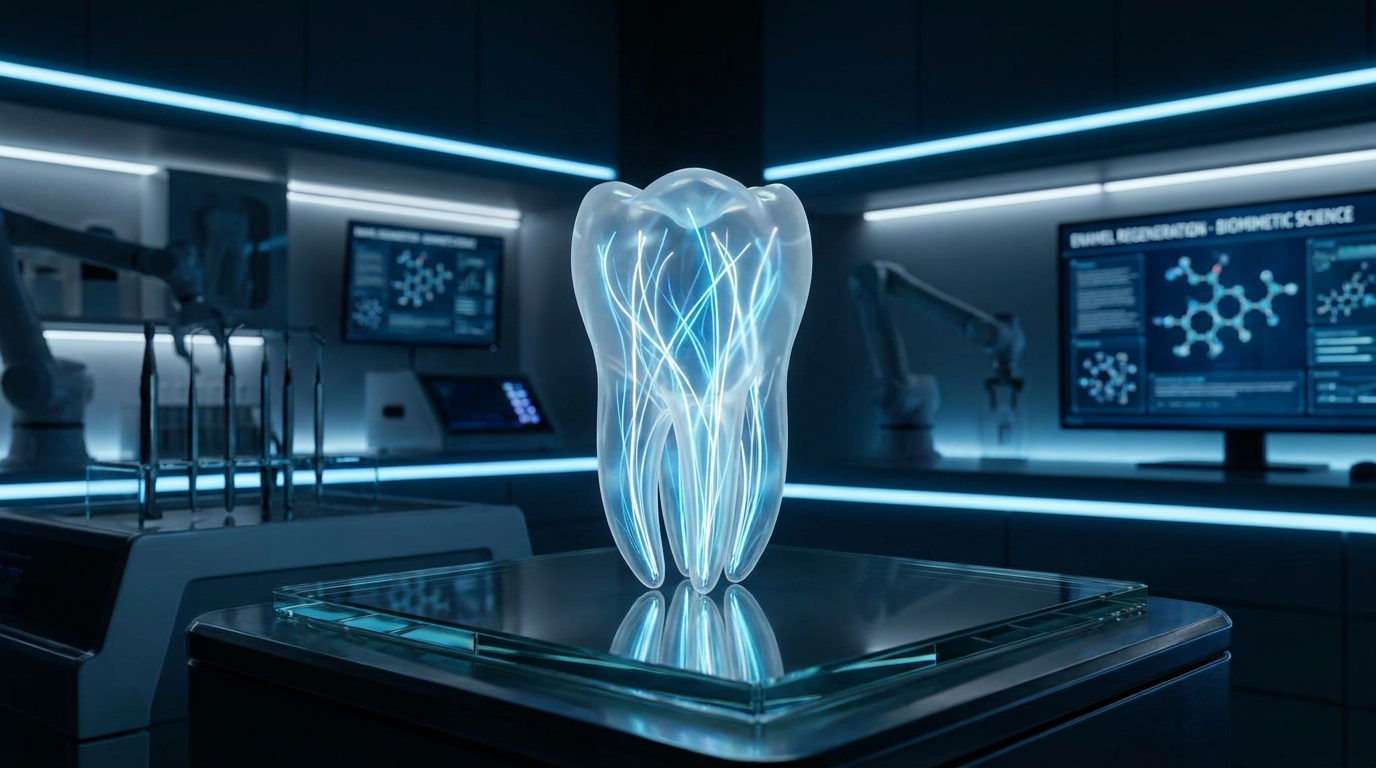
Unlike fluoride, which chemically alters the tooth surface, nano-hydroxyapatite works biomimetically. Because the nanoparticles are small enough to fit into the microscopic pores of demineralized enamel, they physically bind to the tooth, filling in defects and replacing lost minerals with the exact substance that was lost. The result is a smoother, more uniform repair that integrates seamlessly with the natural tooth structure.[2][6]
Unlike fluoride, which chemically alters the tooth surface, nano-hydroxyapatite works biomimetically.
For years, the dental establishment viewed nHA as a niche, "natural" alternative with insufficient data. That consensus is rapidly changing. A landmark 18-month double-blind randomized clinical trial published in Frontiers in Public Health tracked adults using either a standard fluoride toothpaste or a hydroxyapatite toothpaste. At the end of the trial, nearly 90 percent of patients in both groups had no new cavities, demonstrating that nHA was statistically non-inferior to fluoride for caries prevention.[1][2]

Similar studies published by the National Institutes of Health have confirmed that 10 percent hydroxyapatite achieves comparable efficacy to 500 ppm amine fluoride in remineralizing initial caries. Because nHA is completely biocompatible and poses no systemic toxicity risk if swallowed, it has become a highly attractive option for pediatric dentistry, pregnant patients, and consumers seeking clean-label products.[2][6]
But toothpaste is only the first wave of the biomimetic revolution. The true frontier of enamel regeneration lies in self-assembling peptides. While nHA can fill microscopic surface cracks, it cannot rebuild the complex, woven structure of deep enamel on its own. Natural enamel is originally formed on a protein scaffold, which degrades once the tooth is fully grown, leaving the enamel unable to regenerate.[4]
Researchers have now engineered synthetic peptides—short chains of amino acids—that mimic this lost protein scaffold. Products utilizing peptides like P11-4 are applied as a liquid or gel to an early cavity. Within hours, the peptides self-assemble into a three-dimensional biomimetic matrix deep inside the lesion. This matrix acts as a microscopic sponge, actively pulling calcium and phosphate ions from the patient's saliva to grow new hydroxyapatite crystals from the inside out.[3][4]
The clinical applications of these peptides are expanding rapidly. At the University of Washington, researchers are preparing clinical trials for a genetically engineered lozenge derived from amelogenin, the key protein in natural enamel formation. Designed to be used like a daily breath mint, the lozenge deposits several micrometers of new enamel onto the teeth, repairing damage and naturally whitening the smile without the use of harsh bleaching agents like hydrogen peroxide.[3]

Despite the immense promise of these technologies, dental professionals emphasize crucial caveats. Biomimetic remineralization—whether via nHA or peptide scaffolds—can only reverse early, non-cavitated decay, often referred to as "white spot lesions." Once a cavity has physically broken through the enamel and created a void, the tooth structure has collapsed, and a traditional mechanical filling is still required.[4][7]
Furthermore, laboratory results often outpace real-world conditions. While peptide gels can rebuild enamel-like layers within weeks on extracted teeth in a lab, the dynamic environment of a human mouth—complete with fluctuating diets, acidic beverages, and varying plaque levels—can slow down or limit the efficacy of these treatments.[4]
Because of its decades-deep evidence base, fluoride remains the gold standard for public health and high-caries-risk patients. Most dental associations are not advising patients to abandon fluoride, but rather acknowledging that the preventative toolkit has permanently expanded.[1][2]
The era of viewing teeth as inert blocks of mineral to be drilled and patched is ending. By harnessing the exact minerals and proteins the body uses to build teeth in the first place, modern dentistry is moving toward a future where early decay is not a permanent loss, but a temporary deficit that the mouth can be guided to heal.[3][7]
How we got here
1970s
NASA develops synthetic hydroxyapatite to help astronauts recover bone and tooth mass lost in zero gravity.
1993
The Japanese government officially approves hydroxyapatite toothpaste as an anti-cavity product.
2019
NIH-published studies confirm 10% nHA achieves comparable efficacy to standard fluoride in remineralizing early caries.
2021
University of Washington researchers announce clinical trials for a peptide-based lozenge that rebuilds enamel.
2023
An 18-month double-blind clinical trial proves nHA is statistically non-inferior to fluoride in preventing cavities in adults.
Viewpoints in depth
Biomimetic Innovators
Researchers and material scientists focused on regenerating natural tooth structure rather than patching it.
This camp argues that traditional dentistry's reliance on synthetic resins, metals, and surface-hardening chemicals is outdated. By engineering self-assembling peptides and utilizing nano-hydroxyapatite, they aim to mimic the body's original developmental processes. Their evidence points to laboratory successes where peptide scaffolds successfully pull calcium from saliva to grow true enamel crystals, arguing that the future of dentistry is biological regeneration, not mechanical repair.
Traditional Dental Consensus
Public health officials and traditional dentists who prioritize decades of proven efficacy.
While acknowledging the promise of biomimetics, this perspective emphasizes that fluoride remains the undisputed gold standard for caries prevention. They point out that fluoride's mechanism—creating acid-resistant fluorapatite—has successfully reduced global cavity rates for over 70 years. They caution that while peptide gels and nHA work well in controlled lab settings or on early lesions, they lack the multi-generational epidemiological data that supports community water fluoridation and standard fluoride toothpastes.
Holistic & Pediatric Patients
Consumers and parents seeking effective, non-toxic alternatives to traditional dental chemicals.
This growing demographic is driving the commercial demand for nano-hydroxyapatite. Their primary concern is safety and biocompatibility, particularly for young children who are prone to swallowing toothpaste and risk developing dental fluorosis from excess fluoride. They cite recent clinical trials proving nHA's equivalence to fluoride as validation that they no longer have to compromise between natural, clean-label ingredients and clinical efficacy.
What we don't know
- How well peptide-based enamel regeneration holds up over decades of chewing and acidic diets compared to natural enamel.
- Whether dental insurance providers will eventually cover preventative peptide treatments as standard care.
- If biomimetic gels can be formulated to effectively treat patients with severely compromised salivary flow (dry mouth), since the process relies on saliva for minerals.
Key terms
- Nano-hydroxyapatite (nHA)
- A synthetic, microscopic version of the primary calcium-phosphate mineral that makes up human teeth and bones.
- Biomimetic dentistry
- A branch of dentistry that aims to preserve intact tooth structure and restore teeth using materials that mimic natural biological processes.
- Remineralization
- The natural repair process where minerals like calcium and phosphate are deposited back into the tooth enamel.
- Fluorapatite
- A highly acid-resistant mineral formed when fluoride chemically bonds with the calcium and phosphate in tooth enamel.
- Self-assembling peptides
- Engineered chains of amino acids that automatically form a 3D structural scaffold when applied to a tooth, guiding new mineral growth.
Frequently asked
Can these treatments fix a cavity I already have?
No. Biomimetic remineralization can only reverse early 'white spot' lesions where the enamel is weakened but intact. Once a physical hole (cavitation) has formed, a traditional filling is required.
Is nano-hydroxyapatite safe if swallowed?
Yes. Because it is made of the exact same minerals already present in your bones and teeth, it is completely biocompatible and non-toxic, making it popular for children's toothpaste.
Do I need a prescription to get peptide treatments?
Currently, most advanced peptide gels (like P11-4) are applied by dental professionals in a clinic. However, consumer products like peptide lozenges and toothpastes are beginning to enter the market.
Should I throw away my fluoride toothpaste?
Not necessarily. Fluoride remains the most proven anti-cavity agent with decades of data. Many dentists recommend using both, or switching to nHA only if you have specific fluoride sensitivities or preferences.
Sources
Source coverage
7 outlets
3 viewpoints surfaced







[1]Frontiers in Public HealthHolistic & Pediatric Patients
Hydroxyapatite is a safe and effective alternative to fluoride in caries prevention
Read on Frontiers in Public Health →[2]DentaltownHolistic & Pediatric Patients
The toothpaste aisle just got more interesting: Nano-hydroxyapatite vs Fluoride
Read on Dentaltown →[3]University of WashingtonBiomimetic Innovators
Peptide lozenge could rebuild tooth enamel
Read on University of Washington →[4]MDPIBiomimetic Innovators
Self-Assembling Peptide P11-4 for Dental Remineralization
Read on MDPI →[5]WebMDTraditional Dental Consensus
What to Know About Hydroxyapatite Toothpaste
Read on WebMD →[6]National Institutes of HealthTraditional Dental Consensus
Comparative efficacy of a hydroxyapatite and a fluoride toothpaste
Read on National Institutes of Health →[7]Factlen Editorial TeamHolistic & Pediatric Patients
Synthesis by Factlen editorial team
Read on Factlen Editorial Team →
More in health
See all 6 stories →Metabolic Health
The Science of Zone 2 Cardio: Why Slowing Down is the Key to Longevity and Metabolic Health
0 sources

Nutritional Psychiatry
The Gut-Brain Axis: How 'Psychobiotics' and Diet Are Reshaping Mental Health
0 sources
Metabolic Health
The Rise of Over-the-Counter CGMs: How Non-Diabetics Are Tracking Blood Sugar to Optimize Health
0 sources
Vaccine Efficacy
Updated COVID-19 Vaccines Cut Risk of All-Cause Cardiac Events by 24%, Large Study Finds
0 sources
Every angle. Every day.
Get health stories with full source coverage and perspective breakdowns delivered to your inbox.