
The Adaptive Reuse Boom: How Empty Offices Are Becoming Apartments at a Record Pace
Driven by record-high office vacancies and a severe housing shortage, developers are transforming obsolete commercial skyscrapers into residential neighborhoods.
By Factlen Editorial Team
- Commercial Developers
- Focus on salvaging distressed assets and navigating high conversion costs.
- Urban Planners
- Focus on revitalizing downtowns and solving the housing crisis.
- Housing Advocates
- Focus on ensuring conversions include affordable units, not just luxury apartments.
What's not represented
- · Existing Commercial Tenants
- · Construction Labor Unions
- · Suburban Real Estate Markets
Why this matters
The transformation of empty office buildings into housing is fundamentally rewriting the DNA of American downtowns. By turning 9-to-5 business districts into 24/7 neighborhoods, this trend aims to solve both the commercial real estate crisis and the national housing shortage.
Key points
- Office-to-apartment conversions reached a record 90,300 units in early 2026, up 28% from the previous year.
- New York City leads the nation with over 16,000 units currently under construction.
- The trend is driven by persistent hybrid work models and national office vacancy rates hovering near 20%.
- Conversions are structurally complex, requiring developers to carve out light wells and reroute centralized plumbing.
- Cities are offering aggressive tax abatements and streamlined zoning to make the expensive projects financially viable.
The skyline of American cities is undergoing its most dramatic interior renovation in a century. Across the country, millions of square feet of cubicles, conference rooms, and corner offices are being gutted and transformed into residential apartments. This wave of "adaptive reuse" is rapidly reshaping the real estate market, offering a dual solution to two of the decade's most stubborn urban challenges: record-high office vacancies and a crippling national housing shortage.[1][2]
The sheer scale of the transformation has shattered previous records. As of early 2026, there are 90,300 office-to-apartment conversion units in the national pipeline, representing a 28 percent jump from the previous year and a staggering 290 percent surge since 2022. Office buildings now account for nearly half—47 percent—of all future adaptive reuse projects nationwide, far outpacing hotel and industrial conversions.[1][2][6]
The catalyst for this boom is the permanent entrenchment of hybrid and remote work. With national office vacancy rates hovering near 20 percent, property owners are sitting on functionally obsolete assets. Compounding the pressure is a looming financial cliff: roughly $213 billion in U.S. office loans are coming due by the end of the year. For many developers, converting these distressed properties into high-demand housing is no longer just an architectural experiment; it is an economic necessity.[1][3][6][8]

New York City is the undisputed epicenter of the conversion movement. The city currently boasts 16,358 units underway, outpacing the rest of the country by a massive margin. Washington, D.C., follows in second place with 8,479 units, while Chicago, Los Angeles, and Dallas round out the top five. The trend is also gaining intense momentum in mid-sized markets, with cities like Denver, Philadelphia, and St. Louis seeing their conversion pipelines more than double over the past year.[1][2][6]
In Lower Manhattan, the concentration of these projects is so dense that the Water Street corridor has earned the nickname "Conversion Alley." At 77 Water Street, the Vanbarton Group is transforming a 1970s office tower into a 650-unit residential building, complete with open-air cutouts carved directly into the facade. Nearby, the recently completed Pearl House conversion yielded 600 apartments featuring amenities that rival luxury resorts, including a bowling alley, simulated golf, and a pet spa.[4][5]
But turning a 1980s corporate headquarters into a modern living space is a monumental engineering challenge. The most significant hurdle is the "floor plate"—the total square footage of a single level. Modern office buildings were designed with massive, deep floor plates to maximize desk space, relying heavily on artificial fluorescent lighting. Residential building codes, however, strictly require that every bedroom have a window and access to natural light.[4][7]

But turning a 1980s corporate headquarters into a modern living space is a monumental engineering challenge.
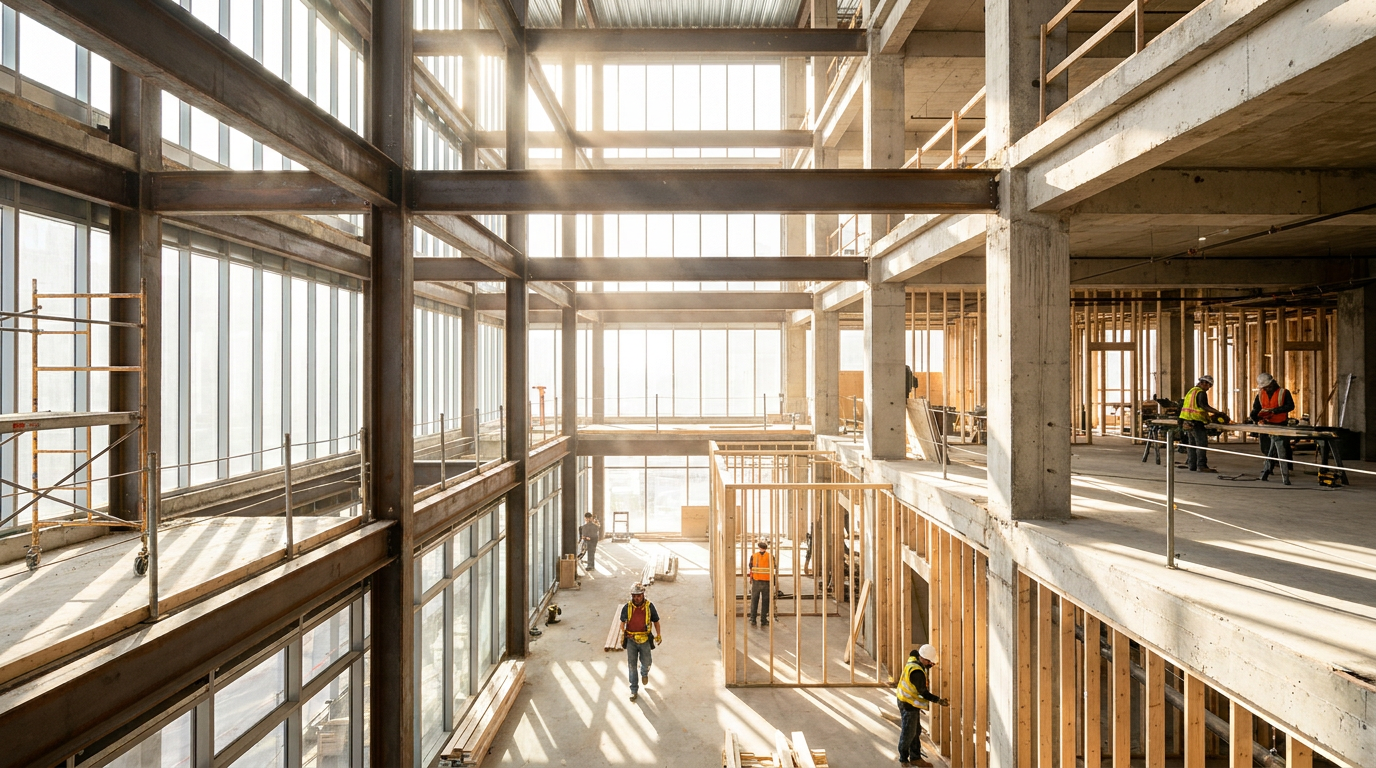
To solve this geometry problem, architects are performing radical surgery on these structures. Developers frequently core out the dead center of a massive office building, creating a central "light well" or courtyard that allows sunlight to penetrate the interior units. In other cases, they strip the building down to its steel skeleton and completely redesign the exterior envelope, replacing concrete panels with floor-to-ceiling glass to maximize natural light.[4][5]
Plumbing presents another massive logistical hurdle. Traditional office buildings feature centralized utility cores, with a set of men's and women's restrooms clustered near the elevators on each floor. Apartments require distributed plumbing, with water and waste lines routed to individual kitchens and bathrooms spread across the entire footprint. To accommodate this, construction crews must often raise the floors or drop the ceilings to create space for the complex new network of pipes.[7]
Because of these structural complexities, conversions are incredibly expensive. Industry estimates suggest that repurposing an office building can cost between $472,000 and $633,000 per unit, depending on the market and the extent of seismic upgrades required. Consequently, real estate analysts estimate that only about 24 percent of the nation's vacant office inventory is structurally and financially suitable for a residential pivot.[3][6][8]

To make the math work, local governments are aggressively stepping in with policy incentives. In New York, the recently enacted 467-m tax incentive offers developers a 90 percent property tax abatement if they set aside at least 25 percent of the newly created units as affordable housing. This policy is designed to ensure that the conversion boom doesn't exclusively produce luxury penthouses, but also serves middle- and lower-income residents.[5][7]
On the West Coast, Los Angeles has modernized its Citywide Adaptive Reuse Ordinance. Previously restricted to historic buildings constructed before 1974, the updated 2025 ordinance now allows any commercial building that is at least 15 years old to be fast-tracked for residential conversion. This streamlined permitting process shaves years off development timelines, making projects significantly more attractive to institutional investors.[3]

The ultimate impact of this conversion wave extends far beyond the creation of new housing units. It is fundamentally rewriting the DNA of the American downtown. Central business districts that once emptied out at 5:00 p.m. are being reborn as vibrant, 24/7 mixed-use neighborhoods, complete with grocery stores, dog parks, and local retail supported by a permanent residential base.[3][5][7]
While adaptive reuse alone cannot entirely solve the nation's housing shortage, it represents a remarkable pivot in urban planning. By recycling the obsolete infrastructure of the past, cities are breathing new life into their urban cores, proving that the most sustainable and transformative buildings are often the ones that are already built.[1][3][7]
How we got here
2020–2021
The pandemic triggers a mass shift to remote work, leaving millions of square feet of downtown office space vacant.
2022
Office-to-apartment conversions begin to gain traction, with roughly 23,000 units entering the national pipeline.
2023–2024
Cities like New York and Los Angeles introduce aggressive tax incentives and zoning overhauls to streamline the conversion process.
Early 2026
The conversion pipeline shatters records, reaching 90,300 units nationwide as developers race to repurpose obsolete commercial real estate.
Viewpoints in depth
Urban Planners & City Officials
Focus on revitalizing downtowns and solving the housing crisis.
For municipal leaders, the office-to-residential pipeline is a lifeline for struggling downtowns. With the decline of daily commuter foot traffic, central business districts have faced plummeting retail sales and a shrinking tax base. Planners view adaptive reuse not just as a housing strategy, but as a neighborhood-building tool. By introducing permanent residents, they hope to transition sterile 9-to-5 corporate zones into vibrant, 24/7 communities that support local grocery stores, restaurants, and nightlife.
Commercial Developers
Focus on salvaging distressed assets and navigating high conversion costs.
Developers see a historic opportunity, but they are highly pragmatic about the financial and architectural hurdles. They emphasize that only a fraction of existing office stock—roughly 24 percent—is geometrically and structurally suited for residential life. Between the costs of coring out light wells, rerouting plumbing, and upgrading seismic infrastructure, conversions can cost upwards of $500,000 per unit. Consequently, developers argue that aggressive municipal tax abatements and streamlined zoning approvals are absolutely essential to make these projects pencil out.
Housing Advocates
Focus on ensuring conversions include affordable units, not just luxury apartments.
While supportive of adding housing supply, tenant advocates caution against creating exclusive enclaves of luxury penthouses. Because conversion costs are so high, developers naturally gravitate toward premium price points to recoup their investments—evidenced by buildings featuring simulated golf and pet spas. Advocates argue that public subsidies and tax incentives must be strictly tied to affordability mandates, ensuring that middle- and lower-income residents also benefit from the revitalization of urban cores.
What we don't know
- Whether the pace of conversions will slow down once the most structurally suitable 'low-hanging fruit' buildings are completed.
- How the influx of new residential units will impact long-term rental prices in traditionally commercial neighborhoods.
Key terms
- Adaptive Reuse
- The process of repurposing an existing building for a use other than its original design, such as turning an office tower into an apartment complex.
- Floor Plate
- The total leasable square footage of a single floor in a commercial building, which dictates how much natural light can reach the interior.
- Light Well
- An unroofed external space carved into the volume of a large building to allow sunlight and fresh air to reach interior rooms.
- Class B/C Office Space
- Older, less modern commercial buildings that lack premium amenities and are currently experiencing the highest vacancy rates, making them prime targets for conversion.
Frequently asked
Why can't all empty office buildings be converted into apartments?
Most office buildings have massive, deep floor plates designed for cubicles. Because residential codes require bedrooms to have windows, it is geometrically impossible to convert the deep interiors of these buildings without carving out expensive central light wells.
Does adaptive reuse solve the affordable housing crisis?
It helps by adding overall supply, but conversions are highly expensive—often exceeding $500,000 per unit. Without specific government tax incentives or subsidies, developers typically must charge luxury rents to make the projects financially viable.
What happens to the businesses still operating in these buildings?
Developers generally target Class B and C office buildings that are either entirely vacant or highly distressed. In some cases, remaining commercial tenants are bought out of their leases to allow for a full-building residential conversion.
Sources
Source coverage
8 outlets
3 viewpoints surfaced





[1]Construction DiveCommercial Developers
Office-to-housing conversions grew 28% last year
Read on Construction Dive →[2]The Real DealCommercial Developers
U.S. office-to-apartment conversions hits new high
Read on The Real Deal →[3]Multifamily DiveUrban Planners
Adaptive reuse: The new standard in housing
Read on Multifamily Dive →[4]New York YIMBYCommercial Developers
YIMBY Checks In On Manhattan’s Office-To-Residential Conversions
Read on New York YIMBY →[5]Agence France-Presse (AFP)Housing Advocates
Tight housing market boosts New York office conversions
Read on Agence France-Presse (AFP) →[6]CRE DailyCommercial Developers
Office conversions hit 90K units in 2026, led by New York
Read on CRE Daily →[7]Cushman & WakefieldUrban Planners
New York City Experiencing Wave of Office-to-Residential Conversions
Read on Cushman & Wakefield →[8]CBRECommercial Developers
U.S. Real Estate Market Outlook
Read on CBRE →
Every angle. Every day.
Get real estate stories with full source coverage and perspective breakdowns delivered to your inbox.