
At-Home Brain Implant Restores Speech for Paralyzed ALS Patient in Historic Milestone
A 48-year-old man with ALS has become the first 'power user' of a speech neuroprosthesis, operating the brain-computer interface independently at home for over 3,800 hours.
By Factlen Editorial Team
- Clinical Neuroengineers
- Focus on the technical milestones of decoding accuracy, long-term stability, and the transition from lab to home.
- Patient Advocates
- Emphasize the restoration of autonomy, quality of life, and the importance of user-driven software features.
- Hardware Developers
- Focus on the durability and safety of the physical microelectrode arrays implanted in the cortex.
What's not represented
- · Regulatory Agencies (FDA)
- · Health Insurance Providers
- · Disability Rights Ethicists
Why this matters
For decades, brain-computer interfaces were confined to highly controlled laboratories. This breakthrough proves that neuroprosthetics can function reliably as daily, independent assistive devices, offering a realistic path to restoring autonomy for millions of people with severe paralysis.
Key points
- Casey Harrell, a 48-year-old man with ALS, has successfully used a brain-computer interface (BCI) at home for nearly two years.
- The device translates neural signals from his speech motor cortex into text and synthesized speech at 56 words per minute.
- Unlike previous trials, Harrell operates the system independently without researchers present, logging over 3,800 hours of use.
- The system maintains a 97.5% accuracy rate across a 125,000-word vocabulary, allowing for natural, unrestricted communication.
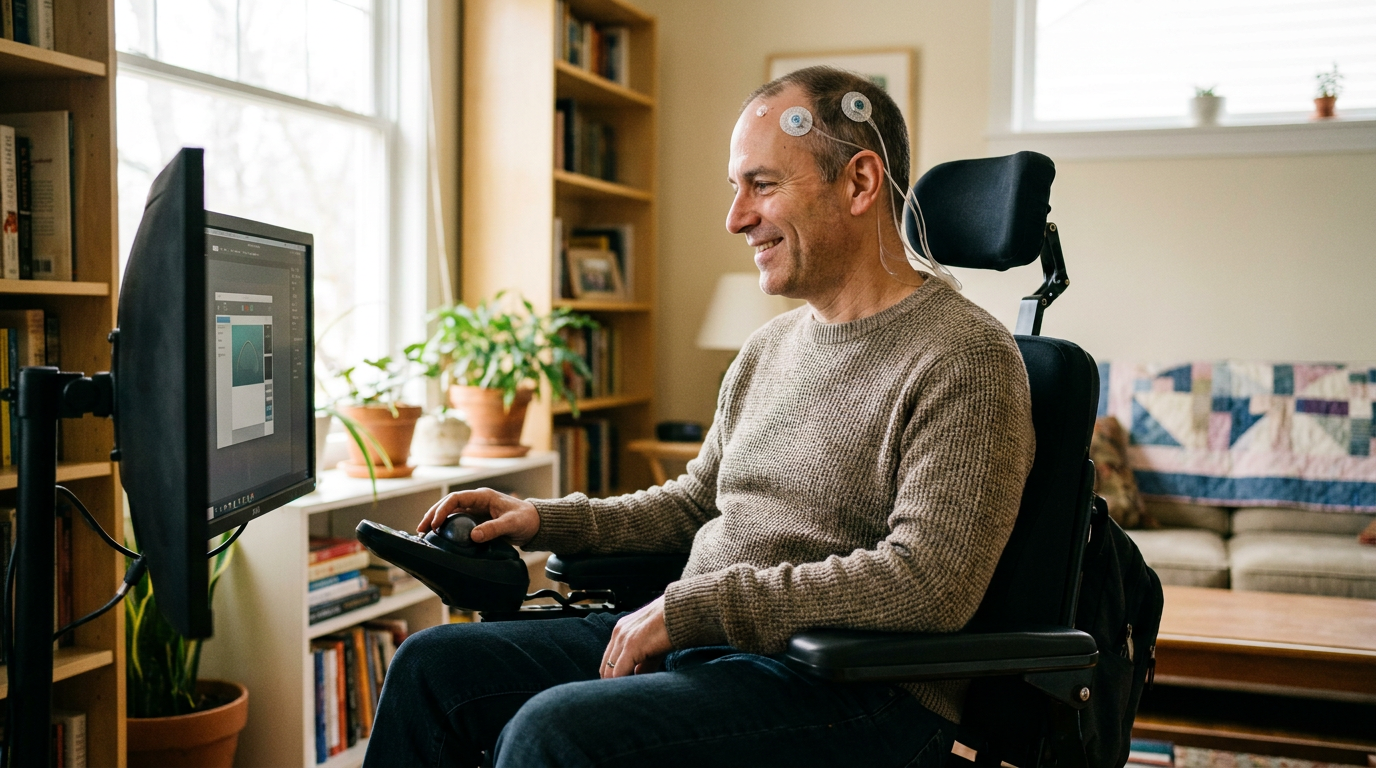
Casey Harrell, 48, was diagnosed with amyotrophic lateral sclerosis (ALS) in 2020. The progressive neurodegenerative disease gradually stripped away his ability to walk, use his hands, and eventually, his voice. But today, he reads bedtime stories to his seven-year-old daughter, browses the internet, and continues his work as an environmental activist.[2][4]
He accomplishes all of this without moving a single muscle. Harrell is the recipient of a highly advanced brain-computer interface (BCI) that translates his neural activity directly into text and synthesized spoken words.[1][3]
While BCIs have been tested in human patients for years, a new study published in the journal Nature Medicine marks a historic threshold for the technology. Harrell has become the world's first "power user" of a speech neuroprosthesis, operating the device independently in his own home for nearly two years.[2][4]
The sheer volume of his usage shatters previous clinical records. Over a 22-month period, Harrell utilized the system for more than 3,800 hours, logging on for 364 out of 397 days. He communicated over 183,000 sentences, seamlessly integrating the experimental technology into his daily routine.[2][4]

Historically, BCI trials required a team of neuroengineers and technicians to be physically present in a controlled laboratory setting. Researchers would spend hours calibrating the machines, monitoring the data streams, and troubleshooting software errors before a patient could communicate a single sentence.[1][3]
Harrell's setup completely bypasses that clinical bottleneck. Each morning, his regular caregiver simply connects external cables to two small pedestals protruding slightly from his skull. From there, Harrell takes full control, operating the system autonomously to speak, send emails, and navigate his digital life.[3][4]
The hardware making this possible consists of four microelectrode arrays, manufactured by Blackrock Neurotech, surgically implanted into his left precentral gyrus—the specific region of the brain's motor cortex responsible for coordinating the complex muscle movements of speech.[3][5]
During a five-hour surgery in July 2023, neurosurgeons from UC Davis placed these 256 microscopic electrodes directly into the cortical tissue. When Harrell attempts to speak, the electrodes intercept the electrical firing of individual neurons that would normally command his lips, tongue, jaw, and vocal cords.[3][4]
During a five-hour surgery in July 2023, neurosurgeons from UC Davis placed these 256 microscopic electrodes directly into the cortical tissue.
A sophisticated machine-learning algorithm decodes these intercepted signals in real time. Rather than trying to guess whole words, the software breaks the neural patterns down into phonemes—the fundamental sound units of the English language—and then rapidly reconstructs them into text on a screen.[1][6]
The speed and accuracy of this translation are unprecedented in the field. The system operates at an average of 56 words per minute, which is roughly half the speed of natural human conversation but vastly faster than traditional eye-tracking or cheek-twitch typing devices.[2][4]

Even more remarkably, the BCI maintains a 97.5% accuracy rate across a massive 125,000-word vocabulary. In highly controlled tests, that accuracy climbed to over 99%, allowing Harrell to express complex, nuanced thoughts without the frustration of constant typographical errors.[2][4]
Because Harrell uses the device so extensively, he has been able to request custom software features that reflect the realities of living with a BCI. The UC Davis team added a "privacy mode" that automatically deletes decoded text, ensuring his private conversations aren't permanently logged on the research servers.[4]
They also implemented a "profanity filter" at Harrell's specific request. This ensures that stray thoughts, momentary frustrations, or algorithmic misinterpretations don't result in inappropriate words being spoken aloud through the voice synthesizer while he is talking to his young daughter.[4]
Beyond speech, the implanted electrodes also capture Harrell's intended hand movements. By attempting to move his paralyzed fingers, he can control a digital cursor, giving him full, independent access to a standard computer operating system.[3][6]

The success of the BrainGate2 clinical trial provides a wealth of data for the future of neuroprosthetics. Researchers note that Harrell's 3,800 hours of usage represent the largest single-neuron-resolution brain recording dataset ever compiled, offering invaluable insights into how the human brain orchestrates language.[3]
The next frontier for the research team is moving beyond synthesized text-to-speech toward a true "brain-to-voice" system. Engineers are currently working on algorithms that decode not just the words, but the intended cadence, pitch, and emotional intonation—allowing a user to sound genuinely happy, sarcastic, or urgent.[4]
For Harrell, the technology has already redefined what is possible after a devastating diagnosis. As he told MIT Technology Review through his BCI, living with ALS is supposed to mean accepting diminished dreams. Instead, the implant has given him a revolutionary degree of autonomy, proving that the era of practical, at-home neuroprosthetics has finally arrived.[2][4]
How we got here
2020
Casey Harrell is diagnosed with ALS at age 41, eventually losing his ability to walk, use his hands, and speak.
July 2023
Harrell undergoes a five-hour surgery to implant four microelectrode arrays into his speech motor cortex as part of the BrainGate2 trial.
August 2023
On the first day of testing, the BCI decodes Harrell's intended speech with 99.6% accuracy on a 50-word vocabulary.
Early 2024
The system's vocabulary is expanded to 125,000 words, and Harrell begins using the device to control a computer cursor.
June 2026
Researchers publish data showing Harrell has used the device independently at home for over 3,800 hours, marking a historic milestone for BCI technology.
Viewpoints in depth
Clinical Neuroengineers
The transition from lab-bound experiments to independent daily use.
For decades, brain-computer interfaces were fragile, proof-of-concept systems that required constant supervision by teams of graduate students and technicians. Researchers view Casey Harrell's 3,800 hours of unmonitored home use as the definitive proof that BCIs can function as reliable, daily assistive devices. The massive dataset generated by his daily life is now being used to train even more robust decoding algorithms, pushing the field closer to commercial viability.
Patient Advocates
Reclaiming autonomy and defining the user experience.
From the perspective of those living with severe paralysis, the true breakthrough isn't just the word-error rate—it's the restoration of agency. Harrell's ability to request specific features, such as a profanity filter for speaking with his daughter and a privacy mode to delete decoded text, highlights a shift in neuroprosthetics. The focus is moving away from purely clinical metrics toward holistic quality-of-life improvements, ensuring the technology serves the human rather than the other way around.
What we don't know
- How long the implanted microelectrode arrays will continue to function before degrading or being rejected by the brain's immune response.
- When this highly experimental, custom-built technology will become commercially available and affordable for the general public.
- Whether the decoding algorithms will perform with the same unprecedented accuracy in patients with different types of neurological damage.
Key terms
- Amyotrophic Lateral Sclerosis (ALS)
- A progressive neurodegenerative disease that affects nerve cells in the brain and spinal cord, gradually stripping away the ability to control voluntary muscles.
- Brain-Computer Interface (BCI)
- A technology that allows a direct communication pathway between the brain's electrical activity and an external device, such as a computer or robotic limb.
- Speech Motor Cortex
- The specific region of the brain responsible for planning and executing the physical muscle movements required to produce spoken language.
- Microelectrode Array
- A tiny grid of microscopic sensors implanted into brain tissue to detect the electrical firing of individual neurons.
- Phoneme
- The distinct units of sound in a specified language that distinguish one word from another, such as the 'p' sound in 'pad'.
Frequently asked
How does the brain implant know what words to say?
The implant records electrical signals from the speech motor cortex—the part of the brain that controls the mouth and vocal cords. An algorithm translates those intended movement signals into phonemes, and then into text.
Does the patient need a scientist present to use it?
No. Unlike previous BCI trials that required a lab environment, this system is used independently at home. A regular caregiver simply plugs in the external cables each morning.
Can the device control anything other than speech?
Yes. The electrodes also decode intended hand movements, allowing the user to control a digital cursor to browse the internet, send emails, and operate a computer.
Is the surgery to implant the device dangerous?
Like any brain surgery, implanting microelectrode arrays carries risks such as infection or bleeding. However, the procedure has been safely performed in multiple clinical trials over the past two decades.
Sources
Source coverage
6 outlets
3 viewpoints surfaced






[1]Factlen Editorial TeamPatient Advocates
Synthesis by Factlen editorial team
Read on Factlen Editorial Team →[2]Nature MedicineClinical Neuroengineers
At-home brain implant gives man with motor neuron disease his daily life back
Read on Nature Medicine →[3]UC Davis HealthClinical Neuroengineers
Brain-computer interface enables independent, accurate communication for man living with ALS
Read on UC Davis Health →[4]MIT Technology ReviewPatient Advocates
This man with ALS is the first 'power user' of a brain implant that lets him speak
Read on MIT Technology Review →[5]Blackrock NeurotechHardware Developers
BCI-Gaming Milestone Published in Nature Medicine
Read on Blackrock Neurotech →[6]New England Journal of MedicineClinical Neuroengineers
An Accurate and Rapidly Calibrating Speech Neuroprosthesis
Read on New England Journal of Medicine →

Every angle. Every day.
Get science stories with full source coverage and perspective breakdowns delivered to your inbox.