
The Rise of the 'Abundance Agenda': How the Push to Build is Reshaping Political Commentary
A new intellectual movement dubbed 'supply-side progressivism' is challenging decades of political orthodoxy by arguing that society's greatest crises stem from an inability to build.
By Factlen Editorial Team
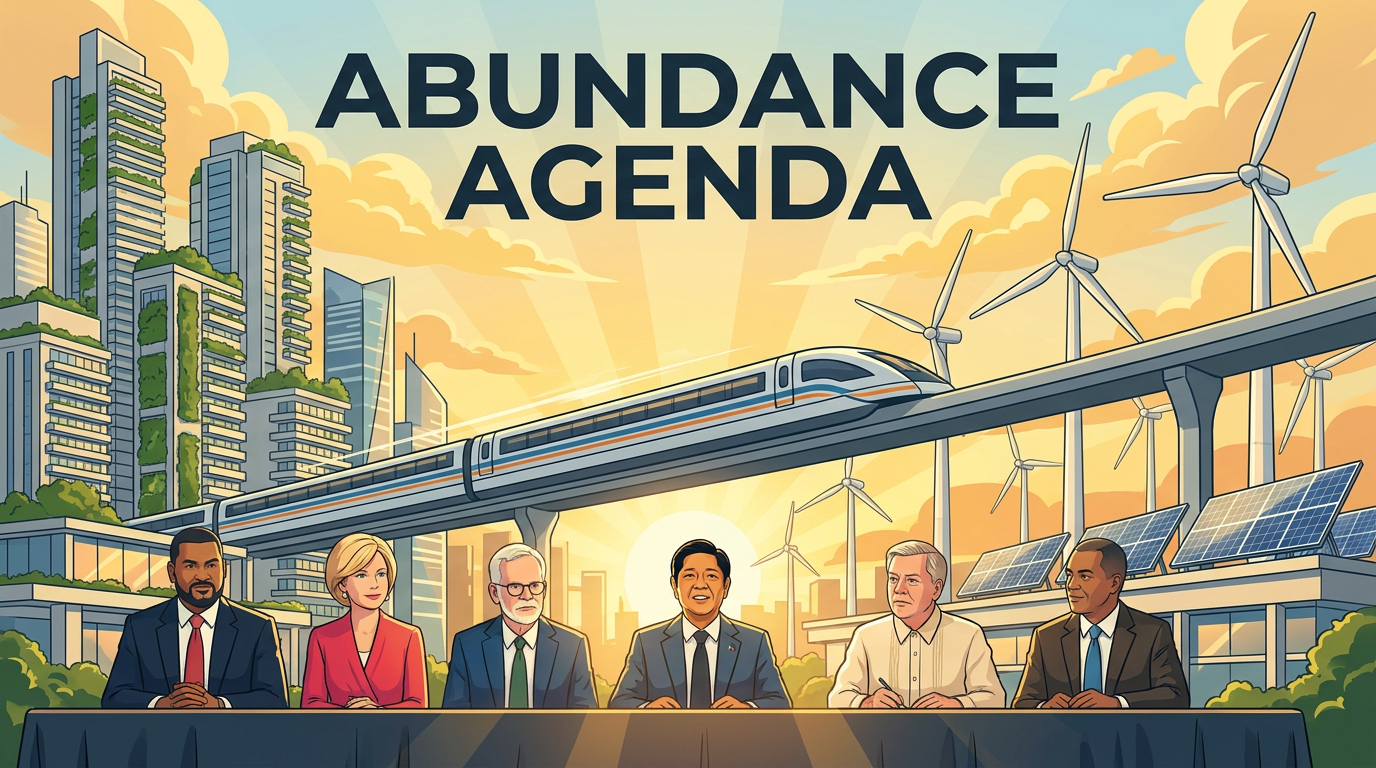
- Supply-Side Progressives
- Argue that progressive goals are best achieved by removing regulatory bottlenecks to build more housing, energy, and infrastructure.
- Left-Wing Antimonopolists
- Warn that the abundance agenda ignores corporate consolidation and serves as a Trojan horse for neoliberal deregulation.
- Degrowth Environmentalists
- Believe that infinite green growth is a myth and advocate for reducing material consumption in high-income nations.
- Free-Market Conservatives
- Agree with slashing red tape but strongly oppose the abundance agenda's reliance on government-directed industrial policy.
What's not represented
- · Local community boards defending historic preservation
- · Public sector labor unions
Why this matters
Understanding the abundance agenda provides a roadmap for how the next decade of policy might shift away from partisan gridlock over wealth redistribution, focusing instead on tangible solutions to housing, energy, and infrastructure shortages.
Key points
- The 'abundance agenda' argues that regulatory bottlenecks are the primary barrier to solving housing and climate crises.
- Advocates claim that subsidizing demand without increasing supply only drives up the cost of essential goods.
- The movement seeks to build a cross-partisan coalition of YIMBYs, tech-optimists, and pragmatic centrists.
- Left-wing critics argue the agenda ignores corporate monopolies and repackages neoliberal deregulation.
- Degrowth environmentalists oppose the movement's reliance on infinite economic expansion and material construction.
For decades, the dominant economic debate in American politics has been a tug-of-war over redistribution. Commentators and policymakers have largely focused on how to divide existing wealth, regulate corporate behavior, and protect marginalized communities from the negative externalities of industrial growth.[8]
But a new intellectual movement is attempting to rewrite the rules of modern commentary. Dubbed "supply-side progressivism" or the "abundance agenda," this framework argues that the primary bottleneck to human flourishing is no longer just how wealth is divided, but the sheer inability of modern democracies to build enough of what society actually needs.[1][5]
The movement reached a cultural inflection point in 2025 with the publication of *Abundance*, a bestselling manifesto by journalists Ezra Klein and Derek Thompson. The book crystallized a growing frustration among policy analysts that the regulatory state, originally designed to protect the public, has inadvertently paralyzed it.[1][8]
The core mechanism of the abundance agenda rests on identifying a phenomenon critics call "cost disease socialism." For years, well-meaning policymakers have attempted to solve crises in housing, healthcare, and higher education by subsidizing demand—essentially giving people more money or tax credits to buy essential goods.[2][5]
However, when the supply of those goods is artificially restricted by zoning laws, environmental reviews, and bureaucratic red tape, demand subsidies simply drive up prices. Klein and Thompson liken this dynamic to building a ladder to reach an elevator that is racing ever upward; the more money pumped into a constrained system, the more expensive the baseline becomes.[1][2]
Housing serves as the movement's primary evidence base. California, a state that frequently champions progressive values, illustrates the paradox of scarcity. Despite housing only 12 percent of the United States population, California accounts for roughly half of the nation's unsheltered homeless population.[4]

Abundance advocates point out that in cities like San Francisco, the cost to construct a single "affordable" housing unit can reach $700,000, bogged down by years of permitting delays, design reviews, and neighborhood vetoes. The solution, they argue, is not just more funding, but a ruthless streamlining of the rules that prevent construction in the first place.[1][4]
This philosophy extends heavily into climate policy. Eco-modernists within the abundance faction argue that decarbonizing the global economy requires an unprecedented era of physical construction, moving away from a mindset of conservation toward one of aggressive deployment.[2][5]
Transitioning away from fossil fuels means building massive solar arrays, wind farms, nuclear plants, and thousands of miles of high-voltage transmission lines. Yet, the very environmental protection laws designed in the 1970s to stop ecological destruction are now frequently weaponized in court to block green infrastructure.[1][2][5]

Transitioning away from fossil fuels means building massive solar arrays, wind farms, nuclear plants, and thousands of miles of high-voltage transmission lines.
To achieve these goals, political scientists at institutions like the Niskanen Center are actively trying to forge an "Abundance Faction." This proposed coalition seeks to unite tech-optimists, pro-housing YIMBYs (Yes In My Backyard), and pragmatic centrists around a shared vision of state-capacity building, cutting across traditional partisan lines.[5]
However, this emerging consensus faces fierce pushback from multiple flanks. On the environmental left, the "degrowth" movement fundamentally rejects the premise that infinite economic expansion is possible or desirable on a finite planet.[6]
Degrowth advocates argue that the abundance agenda is merely a rebranding of "green growth," a concept they view as a dangerous myth. Instead of building more, they argue that high-income countries must actively reduce their material throughput, shifting away from consumerism toward localized, low-energy economies.[6]

A separate critique comes from left-wing antimonopolists and labor advocates. Publications like Jacobin and think tanks like The Revolving Door Project warn that supply-side progressivism is a Trojan horse for corporate deregulation and a return to neoliberalism.[3][7]
They argue that by focusing entirely on removing government bottlenecks, the abundance agenda ignores the reality of corporate consolidation. If private monopolies control the market, critics warn, simply slashing red tape will enrich shareholders without guaranteeing that socially necessary goods are actually produced at affordable prices.[3][7]
Meanwhile, free-market conservatives express a different kind of skepticism. While commentators in outlets like Reason and Commentary applaud the abundance agenda's recognition that overregulation stifles progress, they balk at its proposed solutions.[2][4]

Supply-side progressives still envision a massive, active role for the state in directing industrial policy and funding research. Free-market critics argue that the government lacks the knowledge to pick technological winners and losers, warning that state-directed investments often devolve into cronyism and inefficiency.[2][4]
Ultimately, the abundance agenda represents a profound shift in how commentators diagnose societal stagnation. It asks policymakers to judge themselves not by the purity of their procedural checks, but by the tangible outcomes they deliver to the public.[1][8]
Whether this intellectual framework can survive the bruising realities of coalition politics remains an open question. But by shifting the conversation from managing scarcity to engineering plenty, the abundance movement has injected a rare dose of structural optimism into an otherwise polarized public square.[5][8]
How we got here
2010s
The concept of 'Cost Disease Socialism' emerges to describe skyrocketing costs in heavily subsidized sectors like healthcare and education.
2021
The term 'supply-side progressivism' gains traction among policy analysts to describe a shift toward building state capacity.
2022
The Institute for Progress launches, institutionalizing the push for innovation and abundance-focused policy in Washington.
2024
The Niskanen Center formally outlines the political strategy for an 'Abundance Faction' to bridge partisan divides.
2025
Journalists Ezra Klein and Derek Thompson publish the bestselling book 'Abundance', bringing the movement into mainstream commentary.
Viewpoints in depth
The Abundance Faction
Advocates for slashing red tape to unleash a new era of building and innovation.
Supply-side progressives argue that the regulatory state has become a veto-ocracy, where well-meaning environmental reviews and zoning laws are weaponized to block progress. They believe that the only way to solve the housing crisis and decarbonize the economy is to radically streamline permitting processes, allowing both the private sector and the government to build infrastructure at an unprecedented scale.
Degrowth Advocates
Argue that infinite economic growth is ecologically destructive and mathematically impossible.
The degrowth movement fundamentally rejects the eco-modernist vision of the abundance agenda. They argue that 'green growth' is a myth, as building massive new energy grids still requires immense material extraction and ecological disruption. Instead of trying to engineer our way out of scarcity, they advocate for a planned reduction in consumption, particularly in high-income nations, to live within the Earth's biophysical limits.
Antimonopolist Critics
Warn that focusing solely on deregulation ignores the dangers of corporate consolidation.
Left-wing critics argue that the abundance agenda misdiagnoses the root cause of scarcity. They contend that simply removing government bottlenecks will not lead to affordable housing or healthcare if those markets are controlled by private monopolies. From this perspective, supply-side progressivism risks becoming a Trojan horse for corporate deregulation, enriching shareholders without guaranteeing that socially necessary goods are equitably distributed.
What we don't know
- Whether the 'Abundance Faction' can successfully translate its intellectual framework into a durable voting majority.
- How the movement will reconcile the tension between streamlining government projects and maintaining democratic accountability.
- If deregulating the clean energy sector will actually result in lower emissions fast enough to meet global climate targets.
Key terms
- Supply-Side Progressivism
- A political framework arguing that progressive goals (like affordable housing and clean energy) are best achieved by increasing the supply of goods rather than just subsidizing demand.
- Cost Disease Socialism
- A critique of policies that subsidize the purchase of essential services (like healthcare or education) without addressing the underlying regulatory bottlenecks that make them expensive.
- Degrowth
- An environmental and economic philosophy arguing that infinite economic growth is impossible on a finite planet, advocating for a planned reduction of energy and resource use.
- YIMBY
- An acronym for 'Yes In My Backyard,' a pro-housing movement that advocates for reforming zoning laws to allow for denser construction.
- Eco-Modernism
- An environmental philosophy that believes technological advancement and economic growth are the best tools to solve ecological crises.
Frequently asked
What is the main argument of the abundance agenda?
It argues that society's biggest problems, from housing shortages to climate change, stem from an inability to build. It advocates for slashing red tape to dramatically increase the supply of essential goods.
How does this differ from traditional progressive politics?
Traditional progressivism often focuses on redistributing wealth and regulating industries to protect the public. The abundance agenda argues that over-regulation has paralyzed the government's ability to actually deliver progress.
Why do some environmentalists oppose the abundance agenda?
The 'degrowth' faction of the environmental movement believes that building more infrastructure—even green infrastructure—perpetuates a destructive cycle of infinite growth. They argue for reducing overall consumption instead.
Do conservatives support the abundance agenda?
Free-market conservatives agree with the movement's push to eliminate zoning laws and environmental red tape, but they strongly oppose its reliance on government-directed industrial policy and subsidies.
Sources
Source coverage
8 outlets
4 viewpoints surfaced








[1]The GuardianSupply-Side Progressives
Abundance by Ezra Klein and Derek Thompson review – the case for building more
Read on The Guardian →[2]ReasonFree-Market Conservatives
Abundance Makes the Case for 'Supply-Side Progressivism'
Read on Reason →[3]JacobinLeft-Wing Antimonopolists
The “Magabundance” Agenda Is Creating Strange Bedfellows
Read on Jacobin →[4]CommentaryFree-Market Conservatives
What Liberals Mean by 'Abundance'
Read on Commentary →[5]Niskanen CenterSupply-Side Progressives
The Rise of the Abundance Faction
Read on Niskanen Center →[6]ResilienceDegrowth Environmentalists
Degrowth Is the Only Way Out
Read on Resilience →[7]The Revolving Door ProjectLeft-Wing Antimonopolists
What is the Abundance Agenda?
Read on The Revolving Door Project →[8]Factlen Editorial TeamSupply-Side Progressives
Synthesis by Factlen editorial team
Read on Factlen Editorial Team →
Every angle. Every day.
Get opinion stories with full source coverage and perspective breakdowns delivered to your inbox.