
Quantum Computing Crosses the Error Threshold, Ushering in the Era of Logical Qubits
Recent breakthroughs in quantum error correction have proven that adding more qubits can reduce system noise rather than amplify it, shifting the technology from a physics experiment to a scalable engineering discipline.
By Factlen Editorial Team
- Quantum Hardware Engineers
- Focused on scaling physical qubits, cooling systems, and control wiring to build fault-tolerant machines.
- Cybersecurity Analysts
- Warning that the timeline for quantum decryption has accelerated, demanding immediate migration to post-quantum cryptography.
- Enterprise Software Strategists
- Emphasizing that businesses should adopt hybrid quantum-classical workflows today rather than waiting for pure quantum hardware.
- Quantum Pragmatists
- Cautioning that scaling from a few logical qubits to the thousands required for commercial advantage still faces monumental physical hurdles.
Why this matters
For decades, quantum computers were too fragile to run sustained calculations. The 2026 error-correction breakthroughs prove these machines can be stabilized, accelerating the timeline for revolutionary advances in drug discovery and materials science—while simultaneously starting a ticking clock for global cybersecurity.
For decades, quantum computing has been trapped in a frustrating paradox. The very properties that make quantum bits—or qubits—exponentially more powerful than classical computer chips also make them impossibly fragile. A passing cosmic ray, a microscopic fluctuation in temperature, or even the electromagnetic hum of nearby equipment is enough to destroy a delicate quantum calculation.[4]
This fragility kept the industry stuck in what researchers call the "Noisy Intermediate-Scale Quantum" (NISQ) era. During this period, engineers could build impressive quantum processors, but the errors accumulated so quickly that the machines could only perform short, shallow calculations before the data dissolved into static.[5]
But in the first half of 2026, the field crossed a monumental threshold. Multiple research teams and tech giants independently demonstrated that they had solved the scaling problem of quantum error correction. By proving that adding more qubits to a system can actually decrease the error rate rather than amplify it, the industry has officially shifted quantum computing from a theoretical physics experiment into a scalable engineering discipline.[1][6]
To understand the breakthrough, one must understand the mechanism of a qubit. Unlike classical bits, which are locked into a state of either 0 or 1, qubits operate in a state of "superposition," representing complex probabilities of both 0 and 1 simultaneously. When multiple qubits are "entangled," their processing power scales exponentially, allowing them to explore vast computational landscapes in parallel.[4]

However, this delicate state is prone to "decoherence"—the loss of quantum information to the surrounding environment. In a classical computer, if a bit flips from a 1 to a 0 by mistake, simple error-correcting codes can catch and fix it. In a quantum computer, the act of measuring the qubit to check for an error forces it to collapse out of its superposition, destroying the calculation entirely.[4]
The theoretical solution, proposed decades ago, was the "logical qubit." Instead of relying on a single physical qubit to hold information, engineers could bundle dozens or hundreds of noisy physical qubits together to act as one highly stable, virtual qubit. Through complex mathematical choreography, the system could detect and correct errors in the physical qubits without ever directly measuring the protected logical data.[4]
The catch was the "error threshold." Historically, the massive overhead required to coordinate all those physical qubits introduced more noise than it corrected. Adding more qubits to fix the problem simply made the problem worse, leaving researchers wondering if fault-tolerant quantum computing was physically impossible.[1]

The catch was the "error threshold." Historically, the massive overhead required to coordinate all those physical qubits introduced more noise than it corrected.
That changed decisively in 2026. Google's Quantum AI division, utilizing its 105-qubit Willow processor, demonstrated "below-threshold" error correction using a framework called the surface code. They proved that as they scaled up the lattice of physical qubits, the logical error rate did not increase—it dropped by a factor of roughly 2.14 with each step.[1]
Microsoft achieved a parallel milestone through a different architectural path. Partnering with Atom Computing, Microsoft utilized neutral atom qubits and topological designs to create highly accurate logical qubits. Their approach demonstrated that fault-tolerant quantum computing could be achieved across different hardware paradigms, validating the underlying mathematics of error correction.[3]
Perhaps the most striking efficiency gain came from a joint research team spanning QuEra, Harvard, and MIT. Traditional error-correcting codes require hundreds or even thousands of physical qubits to create a single logical qubit. The QuEra team published a breakthrough demonstrating ultra-high-rate codes that could potentially reduce that ratio to just over two physical qubits per logical qubit.[2]
If these high-rate codes can be commercialized, it dramatically shrinks the size of the hardware required for useful quantum computing. A system of tens of thousands of physical qubits—rather than the millions previously thought necessary—could deliver the logical qubit counts required to run transformative algorithms.[2]

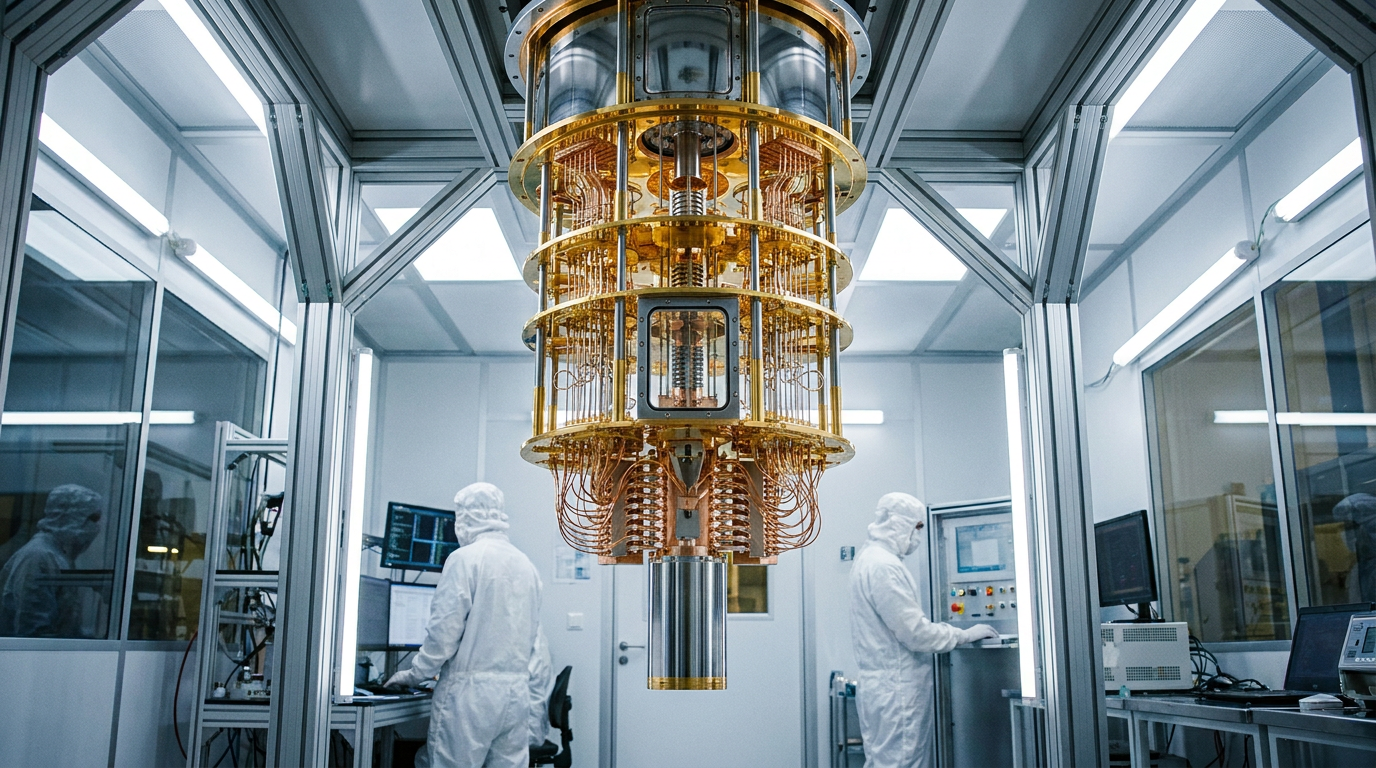
With the physics risk largely retired, the challenge is now purely one of engineering. Companies must figure out how to manufacture these chips at scale, wire thousands of microscopic control lines without generating excess heat, and build the massive dilution refrigerators required to keep the systems near absolute zero.[5][6]
The implications for global industry are profound. Fault-tolerant quantum computers will not replace desktop PCs; they are specialized accelerators designed to simulate nature at the molecular level. This capability is expected to revolutionize drug discovery by simulating complex protein folding, and accelerate materials science by discovering new catalysts for carbon capture or nitrogen fixation.[5]
However, the breakthrough also accelerates a looming cybersecurity crisis. A sufficiently large, error-corrected quantum computer will be capable of running Shor's algorithm, which can instantly factor the large prime numbers that underpin RSA encryption. This reality is driving the urgent migration to post-quantum cryptography, as intelligence agencies warn of "harvest now, decrypt later" attacks where adversaries store encrypted data today to unlock it when the hardware matures.[5]
While "useful quantum advantage"—the moment a quantum computer solves a commercially valuable problem faster than any classical supercomputer—remains a few years away, the timeline has compressed. The 2026 milestones confirm that the roadmap is no longer theoretical. The foundation for the fault-tolerant era has been poured; now, the race is on to build the machine.[1][6]
Viewpoints in depth
Hardware Manufacturers
Arguing that the physics risk is retired and the focus must shift to manufacturing and control systems.
For the teams building the physical machines, the 2026 breakthroughs represent a pivot from theoretical physics to industrial engineering. The challenge is no longer proving that error correction works, but figuring out how to manufacture millions of microscopic control lines without generating excess heat that destroys the qubits. They argue that the timeline to commercial advantage now depends entirely on supply chains, cooling technology, and fabrication precision.
Cybersecurity Analysts
Warning that the timeline for quantum decryption has accelerated.
Security experts view the rapid progress in logical qubits with alarm. A fault-tolerant quantum computer will eventually be capable of running Shor's algorithm, instantly breaking the RSA encryption that secures global finance and communications. Because adversaries are already harvesting encrypted data today to decrypt later, analysts argue that the migration to post-quantum cryptography must become an immediate, board-level priority for every major enterprise and government.
Enterprise Software Strategists
Emphasizing the immediate value of hybrid quantum-classical workflows.
Software leaders argue that businesses shouldn't wait for pure, million-qubit fault-tolerant machines to begin their quantum transition. They advocate for hybrid workflows, where classical supercomputers handle the bulk of an optimization problem and outsource only the most complex probabilistic calculations to near-term quantum processors. By integrating quantum-inspired algorithms today, they argue, companies can build the workforce and infrastructure needed to capitalize on hardware as it matures.
What we don't know
- Exactly when 'useful quantum advantage' will be achieved for commercial applications like drug discovery.
- Whether superconducting circuits, neutral atoms, or topological qubits will become the dominant hardware standard.
- How quickly global infrastructure can migrate to post-quantum cryptography before fault-tolerant machines can break current encryption.
Sources
Source coverage
6 outlets
4 viewpoints surfaced






[1]Google Quantum AIQuantum Hardware Engineers
Demonstrating below-threshold quantum error correction
Read on Google Quantum AI →[2]QuEra ComputingQuantum Hardware Engineers
Quantum Error Correction at Record Efficiency: Why Neutral Atoms Are Leading the Way
Read on QuEra Computing →[3]Microsoft QuantumEnterprise Software Strategists
Quantum Computing: Breakthroughs, Software Innovations, and Strategic Partnerships 2026
Read on Microsoft Quantum →[4]BlueQubitEnterprise Software Strategists
Quantum Error Correction: The Key to Quantum Computing
Read on BlueQubit →[5]The Institution of Analysts and ProgrammersCybersecurity Analysts
QUANTUM COMPUTING IN 2026: Progress, Challenges and What's Next?
Read on The Institution of Analysts and Programmers →[6]Factlen Editorial TeamQuantum Pragmatists
Synthesis by Factlen editorial team
Read on Factlen Editorial Team →

Every angle. Every day.
Get technology stories with full source coverage and perspective breakdowns delivered to your inbox.